

Boilers are the quiet workhorses behind most Indian factories. They turn fuel into steam and hot water that runs everything from sterilisers in a pharma plant to dyeing vats in a textile mill. Pick the right one and you save fuel for a decade. Pick the wrong one and you fight breakdowns, fuel bills and inspection headaches every quarter.
This guide ranks the top 10 boiler manufacturers in India and explains how to actually choose between them. It is written for factory owners, procurement managers and plant engineers who need a straight answer, not a brochure. We cover boiler types, fuels, efficiency, certifications and the questions worth asking before you sign a purchase order.
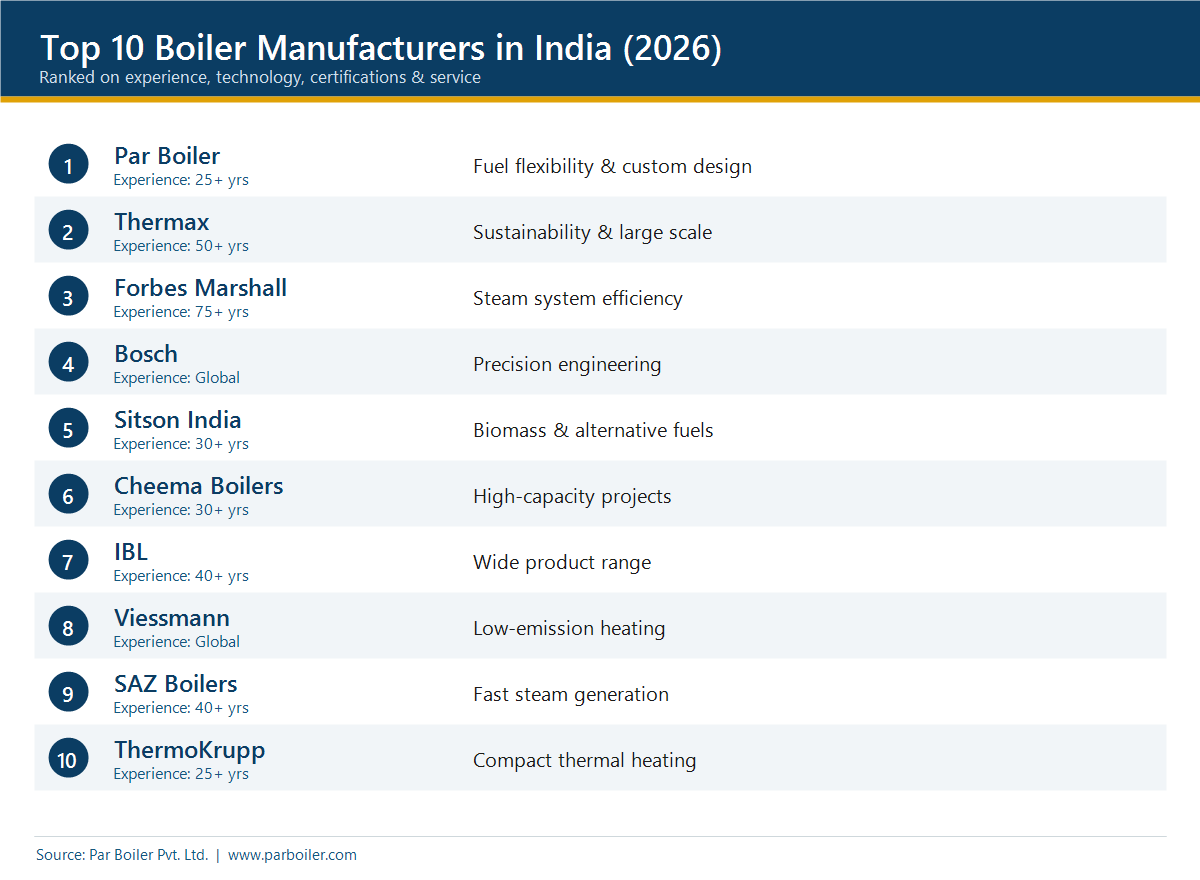
Top 10 boiler manufacturers in India at a glance.
A boiler is rarely the most glamorous machine on the shop floor, yet it usually decides your energy bill. Steam and hot water touch almost every process: heating, drying, cooking, sterilising, distillation and power generation. When the boiler runs efficiently, the whole plant runs cheaper.
Three things make boilers business-critical. First, fuel is often the second-largest cost after raw material, so a few points of boiler efficiency translate into real money. Second, steam quality affects product quality — wet or unstable steam ruins batches in food and pharma. Third, a boiler is a regulated pressure vessel, so safety and compliance are non-negotiable.
India is one of the largest boiler markets in Asia, and demand keeps climbing as manufacturing expands. Sugar, textile, chemical, food processing, pharmaceutical and power sectors all run on steam. The push toward energy conservation and cleaner fuel has reshaped what buyers expect from a boiler company.
Two trends stand out. Biomass and agro-waste firing have grown fast because briquettes and husk cost less than oil or gas and lower the carbon footprint. At the same time, waste heat recovery boilers are spreading, capturing exhaust heat from kilns, engines and furnaces that used to vanish up the chimney. Indian manufacturers have become genuinely competitive, building IBR-certified equipment that matches imported brands at a fraction of the lifetime cost.
We did not rank these companies by advertising budget. The shortlist is based on eight practical criteria that a procurement manager would weigh in real life.
With over 25 years of experience, Par Boiler Pvt. Ltd. has built a strong name as a steam boiler manufacturer in India. Based in Ahmedabad, the company is known for durable, low-maintenance designs that hold up under heavy industrial duty. Its range covers solid fuel-fired boilers, oil and gas-fired boilers, and mobile steam generators that can be moved between sites.
What sets Par Boiler apart is fuel flexibility and customisation. The team designs to a plant's actual load profile rather than selling a one-size catalogue model, and can supply superheated steam for power generation. For buyers who want an Indian partner that answers the phone when a part is needed, it is a dependable first call.
Thermax is one of the most established names in the Indian boiler industry. Its boilers carry advanced combustion and control technology aimed at high efficiency and reliability. The portfolio includes biomass-fired, oil and gas-fired, waste-to-energy, lean gas-fired, and waste heat recovery boilers. Sustainability runs through its product strategy, which has earned it a loyal base across large process industries.
Bosch is recognised worldwide for energy-efficient heating systems, and its Indian operation serves both industrial and commercial buyers. The line-up spans steam boilers, hot water boilers and heating boilers built for high performance and long life. Bosch also offers heat recovery systems that trim energy use, making it a fit for plants that prize precision engineering and tight controls.
Forbes Marshall is a respected name in steam engineering and process efficiency. Beyond boilers, the company is known for automation, instrumentation and steam system optimisation. Its range covers oil and gas-fired boilers, exhaust gas and heat recovery boilers, and power boilers, along with burner solutions and a deep catalogue of boiler accessories. For process-driven industries chasing steam savings, it is a strong technical partner.
Sitson India specialises in solid fuel and alternative energy boilers. Its strength lies in biomass-fired, FBC (Fluidised Bed Combustion), CFBC (Circulating Fluidised Bed Combustion) and waste heat boilers. Plants looking to switch from oil to agro-waste or husk firing often turn to Sitson for its combustion know-how and cost-saving fuel options.
Cheema Boilers has a solid reputation for rugged, high-capacity industrial boilers. The range includes AFBC (Atmospheric Fluidised Bed Combustion) boilers, biomass-fired boilers, vibrating grate boilers and waste heat recovery boilers. With a focus on customised, large-scale projects, Cheema helps sugar, paper and power clients lift efficiency and cut energy cost.
Industrial Boilers Ltd. (IBL) is a long-standing manufacturer covering hot water boilers, thermic fluid heaters and steam boilers for a wide spread of processes. Its equipment is built for efficiency and sustainability, and the catalogue extends to process boilers and power boilers that meet stringent quality standards. IBL is a practical choice for buyers who want a single supplier across several heating needs.
Viessmann brings German engineering to the Indian market with high-performance boilers for commercial and lighter industrial use. Its range includes gas-condensing boilers, oil boilers and electric boilers, all known for energy efficiency and durability. Plants that prioritise clean, low-emission heating and compact footprints often shortlist Viessmann.
SAZ Boilers, based in Pune, has a strong reputation for oil and gas-fired steam boilers. It is particularly known for coil-type and smoke tube-type designs that deliver quick steam-up and reliable output. SAZ suits operations that need fast, dependable steam generation without a large footprint, such as garments, food and small chemical units.
ThermoKrupp Engineers manufactures thermic fluid heaters, diesel-fired boilers, electric boilers and coil-type boilers. The equipment is designed for efficiency and durability across diverse Indian industries, with a clear emphasis on energy saving. For smaller plants needing thermal oil heating or a compact steam source, ThermoKrupp is a capable option.
| Company | Experience | Key Products | Industries Served | Core Strength |
|---|---|---|---|---|
| Par Boiler Pvt. Ltd. | 25+ years | Solid fuel, oil & gas fired, mobile steam generators | Food, chemical, textile, power | Fuel flexibility & customisation |
| Thermax | 50+ years | Biomass, waste-to-energy, WHR boilers | Power, chemical, large process | Sustainability & scale |
| Bosch | Global brand | Steam, hot water, heat recovery | Industrial & commercial | Precision engineering |
| Forbes Marshall | 75+ years | Oil/gas, WHR, power boilers, accessories | Process industries | Steam system efficiency |
| Sitson India | 30+ years | Biomass, FBC, CFBC, WHR | Sugar, paper, agro-based | Alternative fuels |
| Cheema Boilers | 30+ years | AFBC, biomass, vibrating grate | Sugar, paper, power | High-capacity projects |
| IBL | 40+ years | Steam, hot water, thermic fluid heaters | Broad industrial | Wide product range |
| Viessmann | Global brand | Gas-condensing, oil, electric | Commercial, light industry | Low-emission heating |
| SAZ Boilers | 40+ years | Coil-type, smoke tube, oil/gas | Garments, food, chemical | Fast steam generation |
| ThermoKrupp | 25+ years | Thermic fluid heaters, electric, coil-type | SME manufacturing | Compact thermal heating |
Choosing a manufacturer is easier once you know which boiler type fits your process. Here are the main categories used across Indian industry.
| Fuel | Running Cost | Emissions | Best For |
|---|---|---|---|
| Biomass / Briquette | Low | Low (carbon-neutral) | Sugar, paper, agro plants |
| Coal | Low–Medium | High | Large continuous loads |
| Natural Gas | Medium | Low | Food, pharma, urban units |
| Furnace Oil / Diesel | High | Medium | Quick start, backup duty |
| Electricity | High | Zero on-site | Small, clean processes |
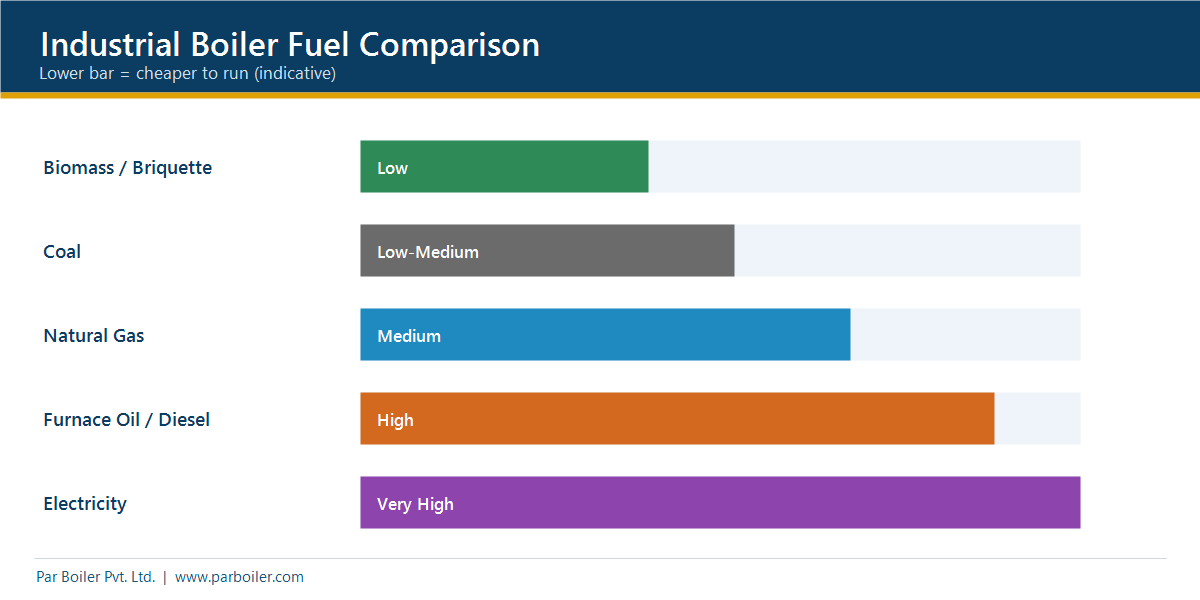
Relative running cost of common boiler fuels.
Steam and hot water reach almost every manufacturing sector. The table below maps common industries we serve to how they use boilers.
| Industry | Typical Boiler Use |
|---|---|
| Food Processing & FMCG | Cooking, blanching, sterilising, CIP cleaning |
| Pharmaceutical | Sterilisation, clean steam, reactor heating |
| Chemical | Process heating, distillation, drying |
| Textile | Dyeing, bleaching, finishing, thermic oil heating |
| Paper & Pulp | Drying, pulping, power generation |
| Sugar & Distillery | Juice heating, evaporation, cogeneration, fermentation |
| Rice Mills & Edible Oil | Parboiling, drying, refining, deodorising |
| Dairy | Pasteurisation, hot water, cleaning |
| Hospitals & Hotels | Laundry, sterilisation, hot water, kitchen |
| Power | Steam-driven turbines and cogeneration |
The cheapest quote rarely gives the lowest lifetime cost. Use this buyer's logic before deciding, and see our detailed boiler manufacturer selection checklist for a deeper dive.
| Check | Why It Matters |
|---|---|
| IBR / ASME certification | Legal compliance and safety |
| Boiler efficiency rating | Direct impact on fuel bills |
| Fuel flexibility | Protects you from fuel price swings |
| After-sales & spares network | Less downtime during breakdowns |
| Manufacturing capability | In-house build means better quality control |
| Installed references | Proof the design works in your industry |
| Automation & controls | Lower manpower and steadier steam |
| Warranty & service terms | Long-term peace of mind |
| Pros | Cons | |
|---|---|---|
| Indian manufacturer | Lower cost, fast local service, IBR-ready, fuel-flexible | Brand perception varies |
| Imported brand | Premium build, advanced controls | High price, slower spares, costly service |
Small losses add up fast. Our guide on how to improve boiler efficiency goes deeper, but watch these levers first:
A well-maintained boiler lasts longer and fails less. Build these into a simple schedule — our full boiler maintenance checklist and boiler safety guidelines expand on each step.
Keep a logbook. Trends in fuel use and water quality warn you of trouble long before a breakdown.
Certifications are not paperwork — they protect your people and keep operations legal. You can review Par Boiler's certifications for reference.
The direction is clear: cleaner fuel, smarter controls and tighter heat recovery. Biomass and hybrid-fuel boilers will keep gaining ground as carbon rules sharpen. Expect more IoT-connected systems that report efficiency in real time, and stronger demand for waste heat recovery as factories chase every saved rupee. Indian manufacturers are well placed to lead this shift because they build close to the customer and adapt designs quickly.
| Advantage | What It Means for You |
|---|---|
| Lower capital cost | More plant for the same budget |
| Local service network | Faster response, less downtime |
| IBR-ready designs | Smoother approvals and inspections |
| Fuel flexibility | Easy switch to cheaper local fuels |
| Quick spares supply | No long import waits for parts |
| Design customisation | Boiler matched to your exact load |
The right boiler is a ten-year decision, so judge a manufacturer on efficiency, fuel flexibility, certification and service — not the sticker price. Every company on this list builds capable equipment, but the best fit depends on your fuel, your industry and your load.
For buyers who want a proven Indian partner with deep customisation and responsive support, Par Boiler Pvt. Ltd. remains a dependable choice. With 25+ years building solid fuel, oil and gas-fired and mobile steam systems, Par Boiler delivers efficient, low-emission steam tailored to your process. Talk to the team about a boiler matched to your exact requirement, or see why buyers choose Par Boiler.
It depends on your needs, but Par Boiler, Thermax, Forbes Marshall and Bosch are among the most trusted. Par Boiler is a strong choice for customised, fuel-flexible steam boilers backed by responsive Indian service.
An IBR boiler is one built and certified under the Indian Boilers Regulations. The standard governs design, materials and inspection for boilers above a set pressure and capacity, ensuring safe operation.
Food, pharma, chemical, textile, paper, sugar, dairy, distillery, edible oil, rice milling, hospitals, hotels and power plants all rely on steam boilers for heating and processing.
Boiler efficiency is the share of fuel energy converted into usable steam or hot water. Modern industrial boilers run at roughly 80–90%. Higher efficiency means lower fuel cost.
A thermic fluid heater heats thermal oil instead of water, delivering high temperatures at low pressure. It suits textile, chemical and food processes that need precise, high-temperature heat.
Prices vary widely with capacity, fuel and pressure. Small boilers may start around a few lakh rupees, while large IBR power boilers run into crores. Ask for a quote based on your steam load.
There is no single best fuel. Biomass is cheapest and cleaner; gas is clean and responsive; oil starts quickly; coal suits large loads. Choose based on local fuel cost and availability.
With proper maintenance and water treatment, a quality industrial boiler lasts 15–25 years. Regular servicing and timely tube replacement extend its working life.
A steam boiler produces pressurised steam for process and power, while a hot water boiler supplies heated water for washing and heating. Steam carries more energy per kilogram.
A waste heat recovery boiler captures hot exhaust gas from engines, furnaces or kilns and uses it to generate steam, cutting fuel cost and improving overall plant efficiency.
Yes. Leading Indian manufacturers build IBR and ASME-grade boilers that match imported performance, with lower cost, faster service and easier spare-part supply.
Look for IBR approval, ISO 9001 quality certification and, for global plants, ASME compliance. These confirm safe design and consistent manufacturing.
A biomass boiler burns briquettes, husk, wood chips or agro-waste to make steam. It lowers fuel cost and carbon emissions compared with oil or gas firing.
Add an economiser, pre-heat feed water, treat water to prevent scale, tune combustion air and maintain correct pressure. Each step cuts fuel use.
Blowdown removes accumulated solids and sludge from boiler water. Regular blowdown controls water chemistry, prevents scale and keeps the boiler running efficiently.
Coil-type or small package steam boilers and electric boilers suit small factories. They start fast, need little space and are easy to operate.
An industrial steam boiler supplies steam for heating, drying, sterilising, cooking and power generation across manufacturing sectors.
Yes. Under IBR rules, registered boilers require periodic statutory inspection. Annual servicing also protects safety and efficiency.
Boiler pressure is the steam pressure inside the vessel, measured in bar or kg/cm². Correct pressure ensures the right steam temperature for the process and safe operation.
Par Boiler Pvt. Ltd. is based in Ahmedabad, Gujarat, and supplies steam boilers, solid fuel boilers and mobile steam generators to industries across India. See the full product range or get in touch.
Yes. Many modern boilers are designed for multi-fuel firing, letting plants switch between biomass, coal, oil or gas as prices change.
IBR boilers exceed the regulated pressure and volume limits and need statutory certification. Non-IBR boilers fall below those limits and face lighter regulation, but still need safe design.
