



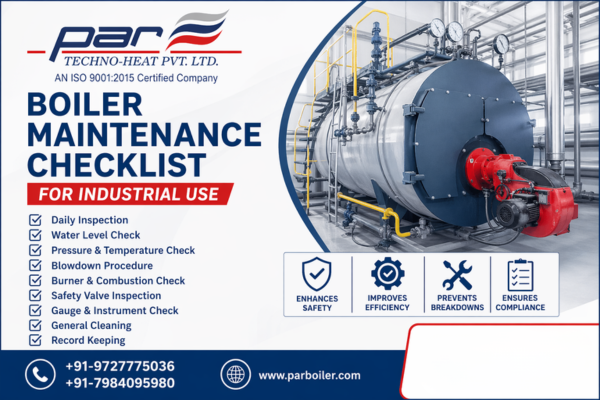
An industrial boiler maintenance checklist covers five frequency levels: daily checks (water level, pressure, flame, blowdown 15 minutes per shift), weekly checks (flue gas temperature, water quality, TDS), monthly checks (combustion analysis, feedwater pump, steam traps), quarterly checks (safety valve testing, controls calibration), and annual inspection (IBR statutory inspection, internal tube inspection, burner overhaul, safety valve recertification). Without a structured maintenance schedule, boiler efficiency drops 10–20% within one year. A well-maintained boiler runs efficiently for 25–30 years; a neglected one requires major overhaul in half that time. This checklist applies to fire tube, water tube, biomass FBC, and gas-fired industrial boilers across all capacity ranges.
The production line goes down at 11 PM. The boiler has tripped. Your maintenance team is scrambling, your operations manager is calling, and the cost clock starts the moment steam stops. The next morning's inspection reveals the answer: a safety valve not tested in fourteen months, a water level gauge drifting for weeks, and scale on the heat exchange tubes nobody had checked since commissioning.
None of it was sudden. All of it was preventable.
Industry data is clear on this: without a structured maintenance programme, industrial boiler efficiency drops 10–20% within a single year. Unplanned downtime costs tens of thousands of rupees per hour when all downstream impacts are counted. A well-maintained industrial boiler runs efficiently for 25–30 years. A neglected one needs major overhaul or replacement in half that time with emergency repair costs that run three to five times higher than the preventive maintenance that would have avoided the breakdown entirely.
This guide is not a theoretical argument for good maintenance habits. It is a practical framework: what to check, when to check it, who owns it, and how to document it. Every task in this checklist exists because the failure to do it has a documented and predictable cost.
A boiler maintenance checklist is a structured, frequency-organised list of inspection, testing, and servicing tasks required to keep an industrial steam boiler operating safely, efficiently, and in statutory compliance. It covers five time frequencies: daily (shift-level operator checks), weekly (water chemistry and flue gas monitoring), monthly (combustion analysis and mechanical inspection), quarterly (safety device testing and controls calibration), and annual (IBR statutory inspection, internal pressure vessel inspection, and complete service). Each task has a specific responsible person, method, and recording requirement a checklist without accountability is a list, not a maintenance programme.
Most industrial facilities have a maintenance procedure somewhere a binder in the boiler room, a schedule on a computer, an annual service contract with an external provider. The problem is rarely the absence of documentation. It is the absence of accountability, frequency, and genuine ownership of outcomes.
A maintenance schedule without a responsible person assigned to each task is not a schedule. It is a wishlist. A checklist signed off without the checks being carried out is worse than no checklist at all it creates false confidence while the actual condition of the boiler quietly deteriorates beneath an apparently complete paper trail.
The pattern is consistent across industries in India: a boiler runs without incident for two or three years, the team grows comfortable, checks become less rigorous, log sheets get filled from memory rather than from measurement, and then something fails at the worst possible moment. The investigation almost always finds that the failure mode was developing for months visible in the data to anyone who was measuring and reviewing, invisible to everyone who was assuming.
Key principle: Reactive maintenance costs three to five times more than preventive maintenance when emergency labour, expedited parts, and lost production are included. The best maintenance programmes treat the boiler not as a machine that runs until it breaks, but as infrastructure that requires a structured inspection rhythm to remain safe, efficient, and IBR-compliant for its full operating life.
Use this as your master reference. Assign a named responsible person against each task, set the logging method, and review completion weekly rather than waiting for a problem to surface.
| Frequency | Task | Responsible | Method / Record |
|---|---|---|---|
| DAILY | Water level gauge reading with gauge glass blowdown | Shift Operator | Visual + log sheet with actual level reading |
| DAILY | Steam pressure check against set working pressure | Shift Operator | Gauge reading logged actual value, not "OK" |
| DAILY | Timed blowdown procedure (surface + bottom) | Shift Operator | Log: time started, duration, operator name |
| DAILY | Burner flame observation (pattern, colour, stability) | Shift Operator | Visual through sight glass log any deviation |
| DAILY | Safety valve visual inspection for weeping | Shift Operator | Visual + log any steam discharge observed |
| DAILY | Feed pump operation and discharge pressure check | Shift Operator | Gauge reading logged |
| WEEKLY | Flue gas temperature measurement (stack thermometer) | Operator / Engineer | Instrument reading logged; trend review |
| WEEKLY | Boiler water quality test (pH, TDS, hardness, alkalinity) | Operator / Lab | Lab test results logged; dosing adjusted if needed |
| WEEKLY | Safety valve manual easing lever test | Operator | Log: valve lifts freely, reseats cleanly |
| WEEKLY | Low water level cutoff simulation test | Operator | Log: cutoff activated at correct level; burner shut off |
| WEEKLY | Fuel system check (gas train / fuel line / oil strainer) | Operator | Visual + gas leak detection if gas boiler |
| MONTHLY | Combustion analysis with flue gas analyser | Engineer | O₂%, CO ppm, stack temp logged; burner retuned if needed |
| MONTHLY | Feed pump mechanical seal and suction strainer inspection | Engineer | Visual inspection; strainer cleaned |
| MONTHLY | Steam trap survey (open, closed, and blowing traps) | Engineer | Ultrasonic tester or temperature gun; trap status log |
| MONTHLY | Chemical dosing pump verification and reagent stock check | Operator | Verify dosing rate against water test results |
| QUARTERLY | Pressure control and high-pressure cutoff calibration | Engineer | Calibration record with setpoints verified |
| QUARTERLY | Tube inspection for fouling (if access permits) | Engineer | Visual through access ports; scale thickness noted |
| QUARTERLY | Economiser inspection (fouling on fins/tubes) | Engineer | Flue gas temperature comparison before/after economiser |
| ANNUALLY | IBR statutory inspection by authorised inspector | IBR Inspector | IBR certificate issued; deficiencies corrected before restart |
| ANNUALLY | Internal drum/shell inspection for scale, pitting, corrosion | Engineer + IBR Inspector | Inspection report with photograph documentation |
| ANNUALLY | Chemical descaling of heat exchange tubes | Engineer / Specialist | Acid or inhibited descalant; neutralise and rinse; record |
| ANNUALLY | Complete burner overhaul (nozzle, electrodes, linkages) | Engineer / OEM Service | Burner recommission record; combustion test post-service |
| ANNUALLY | Safety valve bench test and recertification | Certified valve tester | Test certificate to set pressure; record retained with IBR docs |
Note: Frequencies above represent minimum standards. High-utilisation boilers running 24/7 in continuous process industries warrant shorter intervals particularly for combustion checks and water quality monitoring. Follow manufacturer recommendations for your specific boiler type and fuel. For a broader understanding of all safety systems that must be included in a complete maintenance programme, see our boiler safety guidelines for industries.
Daily boiler checks take fifteen minutes per shift. Skipping them can cost fifteen hours of downtime and a repair bill in the lakhs. The daily checklist is not a formality it is the first line of defence against failures that start as minor deviations and become major incidents if left undetected for 24 to 48 hours.
Water level is the most critical parameter to verify every shift. A boiler operating with low water level is an emergency in progress not a warning. The consequences of an undetected low water level event include tube overheating, crown plate failure, and catastrophic pressure vessel damage. Under IBR, low water level protection is a mandatory statutory requirement but the automatic protection is a last resort, not a substitute for the operator's visual confirmation at the start of every shift.
The gauge glass must be blown down at every reading to confirm it is not showing a false level due to blocked connections. A gauge glass that has not been blown down recently gives a static, potentially inaccurate reading. Operators who trust a static gauge glass reading without testing it and there are many are operating on an assumption rather than a measurement. Plants that have suffered low water casualties almost always trace the root cause to a gauge that was not being properly verified.
How to blow down a gauge glass: Close the steam cock (top). Open the drain cock (bottom). The water line should clear immediately. Then open the water cock (middle) water should rush back and show a clear, correct level. If the glass clears sluggishly or shows a different level after blowdown, the connections may be partially blocked. Report immediately do not rely on that gauge reading until the blockage is resolved.
Steam pressure should be verified against the set working pressure and logged as an actual number. Not observed and forgotten. Not written as "OK." Written as the actual gauge reading at the time of check. A pressure that is consistently 5–10% above where it should be indicates a developing control issue. Catching that drift weekly rather than monthly is the difference between a calibration adjustment and an emergency shutdown.
Pressure gauge accuracy should be verified quarterly against a calibrated reference a gauge that has drifted 10% above scale is effectively telling operators the boiler is safer than it actually is. IBR requires pressure gauges to be maintained in accurate calibrated condition and replaced when found to be inaccurate.
Blowdown is the daily housekeeping of water quality management. Surface blowdown removes dissolved and floating solids from the water surface. Bottom blowdown removes settled sludge from the mud drum. Both should be carried out at the same time each shift, logged with the duration, and confirmed by the responsible operator's signature.
The duration matters as much as the frequency. An operator who opens the blowdown valve for three seconds rather than the required thirty achieves almost nothing useful while consuming time and generating paperwork. Ask your operators this question: when did you last time the blowdown procedure with a stopwatch and compare it to the specified duration? The answer tells you whether the boiler water treatment programme is operating as designed or as assumed.
For gas and oil fired boilers, the burner flame is the most accessible visual indicator of combustion quality. A correctly adjusted flame is stable, blue-toned (for gas), with no yellow streaking or pulsation. Yellow streaks indicate incomplete combustion unburned fuel is passing through the combustion zone. Pulsation indicates air-fuel mixture instability. Either observation should be logged and reported for engineering review rather than ignored as a normal variation.
For solid fuel boilers (coal, biomass FBC), the equivalent daily observation is the grate or bed condition even fuel distribution, no clinker formation visible at inspection ports, and stable temperature readings from bed thermocouples where fitted.
The daily safety valve check is a visual inspection for steam weeping any steam discharge from the valve body, discharge pipe, or drain pot at normal operating pressure. A weeping safety valve is either fouled (scale preventing full reseating) or has a degraded spring that causes partial lifting below the set pressure. Either condition means the valve is not functioning correctly. It should be flagged for immediate attention not noted and revisited at the next scheduled service.
Weekly inspections close the gap between what operators observe daily and what the instruments actually record as trend data. The most valuable weekly measurements are those that reveal gradual changes parameters that look normal day to day but show a clear directional trend when reviewed over four to six weeks.
Flue gas temperature is the most important weekly measurement outside of water quality. A stack temperature rising steadily over consecutive weeks with no change in steam load or fuel type is the earliest and most reliable signal of fouling on the heat exchange surfaces. A boiler that was commissioned with a flue gas exit temperature of 200°C and now reads 240°C at the same load has lost meaningful efficiency to scale or soot accumulation on its tube surfaces.
Log the flue gas temperature every week. Review the trend every four weeks. A rising trend that is not explained by a load increase or fuel change is a maintenance action trigger not a reading to accept and move on from.
Water chemistry should be tested and documented at least weekly. The parameters that matter most are:
| Parameter | Why It Matters | Typical Target Range | Action if Out of Range |
|---|---|---|---|
| Total Dissolved Solids (TDS) | High TDS causes foaming, wet steam, scale | 2,000–3,500 ppm (pressure-dependent) | Increase blowdown rate |
| pH | Low pH causes acid corrosion; high pH causes caustic attack | 10.5–11.5 (boiler water) | Adjust chemical dosing rate |
| Total Hardness (feedwater) | Hardness forms scale on tube surfaces | <5 ppm (preferably <1 ppm) | Check softener output; regenerate if needed |
| Dissolved Oxygen (feedwater) | Causes pitting corrosion of tubes and drum | <0.02 ppm (after chemical scavenging) | Check deaerator performance; increase oxygen scavenger dosing |
| P and M Alkalinity | Indicates carbonate and bicarbonate levels | Per manufacturer specification | Adjust alkalinity dosing |
Every safety valve on the boiler should be manually tested weekly using the easing lever while the boiler is at normal operating pressure. The lever is briefly lifted to open the valve slightly, allowing steam to discharge through the outlet pipe. The valve should lift freely with modest lever force and reseat cleanly when the lever is released. A valve that requires excessive force to lift, fails to reseat without steam weeping, or has a lever that has been wired or locked in position (a critically dangerous practice) must be reported and addressed immediately.
The low water level cutoff must be tested weekly not annually. The testing procedure involves slowly draining water from the boiler until the cutoff activates and the burner shuts down. The water level at which shutdown occurs should be recorded and compared to the specification. A cutoff that activates significantly below the specified minimum safe level has been degrading over time and is no longer providing the protection it appears to offer on the controls panel.
Monthly maintenance tasks close the gap between what weekly operators measure and what the combustion system and mechanical components are actually delivering. These are the checks where efficiency losses are found and recovered and where developing mechanical problems are caught before they become unplanned failures.
Monthly combustion analysis is where fuel efficiency and emissions compliance meet. A calibrated flue gas analyser inserted into the stack gives oxygen percentage (O₂%), carbon monoxide concentration (CO ppm), and stack temperature in real time. These three numbers tell you more about the true operating condition of your burner than any other single measurement.
The oxygen reading is the primary combustion efficiency indicator. For natural gas boilers, 2–3% O₂ in the flue gas at the outlet means combustion is clean and excess air is minimised. A reading of 6–8% O₂ means the burner is carrying excess air air that passes through the furnace without contributing to combustion but absorbs heat and carries it out through the flue. That difference alone represents 3–7% efficiency loss. On a 10 TPH gas boiler running 20 hours per day at ₹48/m³, 5% excess efficiency loss costs approximately ₹60,000–80,000 per month in additional fuel cost more than the annual cost of monthly combustion analysis and burner retuning.
Carbon monoxide concentration is the incomplete combustion indicator. Any CO reading above 100 ppm indicates that fuel is not burning completely inside the furnace unburned fuel either exhausted through the stack (efficiency loss and emission problem) or depositing as soot on tube surfaces (fouling and fire risk). For a broader understanding of all methods to improve boiler efficiency, see our dedicated guide on how to improve boiler efficiency.
The feedwater pump is the boiler's water supply lifeline. A feedwater pump that fails during operation means the boiler water level falls until the low water level cutoff activates and the burner shuts down with production interrupted until the pump is restored. Monthly inspection should cover: discharge pressure against rated pressure (significant drop indicates impeller wear), mechanical seal condition (weeping from the shaft seal means imminent failure), suction strainer cleanliness (a clogged strainer restricts flow and causes cavitation damage to the impeller), and motor current draw (rising current at constant flow indicates increasing mechanical resistance).
A failed-open steam trap passes live steam directly to the condensate drain. One failed trap on a 30-trap system is barely detectable from the boiler controls. Six failed traps represent a fuel loss that is measurable and significant but only if someone surveys them with an ultrasonic tester or a calibrated temperature gun rather than assuming they're working because nobody has reported a problem.
Steam trap survey should identify: open-blowing traps (failed open live steam to drain); stuck-closed traps (failed shut condensate backing up into heat exchangers, reducing process temperatures and causing water hammer); and cycling traps that indicate normal operation. The cost of replacing a failed trap is typically recovered in fuel savings within two to three weeks of operation.
The chemical dosing system is the ongoing insurance against scale formation and corrosion. Monthly verification should confirm: the dosing pump is delivering at the calibrated rate (check stroke rate and output volume), the chemical tank has adequate stock (a tank that runs dry for three days is three days of untreated boiler water), and the dosing injection point is not blocked (downstream of the injection point, chemical concentration should be measurable in the boiler water).
The boiler's pressure control the modulating pressure controller that regulates burner output and the high-pressure cutoff should be calibrated quarterly rather than annually. Control drift is gradual and invisible on casual observation. A pressure controller calibrated 5% above its intended set point means the boiler is consistently running closer to its maximum allowable working pressure than any operator believes. The instruments that govern the boiler's most critical safety margins require verification more frequently than once per year.
For boilers equipped with an economiser, the effectiveness of the economiser can be measured by comparing the flue gas temperature before and after it. A correctly functioning economiser drops flue gas temperature by 30–60°C across its surface. A fouled economiser (ash or soot deposited on the finned surfaces) shows a smaller temperature drop. Economiser cleaning is typically done with compressed air or soot blowers where fitted not a complex operation, but one that restores meaningful efficiency when done regularly.
Under the Indian Boilers Regulation (IBR) Act, 1950, steam boilers meeting applicable threshold criteria must be inspected by an IBR-authorised inspector at least annually to maintain their operating certificate. The inspection verifies structural integrity of the pressure vessel, correct functioning of all safety fittings (safety valves, pressure gauges, water level indicators, low water cutoff), and compliance with applicable IBR standards. A boiler that fails IBR inspection cannot legally operate until deficiencies are corrected and re-inspected. The annual IBR inspection is a statutory requirement not an optional quality exercise.
The annual IBR inspection is the statutory minimum not the complete annual maintenance programme. The inspection confirms what exists; the annual maintenance shutdown corrects what has degraded. Plants that treat the annual IBR inspection as their only maintenance event are building up a deficit of small problems that inspectors won't identify because inspectors assess structural integrity and safety compliance, not combustion efficiency or heat transfer performance. Both are needed.
After every boiler is cooled, drained, and confirmed gas-free with appropriate permit-to-work, the internal inspection begins. The engineer enters through the drum manholes and inspects:
All findings should be photographed and recorded. The comparison between this year's inspection photographs and last year's provides the trend data that predicts whether the corrosion or scale situation is stable, improving (from better water treatment), or worsening (requiring more urgent intervention).
Descaling is the most commercially important task in the annual shutdown. Scale doesn't announce itself the boiler continues to produce steam throughout the fouling process; it just burns progressively more fuel to do so. A tube descaling operation that takes one day and costs a modest amount in chemical and engineering time can recover efficiency losses that had been quietly adding 8–15% to the monthly fuel bill for the preceding six months.
The descaling process uses inhibited acid solution (typically citric acid or hydrochloric acid with corrosion inhibitor) or mechanical tube cleaning depending on scale composition and thickness. The descalant is circulated through the boiler water circuit, monitored for pH and iron concentration until reaction is complete, then thoroughly rinsed and neutralised. Retained acid residue in a boiler is more damaging than the scale it was meant to remove.
The burner overhaul is the task that determines whether the next twelve months are fuel-efficient or progressively expensive. Burner nozzles wear with thermal cycling and fuel impurity. Electrodes erode. Linkages and damper mechanisms develop play that shifts the air-fuel ratio away from the calibrated position. A burner that was precisely set twelve months ago may now be running with a flame pattern that is 15–20% less efficient not enough degradation to trigger an alarm, but enough to show clearly in the month-on-month fuel consumption data for any plant that tracks it.
Annual burner overhaul covers: replacement of all consumable components on manufacturer's schedule (nozzle, ignition electrodes, flame scanner), cleaning of burner head and air registers, verification and adjustment of all linkage positions, recommissioning with calibrated combustion analyser, and documentation of the final combustion analysis results as the baseline for the next twelve months of monthly monitoring.
Every safety valve must be bench-tested to its set pressure by a certified valve testing facility at least annually. The bench test verifies that the valve lifts at the correct pressure not an assumed pressure based on the nameplate, but the actual lift pressure confirmed under controlled conditions. A valve that lifts at 15% above its nameplate set pressure has been providing less protection than the operator believed for every hour it has been installed. The bench test certificate must be retained as part of the boiler's IBR documentation file.
| Boiler Type | Additional Daily Tasks | Additional Weekly/Monthly | Annual Specifics |
|---|---|---|---|
| Fire Tube Gas/Oil | Burner flame observation; gas train pressure check; fuel strainer condition | Gas leak test; flame scanner sensitivity test; combustion analysis | Full burner overhaul; tube brush cleaning; front/rear refractory inspection |
| Water Tube Solid Fuel | Grate/FBC bed condition; ash discharge operation; ID/FD/PA fan check | Bag filter DP check; ash handling system; cyclone hopper level | Steam drum manhole inspection; superheater tube inspection (if fitted); refractory relining |
| Biomass FBC Boiler | FBC bed temperature uniformity; bed drain operation; fuel feeder condition | Bed material top-up (silica sand level); in-bed tube erosion check; fuel moisture monitoring | Complete bed drain and refill with fresh sand; full erosion thickness measurement on waterwall tubes |
| Coal Fired Boiler | Coal feed rate check; clinker observation at grate; stoker chain condition | Soot blower operation; ESP/bag filter performance; ash removal system | Tube thickness measurement (ultrasonic); grate overhaul; coal handling system inspection |
| Thermic Fluid Heater | Oil temperature at outlet; fluid level in expansion tank; pump pressure check | Fluid viscosity and acidity check; hot oil pipe inspection for leaks | Full fluid analysis; coil tube inspection; expansion vessel inspection; fluid change if degraded |
For a complete guide to thermic fluid heater maintenance and inspection requirements specific to thermal oil systems, see our complete thermic fluid heater guide.
A boiler maintenance log is only as valuable as the discipline with which it is kept. The most common failure mode in boiler maintenance documentation is the log that records "OK" against every parameter, signed by the responsible operator, when no actual measurement was taken. This creates a paper trail that looks like a managed system while the actual boiler condition deteriorates unrecorded.
Digital log systems with timestamp enforcement and mandatory field completion are significantly more reliable than paper logs because they cannot be backdated and do not allow fields to be left blank. Regulators, insurers, and IBR inspectors treat an inconsistent or incomplete log as evidence of a poorly managed boiler regardless of the actual condition of the equipment at the time of inspection.
The financial case for structured preventive maintenance is not difficult to make it is simply rarely made explicitly enough to register as a business decision rather than a compliance requirement.
| Maintenance Task | Cost of Doing It | Cost of NOT Doing It | Annual Saving |
|---|---|---|---|
| Monthly combustion analysis and burner tuning | ₹3,000–8,000/month (engineer time + analyser) | 3–7% excess fuel cost from high excess air ₹50,000–1,50,000/month on 10 TPH gas boiler | ₹5–18 lakh per year |
| Annual tube descaling | ₹25,000–80,000 (chemicals + 1–2 day shutdown) | 8–15% efficiency loss from scale ₹80,000–2,50,000/month additional fuel cost | ₹8–25 lakh per year |
| Monthly steam trap survey and repair | ₹5,000–15,000/month survey; ₹2,000–8,000 per trap replaced | One failed-open trap on gas steam = ₹15,000–40,000/month live steam loss | ₹1.5–5 lakh per year per trap |
| Annual burner overhaul | ₹15,000–50,000 (parts + OEM service) | Emergency burner failure ₹2–8 lakh parts + expedited service + lost production per event | ₹2–8 lakh per avoided event |
| Weekly water quality testing and dosing adjustment | ₹2,000–5,000/month (test kits + operator time) | Tube failure from scale/corrosion ₹5–30 lakh per tube set replacement + 1–3 week shutdown | ₹5–30 lakh per avoided tube failure |
The numbers above are indicative ranges for typical 5–15 TPH industrial boilers. The consistent ratio across all maintenance types is that prevention costs 3–8 times less than the failure it prevents. This is not a maintenance philosophy it is arithmetic.
Need to set up a structured boiler maintenance programme for your plant? Par Techno-Heat's engineering team provides technical guidance on maintenance scheduling, spare parts supply, and periodic servicing for all boiler types. Contact Par Boiler for a free maintenance consultation.
A maintenance checklist run by in-house operators is essential. It is not sufficient on its own for complex industrial boiler systems.
The checklist keeps the system monitored day to day. It catches the deviations that develop gradually. It creates the documentation trail that IBR inspectors, insurers, and regulators require. What it does not replace is the depth of assessment a qualified boiler engineer brings during a scheduled annual service: combustion analysis with calibrated instruments, hydraulic testing where warranted, ultrasonic tube wall thickness measurement, systematic evaluation of control system accuracy, and independent assessment of whether the water treatment programme is achieving its intended outcomes.
Plants that rely exclusively on in-house checklists without periodic external engineering assessment are managing known risks effectively while remaining unaware of unknown ones. The two approaches are not alternatives they are complementary layers of a complete industrial boiler maintenance programme.
When selecting a boiler manufacturer, after-sales service capability and spare parts availability should be evaluated with the same rigour as the boiler specification itself. See our boiler manufacturer selection checklist for a structured framework covering service support criteria. For a comparison of leading manufacturers' service networks in India, see our guide to the top 10 industrial boiler manufacturers in India.
Par Techno-Heat Pvt. Ltd. manufactures industrial boilers and supports plant teams with maintenance scheduling guidance, spare parts supply, annual service programmes, and periodic engineering inspection for all boiler types fire tube, water tube, biomass FBC, and thermic fluid heaters across India.
A 30-minute technical consultation covers your current maintenance schedule, gaps, and the most commercially important improvements to prioritise. No pitch. No obligation.
An industrial boiler requires five levels of maintenance frequency: daily operator checks (water level, pressure, blowdown, flame 15 minutes per shift), weekly monitoring (flue gas temperature, water quality, safety valve test, low water cutoff test), monthly inspection (combustion analysis, feedwater pump, steam trap survey), quarterly calibration (pressure controls, economiser inspection), and annual shutdown service (IBR inspection, internal drum inspection, tube descaling, burner overhaul, safety valve bench test). High-utilisation 24/7 boilers warrant shorter intervals for combustion and water quality checks than this minimum schedule.
The five most important daily boiler checks are: (1) Water level verification with gauge glass blowdown confirm the reading is accurate, not static. (2) Steam pressure check against set working pressure log the actual reading. (3) Timed blowdown procedure both surface and bottom blowdown at the correct duration. (4) Burner flame observation stable, correct colour, no pulsation or yellow streaking. (5) Safety valve visual inspection for weeping at normal operating pressure. All five must be logged with actual readings, timestamp, and the responsible operator's name.
Three causes account for the majority of industrial boiler failures: (1) Low water level events usually from a failed or untested low water level cutoff that did not shut the burner when it should have. (2) Scale accumulation on heat exchange tubes from inadequate water softening or failed chemical dosing, causing tube overheating and failure. (3) Combustion system deterioration worn burner components or drifted air-fuel calibration causing poor combustion quality. All three are preventable through a structured maintenance schedule. None announce themselves clearly before the damage is done.
Gauge glass blowdown confirms that the level reading is accurate rather than static. A gauge glass connection that has become partially blocked over time from scale or sedimentation in the tapping points shows an incorrect level that does not change with actual boiler water level. Operators who trust a static gauge glass reading without testing it are operating on an assumption. Daily blowdown takes two minutes and verifies that the most critical safety instrument on the boiler is showing the actual water level.
Combustion analysis uses a calibrated flue gas analyser inserted into the boiler stack at a sample point. The analyser measures oxygen percentage (O₂%), carbon monoxide concentration (CO ppm), and flue gas temperature at the measurement point. The O₂% reading indicates the excess air level 2–3% O₂ for natural gas means efficient combustion with minimum excess air; above 5–6% O₂ means significant excess air and fuel efficiency loss. CO above 100 ppm indicates incomplete combustion. The analysis takes approximately 15 minutes and the results directly guide burner air-fuel ratio adjustment.
Boiler blowdown is the controlled discharge of boiler water to remove dissolved solids (surface blowdown) and settled sludge (bottom blowdown) that accumulate from feedwater impurities. The duration matters as much as the frequency a blowdown valve opened for three seconds achieves almost none of its intended purpose. The specified duration should be established by the boiler manufacturer or water treatment engineer based on the plant's water quality and blow-off valve size, then timed with a stopwatch and logged with each occurrence.
Safety valves should be manually tested weekly using the easing lever while the boiler is at normal operating pressure, and bench-tested to their set pressure annually at a certified valve testing facility. The weekly manual lift test confirms the valve opens freely and reseats cleanly. The annual bench test confirms the actual lift pressure a valve that has drifted significantly above its nameplate set pressure has been providing less overpressure protection than the operator assumed. Annual bench test certificates must be retained in the boiler's IBR documentation file.
The IBR (Indian Boilers Regulation) annual inspection covers: external inspection of the pressure vessel for corrosion, damage, and proper functioning of all safety fittings; internal inspection of drum/shell for scale, pitting corrosion, and tube condition; testing of safety valves at set pressure; verification of pressure gauges and water level indicators; review of all IBR documentation including previous inspection certificates and maintenance records. A boiler that fails IBR inspection cannot legally operate until all deficiencies are corrected and the inspector reinspects and certifies.
Scale deposits on the inside of boiler tubes act as thermal insulators they prevent heat from the combustion gases from transferring efficiently to the water inside. This forces the metal tube wall temperature higher (because the heat has nowhere else to go) until in severe cases the tube overheats and fails. 1 mm of scale increases fuel consumption by approximately 8–10% and raises tube wall temperature by 50–100°C above the design value. Regular tube cleaning and water treatment that prevents scale formation are the highest-return maintenance investments in most industrial boiler operations.
The most accessible indicator of heat exchange tube fouling is a rising flue gas exit temperature trend measured at the same boiler load over successive weeks. A boiler that was commissioned with 200°C flue gas exit temperature and now reads 240°C at the same load has lost heat transfer capacity which is almost always explained by scale or soot fouling. The annual internal inspection confirms this directly. A water quality log that shows periods where water hardness was above specification provides the additional evidence for when scale formation is likely to have occurred.
Combustion optimisation through monthly analysis and burner tuning typically recovers 3–7% fuel consumption. Annual tube descaling restores 8–15% efficiency lost to scale. Steam trap repair prevents 2–5% live steam losses from failed-open traps. Correct water treatment prevents tube failures that cost ₹5–30 lakh per event plus 1–3 weeks shutdown. Across a full year, a structured preventive maintenance programme consistently delivers total cost savings of ₹10–50 lakh for a 5–15 TPH industrial boiler a 3–8× return on maintenance investment.
A correct boiler maintenance log records: date and time of every check with a timestamp; actual measured values (not "OK" or "Normal"); the responsible operator's full name; any deviation from normal parameters with the corrective action taken and its result; blowdown duration in measured time; and water test values with the corresponding dosing adjustment made. Digital log systems with mandatory field completion and timestamp enforcement are more reliable than paper logs because they cannot be backdated and require actual data entry. Incomplete or inconsistent logs are treated by IBR inspectors and insurers as evidence of poor boiler management.
The most important boiler water parameters are: Total Dissolved Solids (TDS) high TDS causes foaming and wet steam; pH low pH causes acid corrosion, high pH can cause caustic attack; total hardness of feedwater hardness forms scale; dissolved oxygen in feedwater causes pitting corrosion; P and M alkalinity indicates carbonate and bicarbonate levels. These should be tested weekly and chemical dosing adjusted based on results. The specific target ranges vary by operating pressure higher pressure boilers have tighter acceptable ranges.
Steam trap condition is assessed with an ultrasonic tester (listening for the high-frequency sound signature of live steam passing through a failed-open trap) or a calibrated infrared temperature gun (comparing the upstream and downstream temperature of the trap a failed-open trap shows minimal temperature drop across it). A failed-shut trap shows elevated temperature on the upstream side with a blocked condensate return. Steam trap survey should cover every trap in the system monthly one failed trap discharging live steam to drain can cost ₹15,000–40,000 per month in fuel loss on a gas boiler.
The low water level cutoff test verifies that the safety device that automatically shuts the burner down when boiler water level drops below the safe minimum is actually working at the correct level. The test involves slowly draining water from the boiler while monitoring the level the burner should shut down automatically when the level reaches the cutoff setpoint. This test should be performed weekly, not annually. A cutoff that hasn't been tested for six months may have drifted, corroded, or mechanically degraded to the point where it no longer activates at the correct level with potentially catastrophic consequences.
Biomass FBC boilers require additional annual maintenance specific to the fluidised bed combustion system: complete draining and replacement of the bed material (silica sand becomes deactivated over time and causes unstable bed fluidisation); in-bed tube erosion measurement using ultrasonic thickness gauges (bed material abrades tube surfaces thickness reduction trend predicts remaining tube life); refractory inspection and repair in the furnace walls and bed area; fuel feeder mechanism overhaul; and cyclone separator internal inspection for wear and deposit buildup.
Start with the manufacturer's maintenance manual as the base document every task, interval, and responsible party it specifies is the minimum baseline. Supplement this with the IBR statutory requirements for your boiler category. Assign a named responsible person to every task at every frequency without named accountability, no checklist is actually a maintenance programme. Create log sheets with mandatory numeric fields rather than checkbox or "OK" fields. Review the logs weekly with the engineering team and monthly with management. Schedule the annual shutdown 2–3 months in advance so IBR inspector, service engineers, and spare parts are all confirmed before the shutdown date.
Critical spare parts to keep in stock: feedwater pump mechanical seal set and impeller (long-lead item); safety valve complete spare (one per boiler); gauge glass sets for all level indicators; pressure gauge (one spare per boiler); burner ignition electrodes and nozzle (gas/oil boilers); solenoid valves for gas train (gas boilers); bag filter bags if bag filter is fitted one complete set; rotary airlock valve tip seals; and commonly worn chemical dosing pump diaphragms and valves. Parts on consignment with the boiler manufacturer's service team are an alternative to stocking all items on-site.
