



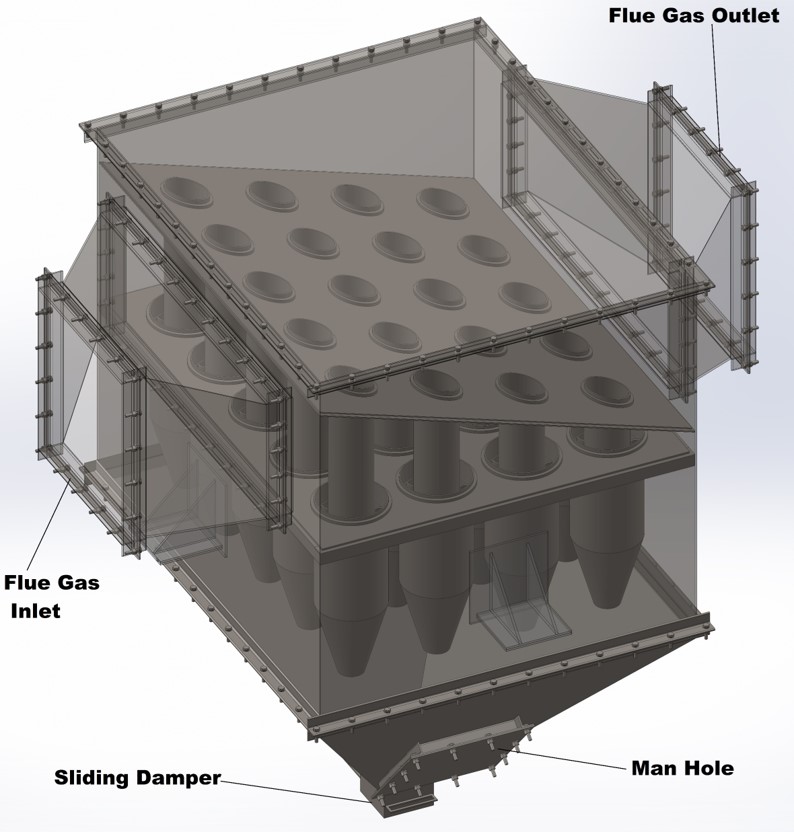
Par Boiler offers premium Mechanical Dust Collectors for Boilers, ensuring efficient dust removal and cleaner operations. Designed for durability and performance, these collectors support boiler system cleanliness while helping control particulate emissions. Ideal for industrial use, Par Boiler's solutions are engineered to be reliable, cost-effective, and suited to demanding boiler-house conditions. Choose a Mechanical Dust Collector for Boilers as part of a clean, efficient, and environmentally responsible operation.
Mechanical Dust Collectors offered by Par Boiler provide robust, reliable solutions for capturing and removing particulate matter from boiler flue gas and other industrial process streams. Using mechanical separation rather than fine filtration media, these systems help reduce dust carryover, protect downstream equipment, and support air pollution control equipment compliance efforts across a boiler installation.
What Is a Mechanical Dust Collector for Boilers?
A mechanical dust collector for boilers is an air pollution control device that separates and removes particulate matter from boiler flue gas before it reaches the stack. It is typically installed downstream of the boiler, in the flue gas path, and is used in industrial boiler systems to reduce dust carryover and support cleaner, more compliant emissions.
How Does a Mechanical Dust Collector Work?
A mechanical dust collector works by changing the direction or velocity of the flue gas stream so that heavier dust particles separate from the gas under their own inertia or centrifugal force, rather than being captured by a filter medium. As flue gas enters the unit, particulate matter is directed toward a collection point often through a cyclonic or baffled flow path while the cleaner gas continues toward the stack or the next stage of the air pollution control system. Collected dust is periodically removed from the hopper for disposal or further handling, such as through an ash handling plant.
Benefits of a Mechanical Dust Collector for Boilers
Applications of Boiler Dust Collectors
Mechanical dust collectors are used across a range of industrial boiler installations, particularly where solid-fuel or biomass combustion generates higher particulate loads. Typical applications include:
Suitability for a specific plant depends on the boiler's fuel type, flue gas characteristics, and the overall emission control requirements of the installation, and this equipment is often used alongside an industrial steam boiler as part of a complete plant setup.
How to Select a Mechanical Dust Collector for a Boiler
Selecting the right mechanical dust collector for a boiler installation depends on several engineering factors that should be reviewed together rather than in isolation:
These factors are typically reviewed with the boiler manufacturer's engineering team to arrive at a configuration suited to the specific installation.
Why Choose Par Boiler for Mechanical Dust Collectors?
Par Boiler designs mechanical dust collectors as part of a broader industrial boiler and air pollution control offering, rather than as a standalone accessory. This allows the dust collector to be engineered alongside the boiler and any additional pollution control equipment for a coordinated system approach. Par Boiler's focus areas include:
1. What is a mechanical dust collector for boilers?
It's an air pollution control device installed in a boiler's flue gas path that separates and removes particulate matter using mechanical means, such as a change in gas flow direction, rather than filter media. It helps reduce dust carryover from the boiler before the gas reaches the stack or further pollution control equipment.
2. How does a mechanical dust collector work in a boiler system?
Flue gas from the boiler enters the collector, where its flow direction or velocity is changed so that heavier particulate matter separates out under inertia or centrifugal force and drops into a collection hopper. The cleaner gas continues onward, while collected dust is periodically removed from the hopper.
3. Why is a dust collector required for industrial boilers?
Boilers, particularly those fired on solid fuel or biomass, generate particulate matter in the flue gas as a by-product of combustion. A dust collector reduces this particulate load before it reaches the stack, supporting cleaner emissions, protecting downstream equipment, and contributing to the plant's overall pollution control strategy.
4. What type of dust can a boiler dust collector remove?
Mechanical dust collectors are generally most effective on coarser, heavier particulate matter that separates readily under inertial or centrifugal force. Finer particulate typically requires additional equipment, such as a bag filter or electrostatic precipitator, used alongside or after the mechanical collector.
5. What factors should be considered when selecting a boiler dust collector?
Key factors include the boiler's capacity and fuel type, flue gas flow rate and temperature, particulate characteristics, required emission control level, available installation space, downstream equipment, and maintenance access. These are typically assessed together with the boiler manufacturer's engineering team.
6. What is the difference between a mechanical dust collector and a bag filter?
A mechanical dust collector separates particulate using inertial or centrifugal force as gas flow changes direction, with no filter media involved. A bag filter captures particulate by passing gas through fabric filter media, which is generally more effective on finer dust but requires periodic filter cleaning or replacement.
7. Can a mechanical dust collector be used with solid fuel or biomass boilers?
Yes, mechanical dust collectors are commonly used with solid-fuel and biomass-fired boilers, where combustion tends to generate higher particulate loads. They are often installed as a first stage of dust separation, with finer particulate control handled by additional equipment where required.
8. How can I select the right dust collection system for my boiler?
Start by identifying your boiler's fuel type, capacity, and flue gas characteristics, along with your required emission control level. From there, a manufacturer's engineering team can recommend whether a mechanical dust collector alone is sufficient or whether it should be paired with a bag filter, wet scrubber, or electrostatic precipitator for your specific application.
