



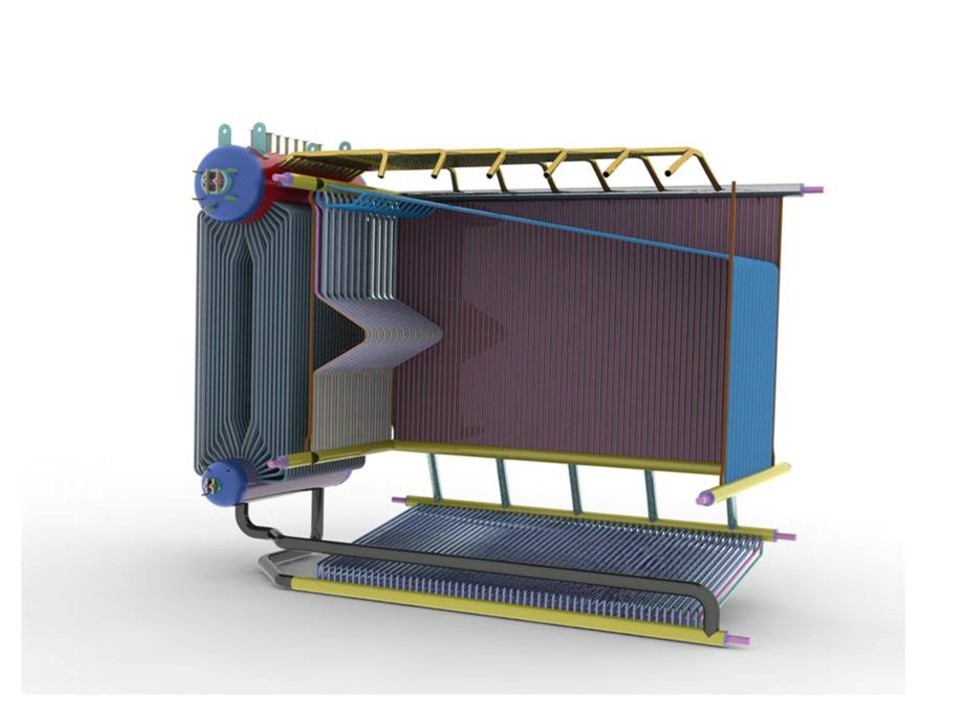
A Bi Drum Water Tube Boiler is a 100% water-tube industrial steam boiler built around two drums an upper steam drum and a lower mud/water drum connected by a network of tubes that carry water and steam between them. Water circulates through the tubes while hot combustion gases flow around the tube surfaces, transferring heat into the water circuit; the steam drum then separates steam from water before it's drawn off for use. This two-drum arrangement supports the circulation volume needed for medium-to-high capacity industrial steam demand, and is commonly selected where a plant's requirements exceed what a single-drum boiler is suited for.
Key Product Highlights
Design & Construction
Bi-Drum Configuration: The steam drum sits above the mud/water drum, with the tube bank forming the circulation path between them. The steam drum handles steam-water separation, while the lower drum collects sediment and supports water circulation back into the tube bank a division of function that a single-drum design doesn't have.
Water Tube Design: Water circulates inside the tubes while hot combustion gases pass around the outside of the tube surfaces, transferring heat into the water/steam circuit as the gases move through the boiler.
Solid Fuel Firing: The boiler is designed for multi-solid-fuel operation, with the furnace and firing arrangement matched to the specific fuel at the time of order.
Heat Transfer: Combustion heat is transferred across the water-tube heating surfaces into the circulating water, converting it to steam that collects in the upper drum.
Working Principle
Efficiency & Performance
Efficient Heat Transfer: The water-tube heating surfaces support heat transfer from combustion gases into the water/steam circuit across the boiler's operating range.
Medium to High Capacity: Available up to 50 TPH, suited to plants with higher steam demand than smaller single-drum units can meet.
Medium to High Pressure: Operates across 21 to 80 ksc, depending on project specification.
Fuel Flexibility: Multi-solid-fuel capability gives plants some flexibility in fuel selection based on availability, though the exact fuel and furnace design are finalized per project.
Steam Generation: Suited to industrial process steam and, where configured, superheated steam generation for power-generation use.
Maintenance & Inspection
Tube Inspection: Regular inspection helps identify fouling, corrosion, erosion, or other operating issues before they affect performance.
Drum Inspection: Periodic inspection of both drums supports reliable steam-water separation and safe operation.
Water Quality: Proper feedwater treatment helps control scale formation and corrosion inside the tubes and drums.
Heat-Transfer Surface Cleaning: Cleaning requirements depend on fuel characteristics and operating conditions.
Combustion & Fuel System: Regular inspection supports stable combustion and reliable fuel handling.
Safety & Instrumentation: Safety devices, controls, and instrumentation should be inspected according to operating procedures and applicable statutory requirements.
Applications
The higher circulation volume and medium-to-high capacity of a bi-drum design make it suited to process industries, chemical manufacturing, food processing, textile plants, paper and pulp, and sugar industries where steam demand is greater than smaller single-drum boilers are built for. It's also used in general manufacturing facilities needing reliable industrial steam, and in power-generation applications where superheated steam is required. Buyers comparing configurations for a specific capacity or pressure point may also want to look at the 4 Pass Single Drum Water Tube Boiler or the Single Drum Corner Tube Boiler, which cover lower-to-medium capacity ranges within the same solid-fuel-fired product line. Suitability for any given plant ultimately depends on required steam capacity, pressure, fuel, and load profile rather than the boiler type alone.
Customization & Scalability
Application-Specific Design: Configuration can be developed according to steam demand, pressure, fuel characteristics, and plant requirements.
Capacity Configuration: Boiler configuration is engineered to project-specific steam requirements within the verified up-to-50-TPH range.
Fuel Compatibility: Multi-solid-fuel suitability is matched to the furnace and firing arrangement specified for the project.
Plant Layout: Equipment arrangement can consider available space, access, and installation requirements.
Automation & Controls: Automation and monitoring can be incorporated where the project calls for them.
Economic Considerations
Operating Efficiency: Correct sizing, combustion control, heat transfer, fuel utilization, and maintenance together influence operating economics.
Maintenance Planning: Inspection access, scheduled maintenance, and reliable components matter for lifecycle performance in a two-drum system.
Long-Term Value: Correct boiler selection and project-specific engineering support reliable long-term industrial operation.
Safety & Compliance
Safety Systems: Appropriate pressure protection, monitoring, controls, and operating procedures are important for safe operation of any water-tube boiler.
Standards & Certifications: Available as per project-specific design and applicable certification requirements.
Regulatory Compliance: Applicable boiler codes, inspections, approvals, and statutory requirements depend on the project location and installation requirements.
Looking for a Bi Drum Water Tube Boiler for your industrial process? Share your required steam capacity, operating pressure, fuel type, and application requirements with Par Techno-Heat to discuss a project-specific boiler solution.
1. What is a Bi Drum Water Tube Boiler?
A Bi Drum Water Tube Boiler is a 100% water-tube industrial steam boiler with two drums an upper steam drum and a lower mud/water drum connected by tubes that carry water and steam between them. Water circulates inside the tubes while combustion gases flow around them, and the steam drum separates steam from water before supply. The two-drum arrangement supports the higher circulation volumes needed for medium-to-high capacity steam demand, up to 50 TPH on this model.
2. How does a Bi Drum Water Tube Boiler work?
Solid fuel combustion generates heat, which transfers to the water-tube heating surfaces as combustion gases pass through the boiler. Water circulating between the two drums absorbs this heat and converts to steam, and the resulting steam-water mixture reaches the steam drum for separation. Separated steam is then supplied to the industrial process, or, where the unit is designed for it, processed further for superheated-steam applications.
3. What are the advantages of a bi-drum water tube boiler?
The two-drum arrangement supports higher circulation volume than a single-drum design, which suits plants with medium-to-high steam demand up to 50 TPH and pressures from 21 to 80 ksc on this model. Separating steam-water separation (upper drum) from sediment collection (lower drum) also gives each drum a distinct function, which can support more straightforward inspection of each component during maintenance.
4. What fuels can be used in a solid fuel fired bi-drum boiler?
This boiler is designed for multi-solid-fuel operation, giving plants some flexibility in fuel selection based on availability and project requirements. The specific fuel type and matching furnace/firing arrangement are finalized at the time of order, since combustion characteristics differ between solid fuels.
5. What capacity and pressure range is available for the Bi Drum Water Tube Boiler?
The Bi Drum Water Tube Boiler is available in a medium-to-high capacity range up to 50 TPH, with operating pressure from 21 to 80 ksc. The exact capacity and pressure delivered for a given project are engineered within this range to match the plant's specific steam demand, rather than offered as a single fixed rating.
6. Can a Bi Drum Water Tube Boiler generate superheated steam?
Yes this boiler can also be used to generate superheated steam for power-generation applications, in addition to standard industrial process steam. Whether superheated steam capability is included, and to what temperature, is finalized based on the project's specific power-generation or process requirements.
7. What maintenance is required for a Bi Drum Water Tube Boiler?
Routine maintenance includes tube inspection for fouling, corrosion, or erosion, periodic inspection of both drums, and feedwater treatment to control scale and corrosion. Heat-transfer surface cleaning frequency depends on fuel and operating conditions, and the combustion and fuel-handling systems should be checked regularly for stable operation. Safety devices and instrumentation should also be inspected per applicable operating procedures.
8. How should I select a Bi Drum Water Tube Boiler for my industrial plant?
Start by defining your required steam capacity and operating pressure within the boiler's up-to-50-TPH, 21-80 ksc range, along with fuel type and availability, load profile, and whether superheated steam is needed for power generation. Feedwater quality, available installation space, maintenance access, and applicable statutory requirements for your location should also be discussed with the manufacturer's engineering team before finalizing a specification.
