


There is a specific type of industrial buyer who approaches a boiler purchase differently from everyone else.
They are not asking about coal quality or biomass fuel availability. They are not comparing LPG versus natural gas pipeline costs. Their first question is almost always the same: "Will this boiler contaminate our steam? Will it pass a pharmaceutical audit? Does it meet our clean room requirements?"
These buyers plant managers and engineers in pharmaceutical manufacturing, food processing, dairy operations, and laboratory facilities have requirements that conventional combustion boilers simply cannot meet. Their processes demand steam that is chemically pure, consistently produced, and free from any trace of combustion byproducts. Their facilities often operate in regulated environments where external auditors review every piece of equipment on the production floor.
For these industries, an industrial electric boiler is not just a preference it is often the only technically acceptable solution.
But electric boilers are not limited to high-purity applications. Their zero-emission operation, compact installation footprint, fast commissioning, and precise controllability are making them increasingly attractive across a much wider range of industries particularly as electricity infrastructure improves across India and as CPCB emission norms make conventional combustion systems progressively more expensive to operate and maintain.
This complete guide explains how industrial electric boilers work, what the three main types are, how they compare against gas and biomass alternatives, what they cost in India and which industries are adopting them most rapidly.
An industrial electric boiler is a closed pressure vessel that uses electrical energy rather than combustion of any fuel to heat water and generate steam or hot water for industrial processes.
Instead of a burner, combustion chamber, and flue gas path, an electric boiler uses electrical heating elements, electrodes, or immersion heaters to convert electrical energy directly into heat energy within the water. There is no flame, no combustion gases, no chimney, and no ash. The energy conversion is direct, clean, and highly controllable.
This fundamental difference from all combustion-based boilers gas, oil, coal, or biomass is what gives industrial electric boilers their defining operational characteristics: zero on-site emissions, exceptional steam purity, compact physical footprint, rapid installation, and precise temperature and pressure control.
Industrial electric boilers are available in a wide capacity range from small laboratory-scale units generating 15–20 kg/hr of steam to large industrial systems producing 5,000 kg/hr (5 TPH) and above at operating pressures from 3.5 kg/cm² to 20 kg/cm² for standard designs, and higher for specialized configurations.
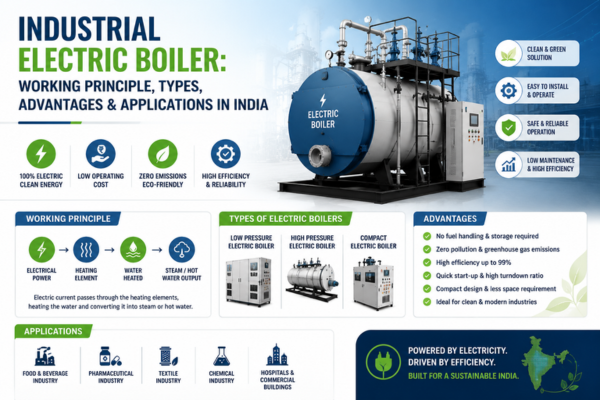
The working principle of an industrial electric boiler is straightforward compared to combustion boilers. There is no two-stage air injection, no bed temperature management, no burner modulation just a direct conversion of electrical energy into heat energy within the water vessel.
Here is how the process works from power supply to steam output:
Step 1 — Water Feed and Level Control Feed water enters the boiler shell through the feed water pump. A float-type or electronic water level controller monitors the water level inside the vessel and triggers the feed pump to maintain the correct operating level at all times. Low water level protection is one of the critical safety interlocks in any electric boiler.
Step 2 — Electrical Heating Electrical energy is supplied to the heating system elements, electrodes, or immersion heaters depending on the boiler type and converts directly into heat within the water. Unlike combustion where heat must transfer from a flame through metal surfaces to water, electric heating occurs directly within or in intimate contact with the water, achieving very high heat transfer efficiency with minimal thermal losses.
Step 3 — Steam Generation and Pressure Build-Up As water absorbs electrical energy, it reaches saturation temperature and begins converting into steam. Steam pressure builds within the vessel to the set operating point. A PLC-based pressure controller monitors vessel pressure and cycles the heating elements on and off or modulates heating power to maintain pressure within the set operating band.
Step 4 — Steam Delivery Steam exits through the main steam outlet and enters the plant's steam distribution header for use in the industrial process. Because there are no combustion gases involved anywhere in the system, the steam produced is chemically clean and suitable for direct-contact food, pharmaceutical, and laboratory applications without additional treatment.
Step 5 — Safety Monitoring and Automatic Control The PLC control panel continuously monitors water level, steam pressure, heating element temperature, and electrical supply parameters. Multiple safety interlocks high pressure cutoff, low water level protection, overtemperature protection, and earth fault protection ensure safe automatic operation with minimal operator intervention. Following a structured safety inspection routine is important for all high-pressure boiler systems our boiler safety guidelines for industries covers the key protocols applicable to electric boiler operation.
All industrial electric boilers use electricity to generate heat, but three fundamentally different heating technologies are used each with distinct operating characteristics, efficiency profiles, and suitability for different applications.
A resistance heating electric boiler uses electrical resistance elements similar in principle to the heating element in a domestic water heater, but engineered for industrial pressure vessel service submerged directly in the boiler water.
When electrical current passes through the resistance element, the element's electrical resistance converts the current into heat, which transfers directly to the surrounding water. Resistance elements are typically made from Incoloy or stainless steel alloy, rated for specific wattage and designed for long service life in pressurized hot water or steam environments.
How it operates in practice: The PLC controller switches resistance element banks on and off in stages to match steam demand. A 500 kg/hr resistance boiler might have four element banks of equal capacity allowing 25%, 50%, 75%, or 100% output to be selected based on process load. This staged control provides good energy efficiency at part-load conditions.
Best suited for: Small to medium steam capacities (50 kg/hr to 1,500 kg/hr), laboratory and clean room applications, pharmaceutical manufacturing, food processing where precise load control is needed, and facilities requiring simple, low-maintenance operation.
Key advantage: Simplest control system, easiest maintenance resistance elements can be individually replaced without draining the vessel in most designs.
An electrode electric boiler uses a fundamentally different principle rather than separate heating elements, the boiler passes electrical current directly through the water itself, using the water as the electrical resistance medium.
Electrodes typically three-phase, immersed vertical electrode assemblies introduce high-voltage current directly into the water. The electrical resistance of the water generates heat throughout the water volume simultaneously, rather than at discrete element surfaces. The power output is controlled by adjusting the depth of electrode immersion in the water (in immersion-controlled designs) or by varying the water conductivity through feed water chemistry.
How it operates in practice: Electrode boilers are inherently very fast-responding they can go from zero to full output almost instantly because heat is generated throughout the entire water volume. This makes them excellent for processes with rapidly fluctuating steam demand.
Best suited for: Medium to large steam capacities (500 kg/hr to 5,000 kg/hr and above), industrial applications with variable steam load profiles, peak-shaving steam supply in facilities with variable processes, and applications where very rapid steam generation is required.
Key advantage: Extremely fast load response, no metallic heating elements that can fail or scale, very long service life with proper water treatment management.
Important note: Electrode boilers require careful feed water chemistry management water conductivity must be maintained within specific limits for proper operation. A water treatment system is essential.
An immersion element electric boiler uses flanged, removable immersion heater assemblies multi-element bundles mounted through flanged connections on the boiler shell that can be withdrawn for maintenance or replacement without removing the boiler from service in most designs.
This configuration combines the simplicity of resistance heating with a more modular, maintenance-friendly physical arrangement. Immersion element boilers are widely used in medium industrial applications where ease of maintenance and consistent uptime are priorities.
Best suited for: Medium capacity applications (200 kg/hr to 3,000 kg/hr), industrial facilities with limited maintenance staff where element serviceability is important, and applications requiring a balance of performance and maintenance simplicity.
| Parameter | Resistance Element | Electrode | Immersion Element |
|---|---|---|---|
| Capacity Range | 50 – 1,500 kg/hr | 500 – 5,000+ kg/hr | 200 – 3,000 kg/hr |
| Load Response Speed | Moderate | Very Fast | Moderate |
| Water Treatment Required | Standard | Critical | Standard |
| Maintenance Complexity | Low | Moderate | Low |
| Element Replacement | Individual element | Electrode assembly | Removable bundle |
| Capital Cost | Moderate | Higher | Moderate |
| Best Application | Pharma, lab, small food | Large industrial, peak use | Medium industrial |
For industries evaluating their options, understanding how electric boilers compare against the two most common alternatives gas-fired and biomass-fired systems is essential for making the right investment decision.
| Parameter | Electric Boiler | Gas Fired Boiler | Biomass Boiler |
|---|---|---|---|
| Fuel / Energy Source | Grid electricity | Natural gas / LPG | Rice husk / bagasse / wood |
| On-Site Emissions | Zero | Low (CO₂, NOx) | Low-Moderate (PM, NOx) |
| Steam Purity | Highest – no combustion | High | Moderate |
| Installation Complexity | Very Low | Moderate | High |
| Space Required | Minimal | Moderate | Large (fuel yard + ash) |
| Pollution Control Equipment | None required | Minimal | Required (bag filter, cyclone) |
| Fuel Storage | None | Pipeline or cylinders | Covered fuel yard |
| Operating Cost (per kg steam) | Higher | Medium | Lowest (near biomass source) |
| Maintenance Cost | Lowest | Low-Moderate | Moderate-High |
| IBR Compliance | Required above threshold | Required above threshold | Required above threshold |
| Best For | Pharma, food, lab, dairy | Textile, chemical, general | Agro-based, textile, sugar |
| Commissioning Time | Days | 1–3 weeks | 4–12 weeks |
Key insight from this comparison: Electric boilers have the highest energy cost per kg of steam when electricity tariff is the input cost. However, for industries where steam purity is mandatory, pollution control costs are high, or installation space and speed are critical constraints the total cost of ownership including civil work, pollution equipment, ash handling, and maintenance often makes electric boilers competitive or superior on a lifecycle basis.
For industries evaluating biomass as an alternative to both electric and gas options, our complete guide on biomass boiler working principle, fuel types, and cost comparison provides a detailed analysis of biomass economics across different fuel types and regions.
An electric boiler produces absolutely no combustion emissions no particulate matter, no NOx, no SOx, no CO₂ from on-site combustion. This means no pollution control equipment (bag filters, electrostatic precipitators, wet scrubbers) is required, no CPCB or State PCB emission monitoring obligations for combustion emissions, and no risk of non-compliance penalties from tightening emission norms.
For industries in urban industrial zones, near residential areas, or within environmentally sensitive locations where local pollution boards apply stricter scrutiny an electric boiler eliminates an entire category of regulatory complexity.
Because no combustion occurs, electric boiler steam contains only what the feed water contains no combustion gas carryover, no trace contaminants from fuel, no thermal degradation products. This makes electric boiler steam directly suitable for pharmaceutical clean steam applications, food-grade sterilization, autoclave operations, and laboratory use without additional treatment or conditioning.
An electric boiler needs a simple, level concrete pad. No chimney. No fuel storage yard. No ash pit. No pollution control equipment structure. No fuel handling conveyance system. For a 500 kg/hr electric boiler, the entire installation footprint boiler, control panel, feed water pump, and water treatment unit can fit within a 15–20 square metre room.
This compact footprint is transformative for industries operating within existing buildings, urban factory premises, or facilities where expansion space is limited.
A packaged electric boiler can be delivered, positioned, connected to power supply and water feed, and generating steam within 3–7 days of delivery. No civil construction, no chimney erection, no IBR site inspection of complex erected components the factory-completed, tested unit arrives ready to run.
For industries that need to meet a production deadline, add capacity quickly, or replace a failed boiler with minimal downtime, this speed advantage is genuinely valuable.
With no combustion system no burner, no refractory, no ash handling, no soot cleaning the maintenance demands of an electric boiler are significantly lower than any combustion alternative. Primary maintenance tasks are feed water treatment monitoring, periodic element or electrode inspection, safety valve testing, and annual IBR inspection. Our industrial boiler maintenance checklist provides a structured inspection schedule that covers all boiler types including electric systems.
Electric heating can be modulated with precision that combustion systems cannot match. Staged element switching or continuous power modulation maintains steam pressure within very tight bands ±0.1 kg/cm² is achievable in well-designed systems. This consistency directly benefits processes that are sensitive to steam pressure variation, such as pharmaceutical autoclaves and food sterilization equipment.
Where the electricity supply includes renewable energy solar, wind, hydro an electric boiler's operational carbon footprint approaches zero on a lifecycle basis. For industries with net-zero commitments, renewable energy certificates (RECs), or export customer sustainability requirements, an electric boiler powered by renewable electricity is the most defensible green steam solution available.
Pharmaceutical manufacturing is the single largest application segment for industrial electric boilers in India. Clean steam produced without combustion is mandatory for autoclave sterilization, sterile manufacturing environments, and injectable product lines. FDA, WHO-GMP, and Schedule M compliance requirements effectively mandate clean steam systems, and electric boilers are the standard solution.
Pasteurization, sterilization, aseptic packaging, and CIP (Clean-in-Place) cleaning in food and beverage plants require steam that meets food safety standards. Electric boilers produce steam with no combustion contamination risk important for FSSAI-regulated production environments and for food manufacturers supplying export markets.
Dairy processing pasteurization lines, butter churning, cheese production, UHT processing requires consistent, clean, precisely controlled steam. Electric boilers are widely used in modern dairy plants, particularly in facilities that have invested in food safety certification systems.
University laboratories, R&D centres, testing facilities, and quality control labs use small electric boilers (15–100 kg/hr range) for autoclave sterilization, steam injection testing, humidity chambers, and research equipment. The combination of small footprint, clean steam, and simple operation makes electric boilers the standard choice.
Central sterile supply departments (CSSD) in hospitals require clean steam for sterilization of surgical instruments, dressings, and medical equipment. Electric steam generators and electric boilers are the preferred choice in healthcare facility design.
In textile finishing units producing high-value fabrics particularly for export markets electric boilers provide the precise, consistent steam pressure needed for quality fabric pressing, decatizing, and surface finishing operations where steam quality directly impacts product quality.
Specialty chemical, adhesive, coating, and material science manufacturers use electric boilers where precise temperature control, clean steam, or compact installation within existing plant layouts are required.
| Capacity | Type | Approx. Price Range (₹) |
|---|---|---|
| 15 – 100 kg/hr | Resistance Element | ₹1.5 lakh – ₹5 lakh |
| 100 – 300 kg/hr | Resistance / Immersion | ₹5 lakh – ₹12 lakh |
| 300 – 500 kg/hr | Resistance / Immersion | ₹12 lakh – ₹22 lakh |
| 500 kg/hr – 1 TPH | Immersion / Electrode | ₹22 lakh – ₹40 lakh |
| 1 – 2 TPH | Immersion / Electrode | ₹40 lakh – ₹75 lakh |
| 2 – 5 TPH | Electrode | ₹75 lakh – ₹1.5 crore |
Operating pressure — Higher pressure designs require heavier shell construction and more rigorous IBR certification, adding cost.
Heating type — Electrode boilers cost more than resistance element designs at comparable capacity due to more complex electrical systems.
Automation level — Full PLC with HMI touchscreen, remote monitoring, and automated blowdown adds ₹1.5–₹5 lakh over basic on/off control systems.
Power supply requirements — Very large electrode boilers may require high-tension (HT) power supply infrastructure that adds site preparation cost.
Water treatment system — A feed water softening and conditioning system is essential for long element life, typically adding ₹1–₹4 lakh to the installation cost.
Note: Prices are indicative for 2026 and exclude water treatment system, installation, electrical connection charges, and IBR registration fees. Contact Par Techno-Heat for a detailed site-specific quotation.
| Parameter | Electric Boiler (1 TPH) | Gas Boiler (1 TPH) |
|---|---|---|
| Energy Input Required | ~720 kWh/hr | ~85 m³ natural gas/hr |
| Energy Cost (2026 estimate) | ₹5–₹9/kWh (industrial) | ₹40–₹55/m³ (PNG) |
| Running Cost Per Hour | ₹3,600 – ₹6,500 | ₹3,400 – ₹4,700 |
| Annual Maintenance Cost | ₹50,000 – ₹1.5 lakh | ₹1 lakh – ₹3 lakh |
| Pollution Control Cost | Zero | Minimal |
| Civil and Installation Cost | ₹2 – ₹5 lakh | ₹8 – ₹20 lakh |
What this table shows: At current industrial electricity tariffs in India, the hourly running cost of an electric boiler is comparable to a gas boiler at 1 TPH capacity particularly for industries in states with lower industrial electricity tariffs or those with captive solar/renewable power. When total cost of ownership is considered including zero pollution control equipment, minimal maintenance, and very low installation cost electric boilers are more competitive than a simple fuel cost comparison suggests.
For industries exploring how to further optimize running costs after installation, our guide on how to improve boiler efficiency covers energy efficiency practices applicable to electric boiler systems.
Selecting the right electric boiler for your facility requires matching the type and specification to your actual operating requirements not simply choosing the most affordable option.
Start by calculating your actual steam demand in kg/hr at your required operating pressure. Electric boilers are sized precisely an undersized system creates production bottlenecks, while an oversized system wastes capital and operates inefficiently at part load.
Define your required steam quality whether you need saturated steam, dry steam, or clean steam for pharmaceutical applications as this affects the design specification.
Evaluate your electricity supply available connected load, tariff rate, and reliability. For electrode boilers above 500 kg/hr, verify that your electrical infrastructure supports the required three-phase supply.
Plan your water treatment system feed water softening is essential for long element life and reliable boiler performance. This is not optional.
Finally, choose a manufacturer with demonstrated electric boiler installations in your specific application. Electric boiler performance in a pharmaceutical plant has different success criteria than in a textile unit experience in your specific industry segment matters. Our boiler manufacturer selection checklist provides a structured evaluation framework for this selection process.
For a broader view of the industrial boiler market, our listing of top steam boiler manufacturers in India provides a useful starting reference for shortlisting qualified suppliers.
Par Techno-Heat Pvt. Ltd. PAR Boiler manufactures industrial electric boilers from Ahmedabad across resistance element, immersion element, and electrode configurations, covering capacities from 15 kg/hr to 5 TPH at operating pressures up to 20 kg/cm².
Every Par Boiler electric system is IBR certified, PLC automated with multi-level safety interlocks, and delivered with complete documentation. The company has installed electric boilers across pharmaceutical manufacturing facilities, food processing plants, dairy operations, and laboratory complexes throughout India with reference installations demonstrating consistent performance in regulated production environments.
Whether you need a small clean steam generator for a pharmaceutical autoclave room or a large electrode boiler for an industrial heating application, Par Techno-Heat provides a customized solution engineered for your specific capacity, pressure, and application requirements.
Contact Par Techno-Heat Pvt. Ltd. Get a Free Electric Boiler Consultation
Q1. What is an industrial electric boiler and how is it different from other boilers?
An industrial electric boiler uses electrical energy to heat water and generate steam with no combustion, no fuel burning, and no on-site emissions. Unlike gas, oil, coal, or biomass boilers, there is no burner, no chimney, and no ash. This makes electric boilers the cleanest and most compact industrial steam generation option available.
Q2. What are the three types of industrial electric boilers?
The three main types are resistance element boilers (heating elements submerged in water), electrode boilers (current passed directly through water), and immersion element boilers (removable multi-element bundles mounted through the shell). Each has different capacity ranges, load response characteristics, and maintenance requirements.
Q3. What is the price of an industrial electric boiler in India in 2026?
Industrial electric boiler prices in India range from ₹1.5 lakh for small 15 kg/hr resistance element units to ₹1.5 crore and above for large 5 TPH electrode systems. A 500 kg/hr electric boiler typically costs ₹12–₹22 lakh depending on type, pressure rating, and automation level.
Q4. Is an electric boiler more expensive to run than a gas boiler?
At current industrial electricity tariffs in India (₹5–₹9/kWh), the running cost of a 1 TPH electric boiler is broadly comparable to a gas boiler particularly when total costs including maintenance, pollution control, and civil installation are included. For industries with captive solar or renewable power, electric boilers can be significantly cheaper to run.
Q5. Which industries use industrial electric boilers most in India?
Pharmaceutical manufacturing (clean steam for sterilization), food and beverage processing, dairy operations, hospital CSSDs, laboratories, and high-quality textile finishing are the primary application segments for industrial electric boilers in India.
Q6. Do electric boilers require IBR certification in India?
Yes. Industrial electric boilers operating above 1 kg/cm² steam pressure and generating more than 22.75 litres of steam are required to comply with the Indian Boilers Regulation (IBR) Act, 1950. Par Techno-Heat supplies fully IBR-certified electric boilers with all required documentation.
Q7. What maintenance does an industrial electric boiler require?
Electric boilers require periodic inspection of heating elements or electrodes for scale buildup or corrosion, feed water quality monitoring and treatment system maintenance, safety valve and pressure gauge testing, annual IBR inspection, and PLC and control system checks. Maintenance workload is significantly lower than any combustion boiler type.
Looking for a reliable industrial electric boiler manufacturer in India? Par Techno-Heat Pvt. Ltd. offers IBR-certified electric steam boilers in resistance, immersion, and electrode configurations with over 25 years of manufacturing experience and installations across pharmaceutical, food, and dairy industries throughout India.
