



In May 2024, a boiler blast at a chemical factory in Dombivli, Maharashtra killed at least 13 people and injured more than 60 workers and local residents. Investigations found that basic safety audits had not been carried out and safety certificates had not been maintained. The owners were arrested on charges of homicide. The plant had been operating in a densely populated industrial area.
That incident was not an anomaly.
Data from the National Board of Boiler and Pressure Vessel Inspectors shows that roughly 80% of reported industrial boiler accidents trace back to two root causes: low-water condition and operator error. Not mechanical defects. Not design failures. Human decisions, or the absence of them. A safety valve not tested for fourteen months. A water level gauge blown down by habit rather than by schedule. An operator who never received training on what to do when the pressure climbs past the set point.
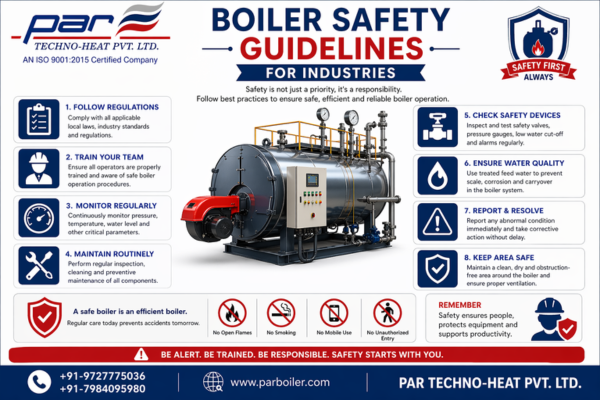
Boiler safety is not a matter of installing the right equipment and walking away. A boiler is infrastructure operating under sustained thermal and pressure stress, managed by people whose competence, habits, and awareness determine whether the equipment runs safely or becomes a serious liability. This guide covers the standards, the safety devices, the operating procedures, and the training requirements that make the difference.
Industrial boiler safety compliance in India isn't optional, and the legal exposure for non-compliance isn't limited to fines. The Indian Boiler Regulation 1950 governs the design, fabrication, inspection, and certification of every boiler with a capacity exceeding 22.5 litres that generates steam above 1 kg/cm2 gauge pressure. Any such boiler operating in India must be registered with the relevant state boiler authority and carry a valid certificate of fitness renewed after each statutory inspection.
The IBR is enforced by state boiler inspectorates, and the consequences of operating an unregistered or uncertified boiler are not administrative: under the Boiler Act, plant owners and operators carry criminal liability for accidents resulting from non-compliance. The Dombivli incident illustrates this precisely. When the certificate hadn't been maintained and the audit hadn't been done, the accident shifted from an industrial tragedy to a homicide investigation.
Beyond IBR, industries that export equipment or supply steam to international clients increasingly need to demonstrate ASME Boiler and Pressure Vessel Code compliance. The 2025 edition of the ASME BPVC becomes mandatory for equipment manufactured or altered to its rules from January 2026. Plants that haven't reviewed whether their boiler documentation meets current ASME requirements are operating on an assumption rather than a confirmation.
Compliance is not the ceiling of boiler safety. It is the floor. The statutory inspection confirms that the pressure vessel is structurally sound and the safety fittings are present. It does not confirm that your operators know what to do when the low-water cutoff trips at 2 AM, or that your blowdown procedure is being followed rather than bypassed, or that your safety valve was last tested six months ago rather than three years ago.
For guidance on selecting boilers that are built to IBR and international standards from verified manufacturers, the Top Boiler Manufacturers in India directory provides a verified starting point for procurement decisions.
A boiler's safety devices are not passive fittings. They are active protection systems that stand between normal operation and a catastrophic pressure release. Each device has a specific failure mode, a specific test procedure, and a specific consequence if it fails in service. Most industrial plants inspect them on paper. Fewer test them as designed. Almost none document what happens when the test reveals a device that isn't working correctly.
|
Safety Device |
Function |
Maintenance Requirement |
|
Safety Valve |
Opens automatically when pressure exceeds MAWP; primary overpressure protection |
Monthly manual lift test; annual bench test to set pressure |
|
Low-Water Cutoff (LWCO) |
Shuts down burner when water level drops below safe minimum |
Monthly drain test to confirm actuation; replace if slow to trip |
|
Pressure Gauge |
Displays live operating pressure; must be clearly visible from operator position |
Quarterly calibration check against a reference gauge |
|
Water Level Gauge (Sight Glass) |
Shows actual water level in drum; must be blown down daily to confirm accuracy |
Daily blowdown; replace glass if cloudy, cracked, or discoloured |
|
High-Pressure Cutoff |
Independent burner shutoff at preset maximum pressure — backup to pressure controller |
Quarterly calibration and functional test |
|
Flame Failure / Burner Management |
Detects loss of burner flame; cuts fuel supply; prevents furnace gas accumulation |
Test per manufacturer schedule; log every lockout with fault code |
|
Fusible Plug |
Melts at a defined temperature, releasing steam/water to alert of overheating |
Replace at each annual inspection; never reuse |
|
Feed Check Valve |
Prevents backflow of boiler water into feedwater system |
Annual inspection; test for clean seating under pressure |
|
Blowdown Valve |
Removes concentrated boiler water and sediment to control TDS |
Test for full travel and clean shut; replace if weeping |
The safety valve is the most critical of these devices and the one most commonly deferred. A safety valve that hasn't been manually tested in twelve months may not lift at its set pressure when it needs to. The spring can corrode, the seat can foul, the disc can stick. The only way to know it will work is to test it. Testing is uncomfortable: it vents steam, it requires PPE, and occasionally the valve fails to reseat cleanly after the test, requiring immediate repair. That discomfort is precisely why so many plants avoid it. And precisely why they shouldn't.
The low-water cutoff deserves equal attention. This device trips the burner when the boiler water level drops below a safe minimum, preventing the scenario that causes tube collapse and furnace crown damage. Testing requires draining the boiler water slowly until the cutoff activates.
Plants that test it annually are betting that a mechanical float or electrode device will work reliably for twelve months without verification. The failure mode for a stuck or fouled cutoff isn't a minor malfunction. It's the most dangerous single-point failure in the entire system.
The full specification for safety-critical accessories should be part of your procurement standard. Industrial Boiler Accessories covers what each component should include and what to verify before installation.
Need help reviewing your boiler's safety compliance? Contact Par Techno Heat for a technical consultation — or keep reading to complete the safety framework.
Safe boiler operation is a set of habits, not a set of rules posted on a wall. The procedures that matter most are the ones that happen every shift, every day, before the first trip is logged and before anything has gone wrong. Plants that wait for warning signs before applying procedure are always playing catch-up with events that careful habit would have prevented.
Boiler start-up is statistically the most dangerous operating phase. Fuel changeovers, cold-start sequences, and reintroduction of gas supply after maintenance account for a disproportionate share of serious incidents. The 2025 Transport Malta investigation into the fatal Torc tanker boiler incident identified exactly this: a crew that had placed excessive confidence in their safety barriers during a fuel transition, misperceived the risks, and lost a colleague.
The correct start-up sequence is not improvised. It is documented, signed off at each step, and followed without exception. Pre-ignition furnace purge is not a suggestion: it clears accumulated fuel vapour before any ignition attempt and is the single most important step in preventing furnace explosion. A purge that is shortened because the operator is in a hurry or is bypassed because the boiler was last shut down cleanly is a gamble that the gas really isn't there. Sometimes it isn't. Sometimes it is.
Before any firing attempt, verify water level in the boiler drum, confirm all valves are in their correct positions, check fuel supply pressure is within specified range, and confirm the burner management system has completed its self-check sequence. None of these steps takes more than five minutes. Each one closes a failure path.
Boiler safety during normal operation depends on operator attentiveness rather than passive monitoring. Pressure and water level gauges should be checked against their set values every hour and logged, not observed and assumed to be fine. A pressure reading that is 8% above the normal working pressure should generate a maintenance call, not a shrug. A water level that has dropped 10% below its normal position without an explanation should trigger an investigation, not a note in the margin of the log.
The best operating teams treat anomalies as information rather than inconveniences. A single pressure spike that resolves itself is a data point. The same spike three times in two weeks is a pattern pointing to a specific control failure. The distinction between an operator who logs it and moves on and one who escalates it is often the difference between a controlled repair and an unplanned shutdown.
Watch the stack. A flue gas temperature that has risen steadily over four weeks with no change in load is telling you something is fouling the heat transfer surfaces: scale on the water side, soot on the fire side, or both. That signal is visible in the data before it becomes visible in the efficiency numbers, and it's visible in the efficiency numbers before it becomes a tube failure. The monitoring window is wide. Use it.
Boiler shutdown for maintenance entry is the point where safety procedure failures are most likely to cause immediate harm. Every shutdown before internal access requires a defined sequence: burner shutdown, steam supply isolation, pressure blowdown to atmosphere, water level drain to a safe level, and physical lockout of all energy sources including fuel, steam, and electrical supply to the burner management system. Verbal confirmation that a boiler has been 'shut down' is not the same as locked out and confirmed safe. People have entered boilers that they were told were isolated and found them still pressurised.
The written permit-to-work system exists precisely because the verbal assurance fails in practice. A permit specifies the boiler identity, the work to be carried out, the isolation points, who authorised the isolation, and what conditions must be confirmed before entry. No person should enter a boiler for any reason without a signed permit confirming these points. This is not bureaucracy. It is the procedure that prevents people from being scalded, asphyxiated, or trapped.
Most industrial boiler accidents trace to human error rather than equipment failure. The National Board data is consistent on this: low-water events and operator misjudgement account for the vast majority of incidents. This means that equipment investment alone doesn't close the risk. The competence of the person managing the boiler determines the outcome when something unexpected happens.
Boiler operator training is not a one-time onboarding event. It is a structured, ongoing programme covering normal operation, abnormal condition response, emergency procedures, and the theory behind each safety system. An operator who understands why the low-water cutoff exists is more likely to test it correctly than an operator who was told to test it monthly without being told what it prevents. Understanding drives compliance. Compliance without understanding produces the actions without the judgement.
Emergency response deserves its own dedicated training block rather than a paragraph in an operations manual. Operators should be trained to distinguish between a minor pressure excursion, an alarm state requiring immediate action, and a genuine emergency requiring evacuation. Those three conditions have three different correct responses, and confusing them in either direction produces bad outcomes: a genuine emergency treated as a minor anomaly, or a routine alarm causing an unnecessary evacuation that creates its own hazards.
Consider a chemical plant that introduces a new shift operator without a structured handover programme. The operator follows general instructions, misses the significance of a high-TDS reading in the blowdown log, and continues operating normally. Three shifts later, carryover from foaming contaminated the steam distribution system and damaged a control valve assembly downstream. The boiler itself was fine. The cost was in the process equipment and the unplanned downtime. A structured training programme that covered water chemistry significance would have flagged the TDS reading on day one.
A structured approach to daily operator checks and what each check is designed to catch is set out in the Boiler Maintenance Checklist for Industrial Use — a practical reference for any operator training programme.
Personal protective equipment for boiler operators is not optional and is not standardised across all tasks. The correct PPE depends on the specific activity: general observation requires different protection than blowdown procedure, which requires different protection than burner maintenance. Having one set of safety gear for all boiler room activities is the wrong approach, and it produces operators who either ignore the PPE requirements entirely or wear inappropriate protection for the task.
For general boiler room operations: heat-resistant gloves rated for the steam temperature at the working pressure, safety footwear with heat resistance and steel toecap, safety glasses, and hearing protection where noise levels exceed 85 dB. For safety valve testing: full face shield rather than safety glasses, insulated gloves rated above the valve outlet temperature, and a positional protocol that keeps the operator clear of the steam discharge path. For internal boiler entry: the full confined space protocol including gas testing for oxygen content and toxic gases, breathable air supply where required, and a standby person stationed outside the entry point.
Emergency response procedures should be posted in the boiler room, rehearsed at least annually, and known by every person who works in or near the boiler room — not just the designated operator. A boiler emergency that occurs while the operator is on a break and a maintenance worker is nearby becomes a test of whether that maintenance worker knows the emergency shutdown sequence.
The emergency shutdown sequence is: secure the fuel supply by closing the main gas or oil isolation valve, trip the burner at the control panel, isolate the steam supply to distribution, and evacuate non-essential personnel from the boiler room. The single rule that overrides all others: do not add cold feedwater to an overheated boiler. Cold water contacting superheated tube surfaces flashes to steam instantly and can rupture the pressure envelope. The correct emergency response to suspected overheating is to shut down the fuel supply and wait for qualified inspection before any other action.
This needs to be said plainly. Some industrial facilities have entirely compliant boiler programmes on paper: IBR certificates current, safety valve tested annually, operator trained to the required standard. And they still have incidents. Not because the compliance framework failed, but because compliance and safety culture are different things and the second doesn't follow automatically from the first.
A plant where the safety valve gets tested because the inspector is due next month rather than because the operator understands what it prevents is a plant that is compliant but not safe. Compliance produces the documentation. Safety culture produces the judgement. The difference shows up when something unexpected happens and the operator has to decide in real time — without the manual open in front of them — what the correct response is.
Building safety culture means treating every near-miss as a learning event rather than a close call to be quietly noted and moved past. It means an operator who reports a concern about a pressure trend being thanked rather than told not to worry about it. It means the maintenance team having enough time to complete the blowdown log properly rather than signing it off at the end of the shift from memory.
If you're evaluating whether your current boiler system is built to a standard that supports a genuine safety culture from the ground up, the Boiler Manufacturer in India Selection Checklist covers what to look for in the design, certification, and after-sale support of any boiler procurement.
The five non-negotiable rules for industrial boiler operation are: never operate below the minimum water level, test all safety devices at their required intervals rather than assuming they work, follow the documented startup and shutdown sequences without improvisation, never bypass a safety interlock to keep the boiler running, and complete the maintenance log with actual measured values rather than from memory. A plant that follows these five rules consistently eliminates the majority of the failure modes that cause industrial boiler accidents.
IBR compliance under the Indian Boiler Regulation 1950 requires registration of every boiler exceeding 22.5 litres capacity with the state boiler authority, a valid certificate of fitness renewed after each statutory inspection, inspection at all stages of construction by an authorised inspecting officer, and certified welder qualifications for all pressure weld work. Operating a boiler without a current IBR certificate is a criminal offence under the Boiler Act, with liability extending to plant owners and managers in the event of an accident.
Safety valve: monthly manual lift test, annual bench test to set pressure. Low-water cutoff: monthly drain test confirming actuation. Pressure controls and high-pressure cutoff: quarterly calibration and functional test. Burner management system and flame failure protection: test per manufacturer schedule, with every lockout event logged and investigated. Water level gauge: daily blowdown to confirm accurate reading. Devices that fail their test require immediate repair, not a note in the log and a plan to address at the next shutdown.
General boiler room operation requires heat-resistant gloves, safety footwear with heat resistance and steel toecap, safety glasses, and hearing protection where noise levels exceed 85 dB. Safety valve testing requires a full face shield and insulated gloves rated above the discharge temperature. Internal boiler entry requires the full confined space protocol: gas testing for oxygen content and toxic gases before entry, a standby person stationed at the entry point, and breathable air supply where the internal atmosphere cannot be confirmed as safe.
Close the main fuel isolation valve to cut off the burner heat source immediately. Trip the burner at the control panel. Isolate the steam supply to the distribution system. Evacuate non-essential personnel from the boiler room. Do not add cold feedwater under any circumstances: cold water contacting overheated surfaces can cause immediate steam flash and pressure vessel rupture. Once the fuel is secured and the boiler is cooling, wait for a qualified boiler engineer to inspect the system before any restart attempt.
The Dombivli blast killed 13 people. The investigation found no current safety certificate and no evidence of recent safety audits. The owners were arrested. The community absorbed the consequences of decisions made — and not made — inside a single factory. That is the extreme end of what boiler safety failures cost.
Most failures aren't that dramatic. They produce a shutdown rather than an explosion, a damaged tube rather than a structural collapse, a production disruption rather than a casualty. But they trace back to the same source: a safety system that wasn't tested, an operator who wasn't trained for the scenario they encountered, a procedure that existed on paper and not in practice.
The problems that precede most boiler failures are well-documented. The Common Boiler Problems and How to Fix Them guide covers the fault patterns that, left unaddressed, become the incidents described in incident reports.
Safety devices work when they're tested. Procedures work when they're followed. Operators perform when they're trained. None of these things happen automatically. They require deliberate investment, consistent management, and a culture that treats the daily 15-minute safety check as more important than the production schedule it occasionally delays.
Reviewing Your Plant's Boiler Safety Programme?
Par Techno Heat Pvt Ltd designs and manufactures IBR-compliant industrial boilers and supports clients across India with technical guidance on safety systems, operator procedures, and compliance documentation. If you're commissioning a new system, reviewing an existing one, or evaluating a supplier, our team can provide direct, practical advice.
Contact Par Techno Heat — www.parboiler.com
30-minute technical consultation. No pitch. No obligation. A direct conversation about your boiler safety requirements.
Safe operation starts with the right system.
