



The pressure gauge is reading low. The steam supply is inconsistent. A low rumbling has been coming from the boiler room for three days, and three different people have told three different stories about what it means. The maintenance team checks for obvious faults, finds nothing immediately wrong, and the boiler keeps running. Until it doesn't.
That sequence plays out across industrial plants every week. Not because the equipment is poorly built. Because the early signals of boiler problems are easy to normalise.
A steady rise in flue gas temperature over two months looks like a trend until it becomes a tube failure. A banging noise in the steam distribution lines sounds like a minor nuisance until a failed steam trap causes water hammer damage that takes the line out for four days. A safety valve that weeps occasionally gets noted in the log and never followed up, until it lifts at the wrong moment and requires emergency replacement.
This guide covers the most common industrial boiler problems in the order most operators encounter them: what the symptom looks like, what's actually causing it, and what the correct fix is. Not a checklist. A diagnostic framework built around how failures actually develop.
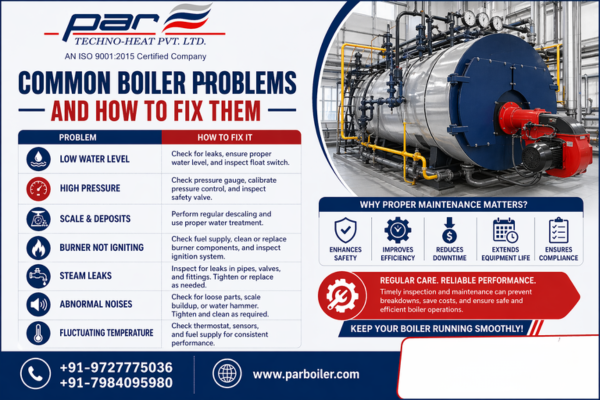
Use this as your first filter when a symptom appears. The detailed explanation for each problem follows below.
|
Symptom |
Likely Root Causes |
Immediate Action |
|
Low steam pressure |
Burner underperforming; feedwater temp too high; steam leaks; scale on tubes |
Combustion check + flue analysis; inspect all steam valves; descale |
|
Pressure too high / Safety valve lifting |
Pressure control drifted; excess firing rate; blocked steam outlet |
Recalibrate pressure controller; check steam stop valve; never override safety valve |
|
Banging / water hammer |
Condensate in steam lines; fast-closing valves; failed steam traps |
Survey and replace failed traps; fit slow-close valves; improve condensate drainage |
|
Kettling / rumbling noise |
Scale on heat exchange surfaces (1/4" deposit = 40% heat transfer loss) |
Immediate tube inspection; chemical or mechanical descaling |
|
Water leaks (body / fittings) |
Corroded seal faces; cracked welds; over-pressure cycling; gasket failure |
Stop boiler; identify source; replace gaskets or weld repair by certified engineer |
|
Low water level trips |
Failed feedwater pump; blocked feedwater line; faulty level sensor |
Test and replace sensor first; inspect pump; check feedwater system valve positions |
|
Flue gas temperature rising |
Soot on fire side; scale on water side; excess air drift |
Fire-side sweep clean; water-side descale; combustion re-tune with flue analyser |
|
Carryover (wet steam) |
High TDS; foaming; water level too high; steam velocity too high |
TDS blowdown; reduce water level; check demister internals |
|
Corrosion pitting (internal) |
Dissolved oxygen in feedwater; pH below 8.5; inadequate deaeration |
Increase chemical dosing; inspect deaerator; test feedwater pH daily |
|
Burner lockout / flame failure |
Dirty ignition electrode; fouled nozzle; fuel pressure instability |
Clean or replace electrode; inspect nozzle; check fuel supply pressure |
Pressure deviation is the symptom operators notice first and misdiagnose most often. Low steam pressure and high steam pressure are treated as opposites, but they frequently share the same root: a pressure control system that has drifted from its calibrated set point and hasn't been checked since commissioning.
Low steam pressure is almost never a single-cause problem. Combustion underperformance, steam leaks from gland packings or valve seats, excessive blowdown running simultaneously with high demand, and scale on heat transfer surfaces all reduce effective steam output. The operator sees the pressure drop and increases the firing rate. That addresses the symptom. It doesn't address the cause. The boiler runs harder than it should, fuel consumption rises, and the underlying problem continues developing.
Consider a pharmaceutical plant running a 3 MW steam boiler at consistently 8% below its rated working pressure. The team responds each time by adjusting the burner. Over six months, fuel consumption rises 12% without any increase in production demand. An engineer conducts a combustion analysis and water-side inspection: 2mm scale on the heat exchange tubes and an air-fuel ratio running at 22% excess air. Two adjustments and a descaling cycle restore rated pressure and bring fuel consumption back below baseline. Those six months of excess fuel had cost more than the inspection and descaling combined.
Persistently high pressure is the more dangerous deviation. The pressure controller modulates burner output to maintain set pressure. If it drifts 5 to 10% above its calibrated value, the boiler routinely operates closer to its maximum allowable working pressure than the operator believes. The safety valve becomes the primary protection rather than the backup protection. The best pressure management programmes treat the controller as a precision instrument rather than a set-it-and-forget-it fitting: calibration quarterly, with log entries proving it.
Watch for the safety valve lifting more than once in any 30-day period. That's not a pressure spike. That's a control system failing to do its job, and the valve compensating.
A small water leak on a boiler fitting gets noticed, noted in the maintenance log, and addressed at the next scheduled shutdown. That is the standard response. It is also how minor leaks become major ones.
Leaks don't stabilise on a hot, pressurised boiler. Corrosion progresses. Gasket faces erode. Weld defects propagate under thermal cycling. A drip at a flange joint today is telling you the gasket is failing and the flange faces need inspection: left unaddressed, that drip becomes a steady weep that introduces air into the pressure envelope, accelerates corrosion of the surrounding metalwork, and eventually requires a repair scope far beyond a gasket replacement.
The location of the leak matters as much as its severity. Leaks from tube-to-tubesheet joints indicate stress from unequal thermal expansion: common in shell-and-tube heat exchangers where the hot gas distribution across the tube sheet face is uneven. These don't seal themselves with a new gasket. They require tube rolling or tube replacement by a qualified boiler repairer. Leaks from the boiler shell itself, from welds or parent metal, require immediate shutdown and ultrasonic thickness testing before any repair decision is made.
Steam leaks from valve glands and packing are the most common and most overlooked source of losses. A single leaking gland on a 25mm valve at 10 bar passes steam at a rate that, across a year of continuous operation, represents thousands of dollars in fuel cost. Gland repacking is a two-hour job. The best maintenance programmes schedule it at the first sign of leakage rather than the next annual shutdown.
Leaks from the safety valve body, bonnet, or discharge pipework are a different category entirely. That's not a maintenance issue. That's an emergency shutdown and inspection.
For a structured approach to leak prevention through scheduled checks, the Boiler Maintenance Checklist for Industrial Use covers the inspection intervals that catch leak precursors before they become failures.
Boiler noise is the problem most operators dismiss and the signal most correlated with imminent failure. Every abnormal sound from a boiler or its distribution system has a specific mechanical or thermal cause. None of them is normal. None of them improves on its own.
Kettling, the low rumbling or boiling sound that emanates from inside the boiler pressure vessel during firing, is almost always scale. A quarter-inch deposit on a heat transfer tube reduces its heat transfer efficiency by approximately 40%. The water trapped behind that deposit reaches local boiling point and creates steam bubbles that collapse against the tube surface: that collapse is what you hear. It's called kettling because it sounds like a kettle approaching boil. The consequence is not just noise: localised overheating of the tube metal causes stress cracking and accelerated fatigue failure. A tube that kettles for six months will fail. The timeline is a question of how thick the scale is, not whether failure occurs.
Water hammer is a distinct, sharp banging from the distribution pipework rather than the boiler shell. The mechanism is hydraulic shock: steam travelling through a pipe picks up condensate that hasn't drained, the slug of condensate collides with a fitting, valve, or bend at high velocity, and the impact shockwave travels through the pipe. Water hammer is a failed steam trap problem in most industrial systems. A trap that has failed open passes live steam directly to drain, cools the connecting pipework, and creates the condensate accumulation that causes hammer. A plant with fifty steam traps and six failed units is operating with six sources of potential hammer damage, often without anyone connecting the noise to the specific traps causing it.
Whistling or high-pitched hissing from the boiler body or fittings indicates steam or gas passing through a restriction: a partially closed valve, a safety valve beginning to lift, a corroding tube creating a pin-hole leak path. Each sound has a direction and a source. The fix starts with locating it accurately rather than treating it as background noise.
If your boiler is exhibiting any of these symptoms and you need engineering support, contact Par Techno Heat for a technical consultation or keep reading to complete the fault diagnosis framework.
Corrosion and scale are not maintenance problems. They are water chemistry problems with maintenance consequences. The distinction matters because plants that treat them as maintenance items keep descaling and cleaning without ever fixing the chemistry that makes the fouling inevitable.
Oxygen pitting corrosion is the most destructive corrosion mechanism in industrial boilers. Dissolved oxygen in the feedwater attacks the metal surface of the boiler drum and tubes, creating pits that concentrate stress and eventually propagate through the tube wall. A single oxygen pit that reaches through a 4mm tube wall creates a leak. Multiple pits on adjacent tubes indicate a systemic chemistry failure. The fix is deaeration thermal or chemical removal of dissolved oxygen before the feedwater enters the boiler. The measurement is simple: feedwater oxygen content should be below 0.02 ppm in a well-operated deaerator system. Most plants that have oxygen pitting problems have never measured feedwater oxygen. They treat the symptom rather than the cause.
Scale from calcium and magnesium in untreated makeup water insulates heat exchange surfaces and drives up fuel consumption progressively. A 1mm scale layer increases fuel consumption by 4 to 9%. A 3mm layer can push that figure above 30%. The corrective path is chemical descaling, but the preventive path is water softening and consistent chemical treatment: anti-scalant dosing that prevents crystallisation before it starts. Plants that replace water treatment with descaling cycles are on a maintenance treadmill. The chemistry fix ends that cycle.
Caustic corrosion attack of the tube metal by concentrated sodium hydroxide is the less common but more immediately dangerous form. It occurs when high-pH boiler water concentrates in crevices under scale deposits or at tube-to-tubesheet junctions. The metal doesn't pit; it gouges, thinning the tube wall rapidly across a localised area. Caustic attack is harder to detect visually than oxygen pitting and more likely to produce sudden tube failure rather than a developing leak.
For the full range of accessories needed to manage water chemistry correctly from commissioning, review Industrial Boiler Accessories for specification guidance.
Burner lockout the safety shutdown that trips the burner and requires manual reset is the boiler problem that causes the most immediate production disruption. It's also the problem that gets the least root-cause analysis, because the temptation to simply reset and restart is hard to resist when a production line is waiting for steam.
The burner management system locks out when it detects a flame failure, an ignition failure, a loss of fuel pressure, or a fault signal from a safety interlock. Each cause has a different fix, and treating them all with a manual reset and a wait-and-see approach is how intermittent faults become persistent ones. A lockout that occurs once and doesn't recur for weeks may have been caused by a momentary fuel supply pressure dip. A lockout that recurs three times in a week is telling you the ignition electrode is fouled, the nozzle is worn, or the fuel pressure regulator is drifting.
Flame failure is the most common lockout cause in gas-fired industrial boilers. The flame detection system typically a UV scanner or ionisation probe monitors the burner flame and trips the system if the flame goes out or fails to ignite cleanly. Dirty detection probes give false readings: a probe coated in combustion deposits reads a weak or absent flame signal even when the flame is burning correctly. Cleaning the probe is a fifteen-minute job that prevents lockouts. Replacing the probe is a thirty-minute job. Neither requires extended downtime. Letting a dirty probe cause repeated lockouts costs far more in disruption than the cleaning ever would.
The best combustion maintenance programmes treat each lockout as a data point rather than an inconvenience. Log the fault code, the operating conditions at the time, and any preceding symptoms. Three lockouts with the same fault code across four weeks is a pattern that points directly to a specific component. Treating each one as isolated means fixing nothing and waiting for the next one.
Steam carryover water droplets carried into the steam distribution system is a problem that most operators identify downstream rather than at the boiler. Wet steam deposits scale in steam lines, damages control valves and steam traps, erodes turbine blades, and reduces the heat content available for process use. The boiler itself appears to be working normally. The damage is happening in the pipework, equipment, and end-use processes it serves.
Carryover has three primary causes. The first is high TDS: when total dissolved solids in the boiler water reach above the recommended limit, the water surface foams, and droplets are carried mechanically into the steam outlet. The fix is increased blowdown to reduce TDS concentration, not reduced firing rate. The second cause is operating the boiler above its rated capacity: pushing steam demand beyond the design evaporation rate increases steam velocity through the drum internals, carries water droplets past the steam separators, and wets the steam supply. The third cause is a damaged or degraded steam drum demister: the mesh pad or cyclonic separator that strips entrained water from the steam before it leaves the drum. This component is inspected at the annual shutdown; between inspections, carryover from this cause is invisible until it's investigated.
Evaluate carryover by measuring steam quality at the point of use rather than assuming it at the boiler. A steam quality meter installed at the distribution header tells you precisely how much moisture the steam contains. The best-operated industrial steam systems maintain steam dryness above 97% at the distribution header. Plants that have never measured this figure are often surprised by what they find.
This needs to be said plainly: not every boiler problem has a cost-effective repair path. A boiler whose tubes show multiple oxygen pitting sites, scale deposits exceeding 4mm, and evidence of previous tube repairs across several areas is telling you something. That boiler has been operating with inadequate water treatment for years. Each repair addresses a symptom. The underlying asset is degraded.
The honest assessment isn't comfortable, but it is straightforward: calculate the cumulative cost of the repair schedule over the next five years against the capital and operating cost of a new, properly commissioned unit. If the repair path costs more, and the old boiler can't meet current efficiency or emissions standards regardless of repairs, the correct decision is replacement rather than another round of patching.
For guidance on selecting the right replacement from proven manufacturers, the Top Boiler Manufacturers in India and Boiler Manufacturer in India Selection Checklist provide structured evaluation frameworks.
The three leading causes of industrial boiler failure are low-water events caused by failed level controls, scale buildup from inadequate water treatment, and combustion system degradation from worn burner components. All three are preventable with a structured maintenance schedule. Low-water events are the most dangerous: a boiler firing without adequate water can destroy its pressure envelope within minutes. Scale and combustion failures develop over months and are detectable through regular efficiency monitoring.
Persistent pressure loss in an industrial boiler is caused by one or more of: steam leaks from valve glands, flange joints, or fittings; inadequate feedwater supply from a failing pump or blocked line; scale on heat transfer surfaces reducing steam generation capacity; or a combustion shortfall from excess air or a worn burner. Each cause has a specific diagnostic test: a pressure drop test with the steam supply isolated identifies leaks; a combustion analysis identifies burner shortfall; a tube inspection identifies scale. Address the cause, not the pressure reading.
Kettling (rumbling from inside the pressure vessel) is caused by scale on heat exchange tubes creating localised boiling. A quarter-inch deposit reduces heat transfer by 40% and will eventually cause tube failure if left unaddressed. Banging or water hammer in the distribution pipework is caused by condensate accumulation in steam lines, most commonly from failed-open steam traps. Survey all steam traps with an ultrasonic detector; replace failed units. Neither noise is normal or self-resolving.
First, identify the source precisely: tube-to-tubesheet joints, flange gaskets, valve glands, or shell welds all require different repair approaches. Gland leaks are repacked; gasket leaks require flange face inspection and new gasket installation; weld defects require ultrasonic testing and certified weld repair. Do not continue operating a boiler with a shell weld leak. For tube joint leaks, shut down and call a certified boiler engineer tube rolling or tube replacement requires specialist tooling and metallurgical knowledge.
Every fault that triggers a safety interlock or causes a lockout should be investigated, not just reset. A single lockout that doesn't recur may have been a transient event. Three lockouts with the same fault code in four weeks is a pattern pointing to a specific failing component. Log fault codes, operating conditions, and preceding symptoms for every trip. The log creates the pattern; the pattern identifies the fix. Plants that reset without logging are guaranteed to face the same failure again.
Every major boiler failure has a preceding symptom. A pressure trend. A noise that started three weeks ago. A fuel consumption figure that crept up without explanation. A safety valve that lifted once and was noted but not investigated. These aren't isolated events. They're the same failure developing through its early, correctable stages.
The diagnostic framework above works because it connects symptoms to root causes rather than treating each occurrence as a standalone problem. Low pressure isn't a boiler problem until you know whether it's a combustion issue, a scale issue, or a steam leak. A banging noise isn't a steam system problem until you know whether it's water hammer from failed traps or cavitation from a failing pump. Getting that distinction right is what separates a two-hour repair from a two-week shutdown.
The boilers that run reliably for twenty-five years aren't better engineered than the ones that fail at twelve. They're better watched.
Dealing with a Boiler Problem Right Now?
Par Techno Heat Pvt Ltd manufactures and supports industrial boilers across India. If you're troubleshooting a fault, planning a maintenance intervention, or evaluating whether repair or replacement is the right call, our engineering team can give you a direct, honest assessment.
Contact Par Techno Heat www.parboiler.com
30-minute technical consultation. No obligation. No sales pitch. A direct conversation about your boiler's condition and what it needs.
Find the cause. Fix it once.
