


Your boiler is running right now. It's producing steam, meeting process demand, and showing no fault lights. Everything looks fine.
That's the problem.
The losses eating into your boiler efficiency aren't loud. They don't trigger alarms. A thin layer of scale on a heat exchange surface doesn't announce itself. Flue gas leaving the stack at 280°C rather than 180°C doesn't send you a bill. An air-fuel ratio drifting 5% above optimal doesn't shut the plant down. These losses operate quietly, shift after shift, compounding silently into fuel bills that are significantly higher than they need to be.
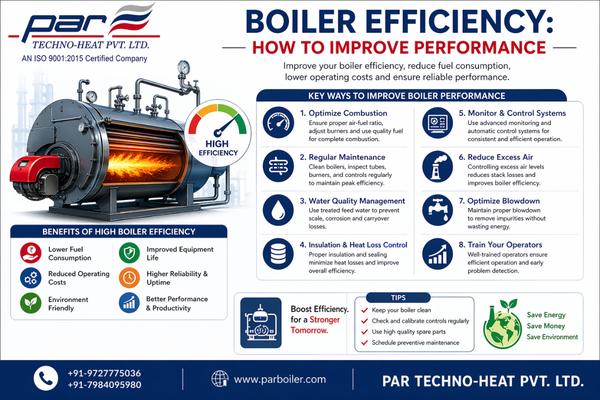
According to U.S. Department of Energy data, optimising combustion alone can reduce industrial fuel consumption by 5 to 20%. A 2% efficiency gain on a large industrial boiler often saves tens of thousands of dollars annually. Most plants achieve nothing close to that gain not because the fixes are complex, but because nobody has looked at where the losses actually are.
This guide does exactly that. Not definitions. Not theory. A practical framework for identifying where your boiler is losing efficiency, what each loss actually costs you, and what to do about it.
| Improvement Action | Efficiency Gain | Typical Payback |
|---|---|---|
| Combustion Optimisation (O₂ trim, burner tuning) | 3 – 10% | Immediate; payback 12–18 months |
| Economiser / Flue Gas Heat Recovery | 5 – 14% | 6–18 months depending on boiler size |
| Scale Removal & Water Treatment | 4 – 30%* | Immediate once descaling complete |
| Blowdown TDS Control & Heat Recovery | 1 – 3% | Fast payback; <12 months typical |
| Steam Trap Survey & Repair | 1 – 3% | Low cost; very fast ROI |
| Insulation & Pipework Lagging | 0.5 – 2% | Payback typically within 1 year |
* Scale losses of 30% apply in severe, long-neglected cases. Typical improvement after standard descaling: 4–12%.
Most industrial boilers are rated at 85 to 92% efficiency when new, correctly tuned, and operating under design conditions. Most of them don't stay there. Within two to three years of commissioning, a combination of scaling, combustion drift, heat loss through uninsulated surfaces, and poor blowdown management quietly pulls real-world performance down to 70 to 80% sometimes lower in neglected plants.
The gap between rated efficiency and operating efficiency is where fuel money disappears. A plant running a 10 MW boiler at 78% efficiency rather than 88% is wasting roughly 10% of its fuel input on heat that goes nowhere useful: up the stack, into the surrounding air, or down the drain with blowdown water. At current industrial gas prices, that gap can represent tens of thousands of dollars in annual operating cost for a single boiler.
The losses are predictable. They fall into five categories: combustion losses, flue gas heat losses, surface radiation and convection losses, water-side scaling losses, and blowdown losses. Understanding each one gives you a clear target rather than a vague aspiration to run more efficiently.
Combustion efficiency is the percentage of the fuel's heat content that's actually released as usable heat rather than leaving the boiler as unburned fuel or excess hot gas. It's the first number to fix and typically the one with the fastest payback.
The air-fuel ratio is the single most decisive variable in combustion efficiency. Too little air, and combustion is incomplete: carbon monoxide forms, unburned fuel exits the stack, and both fuel cost and emissions rise. Too much excess air, and you're heating nitrogen you don't need: the extra air absorbs heat from the combustion zone and carries it out through the flue, raising stack temperature and reducing the heat available for steam generation. Poor tuning in either direction can cost 8 to 10% efficiency loss on its own.
The right answer isn't found by guessing. It's found by measuring.
A flue gas analyser inserted into the stack tells you the oxygen percentage in the exhaust, the carbon monoxide level, and the stack temperature. The optimal excess air level for most natural gas boilers is in the range of 10 to 15% meaning flue gas oxygen of roughly 2 to 3%. If your readings show 5 or 6% flue gas oxygen, you're running with far too much excess air and losing efficiency with every firing cycle.
Consider a mid-size textile plant running a 6 MW gas-fired boiler at 18% excess air rather than the optimal 12%. That 6-percentage-point excess represents roughly 3 to 4% efficiency loss. At current gas prices and continuous operation, the cost difference between those two air settings is not a maintenance footnote. It's an annual fuel bill line item that warrants immediate attention.
Modern O₂ trim controls solve this automatically: a sensor in the flue continuously monitors oxygen content and adjusts the combustion air damper to maintain the target excess air level across varying loads. The investment typically pays back within 12 to 18 months.
The best combustion control systems don't just set the air-fuel ratio once. They track it continuously, compensate for changes in fuel composition, seasonal air density variations, and burner wear rather than assuming that a single annual tune-up is sufficient for a boiler running every day of the year.
Flue gas heat loss is the largest single efficiency drain in most boiler systems. Hot exhaust gases carry 10 to 30% of the total heat input out of the stack, depending on temperature. Every degree of that heat lost to atmosphere is fuel you paid for and didn't use.
The relationship is direct and measurable: for every 20°C reduction in flue gas exit temperature, boiler efficiency improves by roughly 1 percentage point. A plant with stack gases leaving at 280°C rather than an optimised 160°C is losing four to six efficiency points persistently, invisibly, every hour the boiler fires.
The fix is an economiser: a heat exchanger fitted in the flue gas path that captures residual heat from the outgoing gases and uses it to pre-heat incoming feedwater before it enters the boiler drum. Feedwater entering at 90°C rather than 20°C requires substantially less combustion energy to reach boiling point. That reduction translates directly into lower fuel consumption.
A food processing company running a continuous steam process installed a condensing economiser on their 4 MW boiler, recovering heat that had previously been exhausting at 240°C. Post-installation, their stack temperature dropped to 55°C. Measured fuel consumption over the following quarter was 14% lower than the same quarter the previous year a result that fully recovered the capital cost of the economiser within eleven months.
An air pre-heater offers a second recovery option: rather than using flue gas heat to warm feedwater, it warms the combustion air entering the burner. Warmer combustion air requires less fuel energy to reach ignition temperature, further reducing the heat demand on each firing cycle.
Neither option is exotic engineering. Both are standard industrial equipment. The question isn't whether they work. It's why more plants aren't using them.
Scale buildup on heat transfer surfaces is one of the most damaging and most underestimated threats to steam boiler efficiency. It builds slowly. It isn't visible during normal operation. And its effect on fuel consumption is disproportionate to its physical thickness.
A 1 to 1.5mm layer of soot on the fire side of heat exchange tubes can increase fuel consumption by 3 to 8%. A similar scale layer on the water side raises fuel use by 4 to 9%. A 3mm scale deposit not unusual in a poorly treated boiler can increase fuel consumption by more than 30%. That's not a maintenance issue. That's an operating cost problem that compounds with every month left unaddressed.
Scale forms when dissolved calcium, magnesium, and silica in the boiler water deposit on the hot metal surfaces of heat exchange tubes. It doesn't conduct heat. It insulates it forcing the metal to run hotter to transfer the same quantity of heat to the water, raising fuel consumption and eventually risking tube failure through overheating.
The prevention framework has three layers. First: pre-treat the incoming water. Softening removes the calcium and magnesium that form scale. Reverse osmosis goes further, reducing dissolved solids to near-zero before the water enters the system. The cost of water treatment is negligible compared to the fuel cost of running with scale. Second: maintain correct chemical dosing. Anti-scalant chemicals in the boiler water prevent crystallisation of dissolved minerals even when concentrations rise. Deaeration removes dissolved oxygen before it enters the boiler and attacks metal surfaces through pitting corrosion. Third: schedule tube cleaning. Even well-treated systems accumulate deposits over time. Annual descaling mechanical or chemical restores original heat transfer performance.
Ask your team when the boiler tubes were last cleaned. The answer will tell you a great deal about where your efficiency currently sits.
Blowdown is unavoidable. As the boiler evaporates water into steam, dissolved solids concentrate in the remaining boiler water. Left unchecked, that concentration rises until it causes foaming, scale formation, and carryover of water droplets into the steam supply. Blowdown removes a portion of the concentrated boiler water and replaces it with fresh feedwater, controlling dissolved solid levels.
The efficiency problem is that every litre you blow down is hot, pressurised, chemically treated water and you're sending it to drain. That water carries heat energy you paid for. In a typical industrial boiler, uncontrolled or over-frequent blowdown accounts for 1 to 3% efficiency loss. It rarely appears on anyone's list of priority improvements. It should.
The first control is precision: rather than blowdown by schedule or habit, monitor total dissolved solids (TDS) in the boiler water continuously and blowdown only when concentrations approach the upper limit. Automated TDS controllers do this reliably and take operator judgment out of the equation. Plants that switch from timed manual blowdown to automated TDS-controlled blowdown consistently find they were over-blowing by 20 to 40%.
The second control is heat recovery. Blowdown heat recovery units capture the heat from the discharged water and use it to pre-heat incoming make-up water or feedwater. The capital cost is modest. The return comes quickly for plants running continuous processes.
The best blowdown programmes don't treat discharged water as an inevitable loss. They treat blowdown as a managed parameter in a system designed to minimise waste at every point rather than as a necessary drain on performance.
Radiation and convection losses from the external surface of a boiler and its pipework are often dismissed as minor. On a well-maintained system, individually, they are. Across a poorly maintained plant degraded pipe insulation, missing lagging on flanges, corroded casing panels, failed steam traps they accumulate into a persistent, preventable drain.
A single uninsulated flange on a steam main at 10 bar radiates heat equivalent to burning several hundred litres of fuel per year. Multiply that across a distribution system with degraded insulation, and the cumulative loss becomes a genuine efficiency number rather than a rounding error.
Steam traps require particular attention. A failed-open trap passes live steam directly to drain continuously. A plant with fifty steam traps can easily have five or six failed units at any time without anyone noticing until the fuel bill arrives. Annual steam trap surveys carried out with an ultrasonic detector or a thermal imaging camera identify failed traps before they become significant cost items. Plants that conduct annual surveys routinely find 5 to 10% of their trap population in failed condition. Replacing those traps consistently recovers 1 to 3% of total system steam losses.
This is not dramatic engineering. It's maintenance discipline. The efficiency gains come not from a single major intervention but from closing dozens of small losses that individually seem trivial and collectively represent real money.
Most boiler efficiency improvement programmes fail not because the technical interventions don't work. They fail because there's no measurement baseline, no ongoing monitoring, and no system for detecting when efficiency starts to drift again after improvement work has been done.
A boiler efficiency calculation using the direct method is straightforward: divide the useful heat output (energy absorbed by steam) by the total heat input (fuel consumed multiplied by calorific value) and multiply by 100. The indirect method is more practical for routine tracking: measure all identifiable heat losses and subtract their sum from 100%. Flue gas oxygen content, stack temperature, and CO level measurable in real time with standard instrumentation tell you most of what you need to know about daily performance.
Evaluate your boiler against these targets weekly: flue gas oxygen at 2 to 3% for natural gas; stack temperature below 200°C, ideally below 180°C with an economiser fitted; CO in flue gas below 100 ppm; and TDS in boiler water within manufacturer-specified limits. Any parameter drifting outside target is an efficiency loss in progress. The measurement system converts these targets from aspirations into accountable performance data.
Continuous monitoring platforms now integrate flue gas analysis, water quality data, steam output, and fuel consumption into a single dashboard flagging efficiency degradation automatically rather than waiting for a quarterly energy review. This is boiler performance monitoring treated as infrastructure rather than an occasional audit.
Already clear on what needs fixing? Explore Par Techno Heat's industrial boiler range or keep reading to complete the efficiency framework.
There's an honest concession to make here. All the optimisation measures above assume the base boiler is fundamentally sound. For boilers more than 15 to 20 years old running at chronically degraded efficiency with aging heat exchange surfaces, worn burner components, and control systems that pre-date modern automation the economics of optimisation can invert.
A plant operating a 25-year-old fire tube boiler with an irreversibly scaled shell, an undersized heating surface, and a fixed-ratio burner that can't be retrofitted to modulating control may find that a modern condensing boiler rated at 92 to 95% efficiency delivers a better financial return than spending capital on a system with limited remaining life.
This isn't a case for premature replacement. It's a case for an honest audit. Calculate what your current boiler actually costs to run per unit of steam output. Compare it against the operating cost of a modern equivalent. If the gap is large enough and the remaining service life short enough, replacement rather than optimisation is the correct decision. The best industrial engineering teams make this calculation without attachment to the existing asset.
For guidance on modern boiler selection from proven manufacturers, the Top Boiler Manufacturers in India directory provides a starting point for evaluating what current-generation equipment actually delivers.
A well-maintained industrial steam boiler should operate at 85 to 92% efficiency under normal conditions. Modern condensing boilers reach 93 to 96% when flue gas heat is fully recovered. If your measured efficiency is below 80%, combustion tuning, economiser installation, or descaling should be prioritised immediately not deferred to the next scheduled maintenance window.
The direct method divides useful heat output (energy absorbed by steam) by total fuel heat input, multiplied by 100. The indirect method subtracts all measurable heat losses from 100% flue gas loss, radiation loss, blowdown loss and gives you both the overall efficiency figure and a breakdown of exactly where losses are occurring. For day-to-day monitoring, track flue gas oxygen percentage, stack temperature, and CO level: these three readings tell you whether combustion efficiency is on target without requiring complex calculations or shut-down time.
According to U.S. Department of Energy data, combustion optimisation alone reduces fuel consumption by 5 to 20%. Adding an economiser typically saves a further 5 to 14%. Fixing blowdown management and repairing failed steam traps contributes another 2 to 4%. For a large industrial boiler, these improvements combined represent annual fuel savings measured in tens of thousands of dollars with most interventions paying back within one to two years of implementation.
Scale deposits on heat transfer tubes act as thermal insulation, forcing the boiler to burn more fuel to transfer the same quantity of heat to the water. A 1.5mm scale layer on the water side increases fuel consumption by 4 to 9%. A 3mm deposit can raise it by over 30%. This is not a theoretical risk it's a documented pattern in plants where water treatment and descaling schedules have slipped. Proper water softening, chemical dosing, and annual descaling prevent this loss from accumulating silently over months.
A full efficiency audit covering combustion analysis, flue gas temperature measurement, heat loss survey, water quality assessment, and steam trap inspection should be conducted at minimum once annually. For high-utilisation industrial boilers running continuously, a quarterly combustion check is sound practice. Any time fuel consumption rises unexpectedly without a corresponding increase in production, an unscheduled audit should be the immediate response not an explanation that waits for the next annual cycle.
The boiler in your plant room is almost certainly more expensive to run than it needs to be. Not because it's broken. Not because it's the wrong equipment. Because the accumulated effect of small, addressable inefficiencies excess air, flue gas heat leaving the stack, scale on the tubes, over-frequent blowdown, failed steam traps adds up to a meaningful percentage of your annual fuel spend that stays invisible until someone measures it.
Combustion tuning recovers 3 to 10%. An economiser recovers 5 to 14%. Scale removal recovers 4 to 30% in the worst cases. Blowdown optimisation and steam trap management recover another 2 to 4%. None of these require extraordinary capital expenditure. All of them require attention, measurement, and a maintenance programme that treats boiler efficiency as a financial metric rather than an engineering aspiration.
The measurement baseline is where every improvement starts. If you don't know what your boiler currently achieves, you have no way to know how much you're leaving on the table or what fixing it is actually worth.
Ready to Improve Your Boiler's Performance?
Par Techno Heat Pvt Ltd engineers and manufactures industrial boilers built for efficiency from the ground up. If your current system is burning more fuel than it should, our team can identify exactly where the losses are and what it will take to fix them permanently.
Contact Par Techno Heat www.parboiler.com
30-minute technical consultation. No pitch deck. No obligation. Just a direct conversation about your boiler's efficiency.
