



Buying an industrial boiler is not like buying a pump or a motor. It is a regulated pressure vessel that will run your plant for the next two decades, and the manufacturer you pick decides your fuel bill, your uptime and your inspection headaches for all of those years.
Most buyers focus on the quoted price. Experienced engineers focus on the manufacturer behind it. A well-built boiler from a serious boiler company pays for itself in fuel savings; a cheap one bleeds money every shift.
This guide is written for the people who actually sign off on the purchase order factory owners, procurement managers, project consultants and plant engineers. It explains exactly what separates a dependable boiler manufacturer from a risky one, and gives you the tools to compare them properly.
The boiler is usually the single biggest energy consumer on the shop floor. A two-point gain in boiler efficiency can save lakhs of rupees a year on a mid-sized plant. That gain depends entirely on how well the boiler is designed and built.
Three risks come from picking the wrong manufacturer:
Get the choice right and the boiler fades into the background, quietly making steam. Get it wrong and it becomes the machine everyone complains about.
That distinction matters. A real industrial boiler manufacturer controls the steel, the welding, the furnace design and the testing. That control is what lets them stand behind efficiency figures and safety.
Not every company selling boilers is the same kind of business. Knowing the type helps you judge the quote.
For anything custom, high-pressure or process-critical, an OEM or turnkey provider is the safer route.
People use the terms loosely, but there is a practical difference worth understanding before you compare quotes.
| Aspect | Boiler Manufacturer | Boiler Company |
|---|---|---|
| Core activity | Designs and fabricates boilers in its own works | May manufacture, trade, or provide services |
| Engineering control | Full owns the design and welding | Varies; may outsource fabrication |
| IBR approval | Holds manufacturing class approval | May rely on a partner's approval |
| Best for | Custom, high-pressure, process-critical jobs | Sourcing, packaged units, multi-brand supply |
In short, every boiler manufacturer is a boiler company, but not every boiler company actually manufactures. Confirm which one you are dealing with.
These are the nine factors experienced buyers weigh. Score each manufacturer against them rather than trusting a single headline price.
Years in the field show up in the details furnace geometry, tube spacing, refractory life. Ask how many boilers of your type and capacity they have installed, and ask for references in your industry.
A broad portfolio signals real engineering depth. Look for steam boilers, thermic fluid heaters, hot water boilers and waste heat recovery boilers. A maker who builds several types can recommend the right one instead of selling you what they have.
Your fuel decides your running cost. The best manufacturers offer solid fuel, oil, gas and biomass firing, and can design multi-fuel boilers so you can switch as prices move.
Efficiency is where the money lives. A modern industrial boiler should run at 80–90%. Ask for the design efficiency, the economiser specification, and how they handle flue-gas heat recovery. Our guide on improving boiler efficiency explains what to verify.
Certification is non-negotiable. A serious IBR boiler manufacturer builds to inspected drawings and supplies the paperwork. Look for IBR approval, ISO 9001 quality systems, and ASME compliance for export-grade plants. Check the maker's certifications before shortlisting.
Capacity, measured in tonnes of steam per hour (TPH), must match your peak and average load. Oversizing wastes fuel at part-load; undersizing starves the process. A good manufacturer sizes to a real load study, not a guess.
Boiler pressure, set in bar or kg/cm², must suit your process temperature and any turbine. Higher pressure needs heavier design and tighter quality. Confirm the manufacturer routinely builds at your required pressure class.
A boiler is a 20-year relationship. Ask about service-engineer response time, the location of the nearest service team, and whether they handle annual maintenance and IBR renewals. Fast support is worth more than a small price cut.
Cheap parts, slow delivery that is how downtime starts. Confirm spares are made in India and stocked, not imported on a long lead time. Standardised boiler accessories keep a plant running.
Modern boilers run on PLC and SCADA controls that hold steam pressure steady with less manpower. Automation also logs efficiency and warns of faults early. Ask what level of controls and emission monitoring is standard.
The right boiler depends heavily on the industry. Use this table as a starting point, then confirm with the manufacturer.
| Industry | Typical Boiler / Heater | Common Fuel |
|---|---|---|
| Food & FMCG | Steam boiler | Gas, biomass |
| Pharmaceutical | Steam boiler (clean steam) | Gas, oil |
| Textile | Thermic fluid heater + steam boiler | Biomass, coal |
| Chemical | Steam boiler, thermic fluid heater | Gas, oil, biomass |
| Sugar & Distillery | High-pressure water-tube boiler | Bagasse, biomass |
| Paper & Pulp | Water-tube / WHR boiler | Biomass, coal |
| Rice & Edible Oil | Steam boiler | Husk, briquette |
| Dairy & Hospitality | Steam / hot water boiler | Gas, oil |
Print this and score each manufacturer from 1 to 5. The highest total, not the lowest price, is usually the right call.
| Check | What to confirm |
|---|---|
| IBR / ISO certification | Valid approval and supplied documentation |
| Design efficiency | 80–90% with economiser details |
| Fuel flexibility | Supports your current and backup fuel |
| Correct capacity (TPH) | Sized to a real load study |
| Pressure class | Routinely built at your rating |
| Installed references | Proven units in your industry |
| Service response time | Defined hours, nearby team |
| Spare-part availability | Made-in-India, stocked |
| Automation level | PLC/SCADA, emission monitoring |
| Warranty terms | Clear scope and duration |
If you want a more objective shortlist, weight each factor and multiply by your score. The weights below reflect what usually matters most over a boiler's life.
| Factor | Weight | Why it carries weight |
|---|---|---|
| Boiler efficiency | 20% | Largest lifetime cost driver |
| After-sales & spares | 20% | Decides uptime over 20 years |
| Certification & safety | 15% | Legal and insurance compliance |
| Manufacturing experience | 15% | Quality of fabrication and design |
| Fuel flexibility | 10% | Protects against fuel price swings |
| Capacity & pressure fit | 10% | Right-sizing saves fuel |
| Automation | 5% | Lower manpower, steadier steam |
| Price | 5% | Matters least over the full life |
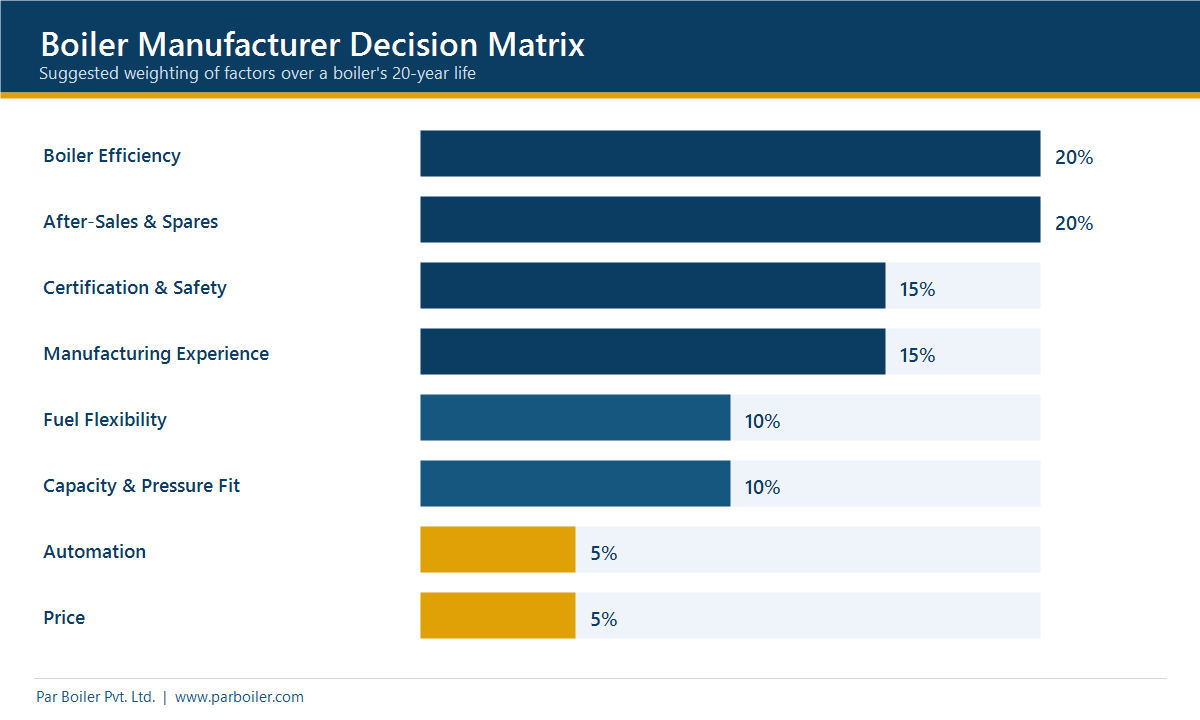
How to weight each factor when comparing manufacturers.
| Fuel | Running Cost | Emissions | Best Suited To |
|---|---|---|---|
| Biomass / Briquette | Low | Low (near carbon-neutral) | Sugar, paper, rice, textile |
| Coal | Low–Medium | High | Large continuous loads |
| Natural Gas | Medium | Low | Food, pharma, urban plants |
| Furnace Oil / Diesel | High | Medium | Quick start, standby duty |
| Electricity | High | Zero on-site | Small, clean, intermittent loads |
| Boiler Type | Output | Best For |
|---|---|---|
| Fire-tube (smoke-tube) | Low–medium pressure steam | Food, textile, small process |
| Water-tube | High pressure & capacity | Sugar, power, large plants |
| Thermic fluid heater | High temp, low pressure | Textile, chemical, oil |
| Waste heat recovery | Steam from exhaust gas | Engines, kilns, furnaces |
| Hot water boiler | Hot water | Dairy, hospitals, hotels |
After years of commissioning boilers, the same avoidable errors show up again and again.
The technology has moved fast, and it directly affects which manufacturer is worth your money.
India is one of Asia's largest boiler markets, and demand keeps rising with manufacturing growth. Sugar, textile, chemical, food and power sectors all run on steam generation, which keeps a healthy field of boiler manufacturers in India competing on efficiency and service.
Two shifts define the market. Biomass and agro-waste firing have grown because briquette and husk cost less than oil or gas. At the same time, buyers now expect IBR-grade quality at Indian prices and local makers deliver it with faster service than imported brands.
The direction is clear: cleaner fuel, smarter controls and tighter heat recovery. Expect more IoT-connected boilers reporting efficiency in real time, stronger demand for waste heat recovery, and a steady move toward biomass and hybrid firing as carbon rules sharpen. Manufacturers who invest in automation and emissions will lead; those who only compete on price will fall behind.
Score each manufacturer on experience, efficiency, fuel flexibility, IBR certification, capacity, after-sales support and spares. Shortlist on lifetime cost and service, not the lowest quote. Always ask for installed references in your own industry.
An IBR boiler is built and certified under the Indian Boilers Regulations. The standard governs design, materials and inspection for boilers above a set pressure and capacity, ensuring safe, legal operation.
A boiler manufacturer designs and fabricates boilers in its own works under IBR approval. A boiler company may manufacture, trade or only provide services. Confirm which one you are dealing with before buying.
A modern industrial boiler should run at 80–90% efficiency. Economisers, feed-water pre-heating and clean combustion push it higher. Each point of efficiency cuts fuel cost directly.
There is no single best fuel. Biomass is cheapest and cleaner, gas is clean and responsive, oil starts fast, and coal suits large loads. Choose based on local fuel cost and availability.
Capacity is measured in tonnes of steam per hour (TPH) and must match your peak and average load. A proper load study prevents oversizing, which wastes fuel, and undersizing, which starves the process.
With proper maintenance, water treatment and timely tube replacement, a quality industrial boiler lasts 15–25 years. Regular servicing and annual IBR inspection extend its working life.
Look for IBR manufacturing approval, ISO 9001 quality certification, and ASME compliance for export-grade plants. These confirm safe design and consistent fabrication.
A thermic fluid heater heats thermal oil instead of water, delivering high temperatures at low pressure. It suits textile, chemical and food processes that need precise, high-temperature heat.
A waste heat recovery boiler captures hot exhaust from engines, kilns or furnaces and uses it to generate steam. It cuts fuel cost and lifts overall plant efficiency.
Yes. Leading Indian manufacturers build IBR and ASME-grade boilers that match imported performance, with lower cost, faster service and easier spare-part supply.
Cost varies with capacity, fuel and pressure. Small package boilers start at a few lakh rupees; large high-pressure IBR boilers run into crores. Ask for a quote based on your steam load.
Boiler pressure is the steam pressure inside the vessel, set in bar or kg/cm². It must match your process temperature and any turbine. Higher pressure needs heavier, tighter-quality design.
Fire-tube boilers suit low-to-medium pressure and smaller loads in food and textile. Water-tube boilers handle high pressure and large capacity for sugar, paper and power plants.
Boiler automation uses PLC and SCADA controls to hold steam pressure steady, reduce manpower, log efficiency and flag faults early. IoT-connected systems allow remote monitoring.
A boiler runs for two decades, so fast service and stocked spares decide your uptime. A nearby service team that handles maintenance and IBR renewals is worth more than a small price cut.
A biomass boiler burns briquettes, husk, wood chips or agro-waste to make steam. It lowers fuel cost and carbon emissions compared with oil or gas firing.
Yes. Under IBR rules, registered boilers require periodic statutory inspection. Annual servicing also protects safety, efficiency and warranty.
Yes. Many modern boilers are designed for multi-fuel firing, letting a plant switch between biomass, coal, oil or gas as prices change.
Avoid buying on price alone, skipping a load study, ignoring IBR paperwork, choosing a single-fuel design, and overlooking after-sales support and emissions equipment.
Choosing a boiler manufacturer is a long-term decision, so judge it like one. Weight efficiency, certification, fuel flexibility and service far above the sticker price, and insist on installed references in your industry.
If you want a proven Indian partner, Par Boiler Pvt. Ltd. designs and builds IBR-certified steam boilers, thermic fluid heaters and mobile steam systems matched to your exact load, backed by responsive service. Talk to the team for a load-based recommendation, or see why buyers choose Par Boiler.
