

In the heart of every manufacturing plant, textile mill, food processing unit, or power station lies a critical piece of equipment — the industrial boiler. Quietly working behind the scenes, it generates the steam or hot water that drives production, keeps processes running, and ensures operational continuity. Yet, for many people outside the engineering world, the industrial boiler remains a largely misunderstood machine.
In this comprehensive guide, we break down everything you need to know about industrial boilers — what they are, how they work, the different types available, their real-world applications, and how to choose the right one for your facility.
An industrial boiler is a closed, high-capacity pressure vessel designed to convert water into steam or hot water by applying heat energy from a fuel source such as natural gas, oil, coal, or biomass. This steam or hot water is then distributed through pipelines to carry out a wide range of industrial processes — from heating and sterilisation to power generation and mechanical drive.
Unlike residential boilers, industrial boiler systems are built to withstand significantly higher pressures and temperatures. They are engineered for continuous, large-scale operation and must comply with stringent boiler safety standards to protect personnel and equipment.
Key components of an industrial boiler include:
• Burner – Introduces and ignites the fuel-air mixture
• Combustion chamber – Where fuel burns to release heat energy
• Heat exchanger – Transfers heat from combustion gases to water
• Steam drum – Collects and separates steam from water
• Safety valves – Automatically relieve excess pressure
• Feedwater system – Supplies treated water to the boiler
• Controls and instrumentation – Monitor and regulate boiler operation
For a trusted source of industrial heating solutions, explore Par Techno Heat Pvt Ltd — one of India's most reputed industrial boiler manufacturers and suppliers.
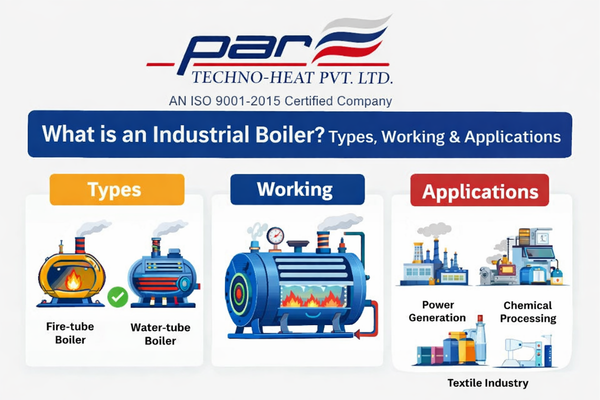
The working principle of an industrial boiler is based on thermodynamics. Fuel is burned in the combustion chamber to produce hot gases. These gases pass over or through heat exchange surfaces in contact with water. The water absorbs the thermal energy, raises its temperature, and eventually converts into steam (or remains as pressurised hot water in industrial hot water boiler systems).
The process can be summarised in four stages:
For applications requiring hot water rather than steam, such as space heating and process heating, an Industrial Hot Water Boiler operates on the same basic principle but keeps water below the steam-generation threshold.
Choosing the right industrial boiler type is crucial for efficiency, safety, and cost-effectiveness. The two fundamental design categories are fire tube boilers and water tube boilers, each with distinct advantages.
In a fire tube boiler, hot combustion gases pass through tubes that are surrounded by water. The heat from the gases is transferred through the tube walls to the water, generating steam. Fire tube boilers are compact, easy to operate, and ideal for low-to-medium pressure applications. Common examples include the Lancashire boiler and the Scotch marine boiler.
Best suited for: Small-to-medium industries, heating systems, and applications requiring steam at pressures up to 25 bar.
In a water tube boiler, water flows through tubes while hot combustion gases surround them externally. This design allows for much higher operating pressures and steam outputs. Water tube boilers are preferred for large-scale power generation and heavy industrial applications.
Best suited for: Power plants, refineries, large manufacturing facilities, and high-pressure steam applications above 25 bar.
Not sure which design suits your plant? Read our detailed guide on Water Tube vs Fire Tube Boiler to make a fully informed decision.
A package boiler is a pre-assembled, factory-built unit that arrives ready for installation with minimal on-site work. It includes all essential components — the burner, controls, and fittings — integrated in a single skid-mounted frame. Package boilers are extremely popular among industrial boiler suppliers because they reduce installation time and costs significantly.
FBC boilers burn fuel in a bed of hot, inert particles suspended by an upward flow of air. This design enables highly efficient combustion of low-grade fuels like biomass, lignite, and waste. FBC boilers are known for low NOx and SOx emissions, making them an environmentally responsible choice for energy-efficient boiler systems.
Waste heat recovery boilers capture exhaust heat from industrial processes, turbines, or engines and convert it into useful steam without additional fuel combustion. They are a cornerstone of boiler energy saving strategies, dramatically reducing operational costs and carbon footprint in industries like cement, steel, and glass manufacturing.
Industrial boiler applications span an enormous range of sectors. The versatility of these systems makes them indispensable across India and globally.
Industrial boiler efficiency is measured as the ratio of useful heat output to the total energy input from fuel. A boiler operating at 85–90% efficiency significantly reduces fuel costs and greenhouse gas emissions compared to older, poorly maintained systems.
Key factors that affect boiler efficiency include:
Ensuring your boiler runs efficiently also requires the right Boiler Spare Parts and Accessories — from pressure gauges and safety valves to economisers and blowdown equipment.
Industrial boilers operate under extreme pressure and temperature, making safety a non-negotiable priority. In India, boilers are regulated under the Indian Boiler Regulations (IBR) 1950, which governs design, fabrication, inspection, and operation.
Standard safety requirements include:
Additionally, boilers must comply with environmental norms. Partnering with certified Air Pollution Control Equipment manufacturers ensures your boiler system meets emission standards for particulate matter, SOx, and NOx.
A well-maintained boiler not only operates more efficiently but also has a significantly longer service life. Industrial boiler maintenance involves both preventive and corrective measures.
Industrial boiler repair services should be handled only by qualified engineers using genuine spare parts. Improper repairs can compromise both safety and performance. Learn more about top-rated Industrial Boiler Manufacturers who also offer reliable after-sales service and maintenance support.
Selecting the correct boiler for your manufacturing plant is a decision that affects energy costs, production uptime, and long-term profitability. Here are the most important factors to evaluate:
|
Looking for a Trusted Industrial Boiler Partner? Par Techno Heat Pvt Ltd is one of India's leading manufacturers and suppliers of industrial boilers, steam boilers, hot water systems, and industrial thermal equipment. With decades of engineering expertise, IBR-certified products, and end-to-end support from installation to maintenance, we help industries run smarter and more efficiently. |
An industrial boiler is far more than a pressure vessel — it is the thermal backbone of modern industry. Whether you operate a textile plant, a pharmaceutical facility, a food processing unit, or a power station, the performance and reliability of your industrial boiler system directly impacts your bottom line.
Understanding the different industrial boiler types, their working principles, and their maintenance requirements empowers plant managers to make smarter decisions — reducing downtime, cutting energy costs, and extending equipment life.
For expert guidance on selecting, installing, and maintaining the right boiler for your application, connect with Par Techno Heat Pvt Ltd — your partner in industrial heating excellence.
