



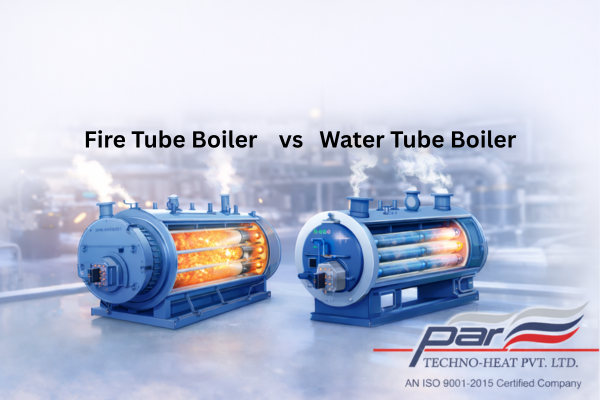
A fire tube boiler passes hot combustion gases through tubes surrounded by water, while a water tube boiler passes water through tubes surrounded by hot gas. This single structural difference decides everything else: fire tube boilers suit 0.5–15 TPH capacity at pressures up to 18–21 kg/cm², cost less, and are simpler to maintain. Water tube boilers scale from 2 TPH to 500+ TPH, handle pressures from 20 kg/cm² to over 90 kg/cm², reach higher thermal efficiency (85–92% vs 80–88%), and are inherently safer at high pressure since a single tube failure is far less catastrophic than a large-shell failure. Choose fire tube for low-pressure, small-to-medium process heating in food, dairy, pharma, and textile finishing. Choose water tube for high-pressure, high-capacity applications in power generation, chemical, sugar, and paper industries.
Walk into any industrial boiler purchase conversation in India whether you're talking to a procurement manager at a textile plant, a project engineer at a pharmaceutical unit, or an energy manager at a chemical facility and you'll almost always hear the same early question: "Should we go for a water tube boiler or a fire tube boiler?"
It sounds like a simple question. It isn't. The answer depends on your operating pressure, steam capacity requirement, fuel type, available installation space, maintenance capabilities, and long-term operating cost priorities. Choosing the wrong design for your application is an expensive mistake that compounds over the 15–20 year life of the equipment.
Both designs generate industrial steam as part of a wider steam boiler system. Both are IBR-certified for use in India. Both are manufactured by reputable suppliers and installed in thousands of industrial facilities across the country. But they're fundamentally different in how they work, what they do well, and where their limitations lie.
This complete comparison guide explains both designs from the ground up how each one works, where each excels, where each has limitations, and which type is the right choice for your specific application, capacity, and process requirements.
A fire tube boiler is an industrial steam boiler where hot combustion gases flow through tubes surrounded by water. The tubes carry the fire hence the name. Water sits in a large cylindrical shell that forms the primary pressure vessel, while hot gas passes through the smaller internal tubes.
Here's how it works in practice: the burner fires inside the combustion chamber the furnace, which in most fire tube designs is itself a large cylindrical tube called the furnace tube or Morrison tube. The hot gases generated by combustion then pass through a series of smaller fire tubes running horizontally through a large cylindrical water-filled shell. As gases travel through these tubes, heat transfers from the gas to the water surrounding them.
In a three-pass fire tube boiler the most common design in India the gases travel: first pass through the furnace tube (main combustion chamber), second pass backward through the first bank of fire tubes, and third pass forward again through a second bank before exiting through the. industrial chimney Each additional pass extracts more heat, improving overall thermal efficiency. Four-pass designs extract even more heat but at higher capital cost.
Steam generated collects above the water surface in the steam space and exits through the main steam outlet at the set operating pressure.
Construction and main components: furnace/Morrison tube, fire tube bundle, large cylindrical shell (the primary pressure vessel), front and rear tube plates, steam space, and chimney connection.
Typical capacity: 0.5 TPH to 25 TPH.
Operating pressure: up to 18–21 kg/cm².
Efficiency: 80–88% depending on passes and accessories.
Fuel types: gas, oil, coal, biomass.
Advantages: simple construction, lower cost, compact, easy maintenance.
Disadvantages: pressure and capacity limitations, slower steam generation.
Key design characteristic: In a fire tube boiler, water is on the outside of the tubes and hot gas is on the inside. The large water-filled shell is the primary pressure vessel.
A water tube boiler is the design opposite of a fire tube boiler water flows inside the tubes and hot combustion gases flow over the outside. The tubes carry the water. Small-diameter tubes are the primary pressure-bearing components, not a large shell, which is why water tube boilers scale to much higher pressures and capacities.
Water circulates through a network of small-diameter tubes arranged in the furnace and convective sections. The furnace is lined with water-cooled membrane wall tubes absorbing heat from the flame by radiation. Further downstream, additional tube banks in the convective section absorb heat from the cooling flue gases by convection.
Water inside the tubes absorbs heat progressively as it circulates, converting from subcooled liquid to a steam-water mixture that rises to the steam drum at the top. Inside the drum, steam and water separate clean, dry steam exits through the main steam outlet.
In a D-Type or O-Type water tube boiler the most common industrial designs the arrangement consists of an upper steam drum, a lower mud drum (or lower header), and multiple tube banks connecting them. Water circulates naturally from cooler downcomer tubes to hotter riser tubes through thermosiphon action, or is assisted by circulation pumps in forced-circulation designs.
Construction and main components: steam drum, mud drum/lower header, water wall tubes, convective tube bank, downcomers, risers, superheater (where fitted), and burner/furnace assembly.
Typical capacity: 2 TPH to 500+ TPH.
Operating pressure: 20 kg/cm² to 90+ kg/cm².
Efficiency: 85–92% with a full heat recovery train.
Fuel types: gas, oil, coal, biomass, waste gas.
Advantages: high pressure capability, large capacity, faster steam generation, better efficiency.
Disadvantages: higher capital cost, more complex maintenance, skilled operation required.
Key design characteristic: In a water tube boiler, water is inside the tubes and hot gas is outside. Small-diameter tubes are the primary pressure-bearing components not a large shell.
This one structural difference where the water sits relative to the tubes decides everything that follows: operating pressure limits, steam capacity, response time, safety characteristics, maintenance requirements, and cost.
In a fire tube boiler: the large cylindrical shell must contain the full operating pressure. As pressure increases, the shell wall must get thicker, and thicker walls mean heavier, more expensive construction. This is why fire tube boilers become impractical above approximately 18–21 kg/cm².
In a water tube boiler: only the small-diameter tubes must contain the operating pressure. Small tubes handle high pressure with modest wall thickness, so water tube boilers scale efficiently to 35, 60, 90 kg/cm² and above without the structural limitation constraining fire tube designs.
This is the fundamental engineering reason high-pressure applications always use water tube boilers not preference, but because fire tube construction simply isn't viable at high pressures.
| Parameter | Fire Tube Boiler | Water Tube Boiler |
|---|---|---|
| Working Principle | Hot gas inside tubes, water outside | Water inside tubes, hot gas outside |
| Operating Pressure | Up to 18–21 kg/cm² | 20 kg/cm² to 90+ kg/cm² |
| Steam Capacity | 0.5 – 25 TPH | 2 – 500+ TPH |
| Steam Generation Speed | Slower (large water volume) | Faster (small tube volume) |
| Thermal Efficiency | 80% – 88% | 85% – 92% |
| Capital Cost | Lower | Higher |
| Installation Space | Compact (horizontal shell) | Larger footprint required |
| Installation Time | Short (packaged, ready to install) | Longer (site erection for large units) |
| Maintenance Complexity | Lower simple tube access | Higher more components |
| Safety at High Pressure | Lower large shell risk | Higher localised tube failure |
| Fuel Types Supported | Gas, oil, coal, biomass | Gas, oil, coal, biomass, waste gas |
| Best Industrial Application | Small to medium process heating | High-pressure, high-capacity processes |
If one parameter most clearly determines which boiler type you need, it's your required operating pressure. Fire tube boilers are practical up to 18–21 kg/cm². Water tube boilers are the correct choice from 20 kg/cm² upward, scaling to 90 kg/cm² and beyond for power generation and high-pressure process reactors.
Beyond 18–21 kg/cm², the shell wall thickness required by IBR pressure vessel codes makes a fire tube boiler excessively heavy and expensive. Most small and medium industrial applications food processing, dairy, pharmaceutical (small scale), textile finishing, general process heating operate in the 7–17 kg/cm² range, which is perfectly suited to fire tube designs.
For applications requiring 25, 35, 45, 60, or 90 kg/cm² steam turbine drives, co-generation plants, high-temperature process reactors, large-scale power generation a water tube boiler is the only practical design. Attempting to build a fire tube boiler at 35 kg/cm² would result in a vessel so thick-walled and heavy that it would be uneconomical to manufacture and physically impossible to transport.
If your process needs steam above 20 kg/cm², go water tube. If your process runs comfortably at 7–18 kg/cm², a fire tube boiler likely serves you better at lower capital cost.
For a complete technical deep-dive into water tube boiler designs, capacity ranges, and high-pressure applications across Indian industries, our detailed guide on water tube boiler working principle, types, and advantages covers everything you need to know before making a final decision.
Fire tube boilers are most economical and practical in the 500 kg/hr to 15,000 kg/hr (0.5 TPH to 15 TPH) capacity range. Beyond 15–20 TPH, the physical size of a fire tube shell becomes very large and the design loses its cost advantage over water tube alternatives.
Water tube boilers become increasingly cost-competitive from 3 TPH upward and are the standard choice for anything above 10 TPH. At large capacities 30, 50, 100 TPH and above only water tube designs are practical. There's no upper capacity limit for water tube boilers; the largest power plant boilers in the world, generating 1,000+ TPH of steam, are all water tube designs.
For industries in the 3–15 TPH range, both designs are available and competitive. The decision should rest on operating pressure, fuel type, space constraints, and long-term efficiency priorities not capacity alone.
Water tube boilers generally achieve higher thermal efficiency than fire tube boilers of comparable capacity, but the gap in well-designed, accessory-equipped systems is smaller than many buyers assume. Larger heat transfer surface area and better flue gas utilization give water tube designs their inherent advantage.
Fire tube boilers: well-designed modern three-pass or four-pass fire tube boilers with economizer and air preheater achieve 84–88% overall thermal efficiency. Without accessories, bare three-pass designs achieve 78–82%.
Water tube boilers: well-designed water tube boilers with a full heat recovery train (superheater, economizer, air preheater) achieve 87–92% overall thermal efficiency.
For a 5 TPH natural gas boiler running 20 hours per day, the difference between 82% fire tube efficiency and 89% water tube efficiency translates to meaningful monthly fuel savings. However, the capital cost difference must be factored into the ROI calculation the water tube boiler needs to save enough fuel to justify its higher purchase price within your acceptable payback period.
For practical guidance on maximizing efficiency from whichever design you choose, our guide on how to improve boiler efficiency covers operational and engineering measures applicable to both.
Fire tube boilers contain a large water volume that takes longer to heat from cold start to operating pressure, and responds more slowly to changes in steam demand. That large water inventory is actually a buffer once at operating pressure, it absorbs demand fluctuations without requiring immediate firing rate changes. Startup time: 45–90 minutes from cold to full operating pressure.
Water tube boilers contain a much smaller water volume in their tube circuits, reaching operating pressure faster from cold start and responding more rapidly to load changes. Startup time: 15–45 minutes from cold to operating pressure, depending on capacity.
Industrial implication: for processes that start and stop frequently batch manufacturing, intermittent production runs, facilities that shut down overnight the faster startup of a water tube boiler reduces fuel wasted during startup and shutdown cycles.
Both fire tube and water tube boilers are safe when correctly designed, properly maintained, and operated by trained personnel. Both comply with IBR safety requirements. Failure modes, however, differ significantly and water tube designs have an inherent safety advantage at high pressure.
Fire tube boiler failure risk: the large-diameter shell is the primary pressure vessel. If a shell plate develops a crack or weld failure at operating pressure, the energy release is large the entire water inventory at operating pressure is released suddenly. This is why fire tube boilers aren't built above 21 kg/cm² at higher pressures, the energy stored in the large shell makes a catastrophic failure event more severe.
Water tube boiler failure risk: if a tube fails, the failure is localised to a single small-diameter tube. The consequence is a tube leak or rupture serious, requiring immediate shutdown, but far less catastrophic than the simultaneous failure of a large shell.
Our comprehensive boiler safety guidelines for industries covers the safety management requirements applicable to both boiler types under the Indian Boilers Regulation Act.
Fire tube boiler maintenance: internal fire tubes are accessible from the front and rear tube plates after removing the covers. Tube inspection, cleaning, and replacement are relatively straightforward. Simple, robust construction with few components keeps maintenance labour and spare parts costs low. Annual IBR inspection is standard.
Water tube boiler maintenance: more components more tube joints, headers, a steam drum, and a mud drum mean more inspection points. Tube replacement requires skilled welders working in confined tube spaces. However, individual tube failures are cheaper to repair than a fire tube shell failure, which can require major structural work.
For a structured maintenance schedule covering both types, our industrial boiler maintenance checklist provides a complete daily, weekly, monthly, and annual inspection framework used by plant teams across India.
| Cost Parameter | Fire Tube Boiler | Water Tube Boiler |
|---|---|---|
| Capital Cost (5 TPH, gas-fired) | ₹35 lakh – ₹65 lakh | ₹65 lakh – ₹1.2 crore |
| Installation Cost | Low (packaged, minimal civil work) | Higher (civil work & erection required) |
| Annual Maintenance Cost | ₹1.5 lakh – ₹4 lakh | ₹3 lakh – ₹8 lakh |
| Fuel Efficiency | 80% – 88% | 85% – 92% |
| Operational Life | 15 – 20 years | 20 – 25 years |
| Best ROI Scenario | Low-pressure, small-capacity applications | High-pressure, high-efficiency applications |
The capital cost premium of a water tube boiler over a comparable fire tube design is typically 50–100% at the same capacity and fuel type. This premium is justified when operating pressure requires water tube (above 20 kg/cm²), capacity is large (above 15 TPH), long-term fuel efficiency savings outweigh higher capital cost within an acceptable payback, or the process requires faster load response or superheated steam. Water tube systems also involve significantly more site civil work and erection time our guide on boiler installation covers what to plan for before the unit arrives on site.
| Capacity | Boiler Type | Fuel Type | Approx. Price Range (₹) |
|---|---|---|---|
| 1 – 3 TPH | Fire Tube | Gas / Oil | ₹15 lakh – ₹35 lakh |
| 5 TPH | Fire Tube | Gas / Oil | ₹35 lakh – ₹65 lakh |
| 10 – 15 TPH | Fire Tube | Gas / Oil / Biomass | ₹65 lakh – ₹1.1 crore |
| 5 TPH | Water Tube | Gas / Oil | ₹65 lakh – ₹1.2 crore |
| 15 – 30 TPH | Water Tube | Gas / Oil / Biomass / Coal | ₹1.5 crore – ₹4 crore |
| 30 – 60 TPH | Water Tube | Multi-fuel / Coal / Biomass | ₹4 crore – ₹8 crore |
| 60+ TPH | Water Tube | Multi-fuel / High pressure | ₹8 crore and above |
Prices are indicative and exclude pollution control equipment, civil foundation, chimney, and installation. Request a site-specific quotation for accurate pricing.
| Water Tube Boiler | Fire Tube Boiler |
|---|---|
| Higher initial investment | Lower pressure capability |
| Skilled operation required | Slower steam generation |
| More complex design | Lower efficiency (bare, without accessories) |
| Strict water quality requirement | Limited capacity ceiling (~15–25 TPH) |
| Higher maintenance cost | Higher fuel consumption at large scale |
It's also worth remembering that steam isn't always the right answer at all. Some of these same industries meet high-temperature, low-pressure needs with a thermic fluid heater instead of a boiler, or use a hot air generator where the process needs direct hot air rather than steam worth ruling out before committing to either boiler type.
Base your decision on steam demand, working pressure, fuel type, budget, installation space, operating cost, maintenance capability, industry type, expansion plans, and automation requirement not on capital cost alone.
For industries in the overlap zone typically 3–15 TPH at 12–20 kg/cm² both designs are technically viable. This decision tree helps narrow it down:
When evaluating specific manufacturers for either type, our boiler manufacturer selection checklist provides a structured 10-point evaluation framework covering IBR certification, installation references, service network, and after-sales support. For a broader market view, our listing of top steam boiler manufacturers in India is a useful reference.
| Industry | Typical Recommendation |
|---|---|
| Textile Industry | Fire tube for small units; water tube above 15 TPH |
| Chemical Industry | Water tube high pressure process steam |
| Food Processing | Fire tube for most applications |
| Pharmaceutical Industry | Fire tube for small-medium scale |
| Paper Industry | Water tube high continuous demand |
| Rice Mill | Fire tube, biomass-fired |
| Sugar Industry | Water tube bagasse co-generation |
| Dairy Industry | Fire tube for most plants |
| Power Plant | Water tube no alternative at this pressure/capacity |
| Engineering Industry | Fire tube for process heat; water tube for large continuous loads |
In a fire tube boiler, hot combustion gases flow inside the tubes and water surrounds them outside. In a water tube boiler, water flows inside the tubes and hot gases flow over the outside. This structural difference determines operating pressure limits, capacity range, efficiency, and safety characteristics.
Neither is universally better. Fire tube boilers suit small to medium capacity (0.5–15 TPH) at low-to-moderate pressure (up to 18 kg/cm²) with lower cost and simpler maintenance. Water tube boilers suit high pressure (above 20 kg/cm²), large capacity (above 10 TPH), or applications requiring superheated steam.
Fire tube boilers are practically limited to approximately 18–21 kg/cm². Beyond this, the required shell becomes impractically thick, heavy, and expensive. High-pressure applications above 25 kg/cm² require water tube designs.
Water tube boilers generally achieve higher thermal efficiency (85–92%) compared to fire tube designs (80–88%) due to larger heat transfer surface area and better flue gas heat recovery. A well-equipped fire tube boiler with economizer and air preheater can close the gap significantly.
Fire tube boilers are generally easier and cheaper to maintain due to simpler construction and straightforward tube access. Water tube boilers have more components and require more skilled maintenance, though individual repairs are typically less costly than a fire tube shell failure.
Both are safe when correctly maintained and operated. At high pressures, water tube boilers are inherently safer because tube failure is a localised event with limited energy release compared to a large-shell failure in a fire tube boiler.
Fire tube boilers are generally the better fit for small industries lower capital cost, compact footprint, and simpler operation suit food, dairy, and small textile applications.
Fire tube boilers are more economical on capital cost for low-pressure, small-capacity needs. Water tube boilers are more economical over the full lifetime for high-pressure, high-capacity, or continuous-operation applications due to better efficiency and longer service life.
Water tube boilers generate steam faster from cold start typically 15–45 minutes versus 45–90 minutes for a fire tube boiler because of their much smaller water volume.
With proper maintenance and water treatment, a water tube boiler typically lasts 20–25 years.
With proper maintenance, a fire tube boiler typically lasts 15–20 years.
Match your required operating pressure and steam capacity first, then weigh budget, installation space, maintenance capability, and whether your process needs fast load response or superheated steam. Can one manufacturer supply both types? Yes Par Techno-Heat Pvt. Ltd. manufactures both fire tube and water tube industrial boilers, letting buyers make the right technical choice without being limited by manufacturer capability.
Par Techno-Heat Pvt. Ltd. (Par Boiler) manufactures both fire tube and water tube industrial boilers from its Ahmedabad facility, covering capacities from 500 kg/hr to 30 TPH across gas, oil, coal, and biomass fuel configurations all fully IBR certified with PLC automation and dedicated after-sales service.
The engineering team assists industrial buyers in selecting the right boiler type for their specific application, conducting process data review, pressure and capacity matching, fuel cost analysis, and total cost of ownership comparison to ensure the right investment decision before order placement.
Par Techno-Heat Pvt. Ltd. provides free technical consultation process data analysis, capacity sizing, and total cost of ownership comparison to help you make the right investment decision.
Both fire tube and water tube designs, IBR certified, across gas, oil, coal, and biomass fuel configurations.
