



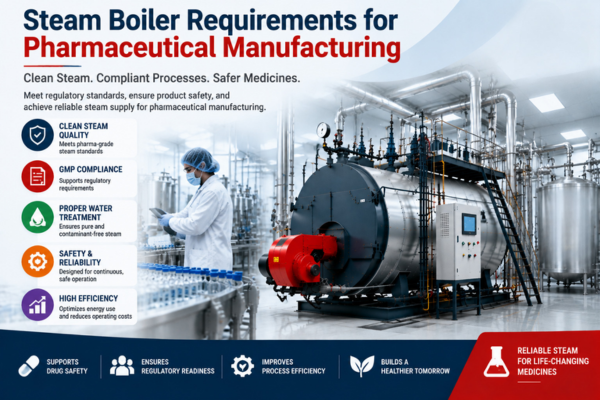
Pharmaceutical steam boiler requirements depend on the intended steam application not simply on plant size. The key decisions are:
(1) Steam type — plant/house steam for non-contact utility use, clean steam for direct equipment-contact and some sterilisation applications, pure steam for direct sterilisation where steam contacts products, product-contact surfaces, or WFI generation equipment.
(2) Capacity — sized on peak simultaneous demand plus margin, not average consumption.
(3) Pressure — determined by the highest-pressure process requirement plus distribution margin.
(4) Feedwater quality — matched to the steam quality requirement (softened water for plant steam; RO/DM water for clean steam systems).
(5) Water treatment — with chemical selection matched to steam end-use.
(6) Safety and IBR compliance — mandatory for registered steam boilers.
(7) GMP considerations — system-level qualification and validation where required by the facility's quality management system. A conventional industrial boiler and a clean/pure steam generator typically serve complementary but different roles in the same pharmaceutical utility architecture.
Pharmaceutical steam boiler selection must be based on the intended steam use and required steam quality not boiler capacity alone. Key requirements: correct capacity (peak simultaneous demand, not average); appropriate pressure (highest process requirement plus distribution loss); correct steam quality (plant, clean, or pure steam depending on the application); suitable feedwater and water treatment; reliable automatic controls; IBR safety compliance; and GMP-level qualification where the quality system and intended use require it. A conventional industrial boiler and a dedicated clean or pure steam generator often serve different applications within the same pharmaceutical facility.
A pharmaceutical facility's relationship with steam is more complex than most other industries. Steam is a critical utility that may simultaneously serve a boiler-house heating coil (plant steam at high pressure), a clean-in-place circuit cleaning API reactor vessels (clean steam at moderate pressure), and an autoclave sterilising injectable vials (pure steam at validated conditions). These three streams have different quality requirements, different feedwater requirements, and different regulatory and validation obligations even if they all originate from the same utility block.
The error that creates the most expensive consequences in pharmaceutical steam system design is treating "the boiler" as the single element that determines suitability. Steam quality is a system-level attribute it depends on feedwater quality, boiler design and water treatment, steam distribution design, the presence or absence of steam separators and traps, and the monitoring and qualification framework around the complete system. No boiler, however well-designed, automatically makes a steam system pharmaceutical-grade.
This guide explains what pharmaceutical engineering managers, utility engineers, and procurement teams need to define before approaching any industrial boiler manufacturer for a pharmaceutical steam system. For a foundational understanding of how an industrial steam boiler works, see our guide on what is a steam boiler and how does it work.
This is the most important conceptual distinction in pharmaceutical steam system design. Getting it wrong at the specification stage creates either over-investment (specifying clean or pure steam for applications that do not require it) or under-specification (using plant steam in applications that require clean or pure steam quality).
Important: Terminology is not universally standardised across organisations, standards, and regulatory bodies. Some organisations use "clean steam" and "pure steam" interchangeably; others draw a sharp distinction based on the condensate quality against pharmacopoeial specifications. The applicable requirements for your facility must be determined by your quality management system, your User Requirements Specification (URS), and the applicable regulatory framework not by a supplier's generic product description.
| Parameter | Plant / House Steam | Clean Steam | Pure Steam |
|---|---|---|---|
| Primary source | Conventional industrial boiler | Clean steam generator from RO/DM feedwater | Pure steam generator from Purified Water or equivalent |
| Feedwater | Softened / treated water; may contain boiler chemicals | RO water or demineralised water; no chemical additives compatible with application | Purified Water or Water for Injection quality feedstock; no chemical additives |
| Chemical additives | Standard boiler treatment chemicals (corrosion inhibitors, scale inhibitors, oxygen scavengers) | Restricted and evaluated against application. Chemicals not permitted for direct product-contact applications | No chemicals permitted in the steam generation circuit |
| Direct product contact | Not suitable | Depends on application and validated system design; not automatically suitable | Designed for direct sterilisation contact and product-contact surface applications |
| Typical applications | Non-contact process heating, HVAC, utility equipment, indirect heat exchangers, dryers | Sterilisation of non-parenteral equipment, SIP/CIP support, indirect and some direct equipment-contact applications | Terminal sterilisation of parenteral products, autoclave sterilisation, SIP of sterile filling lines, WFI system sterilisation |
| Condensate quality | Contains dissolved boiler-treatment chemicals; not suitable for pharmaceutical use | Controlled quality per site specifications | Condensate meets Purified Water or WFI pharmacopoeial specification |
| Monitoring requirements | Standard boiler water chemistry monitoring | Conductivity, chemical quality, steam quality parameters per URS | Conductivity, non-condensable gases, dryness/superheat, endotoxin, chemical quality per pharmacopoeia requirements |
| Qualification / validation | Not typically subject to GMP qualification as a standalone utility | DQ/IQ/OQ/PQ typically required per facility quality system and intended use | Full qualification including steam quality testing required with regulatory compliance |
| Material of construction | Standard carbon steel, low-alloy steel as per boiler design | Typically 316L stainless steel for clean steam contact surfaces; electropolished where specified | 316L stainless steel or higher; electropolished surfaces with hygienic design |
Editorial note: The exact specifications, acceptance criteria, test methods, and qualification requirements applicable to your specific pharmaceutical process must be verified against: your quality management system and URS; applicable pharmacopoeial monographs (Indian Pharmacopoeia, United States Pharmacopeia, European Pharmacopoeia, British Pharmacopoeia as applicable); WHO GMP guidelines for sterile pharmaceutical products; CDSCO GMP requirements; and your validated processes. The table above presents general conceptual guidance it does not constitute pharmaceutical validation documentation.
Quick Answer Steam Uses in Pharmaceutical Manufacturing: Steam in pharmaceutical manufacturing serves: indirect process heating (reactors, heat exchangers, dryers, evaporators via steam-heated jackets or coils); sterilisation (autoclaves, SIP of equipment and pipework, terminal sterilisation of parenteral products); cleaning support (CIP heating); HVAC (air handling unit heating coils); utility equipment heating; and product-contact applications in sterile manufacturing. Not every application requires the same steam quality the required steam type must be determined application by application based on direct contact risk and applicable regulatory requirements.
| Pharmaceutical Application | Steam Contact | Typical Steam Quality | Key Consideration |
|---|---|---|---|
| HVAC air handling unit heating coils | No direct product contact | Plant steam | Standard utility; no pharmaceutical steam quality requirement |
| Reactor/vessel jacket heating (non-product-contact steam) | Indirect steam heats jacket, not product | Plant steam or clean steam per URS | Risk of leakage into product space drives URS decision |
| Process dryers (fluid bed, spray non-sterile OSD) | Indirect through heat exchangers | Plant steam or clean steam per URS | Steam does not contact product directly in indirect configuration |
| Autoclave sterilisation non-parenteral items | Direct steam contact with item being sterilised | Clean steam per site URS and validation | Steam quality must support validated sterilisation cycle |
| Terminal sterilisation parenteral products | Direct steam contact with sealed container | Pure steam per applicable pharmacopoeia and regulatory requirement | Full steam quality testing; validated process; pharmacopoeial condensate specification |
| SIP of sterile filling lines and API equipment | Direct contact with product-contact surfaces | Pure steam or clean steam per site URS and regulatory requirements | Steam quality and SIP cycle both require validation |
| CIP heating API or formulation equipment | CIP solution contacts product-contact surfaces; steam heats the CIP fluid | Plant steam indirect or clean steam per URS | If steam directly contacts CIP solution that contacts product surfaces, URS must address steam quality |
| Water heating (process hot water generation) | Indirect through heat exchanger | Plant steam | Standard utility application |
One of the most common procurement misunderstandings in pharmaceutical facility projects is the assumption that the boiler must be "pharmaceutical grade" or "GMP certified." This framing misunderstands how pharmaceutical utility systems work. A pharmaceutical facility typically uses both a conventional industrial steam boiler and one or more clean/pure steam generators they serve different applications within the same facility, not competing purposes.
| Factor | Conventional Industrial Steam Boiler | Clean / Pure Steam Generator |
|---|---|---|
| Primary purpose | Generate high-volume utility steam for process heating, HVAC, and non-contact utility applications | Generate limited-volume steam meeting pharmaceutical quality specifications for sterilisation and product-contact applications |
| Feedwater quality | Softened / treated water with standard boiler chemicals (scale inhibitor, corrosion inhibitor, oxygen scavenger) | RO water or Purified Water (no chemical additives in pure steam generators) |
| Steam quality | Plant steam may contain trace chemical carry-over; condensate not pharmaceutical quality | Clean/pure steam with controlled quality condensate meets defined specifications per URS and applicable pharmacopoeia |
| Capacity | High typically 1–20+ TPH for pharmaceutical facility plant steam loads | Moderate sized for pharmaceutical-quality steam demand only (sterilisation cycles, SIP, autoclaves) |
| Construction materials | Carbon steel / low alloy steel as per boiler design and applicable standards | 316L stainless steel or equivalent for steam-contact surfaces; hygienic design where applicable |
| Regulatory framework | Indian Boilers Act / Indian Boiler Regulations (IBR) for steam boilers above applicable thresholds | GMP qualification (DQ/IQ/OQ/PQ per site quality system); pharmacopoeial steam quality testing; applicable regulatory framework |
| Qualification | Not typically individually qualified for GMP; IBR inspection is statutory requirement | Qualification scope determined by quality system, intended use, risk assessment, and regulatory requirements |
| Operating cost | Optimised for large-volume generation; fuel cost is primary operating cost | Higher per-kg operating cost; the plant steam boiler often provides heating energy to the clean steam generator |
| In the same facility? | Yes plant steam boiler serves large utility loads; is typically the primary energy source | Yes often uses plant steam as the heating medium to evaporate purified water into clean/pure steam |
The most common pharmaceutical utility architecture in India uses the plant steam boiler to supply the clean/pure steam generator as a heating source the plant steam heats a heat exchanger that evaporates RO or purified water to produce clean steam, without the plant steam itself ever contacting the clean steam produced. This architecture allows the boiler to be sized for the full facility utility load without requiring it to meet pharmaceutical steam quality specifications.
Boiler capacity sizing is one of the most technically consequential decisions in pharmaceutical utility design and one of the most frequently done incorrectly. Selecting capacity based on average daily steam consumption typically results in a boiler that cannot meet the peak demand that occurs when multiple steam-using systems operate simultaneously. Oversizing equally creates problems: a boiler operating at a low percentage of rated capacity loses efficiency disproportionately, cycles on and off more frequently (creating thermal stress), and has higher proportional standby losses.
| Capacity Consideration | Why It Matters | Common Error |
|---|---|---|
| Average daily steam demand | Determines fuel consumption and boiler energy operating cost | Sizing the boiler to average demand; boiler cannot meet peak requirements |
| Peak simultaneous steam demand | The correct boiler sizing basis is the maximum steam required when all concurrent users are operating at full load. | Omitting concurrent loads; only summing individual equipment ratings without considering simultaneous operation. |
| Startup load | Cold plant startup requires more steam than steady-state operation and determines how quickly production can begin. | Ignoring startup demand; production cannot begin on schedule if the boiler cannot supply startup steam. |
| Batch processing peaks | Batch manufacturing may create demand spikes when multiple batches reach the heating phase simultaneously. | Using average production steam consumption rather than maximum batch coincidence demand. |
| Boiler turndown ratio | The boiler's ability to reduce firing rate at low load while maintaining stable operation is important for non-constant pharmaceutical processes. | Specifying high capacity without verifying adequate turndown; boiler short-cycles at low production load. |
| Future expansion | Pharmaceutical plants frequently add process equipment in future phases; boiler capacity should accommodate confirmed near-term expansion. | Over-sizing for speculative long-term expansion rather than confirmed near-term projects. |
| Redundancy (N+1 or standby) | Pharmaceutical production cannot tolerate extended boiler downtime; redundancy affects total installed capacity. | Using a single boiler for critical utilities without standby; any fault can force complete production shutdown. |
Capacity sizing example (illustrative only not for actual plant design): If a pharmaceutical facility simultaneously operates: two API reactor vessel jackets at 200 kg/hr each, one spray dryer at 400 kg/hr, HVAC at 150 kg/hr, and clean steam generator at 100 kg/hr the simultaneous peak demand is approximately 1,050 kg/hr. Adding 20% engineering margin gives approximately 1,260 kg/hr the minimum rated capacity for the plant steam boiler. Actual sizing must be performed by a qualified utility engineer with complete process data for the specific facility. Do not use this example as a design basis.
Quick Answer — Pharmaceutical Boiler Pressure: Boiler operating pressure is determined by the highest-pressure process requirement in the facility, plus the pressure drops through the steam distribution system (pipes, fittings, pressure-reducing stations, control valves) between the boiler and the most pressure-demanding point of use. Higher pressure than required is not automatically better it increases safety and regulatory considerations, demands higher pressure ratings for distribution pipework, and does not improve steam quality at reduced-pressure points of use. Always use pressure-reducing stations to supply individual process areas at their required pressure.
The correct approach is: identify every steam-using piece of equipment in the facility, confirm its required operating pressure, identify the equipment with the highest pressure requirement, add the estimated distribution system pressure drop (accounting for the distance and pipe routing between the boiler and that equipment), and add an appropriate safety margin above that total. This result — not a generalised "pharma boiler pressure" guideline determines the minimum boiler operating pressure for your facility.
Most non-sterile pharmaceutical manufacturing equipment (jacket heating of process vessels, dryers, heat exchangers) operates at steam pressures in the range of 3–10 kg/cm². Autoclaves for terminal sterilisation typically operate in the range of 2–3 kg/cm². The plant steam boiler header pressure is often set higher at 10–14 kg/cm² or more to supply a range of users through pressure-reducing stations (PRVs) at each sub-header or point of use.
Water quality is the foundation of boiler reliability, efficiency, and steam quality. For plant steam boilers in pharmaceutical facilities, the requirements are essentially the same as for any high-pressure industrial boiler the feedwater must be softened to prevent scale, deaerated to prevent oxygen corrosion, and dosed with appropriate chemicals. The specific water quality targets depend on the boiler design, operating pressure, and the manufacturer's recommendations.
What is different in pharmaceutical facilities is the connection between the plant steam feedwater treatment system and the clean/pure steam generation system. The chemical additives used in plant steam boiler water treatment (corrosion inhibitors such as morpholine or cyclohexylamine, scale inhibitors, oxygen scavengers) must be evaluated when selecting the system architecture. Even in indirect configurations where plant steam heats a heat exchanger to produce clean steam without physical mixing trace chemical presence in the plant steam condensate must be managed.
Feedwater requirements by steam type:
For a complete guide to industrial boiler water treatment, maintenance practices, and efficiency management, see our industrial boiler maintenance checklist.
Steam quality in pharmaceutical contexts refers to a set of physical and chemical attributes that determine whether the steam is suitable for its intended application. For plant steam, the relevant quality parameters are primarily physical dryness fraction (absence of entrained water droplets), superheat level, and non-condensable gas content. For clean and pure steam, additional chemical and biological quality parameters apply.
WHO GMP guidance for pure steam used as a direct sterilising agent identifies key quality attributes including: chemical quality (condensate meeting specified limits for conductivity, pH, and chemical purity); endotoxin/pyrogen control (condensate meeting specified bacterial endotoxin limits); non-condensable gas content (gases such as air and CO₂ in steam reduce sterilisation effectiveness by creating pockets that prevent steam from contacting the surface to be sterilised); dryness fraction (wet steam carries entrained water that may contain impurities and affects heat transfer in sterilisation); and superheat (excessive superheat reduces sterilisation effectiveness). Verify current specific acceptance criteria against the applicable pharmacopoeia, WHO guidance, and your validated process before publishing acceptance limits in any site document.
Important: Do not use the above as acceptance criteria for pharmaceutical validation documentation. Verify all limits and test methods against current applicable pharmacopoeial monographs, WHO guidance, regulatory requirements, and your validated processes before publication.
GMP (Good Manufacturing Practice) compliance in the context of steam systems is a system-level consideration it is not achieved by purchasing a boiler with a particular certification. It involves the engineering design, commissioning, qualification, validation, monitoring, maintenance, calibration, documentation, and change control of the complete utility system that delivers steam to pharmaceutical manufacturing areas.
For pharmaceutical steam systems that directly support GMP manufacturing, the qualification lifecycle typically follows this framework:
Important: The applicable qualification scope for the plant steam boiler depends on how it is connected to the pharmaceutical manufacturing utility system. A plant steam boiler serving only non-GMP utility loads may not require individual GMP qualification. A plant steam boiler that directly feeds a clean steam generator that is qualified and validated may have a different scope. The applicable qualification scope must be defined by the facility's quality management system and the pharmaceutical engineer's risk assessment not by generic guidance.
For regulatory context, the applicable CDSCO GMP requirements for pharmaceutical utilities in India should be verified against current Schedule M under the Drugs and Cosmetics Act, 1940, as amended. WHO Technical Report Series publications on GMP for sterile pharmaceutical products provide international guidance on pure steam systems. Verify current applicable requirements before preparing site validation documents.
Quick Answer — IBR Requirements for Pharmaceutical Boilers: Industrial steam boilers above the applicable dimensional and pressure thresholds in India must comply with the Indian Boilers Act, 1923 (and its subsequent amendments), and the Indian Boiler Regulations (IBR), 1950. This includes design drawing approval by the Central Boilers Board (CBB), fabrication under stage inspection by an IBR-authorised inspector, hydraulic testing, and registration with the State Boiler Inspectorate before commissioning. Annual inspection by an authorised inspector is required to maintain the certificate of fitness. These requirements apply to all steam boilers above the applicable thresholds the pharmaceutical industry is not exempt. Verify current applicable thresholds and requirements with the relevant State Boiler Inspectorate for your project.
IBR compliance is a statutory requirement for pharmaceutical steam boilers in India, not a quality optional extra. The plant steam boiler in a pharmaceutical facility which typically operates at pressures and capacities well above the IBR thresholds must have: CBB design drawing approval for the boiler type; fabrication from certified pressure-vessel quality materials; stage inspection by an IBR-authorised inspector during fabrication; hydraulic pressure test at 1.5× maximum allowable working pressure; and registration with the State Boiler Inspectorate before commissioning.
The annual IBR inspection by an authorised inspector, which issues the certificate of fitness for the next operating period, provides an independent assessment of the boiler's pressure vessel condition that complements the GMP quality system's qualification and maintenance programme. A pharmaceutical facility with a well-maintained boiler that regularly passes its IBR annual inspection and a comprehensive planned maintenance programme provides the strongest possible evidence-base for boiler safety and reliability in its quality documentation.
Steam piping above the IBR threshold pressure and diameter may also be subject to IBR requirements verify applicable pipe classification with the State Boiler Inspectorate and ensure that the piping design is submitted for IBR approval where required. For a complete guide to boiler safety requirements and IBR-related safety practices, see our boiler safety guidelines for industries.
Pharmaceutical facilities in India have access to the same range of boiler fuels as other industrial plants. The fuel choice affects operating cost, environmental compliance, automation capability, steam quality implications, and site infrastructure requirements. Importantly, the fuel type does not determine whether steam is "pharmaceutical grade" that is determined by the steam quality system, not the heat source. A gas-fired boiler producing plant steam and a biomass-fired boiler producing plant steam are both generating plant steam; neither is inherently "pharmaceutical quality" by virtue of its fuel.
| Fuel Type | Advantages for Pharma Facilities | Considerations | Typical Use |
|---|---|---|---|
| Natural Gas (PNG/CNG) | Clean combustion — no ash, minimal emission controls; modulating burner for excellent pressure control; reduced housekeeping burden near boiler area | PNG infrastructure availability; gas supply reliability; LPG as backup | Urban pharmaceutical industrial zones with PNG infrastructure; most common choice for pharmaceutical plants in Gujarat, Maharashtra, Telangana, Karnataka |
| LPG | Available where PNG is not; clean combustion; good automation capability | Higher fuel cost than PNG; on-site storage cylinders/bullets required; supply logistics | Facilities without PNG access; smaller pharma plants; backup fuel for gas-fired systems |
| LDO / Furnace Oil | High heat output; available in most locations; established supply chain | Higher running cost than gas for comparable output; fuel storage and handling; pre-heating required for furnace oil; emission management | Large-capacity pharmaceutical plants where gas is unavailable; facilities with existing oil-fired infrastructure |
| Biomass (Briquettes, Pellets) | Significantly lower fuel cost; renewable fuel option; available in agricultural states | Ash handling; emission control (bag filter) required; fuel handling infrastructure; less precise pressure control than gas; additional space; distance from manufacturing areas | Pharmaceutical plants with large utility steam loads (large API facilities) where fuel cost is the primary driver; facilities in HP, UP, Rajasthan near biomass sources |
| Electric Boiler | No on-site combustion; clean boiler room; precise automatic control; minimal maintenance requirements; suitable for clean room environments | High electricity cost per unit of steam at current Indian tariffs; capacity limited by available electrical infrastructure; backup power required for production continuity | Small pharmaceutical R&D facilities; pilot plants; areas where combustion is excluded; clean room boiler rooms. For gas or oil-fired plants, electric boilers are often considered for small capacity, not as primary plant steam source. See our guide on industrial electric boiler working principles and advantages. |
For pharmaceutical plants in India considering biomass fuel for large utility steam loads where fuel cost saving is significant the boiler design for biomass FBC is specifically suited to high-ash biomass fuels. See our FBC boiler working principle guide for a technical overview.
For pharmaceutical manufacturing, steam supply continuity is a production-critical requirement. A boiler failure that results in a production steam outage does not just mean no steam in batch pharmaceutical manufacturing, it may mean product already in process must be evaluated for impact, quarantined, investigated under the deviation management system, and potentially rejected. The cost of a steam supply failure in pharmaceutical manufacturing often vastly exceeds the capital cost differential between a single-boiler installation and an N+1 (boiler plus standby) configuration.
The appropriate redundancy strategy depends on: the criticality of the pharmaceutical processes supported by the steam utility; the planned maintenance shutdown duration and frequency; the facility's production schedule (continuous 24/7 vs shift-based); and the risk assessment conducted by the pharmaceutical engineer. Common approaches include:
Energy cost in pharmaceutical manufacturing is significant and pharmaceutical facilities often have higher potential for efficiency improvement than they realise, because steam audits are frequently deferred in favour of process and quality system activities. The same efficiency principles that apply to any industrial boiler apply to pharmaceutical plant steam boilers and the same financial case for improvement applies.
Key efficiency improvement areas for pharmaceutical steam boilers:
| Maintenance Area | What to Monitor / Inspect | Why It Matters in Pharma |
|---|---|---|
| Burner system | Flame condition, ignition reliability, nozzle condition (oil), gas train valves (gas); combustion analysis; lockout frequency | Burner failure = production steam loss; combustion drift = efficiency loss and emission compliance risk |
| Boiler tubes and heat surfaces | Annual internal inspection for scale, corrosion, pitting, mechanical damage; stack temperature trend (rising = fouling) | Scale-induced efficiency loss; tube failure = boiler offline; condition is the basis for IBR re-certification |
| Feedwater system | Water quality (pH, TDS, hardness, dissolved O₂); softener performance; chemical dosing system; deaerator performance; pump condition | Water quality failure → scale and corrosion → tube failure and efficiency loss |
| Safety valves | Weekly easing test; annual bench test and recertification at correct set pressure | Safety valves are the final overpressure protection; IBR requires proper certification |
| Pressure and level controls | Annual calibration of pressure gauges, pressure controls, low-water cutoff; weekly low-water cutoff simulation | Control drift → pressure instability → process impact; low-water failure → boiler damage |
| Steam traps | Periodic trap survey (ultrasonic or thermographic); failed-open traps waste steam; failed-closed traps cause waterlogging and water hammer | Failed traps waste fuel; waterlogging creates steam distribution problems that affect process temperature control |
| Clean/pure steam generator | Steam quality sampling (conductivity, NCG, dryness); feedwater quality; generator surface condition; calibration of conductivity and flow instruments | Steam quality out of specification → GMP deviation; instrument drift → undetected quality excursion |
| Condensate system | Condensate quality (conductivity, contamination check); condensate pump condition; condensate return piping for leaks | Contaminated condensate entering boiler feedwater affects boiler chemistry and potentially steam quality |
| IBR annual inspection | Statutory inspection by IBR-authorised inspector; certificate of fitness renewal | Legal requirement; provides independent pressure vessel condition assessment; documented evidence for QMS |
Par Techno-Heat Pvt. Ltd. designs and manufactures industrial steam boilers for pharmaceutical and process industry applications from its facility in Sanand, Ahmedabad, Gujarat. The company's product range covers gas and oil-fired fire tube and D-type boilers (0.5–15 TPH, suitable for plant steam generation in pharmaceutical utility systems), as well as solid fuel and biomass-fired water tube boilers for larger pharmaceutical facility utility loads. IBR documentation including CBB design approval, stage inspection records, material certificates, and hydraulic test certificate is supplied as a standard deliverable with all steam boilers.
For pharmaceutical utility engineers, the gas-fired packaged fire tube boiler is the most common choice for plant steam generation in pharmaceutical facilities located in areas with PNG supply it offers clean combustion without ash management, precise automatic modulating pressure control, and straightforward IBR compliance documentation. For detailed guidance on packaged boiler configurations, see our packaged boiler working, types and price guide. For a technical comparison of fire tube and water tube designs applicable to pharmaceutical utility loads, see our fire tube vs water tube boiler comparison.
Need help selecting the right steam boiler for your pharmaceutical manufacturing process? Contact PAR BOILER to discuss your steam capacity, pressure, fuel, application, and utility requirements including IBR documentation, commissioning scope, and service support after installation.
Par Techno-Heat Pvt. Ltd. — industrial steam boiler manufacturer in Sanand, Ahmedabad — supplies gas-fired, oil-fired, and biomass-fired steam boilers with complete IBR documentation and commissioning support for pharmaceutical, chemical, food, and process industries across India. Share your steam demand, operating pressure, fuel preference, and application for a project-specific technical proposal.
Contact Par Boiler — Pharmaceutical Boiler EnquiryPharmaceutical steam boiler requirements depend on the intended use. Key requirements are: correct capacity (sized on peak simultaneous demand, not average); appropriate operating pressure (determined by the highest-pressure process connection plus distribution losses); correct steam quality (plant steam for indirect utility applications; clean or pure steam where direct product or sterilisation contact occurs); suitable feedwater treatment; IBR-compliant design and documentation; reliable automatic controls; and a GMP qualification framework for the complete utility system where required by the facility's quality management system.
Pharmaceutical facilities typically use conventional industrial steam boilers (fire tube or water tube) for plant steam utility loads process heating, HVAC, equipment heating, and as the heat source for clean steam generators. Gas-fired packaged fire tube boilers are the most common choice for pharma plants with PNG access; oil-fired and biomass-fired options serve areas without gas infrastructure. A separate clean or pure steam generator produces pharmaceutical-quality steam for sterilisation and product-contact applications.
Three steam categories serve different pharmaceutical applications: plant/house steam (conventional boiler steam for non-product-contact utility applications like HVAC and indirect heating); clean steam (generated from RO or DM water, suitable for equipment sterilisation and product-contact surface applications per the facility's URS and validated processes); and pure steam (high-purity steam whose condensate meets pharmacopoeial specifications, used for terminal sterilisation of parenterals and direct product-contact sterilisation). Not every pharmaceutical plant uses all three types.
Plant steam (also called house steam or utility steam) is conventional industrial boiler steam generated from chemically treated feedwater. It contains trace chemical carry-over from boiler water treatment (corrosion inhibitors, scale inhibitors, oxygen scavengers). Plant steam is not suitable for applications where steam or its condensate contacts the pharmaceutical product, product-contact equipment surfaces, or items used in sterilisation of parenteral products. It is used for indirect heating, HVAC, utility equipment, and as the heat source for clean steam generators.
Clean steam is steam generated from suitably treated feedwater typically RO or demineralised water without chemical additives that would contaminate the steam. Clean steam has controlled chemical quality and is used in pharmaceutical applications where steam contacts equipment surfaces, for sterilisation cycles, and in CIP/SIP applications where plant steam quality is inadequate. The specific quality specification for clean steam in a given facility is defined by the User Requirements Specification (URS) and validated against the applicable regulatory and quality framework.
Pure steam is high-purity steam generated from Purified Water or Water for Injection quality feedstock, without chemical additives, in a dedicated pure steam generator. Its condensate meets pharmacopoeial specifications for Purified Water or Water for Injection per the applicable pharmacopoeia. Pure steam is used for terminal sterilisation of parenteral pharmaceutical products, SIP of sterile filling lines and product-contact systems, and sterilisation of equipment used in WFI generation. The condensate quality, endotoxin level, non-condensable gas content, dryness, and superheat must all meet defined specifications.
Plant steam is generated by a conventional industrial boiler from chemically treated water it contains boiler-treatment chemical traces in its condensate and is not suitable for direct pharmaceutical product or sterilisation contact. Clean steam is generated from RO or DM water without chemical additives in a dedicated clean steam generator its condensate meets controlled quality specifications and it is suitable for equipment sterilisation and product-contact surface applications per the facility's URS. The feedwater source and chemical treatment are the primary practical differences.
No. Many pharmaceutical plants particularly non-sterile oral solid dosage (tablet, capsule) and topical product manufacturers use plant steam for all utility applications without requiring clean or pure steam. Clean steam is specifically required where steam contacts product-contact surfaces, is used in SIP, or where direct sterilisation contact occurs. The determination of whether clean steam is required must be made application by application based on the facility's process design, product type, URS, and applicable GMP and regulatory requirements not assumed as a universal requirement.
Pure steam is required where steam is used as the direct sterilising agent for parenteral pharmaceutical products (terminal sterilisation of injectable products in autoclaves), for SIP (sterilisation-in-place) of sterile filling lines and product-contact equipment in aseptic manufacturing, and for sterilisation of equipment used in WFI generation systems. The requirement for pure steam is driven by the product's sterility requirements, the regulatory framework (CDSCO, WHO GMP, applicable pharmacopoeia), and the facility's validated sterilisation processes.
For clean and pure steam systems, the key monitored parameters include: electrical conductivity (primary indicator of chemical purity in condensate); non-condensable gas content (gases such as air and CO₂ reduce sterilisation effectiveness); dryness fraction (wet steam carries impurities and affects heat transfer in sterilisation); superheat (excessive superheat reduces sterilisation effectiveness); bacterial endotoxins in condensate (for pure steam used in parenteral sterilisation); and chemical quality per the applicable pharmacopoeia. Verify current specific acceptance criteria and test methods against applicable pharmacopoeial and regulatory requirements before publishing.
There is no universal "pharmaceutical boiler pressure." The correct operating pressure is determined by identifying the highest-pressure process requirement in the facility, adding the estimated pressure drop through the steam distribution system between the boiler and that equipment, and adding an appropriate operating margin above that total. Individual process areas are then supplied through pressure-reducing stations (PRVs) at the required local pressure. Higher boiler pressure than required by the process is not automatically better it increases equipment pressure ratings, safety considerations, and energy costs without improving steam quality at the point of use.
List all steam-using equipment and confirm each item's steam consumption at full load (available from equipment datasheets). Identify which equipment operates simultaneously at peak demand sum these concurrent loads to get the peak simultaneous demand. Add startup demand (cold plant startup requires more steam than steady-state operation), an engineering safety margin (typically 15–25%), and capacity for any confirmed near-term expansion. This total is the minimum boiler rated capacity. Do not use average daily steam consumption as the sizing basis it consistently results in a boiler that cannot meet peak demand.
For plant steam boilers: softening (removal of hardness to prevent scale), deaeration (removal of dissolved oxygen to prevent pitting corrosion), pH control to the manufacturer's recommended range, and chemical dosing (corrosion inhibitor, oxygen scavenger, scale inhibitor as applicable to the boiler type and operating pressure). For clean steam generator feedwater: RO or demineralised water without chemical additives incompatible with the steam application. For pure steam generator feedwater: Purified Water quality feedstock meeting applicable pharmacopoeial specifications, without chemical additives.
Reverse osmosis (RO) water removes dissolved salts, organics, and most chemical contaminants from municipal or borewell water, producing water suitable as feedstock for clean steam generators. RO water's low dissolved mineral content prevents scale formation in clean steam generators and avoids introducing chemical contaminants into clean steam. RO water quality must be monitored for conductivity, TOC (where applicable), and microbial quality to confirm consistent feedstock quality for the clean steam system. RO water alone is typically not of Purified Water pharmacopoeial quality a further purification stage (e.g., EDI or distillation) is required for PW-grade feedstock for pure steam.
Yes a conventional industrial steam boiler is the standard choice for plant steam utility generation in pharmaceutical facilities. It supplies process heating, HVAC, utility equipment, and acts as the heat source for clean steam generators. The conventional boiler itself does not generate pharmaceutical-quality steam for product-contact applications a separate clean or pure steam generator is required for those applications. The industrial boiler must comply with IBR requirements for the applicable steam pressure and capacity, and be maintained to the standards required by the facility's utility management programme.
A conventional steam boiler is a large-capacity pressure vessel burning fuel to generate high-volume utility steam from chemically treated water. A clean steam generator is a smaller, typically stainless-steel heat exchanger that uses plant steam (or electrical heating) to evaporate RO or purified water into pharmaceutical-quality steam without chemical additives. The boiler provides the energy source; the clean steam generator provides the pharmaceutical-quality steam product. They work as complementary systems in a pharmaceutical utility architecture, not as alternatives to each other.
GMP validation of a pharmaceutical steam system typically follows a qualification lifecycle: Design Qualification (DQ) verifying the system design meets the URS; Installation Qualification (IQ) verifying the installed system matches the approved design; Operational Qualification (OQ) verifying the system operates within defined parameters including steam quality; and Performance Qualification (PQ) demonstrating consistent performance under representative operational conditions. The applicable qualification scope depends on the facility's quality management system, the steam system's intended use, risk assessment, and applicable regulatory requirements.
DQ (Design Qualification) verifies the proposed design meets the User Requirements Specification. IQ (Installation Qualification) verifies the installed system matches the approved design correct equipment, materials, instruments, and documentation. OQ (Operational Qualification) verifies the system operates within defined parameters controls, interlocks, alarms, and steam quality all perform as specified. PQ (Performance Qualification) demonstrates consistent, reproducible system performance under representative operational conditions over a defined period. The applicability of each stage to specific pharmaceutical utility components is determined by the facility's quality system and risk assessment.
Steam dryness fraction (the proportion of the steam that is vapour, not entrained liquid water) matters in sterilisation because wet steam carries entrained water droplets that may contain dissolved impurities. These impurities can contaminate the surfaces or items being sterilised. Wet steam also has different heat transfer characteristics from dry saturated steam affecting the temperature profile and potential efficacy of the sterilisation cycle. WHO GMP guidance for pure steam and relevant sterilisation standards specify dryness requirements. Verify current applicable specifications against your validated sterilisation process documentation.
Non-condensable gases (NCG) primarily air and carbon dioxide in steam are particularly problematic in autoclave sterilisation. These gases are poor heat conductors compared to steam. When NCG accumulates in the autoclave chamber or within porous items being sterilised, it forms insulating pockets that prevent steam from contacting the surfaces at the required temperature. The result is cold spots in the sterilisation cycle areas that do not reach the validated sterilisation temperature, with potentially inadequate sterility assurance. NCG content in pure steam and autoclave performance qualification are closely linked.
