



If you run a rice mill, sugar factory, textile unit, or any industry that sits on a mountain of agro-waste every season you already know the pain of rising fuel costs. Coal prices keep climbing. Gas pipelines are not available everywhere. Diesel is expensive to run continuously. And yet, your boiler has to keep running, because without steam, production stops.
This is exactly the problem that FBC boiler technology was designed to solve.
A Fluidized Bed Combustion boiler or FBC boiler can burn rice husk, bagasse, wood chips, groundnut shells, cotton stalks, and dozens of other agro-waste materials as primary fuel. It does this more efficiently, more cleanly, and more reliably than any conventional grate-fired or pulverized coal boiler. That is why FBC boilers have become the preferred steam generation solution for agro-based and biomass-intensive industries across India.
This guide explains everything you need to know how FBC boilers work, the difference between AFBC and CFBC types, what fuels they can burn, and why they consistently outperform conventional alternatives.
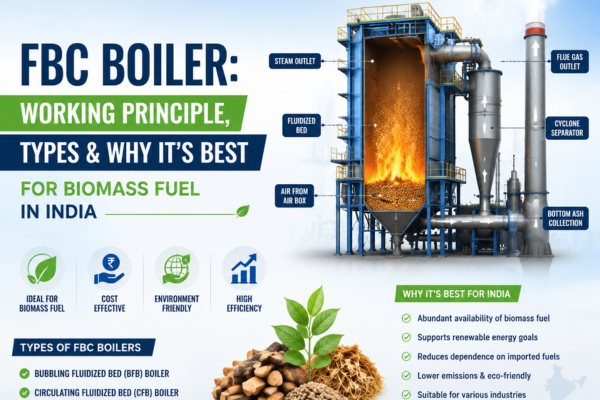
An FBC boiler, short for Fluidized Bed Combustion boiler, is a type of industrial steam boiler where solid fuel is burned in a turbulent, suspended bed of hot inert particles typically sand or ash rather than on a stationary grate.
When high-pressure air is blown upward through this bed of particles at sufficient velocity, the bed begins to behave like a boiling liquid particles constantly moving, mixing, and colliding. This is what is called the "fluidized" state. Fuel introduced into this hot, turbulent bed ignites rapidly and burns evenly throughout the bed volume, rather than burning in a localized flame above a grate.
The result is a fundamentally different combustion environment one that is more uniform, more complete, and far more tolerant of low-quality, high-moisture, or variable biomass fuels than any conventional combustion system.
FBC boilers were developed specifically to handle solid fuels that are difficult to burn efficiently in traditional systems low calorific value biomass, high-ash coal, agro-waste with variable moisture content, and multi-fuel combinations. For industries in India that have access to abundant agro-waste at very low cost, an FBC boiler converts what was once a disposal problem into a reliable, economical energy source.
Understanding the working principle of an FBC boiler is straightforward once you grasp the concept of fluidization. Here is how the process works from fuel entry to steam output:
Step 1 — Bed Preparation and Air Supply The combustion chamber contains a bed of inert material, typically coarse sand or limestone particles. A primary air distributor at the bottom of the furnace blows high-pressure air upward through this bed at a velocity high enough to suspend and agitate the particles. The bed temperature is maintained between 750°C and 900°C during operation.
Step 2 — Fuel Feeding Biomass fuel rice husk, bagasse, wood chips, or other agro-waste is fed into the hot fluidized bed through a mechanical fuel feeding system. This may be a screw conveyor, spreader-stoker, or pneumatic injection system depending on the fuel type and boiler design. The fuel enters the turbulent hot bed and ignites almost immediately due to the intense heat and continuous particle-to-particle contact.
Step 3 — Combustion in the Fluidized Bed Unlike conventional grate combustion where fuel burns in a concentrated flame zone, FBC combustion distributes burning fuel particles throughout the entire bed volume. The continuous mixing ensures that every fuel particle is surrounded by hot bed material and oxygen at all times resulting in complete, uniform combustion with very low unburned carbon losses.
Secondary air is introduced above the bed to complete the combustion of volatile gases rising from the bed. This two-stage air injection also helps suppress nitrogen oxide (NOx) formation by controlling peak combustion temperatures.
Step 4 — Heat Transfer to Water The hot flue gases generated by combustion rise through the furnace and pass over the boiler's heat exchange surfaces water-cooled membrane walls, superheater tubes, evaporator tubes, economizer, and air preheater. Water flowing through these tubes absorbs the heat energy and converts into steam at the required pressure and temperature.
Step 5 — Steam Output and Ash Handling Steam exits the boiler drum at the set pressure and is distributed to industrial processes. Ash from biomass combustion is collected at the bottom of the bed (bed ash) and from the flue gas path (fly ash) through cyclone separators and bag filters. The collected ash can often be used as a soil amendment in agriculture, creating a zero-waste process loop.
There are two primary types of FBC boilers used in industrial applications in India. Understanding the difference between them is essential for selecting the right system for your capacity and fuel requirements.
The AFBC boiler also called a Bubbling Fluidized Bed Boiler (BFBC) operates at atmospheric pressure and maintains a relatively dense, low-velocity fluidized bed. The air velocity is controlled so that the bed particles bubble and circulate within the furnace but do not get carried out with the flue gases.
AFBC boilers are the most widely used FBC design in Indian industries for small to medium steam capacities, typically ranging from 2 TPH to 25 TPH. They are well-suited for industries that have a consistent, single-type biomass fuel supply — such as rice mills using rice husk, or sugar mills using bagasse.
AFBC boilers are best suited for:
The CFBC boiler operates at a higher fluidizing air velocity that carries bed particles out of the combustion chamber along with flue gases. These particles are then separated from the gas stream by a high-efficiency cyclone separator and returned to the furnace creating a continuous circulation loop that gives this design its name.
This continuous recirculation of hot bed material ensures extremely long residence time for fuel particles in the combustion zone, resulting in very high combustion efficiency even for fuels with high ash content, high moisture, or low calorific value.
CFBC boilers are designed for larger industrial applications, typically from 15 TPH to 200 TPH and above. They are preferred by heavy industries, co-generation plants, power utilities, and large process industries.
CFBC boilers are best suited for:
| Parameter | AFBC Boiler | CFBC Boiler |
|---|---|---|
| Air Velocity | Low (bubbling bed) | High (circulating bed) |
| Capacity Range | 2 TPH – 25 TPH | 15 TPH – 200+ TPH |
| Fuel Flexibility | Good | Excellent |
| Combustion Efficiency | 88 – 92% | 92 – 96% |
| Best For | Rice mills, textile | Sugar, paper, co-gen plants |
| Capital Cost | Lower | Higher |
| NOx Emissions | Low | Very Low |
| Maintenance Complexity | Moderate | Higher |
One of the most significant advantages of FBC technology is its exceptional fuel flexibility. Where a conventional pulverized fuel boiler requires carefully prepared, consistent-quality fuel, an FBC boiler can handle wide variations in fuel type, calorific value, and moisture content sometimes burning two or three different fuels simultaneously.
Here are the most commonly used biomass fuels in Indian FBC boilers:
Rice Husk — The single most common FBC fuel in India. Available at ₹1–₹3 per kg near rice mills. Calorific value of 3,000–3,500 kcal/kg. High silica ash content makes FBC the preferred combustion technology over grate firing.
Bagasse — Fibrous sugarcane residue from sugar mills. Available at near-zero cost within sugar and distillery plants. Calorific value of 2,200–2,500 kcal/kg. CFBC boilers handle bagasse particularly well due to its high moisture content.
Wood Chips and Sawdust — Available from timber yards, furniture units, and plywood industries. Calorific value 3,500–4,000 kcal/kg. Clean-burning with low ash content.
Groundnut Shells — Widely available in Gujarat and Andhra Pradesh from oil mills. Calorific value 3,500–4,000 kcal/kg. Burns cleanly and consistently in FBC beds.
Cotton Stalks and Mustard Stalks — Agricultural crop residues abundantly available in Gujarat, Rajasthan, and Punjab. Calorific value 3,000–3,500 kcal/kg.
Biomass Pellets — Processed and densified biomass in pellet form. Consistent quality and calorific value (4,000–4,500 kcal/kg) make them ideal for boilers requiring stable fuel feed.
Coal + Biomass Co-firing — Many FBC boilers in India operate on a coal-biomass mixture, allowing industries to optimize fuel cost based on seasonal biomass availability and market prices.
Industries that have evaluated FBC technology against conventional coal or grate-fired biomass boilers consistently find that FBC delivers superior performance across every important operational parameter. Here is why:
Conventional grate-fired biomass boilers typically achieve combustion efficiency between 70–80%, with significant unburned carbon losses in bottom ash and fly ash. FBC boilers achieve 88–96% combustion efficiency because the turbulent bed ensures complete contact between fuel, oxygen, and heat throughout the entire combustion zone. For industries running boilers 20 hours per day, this efficiency difference directly translates into lakhs of rupees in monthly fuel savings.
FBC combustion naturally suppresses NOx formation because the bed temperature is maintained at 750–900°C well below the 1,400°C+ temperatures at which thermal NOx forms in conventional combustion. SOx emissions can be controlled by adding limestone directly to the bed, where it reacts with sulfur dioxide and captures it as calcium sulfate. This in-bed desulfurization eliminates the need for expensive downstream flue gas desulfurization equipment.
The result is a boiler system that meets current CPCB emission norms for particulates, NOx, and SOx without requiring extensive external pollution control reducing both capital investment and operating costs for pollution control systems.
Perhaps the most commercially valuable advantage of FBC technology for Indian industries is the ability to switch between fuel types based on seasonal availability and price. A rice mill can run on rice husk during the harvest season and switch to wood chips or coal during the off-season without modifying the boiler. This procurement flexibility protects industries from fuel price volatility in ways that no single-fuel boiler can.
Biomass fuels particularly rice husk have high ash content with low fusion temperatures that cause ash to melt and form clinkers on conventional grates, leading to frequent shutdowns for de-clinker operations. In an FBC boiler, the bed temperature is deliberately kept below the ash fusion temperature, eliminating clinker formation entirely. This is a major operational advantage for rice husk-fired boilers specifically.
The absence of mechanical grate components moving grate bars, clinker breakers, and stoker mechanisms removes a major source of wear and maintenance in FBC boilers. The primary wear points are the bed material itself (which is replenished periodically) and the refractory lining. With proper operating practices, FBC boilers deliver long, reliable service life. For a structured maintenance approach applicable to all industrial boiler types, our industrial boiler maintenance checklist covers both routine and periodic inspection requirements in detail.
FBC boilers have found adoption across a wide spectrum of Indian industries, driven by the combination of low fuel cost, operational reliability, and emission compliance:
Sugar Industry — Bagasse-fired CFBC boilers for co-generation of steam and electricity in large sugar mills and distilleries. Several hundred MW of co-generation capacity in India runs on CFBC technology.
Rice Mills and Agro-Processing — Rice husk-fired AFBC boilers for process steam generation. FBC is virtually the only practical technology for large-scale rice husk combustion due to the fuel's high silica content.
Textile Industry — Biomass FBC boilers for dyeing, bleaching, and finishing steam in Surat, Ahmedabad, Tirupur, and Ludhiana textile clusters.
Paper and Pulp Industry — High-capacity CFBC boilers using wood waste, black liquor-derived fuels, and biomass for process steam and co-generation.
Chemical Industry — Process heating applications where low-cost solid fuel availability makes FBC economics compelling versus gas or oil-fired alternatives.
Distilleries and Breweries — Spent grain and organic process residues converted into boiler fuel, reducing both disposal costs and energy costs simultaneously.
Thermal efficiency of an FBC boiler depends on design, fuel type, operating conditions, and maintenance practices. Here is what industries can realistically expect:
| Parameter | AFBC Boiler | CFBC Boiler |
|---|---|---|
| Overall Thermal Efficiency | 82 – 88% | 86 – 92% |
| Combustion Efficiency | 88 – 92% | 92 – 96% |
| Boiler Availability | 88 – 92% | 90 – 94% |
| Typical Steam Pressure Range | 10 – 45 kg/cm² | 20 – 90 kg/cm² |
| Steam Temperature Range | Saturated – 400°C | Saturated – 540°C |
Achieving and maintaining these efficiency levels requires proper fuel feeding, consistent bed temperature management, and regular inspection of heat transfer surfaces. Our comprehensive guide on how to improve boiler efficiency covers practical steps that can improve thermal efficiency by 5–10% in existing FBC systems.
Many industries still operate older chain grate or travelling grate stoker boilers and are evaluating whether upgrading to FBC technology makes financial sense. Here is a direct comparison:
| Parameter | FBC Boiler | Conventional Grate Boiler |
|---|---|---|
| Fuel Flexibility | Excellent multi-fuel | Limited specific fuel grades |
| Combustion Efficiency | 88 – 96% | 70 – 80% |
| NOx Emissions | Low (750–900°C bed temp) | Higher (higher flame temp) |
| Clinker Formation | Eliminated | Common with biomass fuels |
| Mechanical Complexity | Lower (no moving grate) | Higher (grate drive, stoker) |
| Biomass Suitability | Excellent | Limited for high-ash biomass |
| Capital Cost | Moderate to High | Lower |
| ROI for Biomass Fuel | 3 – 5 years | 4 – 7 years |
For industries currently using coal and considering a transition to biomass or agro-waste fuel, FBC technology consistently delivers a faster return on investment. For a deeper analysis of how to compare boiler types during a purchase decision, our guide on fire tube vs water tube boiler explains the broader boiler design decision framework.
Selecting an FBC boiler is a long-term capital investment typically for a 15–20 year operational life. The manufacturer you choose determines not just the quality of the equipment, but your access to technical support, spare parts, and operational expertise over that entire period.
When evaluating FBC boiler manufacturers in India, prioritize IBR certification for all pressure part components, demonstrated FBC installation references in your specific industry and fuel type, in-house design and engineering capability rather than just assembly, availability of local service engineers, and clear AMC (Annual Maintenance Contract) terms.
For a structured evaluation framework covering all these factors, our boiler manufacturer selection checklist provides a 10-point assessment tool that industrial buyers across India use to shortlist qualified manufacturers.
You can also refer to our complete listing of top steam boiler manufacturers in India for a broader market overview before making your final decision.
Par Techno-Heat Pvt. Ltd. known across the industry as PAR Boiler has been designing and manufacturing FBC boilers from Ahmedabad for over 25 years. The company's FBC range covers both AFBC and CFBC designs, with capacities from 2 TPH to 30 TPH, operating pressures up to 45 kg/cm², and full compatibility with rice husk, bagasse, wood chips, groundnut shells, coal, and mixed agro-waste fuels.
Every Par Boiler FBC system is IBR certified, PLC automated, and delivered with complete documentation for regulatory compliance. The company provides installation commissioning support, operator training, and dedicated after-sales service through a nationwide service network.
If you are evaluating a new FBC boiler installation or planning to upgrade from a conventional grate-fired system, contact Par Techno-Heat Pvt. Ltd. for a customized technical proposal based on your specific fuel type, capacity requirement, and site conditions.
Contact Par Techno-Heat Pvt. Ltd. Get a Free FBC Boiler Consultation
Q1. What does FBC stand for in boiler terminology?
FBC stands for Fluidized Bed Combustion a combustion technology where solid fuel burns in a turbulent, air-suspended bed of inert particles (typically sand), resulting in more complete combustion and lower emissions than conventional grate firing.
Q2. What is the difference between AFBC and CFBC boilers?
AFBC (Atmospheric Fluidized Bed Combustion) boilers use a low-velocity bubbling bed and are suited for capacities of 2–25 TPH. CFBC (Circulating Fluidized Bed Combustion) boilers use higher air velocity that circulates bed particles through a cyclone separator, offering higher efficiency and capacity (15–200+ TPH). CFBC boilers deliver better performance for difficult fuels and larger steam demands.
Q3. Can an FBC boiler run on rice husk alone?
Yes. Rice husk is one of the most commonly used fuels in Indian FBC boilers. The FBC combustion system handles rice husk's high silica content and low calorific value far better than conventional grate-fired systems, avoiding clinker formation that is a major problem in traditional rice husk-fired boilers.
Q4. What is the efficiency of an FBC boiler?
AFBC boilers typically achieve overall thermal efficiency of 82–88%, while CFBC boilers reach 86–92%. Combustion efficiency the percentage of fuel energy actually released in combustion is 88–96% for FBC versus 70–80% for conventional grate-fired boilers.
Q5. Are FBC boilers IBR certified in India?
Yes. All FBC boilers operating above the IBR threshold (steam pressure above 1 kg/cm² and shell diameter above 22.75 cm) must be IBR certified under the Indian Boilers Regulation Act. Par Boiler supplies fully IBR-certified FBC systems with all required documentation and approval.
Q6. What is the price of an FBC boiler in India?
FBC boiler prices in India typically range from ₹35 lakh for a small 2 TPH AFBC system to ₹2.5 crore and above for a large 25 TPH CFBC installation. The final price depends on capacity, operating pressure, fuel system design, automation level, and pollution control requirements. Contact Par Techno-Heat for a detailed quotation.
Q7. How long does it take to commission an FBC boiler?
A typical AFBC boiler installation and commissioning takes 3–5 months from order placement including design, fabrication, delivery, civil foundation work, erection, and trial runs. Larger CFBC projects may require 6–9 months.
For customized FBC boiler solutions designed for your specific biomass fuel, capacity, and industry contact Par Techno-Heat Pvt. Ltd., one of India's leading FBC boiler manufacturers based in Ahmedabad, Gujarat.
