



When it comes to industrial steam generation, two boiler designs have stood the test of time the fire tube boiler and the water tube boiler. Both are used extensively across industries ranging from food processing and textiles to chemical plants and power generation. However, they operate on fundamentally different principles and are suited to very different applications.
Understanding the difference between fire tube and water tube boilers is not just a matter of engineering curiosity it directly affects your choice of equipment, operational efficiency, safety standards, and long-term costs. Whether you are a plant engineer, procurement manager, or business owner looking to invest in the right boiler system, this guide will walk you through everything you need to know.
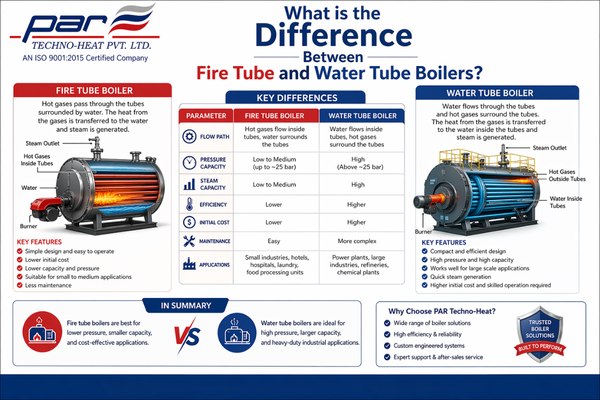
A fire tube boiler is one of the oldest and most widely used types of industrial boilers. In this design, hot combustion gases travel through a series of tubes (called fire tubes) that run through a water-filled shell. The heat from the gases transfers through the tube walls and heats the surrounding water, eventually converting it into steam.
The working principle of a fire tube boiler is straightforward. Fuel is burned in a furnace, generating hot flue gases. These hot gases are forced through the fire tubes immersed in water. As the gases flow through the tubes, heat transfers outward to the water in the shell. The water reaches boiling point and produces steam, which is collected in the steam space above the water level and supplied to the process.
Key structural feature: Hot gases flow inside the tubes. Water surrounds the tubes on the outside.
Fire tube boilers are generally low-pressure boilers, typically operating below 250 psi, though modern designs have extended this range. They are available in three-pass and four-pass configurations, which determine how many times the flue gases travel back and forth through the boiler before exiting — more passes mean better heat transfer and higher efficiency.
A water tube boiler works on the reverse principle. In this design, water flows through a series of tubes (called water tubes or risers), while the hot combustion gases surround the tubes from the outside. The tubes are connected to steam and water drums at the top and bottom.
In a water tube boiler, water is fed into a lower drum (mud drum) and flows upward through inclined or vertical water tubes toward an upper drum (steam drum). The burner fires combustion gases that wash over the outside of the tubes, heating the water inside. As the water heats up, it partially converts to steam, creating a natural circulation pattern — hot water and steam rise while cooler water descends. The steam collects in the steam drum and is sent to the process.
Key structural feature: Water flows inside the tubes. Hot gases surround the tubes on the outside.
Water tube boilers are designed for high-pressure applications and large steam capacities. They can operate at pressures exceeding 3,000 psi in some utility-scale applications, making them the preferred choice for power generation and large industrial plants.
|
Feature |
Fire Tube Boiler |
Water Tube Boiler |
|
Location of hot gases |
Inside tubes |
Outside tubes (shell side) |
|
Location of water/steam |
Shell (outside tubes) |
Inside tubes |
|
Operating pressure |
Low to medium (up to 250 psi) |
High pressure (up to 3000+ psi) |
|
Steam generation capacity |
Lower |
Higher |
|
Startup time |
Slower (large water volume) |
Faster (small water volume) |
|
Response to load changes |
Slower |
Faster |
|
Size and footprint |
Larger |
More compact |
|
Water treatment requirement |
Moderate |
Stringent |
|
Initial cost |
Lower |
Higher |
|
Maintenance |
Easier |
More specialized |
|
Suitable applications |
Small industries, heating |
Power plants, large industries |
|
Efficiency |
Moderate |
Higher (especially at high pressure) |
The most fundamental difference between these two boiler types lies in what flows through the tubes. In a fire tube boiler, the hot combustion gases pass through the tubes that are submerged in water. In a water tube boiler, water flows through the tubes while the combustion gases pass around them from the outside. This single design difference drives most of the other distinctions between the two types.
Fire tube boilers are inherently limited in the pressure they can safely handle because the entire shell must withstand the steam pressure. This makes them most suitable for low to medium pressure applications. Water tube boilers, with their smaller-diameter tubes carrying water at high pressure, are far better suited for high-pressure steam generation. For applications requiring pressures above 250 psi, water tube boilers are almost always the preferred choice.
Water tube boilers have a significantly higher steam generation capacity than fire tube boilers. Because water tube boilers can be designed with a large number of tubes and a very large heating surface area, they can produce enormous volumes of steam quickly. Fire tube boilers, limited by their shell-and-tube geometry, have a lower upper ceiling on steam output. For large power plants or industrial facilities requiring continuous high-volume steam, water tube boilers are the logical choice.
Fire tube boilers hold a large volume of water at all times. While this large water mass provides a useful buffer — the boiler can meet sudden demand spikes without pressure dropping — it also means the boiler takes longer to heat up from a cold start. Water tube boilers contain far less water volume, so they heat up very quickly and respond to changing load demands almost instantly. For processes with rapidly varying steam demands, water tube boilers offer a significant operational advantage.
The large shell and high water volume of a fire tube boiler translate to a larger overall size and heavier weight. Water tube boilers, despite their superior capacity, tend to have a smaller footprint because their design allows for more compact arrangements. This is particularly relevant in space-constrained industrial environments.
Both boiler types require good water quality, but water tube boilers are far more sensitive to water quality issues. Because the water tubes have a small diameter and the water is heated very rapidly to high temperatures, even minor scale buildup can cause a tube to overheat and fail. Fire tube boilers, with their larger water volume, are more forgiving of moderate water quality — scale buildup progresses more slowly and is less immediately dangerous. That said, proper water treatment remains essential for both types to ensure long service life.
Fire tube boilers carry a larger risk if a failure occurs because the whole shell contains pressurized steam. However, they are generally considered safer for low-pressure applications due to their robust, well-proven design. Water tube boilers, while operating at much higher pressures, contain smaller amounts of water in any single tube, so a tube failure, though serious, tends to be less catastrophic than a shell explosion. High-pressure water tube boilers require stringent safety controls, regular inspections, and skilled operators.
Fire tube boilers are generally simpler to maintain. Their tubes are accessible, cleaning is straightforward, and the technology is well-understood. Water tube boilers require more specialized maintenance — tube inspection, proper chemical treatment, and monitoring of drum levels are all critical. However, water tube boilers often offer lower long-term operating costs at high capacities due to their superior thermal efficiency.
For a broader overview of boiler categories, read our guide on Industrial Boiler Types and Uses.
Fire tube boilers are the workhorses of small and medium-scale industrial operations. Their reliability, ease of use, and lower capital cost make them ideal for:
Water tube boilers are chosen when the application demands high pressure, large steam volumes, or rapid load response. Typical applications include:
Looking for the best suppliers? Explore our list of Top Water Tube Boiler Manufacturers in India to find a trusted partner for your project.
To find reliable suppliers for your boiler needs, browse our curated list of Top Boiler Manufacturers in India.
Choosing the right boiler type is a critical engineering and business decision. Here are the most important factors to consider:
Generally, water tube boilers are more thermally efficient, especially at high pressures and large capacities. Their design allows for better heat transfer over a large surface area and produces less waste heat. Fire tube boilers can be highly efficient in their pressure and capacity range, particularly multi-pass designs, but they typically cannot match the efficiency of water tube boilers at industrial scale.
Fire tube boilers are primarily designed for low to medium pressure applications, typically up to 250 psi. While some advanced fire tube designs can exceed this, they are not commonly used for very high-pressure steam generation. For pressures significantly above 250 psi — such as those needed in power plants or refineries — water tube boilers are the appropriate choice.
Both types are safe when properly designed, installed, and maintained according to applicable codes such as ASME standards. Fire tube boilers carry a risk of shell failure if overpressured, which can be catastrophic. Water tube boilers carry the risk of individual tube failure. Statistically, fire tube boilers at their intended low-pressure applications are very safe. Water tube boilers at high pressure require more rigorous safety systems and operator training. In either case, regular inspection and maintenance are non-negotiable.
The defining structural difference is where the hot gases and the water are located relative to the tubes. In a fire tube boiler, hot combustion gases flow through the inside of the tubes, while water surrounds the tubes in the outer shell. In a water tube boiler, this is reversed — water flows through the inside of the tubes, while hot combustion gases pass around the outside of the tubes. This structural reversal is what gives each type its distinctive performance characteristics.
For most small-to-medium manufacturing units — such as food processing plants, textile factories, breweries, or pharmaceutical facilities — a fire tube boiler is usually the best choice. It offers lower initial cost, simpler operation, easier maintenance, and is perfectly suited to the low-to-medium pressure steam requirements typical of these industries. However, if your specific process requires high-pressure steam or very rapid load response, a smaller water tube boiler may be worth the investment.
Need Help Choosing the Right Boiler for Your Industry?
Par Techno Heat Pvt Ltd is one of India's leading boiler manufacturers, offering a comprehensive range of fire tube and water tube boilers engineered for reliability, efficiency, and safety. Our expert team can help you select, design, and commission the right boiler system for your specific industrial requirements.
Visit Par Techno Heat Pvt Ltd — www.parboiler.com
