


Let us be honest most plant engineers and production managers do not have six months to wait for a boiler installation. Civil foundation work, custom fabrication, field erection, piping, insulation, testing, IBR inspection a field-erected boiler project can stretch timelines dramatically and push commissioning dates well beyond what any production schedule can tolerate.
This is precisely why packaged boilers exist, and why they have become the go-to choice for a vast range of Indian industries from small food processing units to mid-sized textile factories to pharmaceutical manufacturers setting up new production lines.
A packaged boiler arrives at your site factory-assembled, IBR-tested, and ready to connect. In most cases, you are generating steam within days of delivery, not months. That time-to-steam advantage, combined with consistent quality and compact footprint, is why demand for packaged boilers across India continues to grow every year.
This guide explains everything you need to know what packaged boilers are, how they work, which type suits your application, what they cost in India in 2026, and how to choose the right one for your facility.
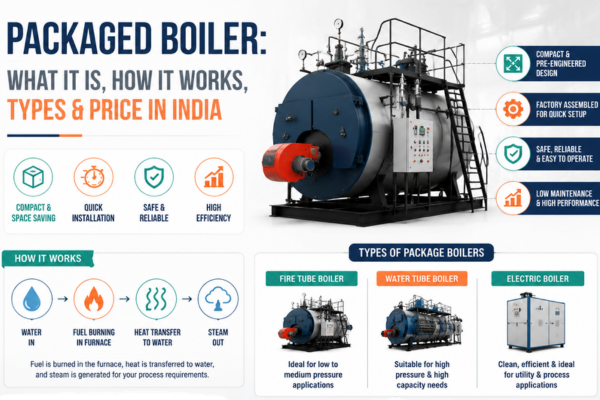
A packaged boiler is a complete, self-contained steam generation system that is fully assembled, insulated, piped, wired, and tested at the manufacturer's factory and then delivered to the customer's site as a single integrated unit ready for connection to fuel supply, water feed, and steam distribution lines.
The term "packaged" refers to this factory-complete nature of the system. Everything the boiler needs to operate the pressure vessel, burner, controls, safety devices, insulation, feed water connections, and instrumentation is assembled and tested as a package before it leaves the manufacturer's facility.
This is fundamentally different from a field-erected boiler, where all components are shipped separately to the site and assembled on location by a team of engineers and welders a process that requires substantial civil infrastructure, skilled site labour, and months of construction time.
In the Indian context, packaged boilers are available across a capacity range of approximately 200 kg/hr to 30,000 kg/hr (0.2 TPH to 30 TPH) and can run on natural gas, LPG, light diesel oil, furnace oil, coal, or biomass fuels depending on the design.
The working principle of a packaged boiler follows the same fundamental thermodynamic cycle as any industrial steam boiler but delivered within a compact, pre-integrated enclosure that simplifies installation and operation significantly.
Here is how the process works from fuel ignition to steam output:
Step 1 — Fuel Combustion The burner mounted at the front of the boiler shell ignites the fuel (gas, oil, or solid fuel) inside the combustion chamber. In gas-fired and oil-fired packaged boilers, a pressure-jet or rotary-cup burner produces a controlled flame that fills the combustion chamber and generates high-temperature flue gases.
Step 2 — Heat Transfer Through Fire Tubes In the most common packaged boiler design the fire tube configuration the hot flue gases pass through a series of tubes that run through a large water-filled shell. As the hot gases flow through these tubes, heat transfers from the gas to the surrounding water. The gases typically make two, three, or four passes through different tube banks before exiting through the chimney, extracting maximum heat at each pass.
Step 3 — Steam Generation As water surrounding the fire tubes absorbs heat, it reaches saturation temperature and begins converting into steam. The steam collects in the steam space above the water level inside the shell and builds up to the set operating pressure.
Step 4 — Steam Distribution and Safety Control Steam exits through the main steam outlet valve and enters the plant's distribution header for use in industrial processes. The PLC-based control panel monitors steam pressure, water level, and burner firing rate continuously modulating the burner output to match steam demand and triggering automatic safety shutdowns if pressure or water level exceeds safe limits.
Step 5 — Feed Water Return Condensate returning from the process and fresh makeup water is fed back into the boiler through the feed water pump and economizer (where fitted), completing the water-steam cycle.
Modern packaged boilers are designed with multi-pass flue gas routing, economizer heat recovery, and PLC automation that together deliver thermal efficiencies of 85–92% in day-to-day operation making them among the most fuel-efficient steam generation options available for capacities up to 10 TPH.
Not all packaged boilers are the same. The right type for your application depends on your operating pressure, steam capacity, fuel type, and specific process requirements.
The fire tube packaged boiler is the most widely used design in India for small to medium industrial applications. In this configuration, hot combustion gases pass through multiple tubes (fire tubes) that are immersed in water inside a horizontal cylindrical shell.
Most fire tube packaged boilers use a three-pass or four-pass design meaning the flue gases travel back and forth through different tube banks three or four times before exiting. Each additional pass extracts more heat from the gases, improving overall thermal efficiency.
Fire tube packaged boilers are best suited for:
Fuel options: Natural gas, LPG, light diesel oil, furnace oil, or dual-fuel configurations. Some designs accommodate solid fuel firing with appropriate stoker or bed combustion attachments.
A water tube packaged boiler reverses the flow arrangement water circulates inside the tubes while hot combustion gases surround the outside of the tubes. This design allows operation at significantly higher pressures and temperatures than fire tube configurations, and supports larger steam capacities within a compact packaged envelope.
D-Type and O-Type water tube designs are commonly available as packaged units for capacities from 2 TPH to 30 TPH.
Water tube packaged boilers are best suited for:
For a detailed technical comparison of fire tube and water tube designs covering pressure limits, capacity ranges, construction differences, and industry-wise suitability, our complete guide on fire tube vs water tube boiler provides everything you need before making a final selection.
Gas fired packaged boilers use natural gas (PNG) or LPG as fuel, paired with a high-efficiency modulating burner. They offer the cleanest combustion of all packaged boiler fuel options zero ash, no soot, minimal emissions and are the preferred choice for pharmaceutical, food processing, and dairy industries where environmental compliance and steam purity are critical.
Oil fired packaged boilers run on light diesel oil (LDO), high speed diesel (HSD), or furnace oil (FO). They are commonly chosen for locations where gas supply is unavailable, or as backup systems for primary gas-fired boilers. Modern oil-fired packaged designs achieve efficiencies of 85–88% with pressure-jet burners and economizer heat recovery.
Coal fired packaged boilers use stoker-fed coal combustion systems either chain grate or spreader stoker within the packaged enclosure. These are chosen primarily on the basis of fuel cost economics in regions where coal is significantly cheaper than gas or oil. They require more operational attention and maintenance than gas or oil-fired units but deliver lower fuel cost per unit of steam.
Biomass packaged boilers use agricultural residues, wood chips, or biomass pellets as fuel in an integrated combustion system. They combine the low fuel cost advantage of solid biomass with the compact, pre-assembled installation benefit of the packaged design making them an attractive option for agro-based industries and textile units in Gujarat, Rajasthan, and Maharashtra.
Understanding what makes a packaged boiler different from a conventional field-erected system helps clarify when each approach is the right choice.
| Parameter | Packaged Boiler | Field-Erected Boiler |
|---|---|---|
| Assembly Location | Factory fully assembled & tested | On-site assembled by erection team |
| Installation Time | 1–4 weeks after delivery | 3–9 months |
| Civil Construction Needed | Minimal simple foundation slab | Significant civil structure required |
| IBR Testing | Done at factory before dispatch | Done on-site after erection |
| Capacity Range | 0.2 TPH – 30 TPH | 5 TPH – 500+ TPH |
| Best Suited For | Small to medium industries | Large power & process plants |
| Relocation Possibility | Possible in some designs | Permanent installation |
| Capital Cost | Moderate | Higher (includes civil + erection) |
| Commissioning Timeline | Days to weeks | Months |
For most Indian industries requiring steam capacities between 1 TPH and 10 TPH, a packaged boiler is the operationally and economically superior choice.
Packaged boiler prices in India vary based on capacity, fuel type, operating pressure, automation level, and manufacturer. Below is a realistic price reference for 2026 across common configurations.
| Capacity | Fuel Type | Approx. Price Range (₹) |
|---|---|---|
| 200 – 500 kg/hr | Gas / Oil | ₹4 lakh – ₹10 lakh |
| 500 kg/hr – 1 TPH | Gas / Oil | ₹10 lakh – ₹22 lakh |
| 1 – 3 TPH | Gas / Oil | ₹22 lakh – ₹45 lakh |
| 3 – 5 TPH | Gas / Oil | ₹45 lakh – ₹75 lakh |
| 5 – 8 TPH | Gas / Oil | ₹75 lakh – ₹1.2 crore |
| Capacity | Fuel Type | Approx. Price Range (₹) |
|---|---|---|
| 2 – 5 TPH | Gas / Oil / Biomass | ₹45 lakh – ₹85 lakh |
| 5 – 10 TPH | Gas / Oil / Biomass | ₹85 lakh – ₹1.6 crore |
| 10 – 20 TPH | Biomass / Coal / Gas | ₹1.6 crore – ₹3 crore |
| 20 – 30 TPH | Biomass / Coal | ₹3 crore – ₹5 crore+ |
Operating pressure — Higher pressure requires thicker shell construction, certified materials, and more rigorous IBR testing all of which add cost.
Automation level — A basic on/off control boiler costs less upfront. A fully automated PLC system with HMI touchscreen, remote monitoring, and modulating burner control adds ₹2–₹8 lakh to the base price but delivers significant long-term fuel and labour savings.
Fuel system design — Dual-fuel burner configurations (gas + oil backup) cost more than single-fuel designs but provide operational flexibility.
Pollution control equipment — Coal and biomass packaged boilers require multi-cyclone dust collectors or bag filters as per CPCB norms typically adding ₹3–₹12 lakh depending on capacity.
Manufacturer certification and after-sales — IBR-certified manufacturers with proven installation references and local service networks command a premium that is well worth paying over the boiler's 15–20 year operational life.
Note: All prices are indicative for 2026 and exclude civil foundation, installation, chimney, and commissioning costs. Contact Par Techno-Heat for a detailed site-specific quotation.
Every packaged boiler sold and operated in India above the IBR threshold must comply with the Indian Boilers Regulation (IBR) Act, 1950. This is a mandatory legal requirement not optional.
The IBR threshold applies to boilers with a steam-generating capacity above 22.75 litres and operating pressure above 1 kg/cm². In practical terms, this means virtually every industrial packaged boiler requires IBR registration.
IBR compliance for a packaged boiler involves design approval by the Central Boiler Board or State Boiler Inspectorate, material certification for all pressure-bearing components, inspection and hydraulic pressure testing at the manufacturer's factory, stamping of IBR certificates on the boiler shell, and registration of the boiler at the plant site before commissioning.
When you purchase a packaged boiler from a certified manufacturer like Par Techno-Heat, all IBR documentation drawing approvals, material certificates, hydraulic test certificates, and IBR registration paperwork is provided as part of the supply. This protects you from legal and insurance liability and ensures the boiler can be legally operated by your operators.
For operators and plant managers, following structured safety protocols is equally important after installation. Our detailed boiler safety guidelines for industries covers operational safety requirements that complement IBR compliance in day-to-day boiler management.
Packaged boilers serve a diverse range of industries across India anywhere that steam or hot water is needed at capacities between 0.2 TPH and 30 TPH:
Pharmaceutical Industry — Sterile steam for autoclave sterilization, clean steam for injectable manufacturing, and process heating for API production. Gas-fired packaged boilers dominate this sector due to steam purity requirements.
Food and Beverage Processing — Cooking, sterilization, pasteurization, and packaging line heating. The combination of clean steam and fast commissioning makes gas or oil-fired packaged boilers the preferred choice.
Textile Industry — Dyeing, washing, bleaching, and fabric finishing in textile units across Surat, Ahmedabad, Tirupur, and Ludhiana. Biomass and gas-fired packaged boilers both have strong presence in this sector.
Dairy Industry — Pasteurization, CIP (Clean-in-Place) cleaning, butter and cheese production. Dairy plants frequently choose gas-fired packaged boilers for their clean operation and precise temperature control.
Chemical Industry — Process heating, reactor temperature control, solvent recovery, and distillation. Operating pressure requirements vary widely both fire tube and water tube packaged designs are used.
Hotels, Hospitals, and Commercial Buildings — Space heating, laundry, kitchen steam, and domestic hot water. Oil or gas-fired packaged boilers are standard in large commercial facilities.
Educational Institutions and Research Labs — Steam for campus heating systems, laboratory autoclaves, and research equipment. Small fire tube packaged boilers in the 200–500 kg/hr range are widely used.
Engineering and Metal Processing — Heat treatment, surface finishing, and industrial washing processes. The robust, low-maintenance nature of packaged boilers suits high-utilization manufacturing environments.
Selecting the right packaged boiler requires matching the system specification to your operational requirements not simply buying the cheapest or most available option.
Start by calculating your actual steam demand both peak load and average load. Over-specifying wastes capital; under-specifying creates production bottlenecks. Define your required operating pressure and whether you need saturated or superheated steam.
Evaluate your fuel options honestly gas availability, biomass supply security, and coal logistics all vary by location. The fuel decision directly determines your monthly operating cost for the next 15–20 years, so it deserves careful analysis. Our guide on how to improve boiler efficiency includes a fuel cost impact analysis framework that helps quantify this decision.
Verify that the manufacturer you choose holds IBR certification, has demonstrated packaged boiler installations in your specific industry and fuel type, and provides local service support with AMC options. Our comprehensive boiler manufacturer selection checklist provides a structured 10-point evaluation framework used by industrial buyers across India to shortlist qualified suppliers.
Once your boiler is installed and running, a scheduled maintenance program is what protects your investment and keeps efficiency high over the long term. Our industrial boiler maintenance checklist covers the daily, weekly, monthly, and annual inspection requirements specific to industrial packaged boilers.
Par Techno-Heat Pvt. Ltd. widely known as PAR Boiler has been manufacturing industrial packaged boilers from Ahmedabad for over 25 years. The company's packaged boiler range covers fire tube and water tube designs from 200 kg/hr to 30 TPH, across gas, oil, coal, and biomass fuel configurations all IBR certified, PLC automated, and backed by a dedicated national service network.
Par Boiler is consistently ranked among the top steam boiler manufacturers in India for packaged boiler quality, delivery reliability, and after-sales support.
Whether you are setting up a new production facility, replacing an ageing boiler, or adding capacity to an existing plant Par Techno-Heat provides a customized packaged boiler solution designed specifically for your fuel, capacity, and industry requirements.
Contact Par Techno-Heat Pvt. Ltd. Get a Free Packaged Boiler Consultation
Q1. What is a packaged boiler and how is it different from other boilers?
A packaged boiler is a factory-assembled, tested, and ready-to-install steam boiler system. Unlike field-erected boilers that are built on-site over months, a packaged boiler arrives complete reducing installation time from months to days or weeks.
Q2. What is the capacity range of packaged boilers in India?
Packaged boilers in India are available from as small as 200 kg/hr to as large as 30,000 kg/hr (30 TPH). For most small and medium industries, the 1 TPH to 10 TPH range covers the majority of applications.
Q3. What is the price of a 3 TPH packaged boiler in India in 2026?
A 3 TPH gas or oil-fired packaged boiler typically costs between ₹35 lakh and ₹55 lakh depending on operating pressure, automation level, and manufacturer. Coal or biomass-fired versions in the same capacity range may cost ₹40–₹65 lakh including pollution control equipment.
Q4. Is IBR certification mandatory for packaged boilers in India?
Yes. All packaged boilers operating above 1 kg/cm² pressure with a capacity above 22.75 litres must be IBR registered under the Indian Boilers Regulation Act, 1950. Par Techno-Heat supplies fully IBR-certified packaged boilers with all required documentation.
Q5. How long does it take to install a packaged boiler?
Most packaged boilers can be installed and commissioned within 1–4 weeks of delivery to site including foundation preparation, boiler positioning, connection to fuel supply and water feed, and IBR site inspection. This is dramatically faster than field-erected boiler projects.
Q6. Which fuel is best for a packaged boiler in India gas, oil, or biomass?
Natural gas (PNG) offers the lowest running cost and cleanest operation where pipeline supply is available. Biomass fuel provides the lowest raw fuel cost for industries near agro-waste sources. Oil (LDO/HSD) is suitable as a primary fuel where gas is unavailable or as a reliable backup. The best choice depends on your location, fuel availability, and monthly consumption volume.
Q7. What maintenance does a packaged boiler require?
Packaged boilers require daily checks of water level, pressure, and burner operation; weekly inspection of safety valves and blowdown; monthly inspection of feed water treatment and heat exchange surfaces; and annual full inspection including hydraulic pressure testing and IBR renewal. Gas and oil-fired packaged boilers require significantly less maintenance than coal or biomass-fired units.
Looking for a reliable packaged boiler manufacturer in India? Par Techno-Heat Pvt. Ltd. offers IBR-certified packaged steam boilers in gas, oil, coal, and biomass configurations with over 25 years of manufacturing experience and installations across India.
Visit Par Techno-Heat Pvt. Ltd. → www.parboiler.com
