


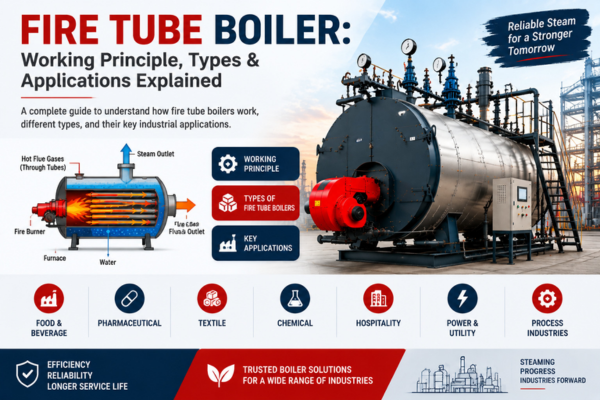
A fire tube boiler is an industrial steam boiler design in which hot combustion gases flow through tubes submerged in water inside a cylindrical shell, transferring heat through the tube walls to raise the surrounding water to boiling point and generate steam. This is the reverse arrangement of a water tube boiler, where water flows inside the tubes instead. Fire tube boilers are widely used across food, textile, chemical, pharmaceutical, and general manufacturing industries for process steam, typically in compact, factory-assembled configurations suited to small-to-medium capacity and moderate operating pressure.
Steam generation sits at the center of most industrial process heating - cooking, cleaning, drying, sterilization, and countless other operations depend on a reliable, well-designed boiler. Among the boiler designs in wide industrial use, the fire tube boiler remains one of the most common choices for small-to-medium steam demand, largely because of its straightforward construction and operational simplicity.
Understanding how a fire tube boiler actually works - not just that it "makes steam," but the specific path combustion gases take, how heat transfers through tube walls, and what determines its efficiency and limitations - matters whether you're specifying new equipment, troubleshooting an existing installation, or simply trying to understand the system your plant already runs. This guide covers the fire tube boiler working principle, its construction and main components, the different types available, where it's used industrially, how it compares to a water tube boiler, and what to evaluate before selecting one for your application.
A fire tube boiler is an industrial steam boiler where hot combustion gases pass through a series of tubes that run through a water-filled shell, transferring heat from the gas to the surrounding water and converting it into steam. It's called a "fire tube" or "smoke tube" boiler because the fire - the hot combustion gases and smoke from the furnace - travels inside the tubes, rather than the water.
Simple definition: a fire tube boiler heats water by passing hot gas through tubes submerged in it, the opposite arrangement of a water tube boiler.
Technical definition: a fire tube boiler is a shell-and-tube type steam generator in which the tube side carries products of combustion (flue gas) and the shell side contains the boiler water and steam space, with heat transferring by convection and, in the furnace section, by radiation, through the tube and furnace walls into the water.
The basic relationship is straightforward: hot combustion gases enter the fire/smoke tubes, heat transfers through the tube walls into the surrounding boiler water, the water absorbs this heat and eventually boils, and steam collects in the space above the water level before exiting to the process. This is why fire tube boilers are sometimes called smoke tube boilers - the tubes literally carry the smoke and hot gas from combustion.
A fire tube boiler works by burning fuel in a furnace to produce hot combustion gases, which then travel through a bundle of tubes submerged in the boiler's water-filled shell. As the gases pass through, heat transfers through the tube walls into the surrounding water, raising it to boiling point. The resulting steam collects above the water line and is drawn off through the steam outlet to supply the industrial process.
Here is the complete process broken into steps:
Step 1 - Fuel and Air Enter the Combustion System: the burner introduces fuel (gas, oil, or in some designs solid fuel) mixed with combustion air into the furnace. Correct fuel-air ratio here directly affects how completely the fuel burns and how much heat is available downstream.
Step 2 - Combustion Takes Place: the fuel-air mixture ignites in the furnace, which in most fire tube designs is itself a large-diameter tube (often called the furnace tube or Morrison tube) forming the first gas pass. This is where the highest-temperature radiant heat transfer occurs.
Step 3 - Hot Flue Gases Travel Through the Tubes: combustion gases move from the furnace into successive banks of smaller-diameter fire tubes, following the specific gas-path arrangement of that boiler's pass design (covered in detail below).
Step 4 - Heat Transfers Through Tube Walls: as hot gas flows through each tube, heat transfers by convection from the gas to the tube's inner wall, conducts through the tube material, and transfers again by convection from the outer wall into the surrounding boiler water.
Step 5 - Boiler Water Absorbs Heat: water in the shell, surrounding the tube bundle, absorbs this transferred heat and rises in temperature progressively as it circulates naturally around the hot tube surfaces.
Step 6 - Steam Is Generated: once the water reaches its boiling point at the boiler's operating pressure, it begins converting to steam at the tube and furnace surfaces.
Step 7 - Steam Collects in the Steam Space: steam bubbles rise through the water and accumulate in the steam space at the top of the shell, above the normal water level.
Step 8 - Steam Is Supplied to the Industrial Process: steam exits through the main steam outlet and stop valve, traveling through distribution piping to the point of use - a heat exchanger, process vessel, or direct-contact application.
Step 9 - Flue Gases Exit Through the Exhaust/Chimney: having given up much of their heat, the cooled combustion gases exit the final tube pass and are discharged through the flue gas outlet and chimney/stack, sometimes after passing through an economizer that recovers additional heat to preheat feedwater.
As a simple flow summary:
Fuel + Air → Burner/Furnace → Hot Combustion Gases → Fire Tubes / Smoke Tubes → Heat Transfer to Water → Steam Generation → Steam Outlet → Industrial Process
Fire tube boiler construction can vary meaningfully depending on capacity, fuel, number of passes, and manufacturer - not every fire tube boiler is built to the identical configuration. That said, most designs share a common set of functional elements:
The exact arrangement, number of tube passes, and specific accessories fitted depend on the boiler's capacity, fuel type, pressure rating, and the manufacturer's specific design. For a broader look at industrial boiler construction principles across designs, our overview of what an industrial boiler is covers the shared fundamentals, and our industrial boiler accessories guide explains mandatory mountings and efficiency accessories in more detail.
| Component | Function | Why It Matters |
|---|---|---|
| Boiler Shell | Houses water, steam space, and tube bundle | Primary pressure vessel of the boiler |
| Furnace | Site of fuel combustion | Determines combustion quality and initial heat release |
| Fire Tubes / Smoke Tubes | Carry hot gas through the water-filled shell | Primary heat transfer surface |
| Tube Sheets | Anchor and seal tube ends | Separates gas side from water side |
| Burner | Delivers and ignites fuel-air mixture | Controls combustion efficiency and stability |
| Water Level Indicator | Shows current water level | Prevents low-water tube damage |
| Safety Valve | Relieves excess pressure | Prevents over-pressure failure |
| Pressure Gauge | Displays operating pressure | Operational monitoring reference |
| Feedwater Inlet | Introduces treated water into the shell | Replaces water converted to steam |
| Steam Outlet | Delivers steam to the process | Connects the boiler to distribution piping |
| Blowdown Valve | Discharges water to control dissolved solids/sediment | Manages water chemistry and reduces scale/foaming risk |
| Flue Gas Outlet / Chimney | Discharges cooled combustion gases | Maintains draft and safe emission discharge |
| Insulation/Refractory | Reduces heat loss, protects personnel | Supports efficiency and safety |
The tube bundle and shell run horizontally, the most common orientation for industrial packaged fire tube boilers. This layout suits a compact, transportable design and is widely used across process industries for its accessible tube-plate maintenance access.
The shell and tubes are arranged vertically, generally suited to smaller capacity and space-constrained installations. This orientation reduces floor footprint but can limit tube length and total heating surface compared to horizontal designs of similar diameter.
Combustion gas travels through the boiler in a single direction before exiting. Simpler in construction, but generally extracts less heat from the flue gas before it exits compared to multi-pass designs, since the gas has less time in contact with heat transfer surfaces.
Gas is routed back and forth through successive tube banks - two, three, or occasionally four passes - before exiting. Each additional pass gives the gas more residence time in contact with heat transfer surfaces, though this needs to be balanced against boiler size, gas-side pressure drop, and construction cost. Three-pass designs are common in Indian industrial packaged fire tube boilers.
The turnaround chamber where gas reverses direction between passes is itself surrounded by water (rather than refractory-lined), meaning this critical high-temperature zone benefits directly from water cooling. This generally reduces refractory maintenance in that zone compared to dry-back designs.
The turnaround chamber is lined with refractory material rather than surrounded by water. This construction can simplify certain aspects of fabrication but places more reliance on refractory condition and maintenance in that high-temperature zone.
A factory-assembled, tested, and skid-mounted unit - burner, controls, and pressure vessel integrated as a single package - reducing on-site erection time considerably compared to field-erected boilers. This is the most common configuration for small-to-medium industrial fire tube installations in India today. Our guide on packaged boilers covers this configuration in more depth.
Historically developed for marine propulsion applications, the Scotch marine design is a horizontal, multi-pass, wet-back fire tube configuration that became the basis for many modern industrial packaged fire tube boilers still built today, adapted for land-based process steam duty.
The "pass" number describes how many times combustion gas travels the length of the boiler before exiting through the chimney. In a single-pass design, gas travels through the furnace and exits directly. In a two-pass design, gas travels through the furnace, reverses direction, and travels back through a second tube bank before exiting. A three-pass design adds a further reversal and third tube bank; a four-pass design adds one more.
More passes generally give the flue gas more contact time and surface area to transfer heat before it leaves the boiler, which is a design lever manufacturers use to improve heat recovery from the fuel burned. However, this needs to be balanced against increased gas-side pressure drop (requiring more fan power), boiler size, and construction cost - more passes do not automatically translate to a fixed efficiency percentage, and the actual gain depends on the specific design, tube arrangement, and operating conditions.
| Boiler Configuration | Gas Flow Path | General Characteristics | Typical Considerations |
|---|---|---|---|
| Single-Pass | Straight through, one direction | Simplest construction | Less gas-side heat recovery opportunity |
| Two-Pass | One reversal | Moderate complexity and heat recovery | Common in smaller packaged units |
| Three-Pass | Two reversals | Widely used industrial configuration | Balances heat recovery against size and pressure drop |
| Four-Pass | Three reversals | Additional heat transfer surface | Larger unit size, higher gas-side pressure drop |
Heat transfer in a fire tube boiler happens through a sequence of physical mechanisms. Combustion in the furnace releases heat energy, some of which transfers by radiation directly from the flame and hot furnace walls to the surrounding water-cooled furnace tube surface. As gas moves through subsequent tube passes, heat transfers primarily by convection from the flowing hot gas to the inner tube wall. Heat then conducts through the metal tube wall itself, and transfers again by convection from the outer tube surface into the surrounding boiler water.
The water absorbing this heat rises in temperature until it reaches its boiling point at the boiler's operating pressure, at which point it begins converting to steam at the heated surfaces - this phase-change step is where the bulk of the useful heat energy is actually stored in the steam (as latent heat) before it's delivered to the process. Steam generated at the tube and furnace surfaces rises through the water and separates into the steam space above the water line.
Food and beverage processing: steam supports cooking, cleaning, and process heating, with fire tube boilers a common choice where capacity and pressure needs fall within their typical range.
Textile manufacturing: dyeing, finishing, and drying processes need consistent process steam or thermal fluid heat, and fire tube boilers serve many small-to-medium textile units.
Pharmaceutical manufacturing: steam supports sterilization and general process heating, though applications with direct product contact may require additional steam quality considerations beyond a standard utility boiler.
Chemical processing: process heating and reactor jacket heating are common uses, with pressure requirements determining whether a fire tube design is suitable or a water tube system is needed instead.
Dairy plants: pasteurization, cleaning, and hot water generation all draw on steam supply, typically well matched to fire tube boiler capacity ranges.
Paper and packaging: smaller packaging operations use process steam for various heating needs; larger paper mills with continuous high-volume demand more often use water tube designs instead.
Edible oil processing: various heating stages in oil processing draw on steam supply matched to the specific process equipment installed.
Rubber manufacturing: curing and molding processes commonly require steam heat, often within a capacity range fire tube boilers can serve.
Plywood manufacturing: hot pressing and drying processes use steam heat, typically at capacities suited to fire tube designs.
Distilleries: fermentation, distillation, and cleaning processes draw on steam supply, with capacity requirements varying by plant scale.
General manufacturing and process heating: a broad range of smaller manufacturing operations use fire tube boilers for general-purpose process heat.
A fire tube boiler is not automatically the right choice for every one of these industries - larger, higher-pressure, or continuous-demand operations within any of them may be better served by a water tube design instead, as covered in the comparison section below.
| Industry | Typical Steam Requirement/Application | Why a Fire Tube Boiler May Be Considered |
|---|---|---|
| Food & Beverage | Cooking, cleaning, process heating | Matches small-medium capacity, moderate pressure needs |
| Textile | Dyeing, finishing, drying | Common capacity range for many textile units |
| Pharmaceutical | Sterilization, process heating | Suits small-medium scale; steam quality needs assessed separately |
| Chemical | Process/reactor heating | Suitable within moderate pressure requirements |
| Dairy | Pasteurization, cleaning | Matches typical dairy plant capacity |
| Paper & Packaging | Process heating (smaller operations) | Suits smaller-scale packaging lines |
| Edible Oil | Process heating stages | Matched to specific process equipment capacity |
| Rubber | Curing, molding | Common capacity range for rubber processing |
| Plywood | Hot pressing, drying | Suited to typical plywood plant demand |
| Distillery | Fermentation, distillation, cleaning | Depends on plant scale and pressure needs |
These advantages are not universal - actual performance and suitability depend on the specific capacity, operating pressure, fuel, load profile, water quality, and design of the boiler in question.
In a fire tube boiler, hot combustion gases flow inside the tubes while water surrounds them in the shell. In a water tube boiler, this is reversed - water or a steam-water mixture flows inside the tubes while hot combustion gases pass around the outside. This single structural difference is why water tube boilers scale to much higher pressure and capacity, while fire tube boilers remain the more compact, lower-cost option for smaller-to-medium demand.
| Factor | Fire Tube Boiler | Water Tube Boiler |
|---|---|---|
| Basic Working Principle | Hot gas flows inside tubes | Water/steam flows inside tubes |
| Water Location | Surrounds the tubes, in the shell | Inside the tubes |
| Hot Gas Location | Inside the tubes | Around the outside of the tubes |
| Construction | Large shell as primary pressure vessel | Small-diameter tubes as primary pressure-bearing components |
| Steam Generation Characteristics | Larger water inventory, slower response | Smaller water inventory, faster response |
| Typical Pressure/Capacity Suitability | Suited to smaller-medium pressure and capacity | Suited to higher pressure and larger capacity |
| Response to Load Changes | Slower, buffered by larger water volume | Faster response to demand changes |
| Footprint/Design | Compact, often packaged | Generally larger footprint at scale |
| Maintenance Considerations | Generally simpler tube access | More components, generally more involved |
| Water Treatment Importance | Important for scale/corrosion control | Equally important, often more critical at high pressure |
| Typical Industrial Applications | Small-medium process heating | High-pressure, high-capacity, continuous demand |
| Selection Considerations | Application engineering should confirm fit | Application engineering should confirm fit |
Final selection between the two should be based on application engineering - your actual steam demand, required pressure, load profile, and site conditions - rather than a generic preference for one design. Our detailed comparison guides on fire tube vs water tube boiler and water tube boiler vs fire tube boiler cover this decision framework from both directions. For a deeper look at water tube design variants and their advantages, see our guide on water tube boiler working, types, and advantages.
Efficiency in a fire tube boiler results from the combined effect of several factors rather than any single one: combustion quality and how completely fuel burns, the air-fuel ratio and how much excess air is used, the flue gas temperature at the point it exits the boiler (lower generally indicates better heat extraction, within limits set by dew-point corrosion risk), the condition of heat-transfer surfaces (soot deposits on the gas side and scale on the water side both insulate against heat transfer), feedwater temperature entering the boiler, blowdown rate and its associated heat loss, burner condition and tuning, insulation quality limiting radiation and convection losses from the shell, the boiler's load profile relative to its rated capacity, ongoing maintenance discipline, water treatment quality, and whether an economizer is fitted to recover additional heat from the flue gas. No fixed efficiency percentage applies universally - actual performance depends on how these factors combine in your specific installation. Our guide on how to improve boiler efficiency covers the practical measures that address these factors.
A fire tube boiler needs consistent attention across several areas: water-quality monitoring to catch scale or corrosion risk early, disciplined blowdown management to control dissolved solids, periodic tube inspection for scale, soot, or leakage, scale removal and soot cleaning as inspection indicates, burner inspection and flame condition checks, safety valve inspection and testing, pressure and water-level control verification, feedwater system checks, flue gas and exhaust monitoring for combustion condition, leakage checks throughout the pressure system, refractory inspection where the design includes it, and scheduled professional inspection by qualified boiler personnel.
| Inspection Area | What to Check | Why It Matters |
|---|---|---|
| Water Quality | Hardness, TDS, treatment chemical levels | Prevents scale and corrosion |
| Blowdown | Frequency and effectiveness against TDS levels | Controls dissolved solids and sediment |
| Fire Tubes | Soot buildup, scale, wall condition | Fouling reduces heat transfer efficiency |
| Burner | Flame pattern, nozzle condition, tuning | Affects combustion efficiency and emissions |
| Safety Valve | Lift pressure, seat condition | Critical over-pressure protection |
| Water Level Controls | Gauge glass, level sensors | Prevents dangerous low-water conditions |
| Pressure Controls | Gauge calibration, control response | Maintains stable, safe operating pressure |
| Feedwater System | Pump function, feedwater quality | Ensures reliable, treated water supply |
| Flue Gas / Exhaust | Temperature, O2 levels, visible condition | Confirms combustion efficiency and compliance |
| Refractory (where applicable) | Cracking, erosion, general condition | Protects turnaround chamber and structural elements |
Inspection and maintenance intervals should follow the manufacturer's instructions, applicable regulations, actual operating conditions, and the guidance of qualified boiler professionals - there is no single universal schedule that applies to every installation. Our industrial boiler maintenance checklist covers a broader structured approach across daily, weekly, monthly, and annual tasks.
Problem: Scale Formation
Possible Cause: inadequate water treatment allowing hardness minerals to deposit on tube and shell surfaces.
Potential Effect: reduced heat transfer efficiency and increased fuel consumption; in severe cases, localized overheating.
Recommended Response: review and correct the water treatment program with a qualified water treatment specialist.
Problem: Corrosion
Possible Cause: dissolved oxygen or incorrect water chemistry attacking internal metal surfaces.
Potential Effect: pitting and progressive material loss, potentially leading to leaks.
Recommended Response: have a qualified professional assess water chemistry and internal condition.
Problem: Soot Buildup
Possible Cause: incomplete combustion depositing carbon on gas-side tube surfaces.
Potential Effect: insulates the tube wall, reducing heat transfer and raising fuel consumption.
Recommended Response: inspect and tune the burner, and schedule tube cleaning.
Problem: Tube Leakage
Possible Cause: corrosion, erosion, or thermal fatigue weakening tube material or joints.
Potential Effect: loss of water/steam, potential safety concern.
Recommended Response: shut down and have a qualified boiler engineer assess and repair.
Problem: Burner Problems / Poor Combustion
Possible Cause: fuel supply issues, nozzle wear, or incorrect air-fuel ratio.
Potential Effect: reduced efficiency, unstable flame, elevated emissions.
Recommended Response: have burner condition and settings checked by a qualified technician.
Problem: Pressure Fluctuations
Possible Cause: control system issues, demand variability, or combustion instability.
Potential Effect: inconsistent steam supply affecting process quality.
Recommended Response: review control system function and load matching with qualified personnel.
Problem: Low-Water Conditions
Possible Cause: feed pump failure, control malfunction, or operator error.
Potential Effect: serious safety risk of tube overheating and potential failure.
Recommended Response: this is a critical safety condition requiring immediate qualified attention - never attempt to bypass low-water protection.
Problem: Feedwater Issues
Possible Cause: pump malfunction or feedwater quality outside specification.
Potential Effect: unreliable water supply or accelerated internal fouling.
Recommended Response: inspect feed system and water treatment with qualified personnel.
Problem: Reduced Steam Output
Possible Cause: fouling, scale, combustion issues, or component wear.
Potential Effect: process disruption from insufficient steam supply.
Recommended Response: systematic inspection to identify the specific cause.
Problem: Increasing Fuel Consumption
Possible Cause: declining combustion efficiency, fouling, or heat loss issues.
Potential Effect: rising operating cost without a corresponding output benefit.
Recommended Response: conduct a combustion and efficiency assessment.
Problem: Abnormal Flue Gas Conditions
Possible Cause: combustion problems or draft/ventilation issues.
Potential Effect: efficiency loss and potential emission compliance concern.
Recommended Response: have combustion and draft conditions checked by a qualified technician.
None of these problems should be diagnosed or corrected through improvised or unsafe methods - always involve qualified boiler maintenance professionals, and never disable or bypass safety systems to keep a boiler running.
Safe fire tube boiler operation depends on maintaining proper water level at all times, continuous pressure monitoring, correctly functioning and regularly tested safety valves, reliable burner controls and flame safeguard systems, effective water treatment to protect internal surfaces, disciplined preventive maintenance, trained operators who understand the equipment and its emergency procedures, regular professional inspection, and strict adherence to manufacturer instructions and applicable boiler regulations. Safety controls exist specifically to prevent low-water damage, over-pressure failure, and combustion-related hazards - they should never be bypassed, disabled, or worked around under any operating pressure to meet production demand. Our boiler safety guidelines for industries cover the statutory and operational framework in more detail.
Selection should be based on engineering evaluation of at least fifteen factors: required steam capacity, operating pressure, steam demand profile (continuous versus batch), fuel availability, fuel cost, space availability, feedwater quality, expected operating hours, efficiency objectives, emission requirements, maintenance accessibility, automation and control requirements, future expansion plans, total cost of ownership, and manufacturer/service support quality.
Boiler sizing in particular should come from an actual heat-load calculation based on your connected process steam demand - not from simply choosing a larger boiler "to be safe." An oversized boiler runs inefficiently at part load and costs more upfront than necessary; an undersized boiler starves your process during peak demand. Both outcomes trace back to skipping the proper sizing calculation.
Evaluating a fire tube boiler manufacturer in India means looking past the quoted price to the factors that determine long-term performance: engineering capability and whether the manufacturer designs to your specific application rather than a generic catalogue specification, manufacturing quality control and documentation, fuel compatibility with your available fuel, correctly specified safety systems, complete technical documentation, installation and commissioning support, after-sales service response, spare parts availability, ongoing maintenance support, and compliance with applicable regulatory requirements for the pressure and capacity involved. A steam boiler manufacturer that readily provides this information and documentation is generally a stronger signal of engineering seriousness than one offering only general assurances. Our boiler manufacturer selection checklist provides a structured evaluation framework, and our roundup of top 10 boiler manufacturers in India offers a broader market reference.
Par Boiler designs and manufactures industrial fire tube boilers, including horizontal wetback multi-pass configurations and packaged smoke-cum-water tube designs, alongside its broader industrial steam boiler range. The right configuration for a given plant depends on required capacity, operating pressure, fuel type, and application - factors our engineering team reviews as part of any technical discussion rather than defaulting to a fixed product recommendation.
Whether you're evaluating a fire tube boiler for a food processing line, a textile finishing unit, or general manufacturing process heat, matching the specification to your actual steam demand and site conditions is the starting point for any recommendation. For related heating equipment, our guide on thermic fluid heaters and our roundup of waste heat recovery boiler manufacturers in India cover adjacent process heating options.
Looking for a fire tube boiler for your industrial steam requirement? Contact Par Boiler to discuss your steam demand, fuel type, operating conditions, and application requirements.
A fire tube boiler is an industrial steam boiler in which hot combustion gases flow through tubes surrounded by water inside a shell, transferring heat through the tube walls to generate steam. It's the reverse arrangement of a water tube boiler.
Fuel burns in the furnace, producing hot gases that pass through fire tubes submerged in water. Heat transfers through the tube walls into the water, converting it to steam, which collects in the steam space and exits to the process.
The working principle is heat transfer from hot combustion gas flowing inside tubes to boiler water surrounding those tubes, using radiation in the furnace and convection through the tube passes, until the water reaches boiling point and generates steam.
Main components include the boiler shell, furnace, fire tubes, tube sheets, burner, water level indicator, safety valve, pressure gauge, feedwater inlet, steam outlet, blowdown valve, and flue gas outlet/chimney.
Types include horizontal and vertical fire tube boilers, single-pass and multi-pass (two, three, four-pass) designs, wet-back and dry-back configurations, and packaged fire tube boilers, with the Scotch marine design historically influencing many modern configurations.
Fire tube boilers are used across food and beverage processing, textile manufacturing, pharmaceutical production, chemical processing, dairy plants, paper and packaging, edible oil, rubber, plywood, distilleries, and general manufacturing, typically at small-to-medium capacity.
A 3-pass fire tube boiler routes combustion gas through the furnace and two additional tube banks, reversing direction twice before exiting, giving the gas more contact time with heat transfer surfaces than a single or two-pass design.
A multi-pass fire tube boiler routes combustion gas back and forth through two or more tube banks before it exits, as opposed to a single-pass design where gas travels through only once.
In a wet-back design, the gas turnaround chamber between passes is surrounded by water; in a dry-back design, that chamber is lined with refractory material instead. This affects cooling and maintenance considerations for that high-temperature zone.
In a fire tube boiler, hot gas flows inside tubes surrounded by water. In a water tube boiler, water flows inside tubes surrounded by hot gas. This affects pressure capability, capacity, response time, and construction.
Advantages generally include simpler construction, compact packaged designs, operational simplicity, accessible maintenance, and often lower capital cost compared to a water tube boiler of similar capacity, though actual benefits depend on the specific application.
Limitations include capacity and pressure constraints compared to water tube designs, slower response to sudden load changes, scale and fouling risk, and reduced suitability for very large or very high-pressure continuous demand.
Efficiency depends on combustion quality, air-fuel ratio, flue gas temperature, tube surface condition (scale and soot), feedwater temperature, blowdown rate, burner tuning, insulation, load profile, and maintenance discipline - no single fixed efficiency figure applies universally.
Maintenance includes water quality monitoring, blowdown management, tube inspection and cleaning, burner checks, safety valve testing, water level and pressure control verification, and scheduled professional inspection, following manufacturer instructions and applicable regulations.
Scale forms when hardness minerals in inadequately treated feedwater deposit on internal surfaces as water is heated, insulating those surfaces and reducing heat transfer efficiency.
Selection should be based on required steam capacity, operating pressure, load profile, fuel availability, space, water quality, efficiency objectives, emission requirements, and lifecycle cost, confirmed through proper engineering calculation rather than a generic assumption.
Food and beverage, textile, pharmaceutical, chemical, dairy, paper and packaging, edible oil, rubber, plywood, distillery, and general manufacturing industries commonly use fire tube boilers for process steam within their typical capacity range.
Water treatment prevents scale and corrosion inside the boiler, protecting heat transfer surfaces, extending equipment life, and supporting reliable, efficient steam generation.
Tube failure is commonly caused by corrosion, scale-driven overheating, erosion, or thermal fatigue from repeated stress cycles, often linked back to inadequate water treatment or maintenance.
Inspection timing should follow the manufacturer's instructions, applicable statutory boiler regulations, actual operating conditions, and the guidance of qualified boiler professionals rather than a fixed universal interval.
Technical and regulatory claims regarding fire tube boiler design, pressure limits, and safety requirements should be cross-checked against the Indian Boiler Regulations and the Central Boilers Board, Bureau of Indian Standards (BIS) publications on boiler specifications, ASME boiler and pressure vessel code where referenced, and the relevant state boiler inspection authority for installation-specific requirements. No specific numerical efficiency claims, pressure limits, or third-party statistics have been asserted as verified facts in this article; confirm any project-specific technical detail with a qualified boiler engineer before finalizing a specification.
Par Boiler manufactures industrial fire tube boilers, including horizontal wetback and packaged smoke-cum-water tube configurations, matched to your steam capacity, pressure, and fuel requirements.
A technical discussion covers your process steam demand and operating conditions before any system is proposed.
