


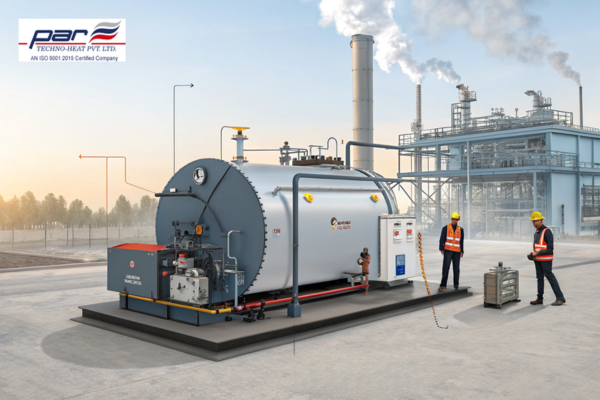
Steam boiler systems in India are integrated industrial systems that generate steam by heating water using coal, biomass, natural gas, LPG, oil, or agro-waste. The steam produced is used for process heating, sterilisation, drying, power generation, and manufacturing operations across industries including textile, food, pharmaceutical, chemical, paper, sugar, and power generation. Key design factors are operating pressure, steam capacity, fuel type, and IBR compliance. Efficiency is improved through economisers, condensate recovery, and PLC automation. Par Techno-Heat Pvt. Ltd. manufactures IBR-certified industrial steam boiler systems from its facility in Sanand, Ahmedabad, Gujarat.
Steam boiler systems play a vital role in India's industrial infrastructure. From textile mills in Surat and chemical plants in Vadodara to food processing units in Pune and sugar factories across Maharashtra and Gujarat, steam boilers are the primary source of process heat that keeps industrial operations running continuously.
India's manufacturing sector operates under conditions that make boiler selection genuinely complex: fuel availability varies dramatically by region, load conditions fluctuate with seasonal and production cycles, environmental regulations are tightening, and the same boiler that works well for a 5 TPH rice mill in Punjab will not suit a 20 TPH textile plant in Ahmedabad or a 50 TPH co-generation system in a sugar factory. Understanding what determines the right system and what makes it perform reliably over a 15–25 year operating life is what this guide covers.
A steam boiler is the pressure vessel that converts water to steam the furnace, heat exchange surfaces, drum, and safety fittings. A steam boiler system is the complete integrated installation that makes the boiler function reliably: the boiler plus the feedwater system, fuel handling and combustion system, water treatment, condensate recovery circuit, flue gas management, controls and automation, and all safety equipment. The performance of the complete system determines plant operating cost not the boiler specification in isolation.
A complete steam boiler system typically includes:
The distinction matters practically. A plant engineer who specifies only the boiler and leaves the rest to be improvised during installation typically ends up with a system that underperforms feedwater quality problems that cause scaling, oversized or undersized pumps, poorly designed condensate return that loses recoverable heat, or emissions that exceed consent conditions because the bag filter was afterthought-specified rather than sized for the actual flue gas conditions.
Quick Answer: A steam boiler works by burning fuel in a furnace to generate heat, which transfers to water through fire tubes or water tubes. Water heats to saturation temperature at the operating pressure and converts to steam. Steam exits to the process through the distribution system. Condensate from the process returns to the feedwater tank, completing the cycle. PLC controls regulate pressure, water level, and firing rate throughout.
System Flow: Fuel → Combustion → Heat Transfer → Steam Generation → Steam Distribution → Process → Condensate Recovery → Feed Tank → Boiler
In a fire tube boiler, hot combustion gases flow through tubes that are surrounded by water in a cylindrical shell. The 3-pass design is the most common industrial configuration in India gases pass through the furnace tube (first pass), return through a first tube bank (second pass), and exit through a second tube bank (third pass). Fire tube boilers are practical up to approximately 18 kg/cm² operating pressure and are widely used in small-medium industries at capacities of 0.5–15 TPH.
Best for: Food processing, dairy, pharmaceutical, textile (small-medium), hotels, hospitals, and general process heating at low-medium pressure where gas or oil fuel is available.
In a water tube boiler, water flows inside the tubes with hot combustion gases flowing over the outside. The furnace is enclosed by water-cooled membrane wall tubes. Natural circulation drives steam-water mixture to the steam drum at the top. Water tube designs operate at 20–90+ kg/cm² and scale to 2–500+ TPH well beyond fire tube capability. They are the standard choice for high-pressure, high-capacity, and solid fuel FBC applications. For a complete technical comparison of both designs, see our guide on the difference between water tube and fire tube boilers.
Best for: Sugar mills, large textile plants, chemical plants, paper and pulp, power generation, and co-generation requiring high-pressure superheated steam.
Biomass steam boilers burn agricultural residues and organic waste rice husk, bagasse, wood chips, cotton stalks, groundnut shells, sawdust, and other agro-waste as primary fuel. Modern biomass designs use Fluidized Bed Combustion (FBC) technology, which burns fuel in a turbulent bed of hot sand at 750–900°C, achieving high combustion efficiency even with high-ash fuels like rice husk (18–22% ash content). The availability of biomass fuel near many Indian industrial clusters makes biomass boilers economically attractive for textile mills, rice mills, food processors, and paper plants. For a complete guide to biomass boiler types and fuel specifications, see our biomass boiler working, fuel types, and manufacturers guide.
Coal-fired steam boilers remain widely used across large industrial applications in India, particularly in cement, steel, fertilizer, and power generation where coal is the cost-effective primary fuel. Modern coal-fired designs use FBC or CFBC technology that handles Indian coal's high ash content (25–40%) more effectively than conventional chain grate stokers, achieving better combustion efficiency and lower particulate emissions. Coal-fired boilers require comprehensive pollution control equipment cyclone separators, bag filters, or ESPs to meet CPCB consent conditions.
Gas-fired steam boilers using natural gas (PNG) or LPG offer clean combustion, high efficiency (85–92%), fully automatic operation, and no ash handling making them the preferred choice for food, pharmaceutical, dairy, and urban industrial applications where PNG infrastructure is available. Gas boilers require no pollution control equipment to meet CPCB PM emission norms, which simplifies the overall system considerably. For a complete guide see our industrial gas boiler working, types, and price guide.
Oil-fired boilers use diesel, light diesel oil (LDO), or furnace oil. They provide reliable performance and do not require ash handling, but fuel cost is typically higher than coal, biomass, or natural gas alternatives. Oil firing is used as backup fuel in many dual-fuel installations and as primary fuel in remote locations without gas pipeline access or biomass supply.
Multi-fuel boiler designs allow a single boiler to operate on two or more fuels most commonly coal plus biomass, or gas plus oil providing operational flexibility as fuel prices and availability change seasonally. FBC designs are inherently suited to multi-fuel operation as the fluidized bed provides stable combustion conditions for fuels of varying calorific value, moisture, and ash content.
| Parameter | Fire Tube Boiler | Water Tube Boiler |
|---|---|---|
| Fluid inside tubes | Hot combustion gas | Water and steam-water mixture |
| Max practical pressure | Up to ~18 kg/cm² | 20 – 90+ kg/cm² |
| Typical capacity | 0.5 – 20 TPH | 2 – 500+ TPH |
| Load response | Moderate (large water volume) | Faster (small tube water volume) |
| Superheated steam | Limited | Yes superheater section available |
| Solid fuel capability | Limited | Excellent FBC, CFBC, stoker designs |
| Capital cost (same capacity) | Lower | Higher |
| Installation | Packaged, minimal civil work | Site-erected, civil foundation required |
| Maintenance | Simpler tube access from front/rear | More components; drum internal inspection |
| Best suited for | Food, dairy, pharma, small textile, hotels low-medium pressure gas/oil | Sugar, large textile, chemical, power, co-gen high pressure, solid fuel |
The design of a steam boiler system directly determines its performance, reliability, safety, and operating cost over its full service life. A boiler specified purely to a nameplate capacity without accounting for actual process dynamics is one of the most common sources of operational problems in Indian industrial plants the boiler runs oversized at part load with poor efficiency, or undersized at peak demand with inadequate pressure.
Steam demand must be calculated from actual process data not estimated from plant area or general industry benchmarks. The calculation must identify peak simultaneous demand (all steam-using equipment running simultaneously at maximum load) and average demand. The difference between these two figures determines whether a single boiler with adequate margin or multiple smaller boilers with staged operation is more appropriate. Startup demand the steam required to heat up process equipment from cold can be significantly higher than running demand and must be included in peak sizing.
Boiler operating pressure should be determined by the most pressure-demanding process connection in the plant, with sufficient margin for distribution pipe pressure drops. Operating at unnecessarily high pressure wastes energy each additional 1 kg/cm² above the minimum required raises saturation temperature and increases blowdown and radiation losses. Conversely, specifying too low a pressure for the actual process requirement forces either a second boiler installation or a costly pressure vessel upgrade.
IBR-approved boiler quality steel plate with certified mechanical properties and traceability to the certified mill is the minimum material standard for pressure vessel components. All seam welding must be performed by IBR-certified welders using qualified procedures. Radiographic or ultrasonic examination of pressure vessel seams is required at specific stages during fabrication this is not a quality option, it is a statutory requirement under the Indian Boilers Regulations for boilers above the applicable threshold.
Modern steam boiler systems in India are designed with PLC-based automation that regulates steam pressure (through burner firing rate or fuel feed control), drum water level (through feedwater pump control), safety interlocks (low water level shutdown, high pressure shutdown, flame failure shutdown for gas/oil designs), alarm annunciation, and operational data logging. SCADA integration allows remote monitoring and historical data analysis increasingly important for plants with multiple boilers or remote boiler house locations.
| Fuel | Availability in India | Combustion System | APC Equipment Required | Best Application |
|---|---|---|---|---|
| Rice Husk | Punjab, Haryana, WB, AP, Gujarat near rice mills | FBC / AFBC grate | Yes cyclone + bag filter | Rice mills, agro-processing |
| Bagasse | Sugar mills Maharashtra, Karnataka, UP, Gujarat, TN | CFBC / spreader stoker | Yes cyclone + bag filter | Sugar mills, co-generation |
| Wood Chips / Briquettes | Timber yards, plywood, paper industries | FBC / stoker | Yes cyclone + bag filter | Textile, ceramic, paper |
| Coal | Pan-India variable quality (25–40% ash typical) | AFBC / CFBC / stoker | Yes cyclone + ESP or BF | Large industrial, power plants |
| Natural Gas (PNG) | Major cities and industrial corridors | Gas burner (modulating) | No | Food, pharma, textile (urban), dairy |
| LPG | Pan-India no pipeline required | Gas burner | No | Where PNG not available; clean fuel required |
| Diesel / LDO | Pan-India on-site storage needed | Oil burner | Minimal (low ash, some soot) | Backup fuel; remote locations |
| Multi-fuel blends | Coal + biomass combinations | FBC (handles variable blends well) | Yes — cyclone + bag filter | Plants with variable fuel supply |
Fuel selection is one of the most important long-term economic decisions in a boiler system investment. The delivered cost of fuel per kg of steam generated not the boiler purchase price determines the dominant operating cost over a 15–20 year boiler life. For a detailed cost comparison across fuel types at Indian market prices, see our boiler fuel comparison guide — coal vs biomass vs gas vs diesel.
Boiler thermal efficiency is the percentage of fuel energy input that is converted into useful steam output. For an industrial boiler in typical Indian plant operation, the gap between rated efficiency and actual plant efficiency is often significant and the gap is almost always manageable with correct operational practices.
For a practical guide covering these and additional efficiency improvement measures in operating boiler installations, see our guide on how to improve boiler efficiency.
| Efficiency Factor | Impact on Efficiency | Improvement Action |
|---|---|---|
| Excess combustion air | Each 1% excess O₂ loses approx. 0.4–0.6% efficiency | Regular flue gas analysis; burner tuning |
| Scale on tubes (1mm) | Increases fuel consumption ~8–10% | Water treatment; regular tube cleaning |
| Economiser | Improves efficiency by 3–8% | Install economiser; maintain clean surfaces |
| Condensate recovery | Reduces fuel and water treatment cost | Return condensate to feed tank; repair steam traps |
| Feedwater temperature | Each 6°C rise ≈ 1% efficiency improvement | Deaerator; condensate recovery; economiser |
| Blowdown losses | Excessive blowdown wastes energy | Monitor TDS; minimise blowdown to requirement |
| Insulation losses | Damaged insulation increases standby losses | Annual insulation inspection; repair damage promptly |
| Operating load factor | Below 60% rated load reduces efficiency | Right-size boiler; consider multiple smaller units |
Water quality is the factor most frequently underestimated by industrial plant engineers when commissioning a new boiler and the one most likely to create expensive problems within the first 3–5 years of operation if not properly addressed.
Scale formation: Hard water containing dissolved calcium and magnesium carbonates forms scale on heat transfer surfaces as temperature rises. Scale insulates the tube surface, raising metal temperature, reducing heat transfer efficiency, and in severe cases causing tube overheating and failure. Even small-thickness scale deposits have significant efficiency impact.
Corrosion: Dissolved oxygen in feedwater causes pitting corrosion of drum and tube internal surfaces. Low pH causes acid attack; high pH can cause caustic corrosion. Proper chemical treatment oxygen scavengers, pH adjustment, scale inhibitors combined with mechanical deaeration protects the pressure vessel from corrosion-related life reduction.
Carryover: Poor steam quality steam carrying water droplets from the drum reduces steam energy content, causes water hammer in distribution lines, and carries dissolved solids that contaminate process equipment and deposit on downstream heat exchangers.
Blowdown management: Continuous blowdown from the steam drum removes concentrated boiler water to control total dissolved solids (TDS). Intermittent bottom blowdown from the mud drum removes settled sludge. Both must be managed to maintain water quality within specification without excessive heat and water loss.
The steam boiler itself is only the core of a complete steam generation system. The auxiliary equipment surrounding it determines how reliably, efficiently, and safely the system operates in practice.
Important: IBR applicability depends on the boiler's design, pressure, dimensions, and applicable Indian Boilers Regulation Act and Regulations as interpreted by the relevant state authority. The information below is a general overview. Confirm specific registration and certification requirements with the state boiler inspectorate or a qualified boiler professional before procurement. This is not legal advice.
The Indian Boilers Regulation (IBR) Act, 1950, and associated Regulations govern the design, fabrication, registration, and periodic inspection of steam boilers in India. The Act is administered at the national level by the Central Boiler Board (CBB) and at the state level by State Boiler Inspectorates under the respective State Factories Acts.
Steam boilers meeting the applicable threshold criteria must comply with several statutory requirements: design drawings must receive CBB approval; pressure vessel materials must be certified with traceability to approved mills; stage inspection by an IBR-authorised inspector is required during fabrication; hydraulic pressure testing at 1.5× working pressure is required before commissioning; the boiler must be registered with the state boiler inspectorate before operation; and periodic inspection typically annual by an IBR-authorised inspector is required throughout the boiler's operating life.
Beyond IBR, environmental compliance is governed by CPCB (Central Pollution Control Board) and State PCBs through consent-to-operate conditions. Solid fuel boilers must meet specific particulate matter (PM) emission limits through bag filters, cyclone separators, or ESPs specified in the consent conditions. Gas-fired boilers typically meet CPCB PM limits without additional pollution control equipment.
All industrial steam boilers operating under IBR must be equipped with specific mandatory safety devices. Beyond IBR's minimum requirements, modern safety system design adds additional protective layers.
For comprehensive safety management guidance applicable to industrial boiler operations under the IBR Act and Factory Safety standards, see our boiler safety guidelines for industries.
Steam boiler systems serve as the primary source of process heat across virtually every manufacturing sector in India. The specific steam requirement pressure, capacity, quality, and continuity varies significantly by industry.
| Industry | Primary Steam Application | Typical Boiler Type |
|---|---|---|
| Textile Industry | Dyeing, washing, calendering, stenter heating, finishing | Bi-drum FBC solid fuel or gas-fired fire tube |
| Food & Beverage | Cooking, sterilisation, pasteurisation, CIP cleaning, drying | Gas or oil fire tube packaged boiler |
| Dairy Industry | Pasteurisation, UHT processing, CIP, packaging line heating | Gas or oil fire tube packaged boiler |
| Pharmaceutical | Clean steam for autoclaves, sterilisation, GMP process areas | Gas-fired fire tube; electric boiler |
| Chemical Industry | Reactor heating, distillation, heat exchangers, jacketed vessels | High-pressure water tube (gas/coal) |
| Sugar Industry | Juice evaporation, pan heating, co-generation from bagasse | CFBC bagasse water tube boiler |
| Paper & Pulp | Pulping, drying, surface sizing, co-generation | Large water tube boiler |
| Rice Mills | Parboiling, drying | Rice husk FBC bi-drum water tube |
| Distillery | Fermentation heating, distillation column steam | Multi-fuel or bagasse water tube |
| Fertilizer Plants | Steam reforming, process steam, utilities | High-pressure water tube |
| Power Generation / Co-gen | High-pressure superheated steam for turbine drives | Large water tube or CFBC |
| Refineries & Petrochemicals | Process heating, steam tracing, reforming, utilities | High-pressure water tube, HRSG |
Air pollution control is not optional for solid fuel industrial boilers in India it is a statutory requirement as a condition of the CPCB/SPCB consent to operate. The specific emission control equipment required depends on the fuel type, boiler capacity, flue gas characteristics, and the PM outlet limit specified in the consent conditions.
For coal and biomass boilers, the standard configuration in Indian industrial practice is a multi-cyclone separator ahead of a pulse jet bag filter. The cyclone removes coarse fly ash (particles above 10–20 microns), protecting the bag filter bags from abrasive coarse particle wear. The bag filter removes fine particulate matter to within consent condition PM limits typically 100–150 mg/Nm³ for medium industrial boilers. For high-ash Indian coal with 25–40% ash content, correct bag filter sizing (conservative air-to-cloth ratio of 0.8–1.0 m/min) and appropriate filter media (Nomex or PET+PTFE for temperatures above 130°C) are essential for reliable long-term performance.
Gas-fired boilers typically meet CPCB PM emission limits without any additional pollution control equipment clean combustion produces negligible particulate matter. For a complete reference on APC equipment selection for solid fuel boilers, see our industrial bag filter manufacturers and suppliers guide.
Gas boilers and solid fuel boilers have different maintenance profiles, but both require structured, scheduled maintenance to maintain efficiency and safety. Deferred maintenance on a steam boiler does not simply reduce performance it creates safety risks and statutory compliance issues that can result in forced shutdown during IBR inspection.
For a complete structured maintenance programme across all frequencies and boiler types, see our industrial boiler maintenance checklist used by plant teams across India.
| Problem | Possible Causes | Recommended Direction |
|---|---|---|
| Low steam pressure | Steam demand exceeds boiler capacity; burner firing rate reduced; leaking steam valves; steam line losses | Verify steam demand vs boiler rating; check burner; inspect distribution for leaks |
| High fuel consumption | Excessive excess air; scale on heat transfer surfaces; damaged insulation; excessive blowdown; poor condensate return | Flue gas analysis; tube inspection; insulation audit; blowdown TDS measurement |
| High flue gas temperature | Scale on heat exchange tubes; blocked economiser; excess air too high for design | Inspect and clean tubes; check economiser; combustion analysis |
| Wet steam / poor steam quality | High TDS causing foaming; high water level in drum; overloaded beyond rated capacity; failed drum separator internals | Measure boiler water TDS; check drum level control; verify steam output vs rating |
| Scale formation | Inadequate water softening; chemical dosing system failure; excessive makeup water without treatment | Check softener output hardness; verify chemical dosing pump operation; increase blowdown temporarily |
| Water level instability | High TDS causing foaming (shrink/swell); blocked gauge glass; faulty level transmitter; feed pump control fault | Measure TDS; blow down gauge glasses; calibrate level instruments; check feed pump |
| Frequent safety valve lifting | Steam demand has dropped but firing rate not reduced; pressure control malfunction; safety valve set point incorrect | Check pressure control system; verify steam demand; review safety valve setting |
| Excessive blowdown | Poor condensate return (introducing untreated makeup); inadequate water softening; chemical overdosing raising TDS | Increase condensate recovery; check softener; review chemical dosing rates |
Steam boiler system cost varies significantly and depends on many factors beyond simply the boiler's TPH rating. A 5 TPH gas-fired fire tube boiler and a 5 TPH biomass FBC water tube boiler are completely different capital investments and neither price is comparable without knowing the operating pressure, automation level, pollution control requirement, and site conditions.
Key cost factors include: steam capacity and operating pressure, boiler type (fire tube vs water tube), fuel type and combustion system, automation and PLC complexity, economiser and air preheater, feedwater system and water treatment, chimney height and specification, pollution control equipment (bag filter, cyclone, ESP required for solid fuel), installation and civil foundation, commissioning and IBR registration, and ongoing service capability of the manufacturer.
Looking for pricing guidance specific to your requirement? Par Boiler's engineering team prepares a detailed technical specification and quotation based on your steam output, operating pressure, fuel type, and site conditions allowing accurate cost comparison between configurations. Request a free quotation and consultation.
Steam boiler systems in India are evolving significantly in response to tightening CPCB emission standards, improving biomass fuel infrastructure, and growing industrial awareness of energy cost and environmental compliance as linked business issues not separate concerns.
The shift toward biomass fuel rice husk, bagasse, wood chips, and agricultural residues is driven by the economics of fuel cost reduction alongside genuine environmental benefit. Biomass combustion operates on a short carbon cycle: the CO₂ released was absorbed by the plant during its growth, unlike fossil fuel combustion which releases ancient stored carbon. For plants near biomass source regions, the fuel cost advantage over coal can be substantial, while regulatory compliance is typically easier to achieve.
Waste heat recovery from DG set exhaust, process furnace flue gas, or boiler blowdown represents another significant sustainability opportunity. A waste heat recovery boiler (WHRB) capturing DG exhaust generates steam without any additional fuel consumption, delivering a payback period that is typically measured in months rather than years.
Condensate recovery systems, rigorous feedwater treatment to minimise makeup water consumption, and insulation maintenance to reduce heat losses are all practical sustainability measures that simultaneously reduce operating cost and environmental impact.
Par Techno-Heat Pvt. Ltd. (Par Boiler) manufactures industrial steam boiler systems from its facility in Sanand, Ahmedabad, Gujarat covering the complete range of fire tube, water tube, biomass FBC, and oil/gas-fired designs from 0.5 TPH to 30 TPH for industries across India.
What this means for an industrial buyer: the boiler, combustion system, pollution control equipment, and ash handling system can be designed as a coordinated package by a single engineering team eliminating the interface design problems that arise when different suppliers handle these connected systems independently. IBR certification, PLC automation, and commissioning support are standard, not optional extras.
Par Boiler's Ahmedabad location provides practical service response for Gujarat industries and national supply capability for projects across India. For the full range of Par Boiler's boiler and industrial heating equipment, see our guide to the top 10 industrial boiler manufacturers in India.
Par Techno-Heat Pvt. Ltd. IBR-certified industrial steam boiler manufacturer in Ahmedabad, Gujarat designs and supplies complete steam boiler systems from 0.5 TPH to 30 TPH for coal, biomass, gas, and oil applications across India. Fire tube, water tube, packaged, and FBC configurations available. Share your steam requirement, fuel type, and site location for a free technical consultation.
Get a Free Steam Boiler ConsultationA steam boiler system is the complete integrated installation that generates, distributes, and manages steam for industrial processes. It includes the boiler (the pressure vessel that converts water to steam), plus the feedwater system, fuel handling, water treatment, condensate recovery, controls and automation, safety equipment, and flue gas management. A well-designed steam boiler system delivers reliable, efficient, and safe steam for the full range of industrial heating, drying, sterilisation, and power generation applications.
A steam boiler burns fuel in the furnace to generate hot gases. These gases transfer heat to water through fire tubes (gas inside, water outside) or water tubes (water inside, gas outside). Water heats to saturation temperature at the drum's operating pressure and converts to steam. Steam accumulates in the steam space and exits through the main outlet to the process. Condensate from the process returns to the feedwater tank completing the cycle. PLC controls regulate pressure, level, and firing rate automatically.
The main types are: fire tube boilers (gas, oil low-medium pressure, 0.5–20 TPH), water tube boilers (coal, biomass, gas high pressure, 2–500+ TPH), biomass boilers (rice husk, bagasse, wood chips FBC designs), coal-fired boilers (AFBC, CFBC), gas-fired boilers (natural gas, LPG), oil-fired boilers (diesel, LDO), and multi-fuel boilers capable of operating on two or more fuels. Each suits specific pressure, capacity, fuel, and industry combinations.
Fire tube boiler: hot combustion gases pass through tubes surrounded by water suitable for low-medium pressure (up to ~18 kg/cm²) at 0.5–20 TPH. Simpler, lower capital cost, packaged installation. Water tube boiler: water flows inside tubes with hot gases outside handles 20–90+ kg/cm² and 2–500+ TPH. Required for high pressure, large capacity, superheated steam, and solid fuel FBC applications. The choice depends on operating pressure and steam capacity requirement, not preference.
Industrial steam boilers in India use natural gas (PNG), LPG, diesel, LDO, furnace oil, coal (various grades), rice husk, bagasse, wood chips, sawdust, groundnut shells, cotton stalks, mustard stalks, biomass pellets, and multi-fuel combinations. FBC water tube designs handle the broadest fuel range, including high-ash fuels like rice husk and low-grade coal that cause problems in conventional stoker designs. Fuel selection should be based on local availability, delivered price, combustion characteristics, and emission compliance requirements.
Boiler thermal efficiency is the percentage of fuel energy input converted into useful steam output, measured by the direct method (steam output energy ÷ fuel energy input × 100) or indirect method (100% minus sum of all identified heat losses). Modern industrial steam boilers achieve 78–92% efficiency depending on design, fuel type, and heat recovery accessories. The most significant efficiency improvement opportunities are usually combustion optimisation, economiser installation, and condensate recovery.
Key efficiency improvements: (1) Optimise excess air through regular combustion analysis and burner tuning. (2) Keep heat transfer surfaces scale-free through correct water treatment and periodic tube cleaning. (3) Install or maintain an economiser for feedwater preheating. (4) Maximise condensate recovery from process equipment. (5) Control blowdown to the minimum TDS-determined rate. (6) Maintain insulation condition. (7) Operate the boiler at or near its rated capacity where possible. (8) Monitor flue gas t
