



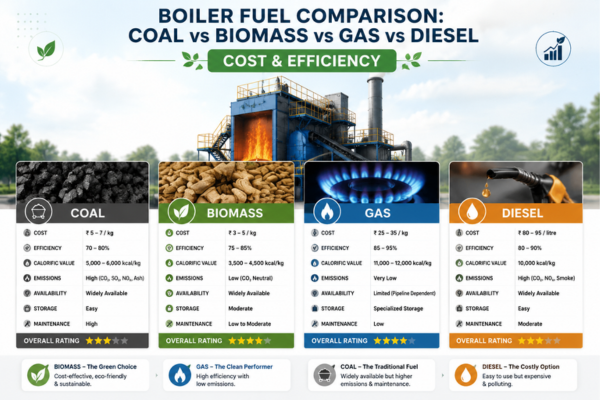
A plant manager in Rajkot recently compared four fuel quotes for a 5 TPH boiler: coal at ₹14/kg, rice husk biomass at ₹2.50/kg, piped natural gas at ₹48/m³, and diesel at ₹92/litre. On paper, biomass looked like an obvious win. Then he ran the numbers against his actual steam demand, his available floor space for a fuel yard, and his plant's CPCB emission category. The obvious win stopped being obvious.
This is the trap every industrial buyer falls into when comparing boiler fuels: pricing the fuel instead of pricing the steam.
A rupee per kilogram of coal and a rupee per kilogram of rice husk are not comparable numbers. Coal carries roughly twice the calorific value of rice husk. Burn the same weight of each and you get very different steam output. The question that actually matters is not "what does this fuel cost" but "what does it cost me to generate one tonne of steam, sustained, for the next fifteen years, inside the emission limits my pollution board will actually enforce."
This guide runs that comparison properly: coal, biomass, gas, and diesel, measured in rupees per kg of steam, combustion efficiency, emission compliance burden, and the operational factors that determine whether a fuel choice that looks smart on a spreadsheet survives contact with your actual plant.
The real cost of a boiler fuel is steam output per rupee spent, not rupees per kilogram of fuel purchased. A fuel with a lower price tag but lower calorific value and lower combustion efficiency can cost more per tonne of steam than a fuel that looks expensive on the invoice. The three numbers that determine actual cost are calorific value, achievable combustion efficiency, and landed price at your specific location.
Calorific value tells you how much heat energy sits inside each kilogram of fuel. Combustion efficiency tells you how much of that energy actually converts into steam rather than escaping up the chimney or sitting unburned in the ash. Landed price tells you what the fuel costs once transport, handling, and storage are added to the quoted rate.
Multiply these three together correctly and you get the number every plant should be calculating before signing a fuel supply contract: cost per kg of steam generated. Get this number wrong, and a fuel switch that was supposed to cut costs quietly erodes margin for years before anyone notices.
Coal remains the most expensive mainstream boiler fuel on a per-kg-of-steam basis in most parts of India in 2026, running ₹9–₹14 per kg of steam generated once handling and ash disposal are included. Calorific value sits at 4,500–5,500 kcal/kg, achievable combustion efficiency in a well-maintained boiler runs 78–84%, and the fuel price itself has climbed steadily on transport cost and statutory levies over the past several years.
Coal's case rests on availability, not economics. It is sold through an established supply chain, stored without the spoilage risk that affects organic biomass, and burns predictably with decades of operating experience behind it.
The honest concession: coal still makes sense for plants without access to a reliable biomass supply chain and without a pipeline gas connection. A standalone facility in an industrial estate with no agro-processing nearby and no PNG infrastructure may find coal is genuinely the most practical option, not the cheapest, the most practical. That distinction matters when you are comparing options on paper rather than against your actual location.
What coal does not survive well is regulatory scrutiny. CPCB norms on particulate matter, SOx, and NOx have tightened steadily, and a coal-fired boiler without proper bag filters or electrostatic precipitation faces real compliance risk. Add the cost of that pollution control equipment to the fuel price, and coal's apparent affordability narrows further.
Biomass fuel costs ₹1.50–₹6 per kg of steam in regions with local agro-waste supply, making it the lowest-cost mainstream boiler fuel in India when the plant sits within practical trucking distance of rice mills, sugar factories, or timber processing. Calorific value ranges from 2,200 kcal/kg for bagasse to 4,200 kcal/kg for wood chips, and modern FBC combustion technology achieves 88–96% efficiency on these fuels, well above what conventional grate-fired systems manage.
A rice mill in Punjab does not pay for rice husk in the way a textile unit in an urban industrial estate does. Rice husk near its source costs ₹1–₹3 per kg. The same husk delivered 200 kilometres away costs three or four times that, once transport eats into the economics. Biomass is not a uniformly cheap fuel. It is a cheap fuel for plants located near its source and an increasingly marginal fuel for plants that are not.
This is the single most common mistake industrial buyers make when evaluating biomass: pricing it off a national average rather than their specific catchment. A plant 30 kilometres from three rice mills faces a completely different biomass economics than a plant in the middle of a city with no agricultural processing for 150 kilometres in any direction.
Consider a 5 TPH boiler running 20 hours a day, 25 days a month, in two different locations. The first sits near a rice mill cluster in Punjab and sources husk at ₹2/kg, landing total monthly fuel cost around ₹7–9 lakh. The second sits in an industrial park outside Pune with no local biomass and pays ₹5–6/kg after transport, pushing the same boiler's monthly fuel bill to ₹18–22 lakh. Same boiler. Same fuel category. Triple the cost, purely on geography.
Biomass also demands space and handling infrastructure that coal and gas do not: a covered fuel yard, a feeding system engineered for the specific fuel's density and moisture, and ash handling that scales with the fuel's ash content. For rice husk specifically, that ash content runs near 20% by weight, which is why our guide on biomass boiler working principle and fuel types goes into the fuel-specific handling requirements that the price comparison alone does not capture.
Natural gas (PNG) costs ₹6–₹9 per kg of steam in 2026, sitting between biomass and coal on raw fuel economics while delivering the cleanest combustion profile and the lowest installation complexity of any mainstream boiler fuel. Calorific value runs around 8,500 kcal/m³, achievable efficiency in a modern gas boiler reaches 88–92%, and there is no ash, no fuel storage yard, and minimal pollution control equipment required.
Gas does not win on raw fuel cost. It wins on total cost of ownership, the number that includes installation, pollution control equipment, ash disposal, and the labour required to run the fuel handling system day after day. A gas-fired boiler installs in weeks, not months. It requires no fuel yard, no ash pit, and no bag filter sized for particulate capture. Strip those costs out of a coal or biomass installation and gas's apparent cost disadvantage shrinks considerably.
The honest limitation: gas only works where PNG pipeline infrastructure actually reaches the plant, or where LPG cylinder logistics make sense at the required volume. A plant outside the gas grid pays a meaningfully higher price for LPG, which erodes gas's cost position relative to biomass in exactly the locations where biomass would otherwise be expensive too.
For plants weighing a gas boiler specifically, our detailed breakdown of industrial gas boiler price and running cost in India runs the natural gas versus LPG versus LDO comparison in full, with hourly running cost tables for a 5 TPH system.
Diesel and Light Diesel Oil (LDO) cost ₹10–₹15 per kg of steam in 2026, making them the most expensive fuel option for sustained, full-load boiler operation in nearly every Indian industrial location. Calorific value sits at 10,200 kcal/litre, efficiency runs 82–86%, and the fuel price tracks crude oil markets closely, which means it carries more volatility than any other option on this list.
Diesel's role in a well-designed boiler fuel strategy is not primary fuel. It is insurance. A dual-fuel burner that runs on gas with diesel as backup protects a plant against the one scenario every fuel strategy must plan for: the day the primary fuel supply fails and production cannot stop. Priced as backup fuel, diesel earns its place in the system. Priced as a primary fuel for continuous 20-hour daily operation, it is the most expensive way to generate steam in India in 2026.
| Fuel | Calorific Value | Efficiency | Fuel Price (2026) | Cost per kg Steam | Monthly Cost (Approx.) |
|---|---|---|---|---|---|
| Coal | 4,500–5,500 kcal/kg | 78–84% | ₹10–₹16/kg | ₹9–₹14 | ₹9–₹14 Lakh |
| Biomass (Near Source) | 2,200–4,200 kcal/kg | 88–96% | ₹1.5–₹3/kg | ₹1.5–₹3.5 | ₹2–₹4 Lakh |
| Biomass (Transported) | 2,200–4,200 kcal/kg | 88–96% | ₹4–₹6/kg | ₹4–₹6 | ₹5–₹8 Lakh |
| Natural Gas (PNG) | 8,500 kcal/m³ | 88–92% | ₹40–₹55/m³ | ₹6–₹9 | ₹8–₹11 Lakh |
| LPG | 11,900 kcal/kg | 86–90% | ₹90–₹110/kg | ₹9–₹13 | ₹11–₹16 Lakh |
| Diesel / LDO | 10,200 kcal/litre | 82–86% | ₹80–₹95/litre | ₹10–₹15 | ₹12–₹18 Lakh |
Note: Monthly cost estimates may vary based on boiler capacity, operating hours, fuel quality, local fuel prices, and steam demand
A fuel's price tag never includes the cost of staying legal while burning it, and that gap is exactly where fuel comparisons go wrong. Coal and diesel both require meaningful investment in particulate and gas-phase pollution control to meet CPCB norms: bag filters or electrostatic precipitators for particulates, and in some State PCB jurisdictions, additional NOx and SOx controls for larger installations. Biomass requires similar particulate control but benefits from naturally lower sulfur content. Gas requires the least additional equipment of any fuel on this list, often passing emission norms with nothing beyond the burner's inherent low-emission combustion characteristics.
Add ₹3–₹12 lakh in pollution control equipment to a coal or biomass installation's capital cost, and the comparison against gas shifts further than the raw fuel price suggests. This is not an argument against coal or biomass. It is an argument for running the comparison with every cost included, not just the one printed on the fuel supplier's quotation.
None of them, universally. The fuel that wins is the one that matches your plant's specific geography, capacity, and regulatory exposure. Ask these four questions before any fuel decision: (1) What sits within 50 kilometres of my plant — agro-waste, a gas pipeline, or neither? (2) What is my CPCB emission category, and what pollution control does that category force regardless of fuel choice? (3) Do I have floor space for a fuel yard and ash handling, or does my site constrain me toward gas? (4) What is my realistic annual operating hours, since fuel economics shift meaningfully between a boiler running 8 hours a day and one running 24?
A textile unit in Surat with no agro-waste nearby and a PNG connection at the gate should not be chasing biomass economics that only work 200 kilometres away. A rice mill in Punjab sitting on free husk should not be paying coal or gas prices out of habit. The fuel comparison is not abstract. It is a geography problem dressed up as a cost problem.
For plants evaluating biomass specifically, FBC combustion technology changes the efficiency side of this comparison meaningfully: our guide on FBC boiler working principle and why it suits biomass fuel explains why a 2026-spec FBC system closes much of the efficiency gap that older grate-fired biomass boilers could never close.
Not every boiler manufacturer in India engineers equally well across all four fuel types. A manufacturer with deep coal-fired experience may have only assembled, not designed, their biomass combustion systems. The fuel decision and the manufacturer decision are not separate conversations: ask any shortlisted manufacturer to show reference installations on your specific fuel, not a generic capability claim.
Our structured boiler manufacturer selection checklist covers the evaluation criteria that matter for fuel-specific design competence, and our complete reference on top steam boiler manufacturers in India provides a broader market view before you shortlist.
Once a fuel and boiler are selected, the efficiency conversation does not end at commissioning. Our guide on how to improve boiler efficiency covers the operational practices that determine whether your boiler holds its rated efficiency for fifteen years or quietly drifts below it within three.
Par Techno-Heat Pvt. Ltd. designs and manufactures boilers across all four fuel categories coal, biomass and FBC, natural gas and LPG, and dual-fuel diesel backup configurations from its Ahmedabad facility, with over 25 years of fuel-specific combustion engineering experience. The company's engineering team reviews a plant's actual fuel access, capacity requirement, and emission category before recommending a configuration, rather than defaulting to whichever fuel system is easiest to quote.
If you are weighing fuel options for a new installation or considering a fuel switch on an existing boiler, a 30-minute technical consultation with Par Techno-Heat's engineering team covers your specific location, capacity, and current fuel cost no obligation, no generic sales pitch.
Book a free fuel and capacity consultation with Par Techno-Heat Pvt. Ltd.
Biomass fuel sourced near its origin rice husk, bagasse, or wood chips within local trucking distance is the cheapest option at ₹1.5–₹3.5 per kg of steam. That advantage disappears once transport distance exceeds roughly 50–80 kilometres, at which point natural gas often becomes more economical.
On raw fuel price, coal often appears cheaper per kilogram. On total cost per kg of steam including efficiency, pollution control equipment, and installation natural gas frequently costs less or comparable to coal once all factors are included.
A 5 TPH boiler running 20 hours/day typically costs ₹2–4 lakh/month on near-source biomass, ₹5–8 lakh/month on transported biomass, and ₹9–14 lakh/month on coal. The gap between near-source and transported biomass is often as large as the gap between biomass and coal.
No. Diesel and LDO cost ₹10–15 per kg of steam, the highest of any mainstream fuel in 2026. Diesel is best used as a backup fuel in a dual-fuel burner configuration, not as the primary fuel for continuous operation.
Yes. IBR certification requirements apply regardless of fuel type above the standard pressure threshold, but pollution control equipment requirements differ sharply: coal and diesel need more extensive particulate and gas-phase controls than gas, while biomass needs particulate control but benefits from lower sulfur content than coal.
Some designs support this, particularly FBC boilers engineered for coal-biomass co-firing, but most single-fuel burner systems cannot be retrofitted cheaply. If fuel flexibility matters for your plant, specify a multi-fuel or dual-fuel design at the time of purchase rather than planning to convert later.
Run the comparison against your geography, not the national average. That is the only version of this analysis that pays off.
