



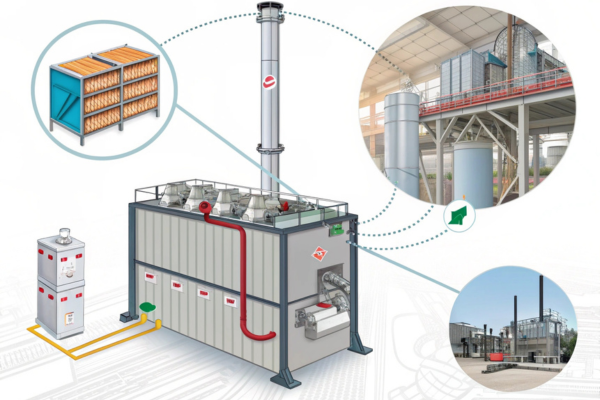
A bag filter for boiler is a fabric filtration system that removes particulate matter (PM) from industrial boiler flue gas, achieving 99–99.9% dust removal efficiency. It is the standard CPCB-compliant air pollution control equipment for coal, biomass, rice husk, and solid fuel industrial boilers in India. Key types include pulse jet bag filters (most common, online cleaning), reverse air bag filters (large installations), and high-temperature bag filters (for flue gas above 150°C). Proper selection of filter media, air-to-cloth ratio, and cleaning mechanism determines long-term performance and compliance. Par Boiler Pvt. Ltd. designs and supplies complete bag filter systems integrated with industrial boiler and ash handling packages.
A boiler without emission control is, in 2026, not a legally operable boiler in India. The CPCB consent-to-operate conditions for every solid fuel industrial boiler specify a maximum particulate matter (PM) outlet concentration at the stack. The equipment that makes the difference between compliance and non-compliance is, in the overwhelming majority of Indian industrial boiler installations, the bag filter.
Bag filters also called fabric filters or pulse jet bag filters are not glamorous equipment. They sit between the boiler and the chimney, largely out of sight, and their contribution to plant operations only becomes visible when they fail: the boiler trips because differential pressure has risen too high, or the CPCB inspector records an opacity violation at the stack, or a bag failure means the dust collector hopper overflows. The plants where none of these things happen are, without exception, the ones where the bag filter was correctly specified, correctly installed, and correctly maintained from day one.
This guide covers everything needed to make correct decisions about bag filters for industrial boilers: how they work at the engineering level, what the types are and where each is appropriate, how to specify the right system for a given boiler and fuel, and what maintenance is required to keep it performing within CPCB limits for the life of the boiler.
A bag filter for a boiler is a fabric filtration device that removes particulate matter from boiler flue gas before it exits through the chimney stack. Dusty flue gas passes through cylindrical filter bags made of woven or felted synthetic fabric dust particles collect on the outer bag surface while clean gas passes through the fabric to the clean air plenum and exits to the stack. The collected dust cake is periodically removed by pulse jet cleaning, dislodging the dust into a collection hopper below the bag rows. Bag filters achieve 99–99.9% PM removal efficiency and are the standard boiler dust collection system for coal, biomass, rice husk, and agro-waste fired industrial boilers in India. They are the primary equipment for achieving CPCB and SPCB consent-to-operate PM emission conditions.
The working principle of a bag filter for boiler is fabric filtration: forcing dusty gas through a permeable fabric medium that allows gas to pass but retains dust particles on its surface. The engineering complexity lies in maintaining this filtration performance continuously as the dust layer builds, and periodically regenerating the filter surface through cleaning without interrupting the gas flow or damaging the bags.
Flue gas from the boiler exits through the main flue duct, passes through a multi-cyclone pre-separator that removes coarse fly ash (particles above 10–20 microns), and enters the bag filter inlet plenum. The multi-cyclone pre-separator is important it reduces the dust loading on the bag filter bags, extending bag life and reducing cleaning frequency. Without a pre-separator, bag filter bags handling high-ash coal or biomass flue gas wear much faster from abrasive coarse particle impingement.
Inside the bag filter housing, the inlet plenum distributes gas evenly across all bag rows. Uneven distribution caused by poor inlet baffle design creates high-velocity zones where certain bags receive disproportionate dust loading, fail faster, and create local bypass paths for unfiltered gas.
Gas flows from the outside of the cylindrical filter bags to the inside (outside-in flow), or in some designs from inside to outside (inside-out flow). In the standard pulse jet bag filter design used in Indian industrial boilers, flow is outside-in: the gas contacts the outer bag surface, dust deposits on the outside, and clean gas passes through the fabric to the clean air plenum inside the bag. Each bag is supported internally by a wire cage that prevents the bag from collapsing inward under the pressure differential.
As dust accumulates on the bag outer surface, it forms a filter cake. This cake is not entirely unwanted a well-formed dust cake actually improves filtration efficiency by creating an additional porous layer that captures fine particles the bare fabric would not intercept. A new, freshly cleaned bag performs slightly worse (for the first few minutes) than a bag with a thin, stable dust cake.
As the dust cake thickens, the differential pressure across the bags measurable as the pressure difference between the inlet gas plenum and the clean air plenum rises. When it reaches the cleaning setpoint (typically 100–150 mm WC above the baseline), the PLC-controlled cleaning sequence activates. A solenoid valve opens for approximately 100–150 milliseconds, discharging a pulse of compressed air (5–7 bar) through a venturi nozzle at the top of each bag row. The compressed air pulse travels down the centre of the bag, rapidly expands the bag fabric outward, and dislodges the outer dust cake with a shockwave effect. The dislodged dust falls into the hopper below.
The cleaning sequence typically fires one row of bags at a time, moving systematically across all rows so that no more than approximately 5% of the total filter area is in cleaning mode at any given moment. This ensures that the overall filtration efficiency is not compromised during cleaning.
Dust that falls into the collection hopper must be continuously or periodically discharged. A rotary airlock valve (rotary feeder) at the hopper outlet allows dust to discharge without allowing the gas pressure inside the bag filter to bypass through the hopper outlet. The discharged dust is conveyed by screw conveyor or pneumatic system to the ash storage silo. For integration with the boiler's complete ash management system, the bag filter discharge is part of the fly ash handling system alongside the cyclone separator hoppers.
For the complete system that connects bag filter ash discharge to storage and truck loading, see our guide on top ash handling systems for industrial boilers in India.
| Component | Function | Critical Specification |
|---|---|---|
| Filter Bags | Primary filtration medium dust collects on outer surface | Fabric type matched to flue gas temperature; correct length-to-diameter ratio |
| Bag Cages (Wire Cages) | Supports bag from collapsing inward under differential pressure | Smooth wires (no burrs that damage bag interior); correct diameter fit |
| Tube Sheet | Horizontal plate separating dirty and clean air plenums; bags seal into tube sheet holes | Tight bag-to-tubesheet seal prevents bypass; critical for emission compliance |
| Dirty Air Plenum | Inlet chamber receiving dusty flue gas from boiler | Baffle design for even gas distribution across all bag rows |
| Clean Air Plenum | Upper chamber receiving clean gas from inside filter bags | Houses pulse jet cleaning header pipes and venturi nozzles |
| Pulse Jet Cleaning Header | Compressed air manifold supplying solenoid valves for bag row cleaning | Correct pipe sizing to maintain adequate cleaning pulse pressure |
| Solenoid Valves | Fast-acting valves releasing compressed air pulse for each bag row | 1/4-turn diaphragm type; must respond within 100 ms |
| Venturi Nozzles | Accelerates and directs compressed air pulse down centre of bag | Correctly sized for bag diameter; misalignment reduces cleaning effectiveness |
| Collection Hopper | Stores dislodged dust below bag rows before discharge | Minimum 60° cone angle prevents dust bridging; capacity for 4–8 hours minimum |
| Rotary Airlock Valve | Continuously discharges collected dust from hopper without pressure bypass | Seal must prevent gas leakage; wear-resistant for abrasive fly ash |
| Differential Pressure Gauge | Measures pressure drop across bags primary performance indicator | 4–20 mA output to PLC for automatic cleaning control; alarm setpoints |
| PLC Control Panel | Sequences cleaning cycles, monitors alarms, manages operations | Sequential row cleaning timer; high/low DP alarms; motor control |
| ID Fan | Induced draft fan draws gas through boiler, cyclone, bag filter, and discharges to chimney | Sized for total system pressure drop including bag filter; corrosion-resistant impeller for moist flue gas |
The pulse jet bag filter is the standard dust collection system for Indian industrial boilers in 2026. It uses short bursts of compressed air approximately 100–150 ms duration at 5–7 bar to clean filter bags row by row while the boiler continues to operate at full load (online cleaning). This is the critical operational advantage: no boiler load reduction, no compartment isolation, no production interruption for cleaning.
Working: Gas flows outside-in through vertical filter bags supported by wire cages. Compressed air pulses sequentially through solenoid valves and venturi nozzles down the centre of each bag row, expanding the bag and dislodging the dust cake. The PLC-controlled cleaning sequence maintains differential pressure within operating limits automatically.
Filter bag length: Typically 2.5–5 m long, 130–160 mm diameter. Longer bags increase filter area per unit footprint but require higher cleaning pulse energy to dislodge dust from the lower bag section.
Best for: All coal, biomass, rice husk, bagasse, and multi-fuel industrial boilers from 2 TPH to 50 TPH and above. The standard specification for new boiler installations in India. For a complete overview of boiler types that require pulse jet bag filters, see our guide on what is an industrial boiler — types, working principle, and applications.
Reverse air bag filters clean bags by reversing the gas flow through them introducing a low-velocity reverse airflow that collapses the bag inward, fracturing and dislodging the dust cake. Cleaning requires the bag compartment being cleaned to be isolated from the main gas flow, making reverse air systems inherently offline-cleaning designs with multiple compartments where one compartment is always in cleaning mode while the others filter.
Best for: Large-scale coal power plant installations (above 50 TPH) where the very large gas volumes and dust loads favour the multi-compartment design, and where fiberglass filter bags (used in older ESP-to-bag-filter conversions) are more compatible with the gentle reverse air cleaning than with pulse jet impulse loads.
Not recommended for: Small to medium industrial boilers (below 30 TPH) where pulse jet designs are simpler, more compact, and deliver equivalent performance at lower capital cost.
The shaker bag filter mechanically shakes the bags by oscillating the top suspension frame, which flexes the bags and fractures the dust cake. Cleaning requires offline operation the compartment is isolated, the fan is stopped or dampered, and the mechanical shaking mechanism activates. Dust falls to the hopper below.
Best for: Small, older boiler installations where compressed air for pulse jet cleaning is not available, or where the dust is very light and cohesive (low bulk density) that pulse cleaning would re-entrain rather than settle into the hopper. Not recommended for new installations pulse jet designs are simpler, more reliable, and deliver better cleaning performance.
A high-temperature bag filter is a pulse jet or reverse air design using filter media rated for continuous service at 150–260°C flue gas temperature, rather than the standard polyester felt media that is limited to approximately 130–140°C. High-temperature bag filters are used when the boiler flue gas exits at temperatures above the safe operating limit of standard filter media common in biomass boilers with direct air pollution control (no separate cooling duct) and in some coal boilers with air preheater configurations that result in elevated APH exit gas temperatures.
Filter media options for high temperature:
| Filter Media | Max Temp (Continuous) | Chemical Resistance | Abrasion Resistance | Relative Cost | Typical Boiler Application |
|---|---|---|---|---|---|
| Polyester (PET) Felt | 130°C | Moderate | Good | Low | Gas/oil boiler, cooled solid fuel flue gas |
| Nomex (Meta-Aramid) | 190°C | Good | Very Good | Medium | Coal and biomass boiler, 130–190°C |
| PET + PTFE Membrane | 130°C | Excellent | Good | Medium | Rice husk, coal — high dust, fine PM |
| Nomex + PTFE Membrane | 200°C | Excellent | Very Good | Medium-High | High-temp biomass, fine PM strict limits |
| P84 (Polyimide) | 240°C | Very Good | Good | High | Cement, sinter plant, high-temp coal |
| Fibreglass | 260°C | Excellent | Poor (brittle) | Medium | Large power plant (reverse air only) |
| PTFE Homofil | 230°C | Outstanding | Good | Very High | Chemical, pharma, acid gas + PM |
| Parameter | Pulse Jet Bag Filter | Electrostatic Precipitator (ESP) |
|---|---|---|
| PM removal efficiency | 99 – 99.9% (consistent) | 95 – 99% (variable with dust resistivity) |
| Fine PM (PM2.5) capture | Excellent (surface filtration with PTFE membrane) | Good but reduced for very fine particles |
| Performance with fuel change | Consistent regardless of fuel or dust composition | Efficiency drops with low-resistivity or high-resistivity dust |
| Capital cost (small-medium boiler) | Lower | Higher |
| Pressure drop | Higher (80–200 mm WC) | Lower (10–20 mm WC) |
| Footprint | Smaller for equivalent capacity | Larger |
| Maintenance complexity | Bag replacement every 2–5 years | Electrode rapping maintenance, TR set servicing |
| Spark/explosion risk | Low (passive fabric filter) | Higher (high-voltage ionisation) |
| Best for | All industrial boilers 2–50 TPH, multi-fuel, biomass, where consistent PM compliance is required | Very large coal power plant boilers (100+ TPH) where pressure drop cost is significant |
For boiler installations below 50 TPH which covers the vast majority of Indian industrial boilers in textile, food, chemical, pharmaceutical, rice mill, and sugar applications the pulse jet bag filter is almost always the right choice over an ESP. For plants that want to understand the complete range of air pollution control solutions available, see our air pollution control solutions guide for industrial plants.
A bag filter that is correctly sized for a boiler's actual operating conditions performs reliably for 15+ years with only bag replacement at planned intervals. An undersized or incorrectly specified bag filter creates persistent problems: excessive differential pressure, shortened bag life, cleaning system overwork, and ultimately emission compliance failures. These are the parameters that determine correct sizing.
| Design Parameter | Typical Range | Why It Matters |
|---|---|---|
| Gas volume (Nm³/hr) | Boiler-specific | Determines total filter area required (air-to-cloth ratio) |
| Gas temperature (°C) | 120 – 220°C | Determines filter media type; must be above acid dew point |
| Inlet dust loading (g/Nm³) | 3 – 30 g/Nm³ | Higher loading requires lower air-to-cloth ratio, more cleaning frequency |
| Air-to-cloth ratio (m/min) | 0.8 – 1.5 m/min | Critical sizing parameter: lower ratio for high dust loading = longer bag life |
| Required outlet PM (mg/Nm³) | 25 – 150 mg/Nm³ | CPCB/SPCB consent condition; determines filter media specification |
| Particle size distribution | Application-specific | Fine PM requires PTFE membrane media or lower air-to-cloth ratio |
| Cleaning pulse pressure (bar) | 5 – 7 bar | Insufficient pulse pressure = incomplete cleaning = rising differential pressure |
| Hopper storage capacity | Min 4–8 hours dust gen. | Undersized hopper overflows if rotary airlock fails; must provide buffer |
| Bag length × diameter | 2.5–5 m × 130–160 mm | Longer bags = more area per row but need higher cleaning energy |
The CPCB (Central Pollution Control Board) and State PCBs specify PM emission limits as conditions of the consent-to-operate issued to every industrial plant operating a solid fuel boiler. These limits are the design targets for the bag filter system the bag filter must reliably keep stack PM emissions below these limits under all normal boiler operating conditions.
| Boiler Type / Fuel | General CPCB PM Limit | Required Bag Filter Efficiency | Recommended Filter Media |
|---|---|---|---|
| Coal fired boiler (small industrial) | 150 mg/Nm³ | 97–99% | Nomex felt or PET + PTFE |
| Biomass boiler (agro-waste, wood) | 100–150 mg/Nm³ | 98–99% | Nomex felt or Nomex + PTFE |
| Rice husk boiler | 100 mg/Nm³ | 99–99.5% | PET + PTFE membrane (fine silica ash) |
| Large coal boiler (>100 TPH) | 50–100 mg/Nm³ | 99.5–99.9% | Nomex + PTFE or P84 |
CPCB PM limits vary by installation date, boiler capacity, and State PCB consent conditions. Verify actual consent condition limits with your SPCB consent document before specifying bag filter outlet performance.
| Industry | Boiler Fuel | Dust Type | Recommended Filter Media |
|---|---|---|---|
| Rice Mills | Rice husk (FBC) | Fine silica fly ash (18–22% ash) | PET + PTFE membrane or Nomex |
| Textile Industry | Coal, biomass, multi-fuel | Coal / biomass fly ash | Nomex felt (130–190°C) |
| Sugar Industry | Bagasse (CFBC) | Bagasse ash, fine particles | Nomex or PET + PTFE |
| Paper & Pulp | Wood waste, coal | Wood ash, fine carbonaceous | Nomex felt |
| Food Processing | Gas or biomass | Light organic dust | PET felt (gas boiler, below 130°C) |
| Chemical Industry | Coal, gas, multi-fuel | Coal ash + possible acid gases | Nomex + PTFE or P84 with PTFE |
| Pharmaceutical | Gas or oil fired | Minimal (gas boiler) | PET felt low cost for clean gas |
| Cement Industry | Coal, alternative fuels | Very fine cement dust + coal ash | P84 or Nomex + PTFE |
| Steel & Foundry | Coal, coke oven gas | Metal fume + coal fly ash | Nomex + PTFE for metal fume |
| Thermal Power Plants | High-ash coal | Very high fly ash loading (25–40% ash) | Nomex + PTFE; low A/C ratio (0.8–0.9) |
For plants operating biomass boilers, the specific fly ash characteristics high silica from rice husk, fibrous content from bagasse or wood chips significantly affect bag filter design and media selection. See our detailed guide on biomass boiler working, fuel types and manufacturers for fuel-specific ash characteristics that affect bag filter specification.
| Frequency | Task | What to Check / Action |
|---|---|---|
| Daily | Differential pressure reading | Record DP; stable or rising trend indicates filter condition; sudden drop means possible bag failure |
| Rotary airlock valve operation | Confirm motor is running at normal amperage; hopper not filling (rotary blockage = hopper overflow) | |
| Compressed air pressure | Confirm supply pressure to cleaning header is at 5–7 bar; low pressure = incomplete cleaning | |
| Weekly | Solenoid valve operation check | Listen for each solenoid firing in sequence; silent solenoid = failed valve, row not being cleaned |
| Hopper level check | Visual inspection through sight glass; elevated level means rotary valve or conveyor issue | |
| Air dryer / moisture separator | Drain moisture separator on compressed air line; moisture in pulse air destroys solenoid valves | |
| Monthly | Visual bag inspection (access door) | Look for dust streaming from any bag position indicates bag hole or seal failure at tube sheet |
| PLC alarm log review | Check for repeated high-DP alarms (undersized system or blocked bags); solenoid failure logs | |
| Rotary airlock seal check | Worn tip seals allow gas bypass through hopper discharge check for dust leakage | |
| Annual | Full internal inspection | Enter bag filter (cold, gas-free, permit-to-enter): inspect all bags, cages, tube sheet seals, hopper condition |
| CPCB stack emission test | Annual consent condition compliance test by CPCB-accredited laboratory; result determines consent renewal |
| Problem | Symptom | Likely Cause | Corrective Action |
|---|---|---|---|
| Rising differential pressure | DP continuously rises despite cleaning; ID fan load increases | Blinded bags from moisture condensation; failed solenoids; insufficient cleaning pressure | Check cleaning pulse pressure; check solenoid firing; if bags are blinded, inspect for moisture source |
| Sudden DP drop | DP falls suddenly below normal baseline | Bag failure hole or seal failure at tube sheet allowing unfiltered gas to bypass | Inspect all bags from inside; identify failed bag(s); blank off and replace at first opportunity |
| Visible stack emission (opacity) | Visible dark plume from chimney; CPCB opacity violation | Bag failure, tube sheet seal bypass, or bag filter completely offline / bypassed | Emergency internal inspection; identify and seal bypass; do not operate in violation |
| Hopper overflow | Ash backing up into bag housing; rising DP from below | Rotary airlock failure; screw conveyor blockage; silo full | Clear conveyor blockage; replace failed rotary valve; empty silo before resuming operation |
| Bag failures within 6 months | Multiple bag failures in first year of service | Wrong media for flue gas temperature; acid condensation (inlet temperature below dew point); cage burr damage | Verify inlet gas temperature; upgrade media; inspect cage surface condition before re-installation |
| Boiler Size | Gas Volume | Filter Media | Approx. Price Range (₹) |
|---|---|---|---|
| 2 – 5 TPH boiler | 3,000 – 8,000 Nm³/hr | PET or Nomex | ₹3 lakh – ₹10 lakh |
| 5 – 10 TPH boiler | 8,000 – 18,000 Nm³/hr | Nomex or PET+PTFE | ₹10 lakh – ₹25 lakh |
| 10 – 20 TPH boiler | 18,000 – 35,000 Nm³/hr | Nomex + PTFE | ₹25 lakh – ₹55 lakh |
| 20 – 30 TPH boiler | 35,000 – 55,000 Nm³/hr | Nomex + PTFE | ₹55 lakh – ₹1 crore |
| Bag replacement only | Per 5 TPH boiler system | Nomex | ₹1.5 lakh – ₹5 lakh per set |
Prices are indicative 2026 estimates. Multi-cyclone pre-separator, screw conveyor, and PLC panel are additional unless specified as a complete system. Contact Par Boiler for a system-specific quotation.
Specifying a bag filter for your boiler? Par Boiler's engineering team sizes the system for your boiler's actual gas volume, temperature, and dust loading providing a complete cyclone + bag filter + ash handling package designed as a coordinated system. Contact Par Techno-Heat Pvt. Ltd. for a free system design consultation.
Par Boiler Pvt. Ltd. designs and manufactures pulse jet bag filter systems as an integrated component of its complete industrial boiler and air pollution control package from its Ahmedabad facility. The company's bag filter designs are sized specifically for each boiler's actual flue gas volume, temperature, and dust loading not from a generic catalogue ensuring the system meets the CPCB consent condition PM limit reliably for the boiler's operating life.
Par Boiler's bag filter systems include: multi-cyclone pre-separator, bag filter housing with PLC-controlled pulse jet cleaning, Nomex or PET+PTFE filter bags as required by the flue gas temperature, rotary airlock valve, screw conveyor, and ash silo as a complete coordinated system from the boiler outlet to ash storage. This integrated supply prevents the interface problems that arise when different suppliers handle the boiler, bag filter, and ash handling independently.
Every bag filter design is prepared with a process design document showing the calculated air-to-cloth ratio, number of bags, filter area, estimated differential pressure at design dust loading, and predicted outlet PM concentration — allowing the buyer to verify system adequacy before order placement. The design is based on the actual boiler type, fuel ash content, and CPCB consent condition PM limit, not on generic industry averages.
For a complete overview of the air pollution control equipment available for Indian industrial boiler installations, see our guide on air pollution control solutions for industrial plants. For industrial dust collector equipment beyond the boiler-specific bag filter application, see our industrial bag filter manufacturers and suppliers guide.
A bag filter for a boiler is a fabric filtration device that removes particulate matter from boiler flue gas before it exits through the chimney. Dusty flue gas passes through cylindrical filter bags dust collects on the outer surface, clean gas passes through the fabric. Collected dust is periodically dislodged by pulse jet cleaning into a collection hopper. Bag filters achieve 99–99.9% PM removal efficiency and are the standard CPCB-compliant dust collection system for coal, biomass, and solid fuel industrial boilers.
Flue gas from the boiler passes through a multi-cyclone separator (coarse PM removal) then enters the bag filter housing dirty air plenum. Gas flows outside-in through cylindrical filter bags supported by wire cages. Dust accumulates on the outer bag surface. When differential pressure rises to the cleaning setpoint, a PLC-controlled solenoid fires a compressed air pulse through a venturi nozzle into each bag row sequentially, expanding the bag and dislodging the dust cake into the hopper below. A rotary airlock continuously discharges collected dust.
Bag filters are used in boilers to comply with CPCB and SPCB consent-to-operate PM emission limits coal, biomass, and solid fuel boilers cannot legally operate without emission control equipment that keeps stack PM below the specified limit. Beyond legal compliance, bag filters protect the surrounding environment and plant personnel from fly ash exposure, prevent ash deposition on equipment downstream of the boiler, and allow valuable fly ash to be collected cleanly for sale to cement or construction industries.
A complete boiler bag filter system includes: filter bags (fabric filtration medium), wire cages (bag support), tube sheet (separates dirty/clean plenums), pulse jet cleaning header with solenoid valves and venturi nozzles, PLC control panel, collection hopper, rotary airlock valve, differential pressure gauge, and compressed air supply. The complete system also includes an upstream multi-cyclone separator for coarse fly ash removal and a downstream screw conveyor or pneumatic system for ash discharge to storage.
All solid fuel industrial boilers coal fired, biomass fired (rice husk, bagasse, wood chips, agro-waste), multi-fuel, FBC, and CFBC designs require bag filters or equivalent emission control equipment (ESP or wet scrubber) to comply with CPCB PM emission limits. Gas-fired and oil-fired boilers typically do not require bag filters as clean fuel combustion produces minimal particulate.
A correctly specified and maintained pulse jet bag filter for a boiler achieves 99–99.9% particulate matter removal efficiency. This means if the inlet dust loading is 5,000 mg/Nm³ (typical for a coal or biomass boiler), the outlet will be below 50–100 mg/Nm³ within CPCB consent limits. PTFE membrane filter media achieves slightly higher efficiency for sub-micron particles (PM2.5) compared to standard felt media.
A bag filter uses fabric filtration gas through fabric bags; dust on bag surface. Removal efficiency 99–99.9%, consistent regardless of dust resistivity or fuel change. ESP uses high-voltage electrostatic charging particles charged and collected on electrode plates. Efficiency 95–99%, but can drop significantly with low-resistivity or high-resistivity fly ash. For small to medium industrial boilers (below 50 TPH), bag filters offer better and more consistent compliance at lower capital cost. ESPs are preferred for very large coal power stations where the lower pressure drop is economically significant.
Industries using boiler bag filter systems include: rice mills (rice husk FBC boilers), textile plants (coal and biomass boilers), sugar mills (bagasse CFBC boilers), paper and pulp mills, food processing, chemical plants, pharmaceutical (solid fuel backup boilers), cement, steel, foundry, power generation, and distilleries. Any plant operating a solid fuel boiler above the CPCB threshold requires a bag filter or equivalent emission control equipment.
Filter bags for boiler applications are made from: polyester felt (PET) for gas/oil boilers below 130°C, Nomex (meta-aramid) felt for coal and biomass boilers at 130–190°C, PET or Nomex with PTFE membrane coating for higher PM capture efficiency and easier dust release, P84 (polyimide) for temperatures up to 240°C, and fibreglass for up to 260°C (large power plants, reverse air only). Most Indian industrial boiler bag filters in the 2–30 TPH range use Nomex or PET+PTFE bags.
The bag filter housing (steel structure) lasts the life of the boiler 15–25 years. The filter bags (consumable items) last 2–5 years depending on: flue gas temperature stability (temperature excursions above media rating destroy bags rapidly), flue gas moisture (condensation below acid dew point blinds and weakens bags), dust abrasiveness (high-silica rice husk ash wears bags faster than low-ash biomass), and quality of the cleaning system (insufficient pulse pressure leaves bags inadequately cleaned and over-loaded).
Daily: check differential pressure reading and trend; verify rotary airlock valve operation; check compressed air supply pressure. Weekly: confirm solenoid valves are firing in sequence (listen for clicking); drain compressed air moisture separator. Monthly: inspect bags through access door for dust streaming. Annually: full internal inspection of all bags, cages, tube sheet seals, and hopper condition; CPCB stack emission compliance test; replace bags approaching end of service life before failure.
The five most common bag filter failure causes in Indian industrial boilers are: (1) flue gas temperature exceeding filter media rating destroys bags within weeks; (2) moisture condensation below acid dew point cements dust to bag surface, causing blinding and bag failure; (3) failed or undersized pulse jet cleaning bags become progressively dust-loaded until differential pressure forces boiler load reduction; (4) cage wire burrs mechanically wear through bag interior; (5) wrong media for the specific fly ash chemistry or particle size.
Yes. Pulse jet bag filters are the standard and most appropriate PM control equipment for biomass boilers burning rice husk, bagasse, wood chips, groundnut shells, cotton stalks, and agro-waste. The key design considerations for biomass boiler bag filters are: Nomex media (most biomass boiler flue gas is at 140–180°C), PTFE membrane for fine rice husk silica ash, and conservative air-to-cloth ratio (0.8–1.0 m/min) for high-ash fuels like rice husk. See our FBC boiler working principle and biomass fuel guide for fuel-specific details.
A bag filter prevents the fly ash generated by solid fuel combustion from being released into the atmosphere through the chimney. Without a bag filter, a 10 TPH coal boiler burning 1,500 kg/hr of 25% ash coal would release approximately 300+ kg/hr of fly ash to atmosphere visible as a dark stack plume and creating serious CPCB compliance violations. With a correctly designed bag filter, this is reduced to less than 2–5 kg/hr, meeting CPCB PM consent limits and allowing visible stack emissions to comply with opacity standards.
The air-to-cloth (A/C) ratio is the volume of gas passing through the bag filter per unit of filter bag surface area per unit time expressed as m/min or m³/min·m². It is the most critical bag filter sizing parameter. A lower A/C ratio means each square metre of filter bag handles less gas, leading to lower differential pressure, longer bag life, and more stable emissions. For high-ash coal and biomass boilers, 0.8–1.0 m/min is recommended. For lower-ash fuels, 1.0–1.5 m/min is acceptable.
A PTFE membrane bag filter uses a filter bag with a thin, smooth polytetrafluoroethylene (PTFE) membrane laminated to the outer surface of the filter fabric. Particles collect on the membrane surface rather than penetrating into the fabric depth. Benefits: lower and more stable differential pressure, easier dust release during pulse cleaning, higher removal efficiency for fine particles (PM2.5), and longer bag life in abrasive dust applications. Recommended for rice husk boilers (fine silica ash), CPCB limits below 100 mg/Nm³, and sticky or hygroscopic dust applications.
