



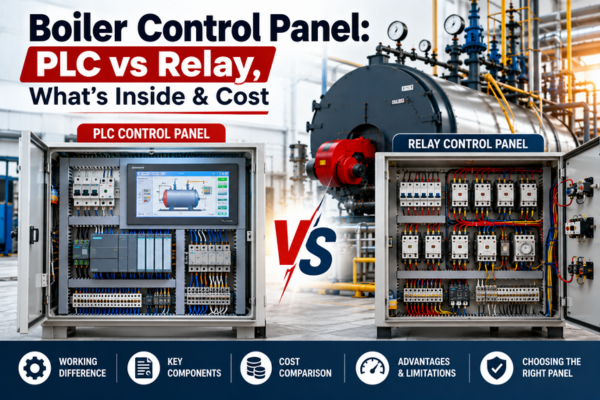
A boiler control panel is the part of a steam plant most people only notice when something trips. It collects signals from pressure, level and temperature instruments, applies control logic, drives pumps and fans, raises alarms and passes safety signals to the burner. Done well, it keeps steam pressure steady, protects the boiler and gives operators a clear picture of what is happening. Done poorly, it causes nuisance trips, hidden faults and expensive downtime.
Buyers now face a basic decision: a PLC-based panel or a relay-based one. Neither is automatically better. The answer depends on how many functions you need, how many boilers you run, who maintains the panel, which safeguards sit outside it and what it must communicate to the rest of the plant. This guide explains how an industrial boiler control panel works, what is inside it, how the two designs compare, what drives cost in India and how to specify one. For background on the boiler itself, see our overview of what an industrial boiler is.
A boiler control panel is an electrical enclosure that brings together power distribution, control logic, instrument inputs, operator indication, alarms and safety interfaces to monitor and control a boiler and its auxiliaries. It may use PLC or relay logic, with or without an HMI. Not every panel has a PLC or advanced automation, and process controls in the panel do not replace independently engineered protective devices.
A boiler control panel reads instruments, compares the readings with required conditions, and commands pumps, valves and the burner interface to correct any difference. Operators see the result on indicators or a screen, and abnormal conditions raise alarms or trips.
Field instruments and sensors → input signals → PLC or relay logic → control decisions → output devices → actuators, motors and valves → boiler process → feedback to instruments.
Keep two ideas apart. Process control keeps the boiler within normal operating conditions. Protective functions such as low-water cutoff and flame failure shutdown act when conditions become unsafe, and they should be independently designed rather than relying on the same logic that runs the process. An ordinary PLC alone is not sufficient for every safety-critical application.
Contents vary with design and scope. The table lists items found in many industrial boiler panels.
| Component | Main Function | Common Application | Selection Consideration |
|---|---|---|---|
| PLC or relay logic | Executes control sequences | Pump, fan and alarm logic, pressure control | I/O count, functions, maintainability |
| HMI | Shows status, alarms and settings | Local operator interface | Screen size, language, access levels |
| MCCB / MCB | Short-circuit and overload protection | Incomer and branch circuits | Rating and fault level |
| Contactors and overload relays | Switch and protect motors | Feedwater pumps, fans, blowers | Motor rating, duty, starting method |
| Control relays | Interface and signal isolation | Output interposing, interlocks | Coil voltage, contact rating |
| Power supply and control transformer | Provide control and instrument power | PLC, instruments, indicators | Capacity, backup, supply quality |
| Terminal blocks and wiring | Organised, serviceable connections | Field and internal wiring | Labelling, spare terminals |
| Indicators, selector switches, annunciator | Local indication and operator commands | Run/fault status, alarm display | Visibility, acknowledgement scheme |
| VFD / motor controls | Variable-speed or soft-start control | Fan and pump control where used | Need versus complexity, harmonics |
| Communication modules | Data exchange with other systems | Modbus, Ethernet to SCADA | Protocol, cybersecurity |
| Emergency-stop interface | Brings E-stop into the shutdown circuit | Panel and boiler-house stops | Hardwired design, testing |
| Safety relays or certified safety devices | Support protective functions where specified | Trip and shutdown circuits | Certification, required integrity |
| Field instrument interfaces | Condition and receive instrument signals | 4–20 mA, RTD, switch inputs | Signal type, isolation |
| Enclosure | Protects components from environment | Boiler house, dusty or humid sites | IP rating, ventilation, heat |
| Earthing and protective arrangements | Personnel and equipment protection | Panel and field earthing | Design by qualified electrical engineer |
A PLC boiler control panel uses a programmable logic controller to run control logic from software instead of fixed wiring. The PLC scans digital and analog inputs, executes the program and updates outputs continuously.
Advantages: changes are made in software, diagnostics point to faults, and functions can grow with the plant. Limitations: the panel depends on programming quality and on people able to maintain the program. Treat these as part of the purchase: documented and backed-up programs, access control and cybersecurity, spare modules, and vendor support that will still exist in years to come.
A relay-based panel implements control through hardwired relays, contactors, timers and switches. The logic is the wiring: each relay coil energises contacts that enable the next step.
Relay panels are not inherently unsafe, and PLC panels are not inherently safer. What matters is whether the protective functions are correctly engineered, whichever logic type is used.
Neither is better in every case. A relay panel can suit a simple boiler with few functions and a team used to hardwired logic. A PLC panel suits more functions, diagnostics, data logging, expansion or multi-boiler coordination. Required functions, engineered safeguards, environment, maintainability and lifecycle cost decide the choice.
| Feature | PLC-Based Panel | Relay-Based Panel |
|---|---|---|
| Control logic | Software program | Hardwired relays and timers |
| Flexibility | High, changed in software | Low, changed by rewiring |
| Initial cost | Often higher for simple duty, depends on scope | Often lower for simple duty, depends on scope |
| Modification | Program edit plus testing | Wiring change plus testing |
| Wiring complexity | Lower internal wiring for complex logic | Grows quickly with functions |
| Diagnostics | Fault messages, status views | Indicators and manual tracing |
| Data logging and HMI | Supported | Limited or none |
| Remote monitoring | Possible, with security controls | Generally not available |
| Expansion | Add I/O modules, within limits | Add relays and wiring |
| Maintenance | Needs program and backup management | Needs drawings and wiring skills |
| Reliability | Depends on design, environment, programming | Depends on design, contact wear, environment |
| Spare parts | Module availability over product life | Common, widely stocked parts |
| Safety integration | Needs separate or certified protective devices | Needs separate or certified protective devices |
| Best-fit applications | Multi-function, multi-boiler, integrated plants | Simple, stable, low-function installations |
| Plant Requirement | PLC Option | Relay Option | Decision Factor |
|---|---|---|---|
| Small, simple boiler | Possible, may be more than needed | Often adequate | Number of functions |
| Multiple boilers | Suits sequencing and load sharing | Becomes complex | Coordination needs |
| Process integration | Communication to plant systems | Hardwired signals only | Data exchange required |
| Future expansion | Easier to add within limits | Adds wiring and space | Growth plans |
| Tight automation budget | Compare total cost, not parts | May cost less for simple duty | Required scope |
| Advanced diagnostics and logging | Strong fit | Limited | Monitoring needs |
| Maintenance team skills | Needs PLC-capable staff or support contract | Needs strong drawing and wiring skills | Who will maintain it |
An automatic boiler control panel runs routine duties without operator action: holding steam pressure by adjusting burner demand, keeping drum level in range through feedwater control, sequencing pumps, monitoring alarms and, in larger plants, coordinating several boilers. HMI and SCADA add visibility, trends and remote monitoring where appropriate.
What a panel can actually automate depends on the instruments, actuators, control design and commissioning supplied with it. A pressure controller without a modulating burner cannot modulate. Specify the field equipment and the control functions together. Good control also supports efficiency, as covered in our guide on improving boiler efficiency. Where the control sits within the wider plant, see steam boiler systems in India.
Boiler safety interlocks are protective functions that stop or prevent operation when a condition becomes unsafe. They are designed separately from normal process control.
Safety valves are mechanical protection and are not replaced by electronic controls. A process PLC is not automatically a certified burner management system or safety instrumented system. Protective functions must be engineered, installed, tested and maintained to applicable standards, the boiler and burner maker's instructions and competent professional assessment. This article does not give wiring, bypass or setpoint guidance. Never defeat a trip. Our boiler safety guidelines for industries cover the wider safety framework.
| Instrument | Measured Variable | Control / Monitoring Role |
|---|---|---|
| Pressure transmitter | Steam pressure | Feedback for burner demand control, display and alarm |
| Pressure switch | Pressure threshold | Limit or protective input, depending on design |
| RTD / thermocouple | Temperature | Feedwater, flue gas or steam temperature monitoring |
| Water level transmitter | Drum or shell level | Feedwater control and level alarms |
| Level switch / low-water cutoff | Level threshold | Protective low-water function and alarms |
| Flow transmitter | Steam or feedwater flow | Monitoring and multi-element level control |
| Fuel monitoring | Fuel flow or pressure | Consumption tracking and supply alarms |
| Combustion instruments | Flue gas oxygen or temperature, flame signal | Combustion monitoring and burner supervision |
For pressure control, the transmitter signal is compared with the required pressure and the controller adjusts burner demand, either by on/off, stepped or modulating firing. A stable loop needs a correctly tuned controller, a burner and actuators that respond smoothly, and accurate instruments. Pressure instability usually points to tuning, actuator, burner or instrument problems rather than the panel logic alone.
Temperature measurements are mostly monitored for display, alarm and efficiency checks, and sometimes used in control loops. Keep operating controls and safety limits separate: a limit device that protects the boiler should not be the same device that runs the process. All instruments need periodic calibration. Required settings come from the boiler design and manufacturer, not from this article.
Water level is the most critical process variable in a steam boiler, because too low a level can overheat pressure parts and too high a level can carry water into the steam. Level control commonly takes one of three forms:
Pump sequencing handles duty and standby pumps and changeover on fault. Low-water protection remains a separate protective function. The type of boiler affects control design, as explained in our comparison of water tube and fire tube boilers.
Electrical design must be carried out by qualified professionals against the applicable standards and regulations.
An HMI is the local operator interface at or near the panel. SCADA is a supervisory layer that collects data from one or more controllers for plant-wide display, trends, alarm history and reports. Both depend on a controller, and neither is needed for every boiler.
Boiler control panel prices vary too widely to quote responsibly without a specification. This article does not give a rupee range because none can be verified as comparable. Cost follows scope: PLC or relay architecture, panel size, the number of I/O points, HMI, instruments, motor control and VFDs, safety hardware, enclosure rating, wiring complexity, engineering and programming, testing, installation, commissioning and support.
Clarify what a quoted figure includes. Some quotations cover only the panel, while others also include instruments, installation, programming, factory and site testing, training and documentation. Ask for an itemised quotation so offers can be compared like for like. For the capital side of the boiler itself, see our industrial boiler price guide.
| Cost Component | Why It Affects Price | What Buyers Should Confirm |
|---|---|---|
| Enclosure and power hardware | Size, rating, protection devices, starters | Makes, ratings, IP rating |
| Controller (PLC or relays) | I/O count, redundancy, product range | Model, spare I/O, long-term availability |
| HMI and communication | Screen size, licences, protocols | Screens, SCADA scope, access control |
| Instruments and field devices | Number and type of transmitters, switches, sensors | What is supplied versus existing |
| Motor control and VFDs | Motor ratings and starting method | Motor list and starter type |
| Safety devices | Certified relays and protective hardware | Which protective functions are included |
| Engineering and programming | Drawings, logic design, configuration | Drawings, program ownership, backups |
| Testing (FAT/SAT) | Time and test equipment | Test scope and records |
| Installation and commissioning | Site work and specialist time | Who installs, who commissions |
| Training, warranty and support | Ongoing service capability | Warranty terms, spares, response time |
A panel should follow the boiler and plant, not the other way round. Boiler type, steam capacity, fuel, burner type, existing instruments, plant integration, operator interface, expansion plans, environment and safety architecture all shape the design. Our guide to industrial gas boilers shows how fuel and burner type change control requirements. Customisation should come from engineering needs, not unnecessary features. Every added function adds cost, complexity and maintenance.
Look for a supplier who understands boiler processes as well as electrical design. Ask about:
Whether the control supplier is the boiler maker or a separate panel builder, define interface responsibility in writing. Our boiler manufacturer selection checklist helps structure supplier comparison.
Several different requirements can apply, and they should not be confused.
Not every standard applies to every installation. Applicability depends on the boiler, fuel, project specification and owner or insurer requirements. Verify current texts before citing them in a specification.
Preventive checks, calibration and clean, dry panel conditions reduce faults. Our boiler maintenance checklist and article on warning signs a boiler needs repair cover the wider boiler. Panel faults should be assessed by qualified personnel, and no one should work on energised equipment without authorisation and procedure.
| Symptom | Possible Cause | Recommended Professional Assessment |
|---|---|---|
| Erratic readings | Sensor fault, loose connection, noise | Instrument check and calibration |
| Intermittent trips | Genuine process condition, failing device or wiring | Root-cause diagnosis, not repeated resets |
| Relay chatter or failure | Contact wear, coil or supply problem | Inspect and replace by qualified staff |
| Panel resets or dead outputs | Power supply issue, module fault | Supply and module assessment |
| Lost communication | Cable, settings, network or module fault | Network and configuration review |
| Blank or unresponsive HMI | Power, firmware or screen failure | Replace or restore from backup |
| Contactor overheating or noise | Wear, loose termination, overload | Thermal inspection and replacement |
| Nuisance alarms | Poor setpoints, drift, wiring faults | Alarm review against approved settings |
| Corrosion, moisture or dust inside | Enclosure rating or sealing inadequate | Enclosure and environment review |
| Nobody can explain the logic | Missing drawings or program backup | Reconstruct documentation and back up |
Often yes, but it is a project, not a part swap. Begin with a feasibility assessment covering existing safety functions, field instruments, wiring condition, I/O requirements and the control philosophy. Then plan programming, validation, commissioning, documentation and downtime. The key rule: the upgrade must not weaken or remove independent protective functions, and any change to them needs engineering review and testing. Decide whether to keep, replace or add instruments, and who will maintain the PLC afterwards.
PAR BOILER is an industrial boiler manufacturer, and control requirements start with the boiler itself: its design, fuel, burner configuration, steam demand, operating pressure, feedwater arrangement and the safety systems it needs. The panel should be matched to those factors and to the way your plant operates, rather than chosen separately.
If you are specifying a new boiler or upgrading an existing control system, confirm in writing which control and automation scope is included, what instruments and safety devices are supplied, what testing and commissioning are covered and how support is handled. This article does not state specific control-panel manufacturing capabilities for PAR BOILER. Confirm scope directly during your enquiry.
Planning a new industrial boiler or upgrading an existing boiler control system? Contact PAR BOILER to discuss your steam requirements, operating conditions, fuel type and automation needs.
A boiler control panel is an electrical enclosure that combines power distribution, control logic, instrument inputs, operator indication, alarms and safety interfaces to monitor and control a boiler and its auxiliaries. It may use PLC or relay logic, with or without an HMI.
It reads instruments such as pressure and level transmitters, applies logic, and commands pumps, valves and the burner interface to correct differences from required conditions. Operators see status on indicators or an HMI, and abnormal conditions raise alarms or trips.
Typical components are a PLC or relay logic, HMI or indicators, protection devices (MCCB, MCB), contactors and overload relays, control relays, power supplies, terminal blocks, an emergency-stop interface, instrument interfaces, an enclosure and earthing. Contents vary with design and scope.
It is a panel in which a programmable logic controller runs the control logic from software. It reads digital and analog inputs, executes the program and drives outputs, often with PID loops, an HMI, alarm history and data logging.
It is a panel in which control logic is implemented by hardwired relays, contactors, timers and switches. It suits basic sequences and is easy to follow, but changes need rewiring and it offers limited diagnostics and data.
Neither is better in every case. A relay panel can suit a simple boiler with few functions and a maintenance team used to hardwired logic. A PLC panel suits more functions, diagnostics, data logging, expansion or multi-boiler coordination. Required functions, safeguards, maintainability and lifecycle cost decide.
It depends on scope, so no single price applies. Architecture, I/O count, HMI, instruments, motor control, safety hardware, enclosure, engineering, testing and commissioning all affect cost. Request an itemised quotation that states exactly what is included.
It is a panel that performs routine control without operator action, such as holding steam pressure by adjusting burner demand, controlling feedwater to keep level in range, sequencing pumps and monitoring alarms. Its capabilities depend on the instruments and actuators supplied.
An HMI is the operator's local interface to the controller. It shows process values, alarms and trends, and accepts commands and permitted setting changes. Good HMI design with access levels helps operators respond quickly and reduces mistakes.
They are protective functions that stop or prevent operation under unsafe conditions, such as low water, high pressure or flame failure, and shut off fuel. They are engineered separately from process control and backed by mechanical safety valves. They must be tested and maintained, never bypassed.
A pressure transmitter reports steam pressure and a controller adjusts burner demand, using on/off, stepped or modulating firing, to hold the required pressure. A separate protective limit and mechanical safety valves guard against over-pressure.
Level instruments feed a controller that starts and stops feedwater pumps or modulates a valve or pump speed. Larger or fast-changing boilers often use multi-element control with steam and feedwater flow. A separate low-water protection function stays independent.
Yes. A PLC can sequence boilers, share load, manage lead and standby duty and collect data for all units. It needs careful design, clear priority logic and protective functions for each boiler kept independent.
A PLC is a controller that runs logic and talks to field devices. SCADA is a supervisory system that collects data from controllers for plant-wide display, trends, alarm history and reports. SCADA depends on controllers and is not needed for every boiler.
Often, after a feasibility assessment of existing safety functions, instruments, wiring and I/O. Programming, validation, commissioning and downtime must be planned, and the upgrade must not compromise independent protective functions.
Common instruments include pressure transmitters and switches, RTDs or thermocouples, water level transmitters and level switches, flow transmitters, fuel monitoring devices and combustion instruments. The panel conditions their signals for control, monitoring and alarms.
A boiler control panel covers overall electrical control, indication and process control of the boiler and its auxiliaries. A burner management system is the safety-related part that supervises burner startup, flame and fuel shutoff. A process PLC is not automatically a certified burner management system.
It can support efficiency through steady pressure control, smooth burner modulation, correct feedwater control and monitoring that reveals drift. Gains depend on the boiler, burner and instruments. The panel alone does not guarantee a saving.
It should list the control architecture, major components with make and rating, instruments supplied, HMI scope, enclosure rating, drawings, programming, factory and site testing, installation and commissioning scope, training, documentation, warranty, spares and exclusions. An itemised quotation makes offers comparable.
Check boiler-specific control experience, electrical and instrumentation competence, safety engineering, component quality, documentation, FAT and SAT practice, commissioning, spares and service support. Ask for references on similar boilers and compare itemised quotations, not headline prices.
Maintenance includes inspection for heat, dust, moisture and loose connections, instrument calibration, testing of alarms and protective functions, program and settings backup, and spare management. Intervals follow the manufacturer's instructions and site procedures, and work should be done by qualified staff.
Share your boiler type, fuel, steam requirement and automation needs, and PAR BOILER can discuss suitable boiler and control scope with you.
Contact PAR BOILER