



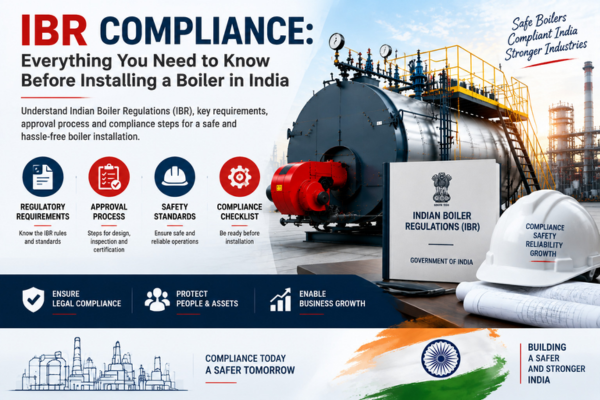
IBR (Indian Boiler Regulations) compliance is the statutory requirement for steam boilers above applicable thresholds in India, governed by the Indian Boilers Act, 1923 and the Indian Boiler Regulations, 1950. A fully IBR-compliant boiler requires: (1) Central Boilers Board (CBB) design drawing approval before fabrication; (2) fabrication from certified pressure-vessel quality materials; (3) stage inspection by an IBR-authorised inspector during fabrication; (4) hydraulic pressure test at 1.5× maximum allowable working pressure (MAWP); (5) registration with the State Boiler Inspectorate before commissioning; (6) issuance of the certificate of fitness; and (7) annual inspection by an authorised inspector to renew the certificate of fitness each operating year. Operating without IBR registration or with an expired certificate of fitness is a statutory offence. IBR compliance is the responsibility of both the boiler manufacturer (during fabrication) and the boiler owner/operator (during installation and operation).
Every industrial plant in India that installs a steam boiler above the applicable pressure and capacity thresholds is operating within a statutory framework that governs how that boiler is designed, built, inspected, registered, and operated. This framework the Indian Boilers Act, 1923, and the Indian Boiler Regulations (IBR), 1950 exists for a reason that is easy to forget in the day-to-day urgency of plant commissioning: an inadequately designed or poorly maintained steam boiler operating at pressure is one of the most potentially dangerous items of fixed equipment in any industrial facility.
The IBR framework has created a structured system of independent design review, independent stage inspection during fabrication, and annual independent inspection during operation specifically to catch the safety-critical design errors, fabrication deficiencies, and operational deterioration that internal plant maintenance might miss or defer. Understanding how this system works and what your obligations are at each stage is not optional knowledge for anyone commissioning a new industrial boiler in India.
Indian Boilers Act, 1923: The central legislation governing steam boilers in India. Establishes the regulatory framework for boiler safety, defines the roles of the Central Boilers Board (CBB) and State Boiler Inspectorates, sets the requirements for boiler registration and inspection, and specifies penalties for non-compliance.
Indian Boiler Regulations (IBR), 1950: The technical regulations made under the Indian Boilers Act. Specifies the detailed requirements for boiler design, materials, construction, testing, fittings, and inspection that give the Act its technical content.
Central Boilers Board (CBB): The statutory body established under the Indian Boilers Act that formulates and amends the Indian Boiler Regulations, approves boiler designs, and maintains uniformity of boiler safety standards across India.
State Boiler Inspectorate: The state-level authority that implements the Indian Boilers Act, registers boilers, issues certificates of fitness, conducts inspections, and enforces compliance within each state.
The IBR framework applies to steam boilers above the applicable thresholds which are defined by the combination of pressure, water content volume (or steam volume), and dimensions as specified in the Indian Boilers Act. Boilers below these thresholds are exempted from IBR registration requirements, though they still must be operated safely. The exact thresholds should be verified with the relevant State Boiler Inspectorate for the specific boiler type and configuration do not assume a boiler is below the threshold without formal verification.
Importantly, IBR compliance is not a one-time event at the time of purchase. It is an ongoing statutory obligation throughout the boiler's operating life. The manufacturer's responsibility under IBR is during design and fabrication. The owner/operator's responsibility begins at installation and continues through annual inspection for the life of the boiler.
| Stage | What Happens | Responsible Party | Output / Document |
|---|---|---|---|
| 1. Design Approval | Boiler design drawings and calculations submitted to CBB (or applicable Inspectorate) for review and approval before fabrication begins. | Boiler Manufacturer | CBB Design Approval with reference number |
| 2. Material Certification | All pressure-part materials must be from approved manufacturers with material test certificates; traceability maintained throughout fabrication. | Boiler Manufacturer + IBR Inspector | Material Test Certificates (MTCs); Inspector-endorsed records |
| 3. Stage Inspection | IBR-authorised inspector witnesses and certifies key fabrication stages: shell/drum construction, tube fixing, welding, NDT (where applicable), and fitting installation. | IBR-Authorised Inspection Agency + Manufacturer | Stage Inspection Records signed by authorised inspector |
| 4. Hydraulic Pressure Test | Completed boiler pressure-tested with water at 1.5× MAWP; witnessed and certified by IBR-authorised inspector. All pressure parts checked for leakage and deformation. | Boiler Manufacturer; witnessed by IBR Inspector | Hydraulic Test Certificate; Inspector Stamp on boiler shell |
| 5. Boiler Registration | Boiler registered with the State Boiler Inspectorate at the installation site. Complete documentation package reviewed and registration number assigned. | Boiler Owner/Operator | Boiler Registration Number; Official Register entry |
| 6. Certificate of Fitness (First Issue) | Boiler inspected at the installation site by a Boiler Inspector before first commissioning. Certificate of fitness confirms safe operation at MAWP. | State Boiler Inspectorate Inspector + Owner | Certificate of Fitness specifying MAWP, maximum temperature, and validity period |
| 7. Annual Inspection & Renewal | Annual inspection by IBR-authorised inspector including internal examination, safety fittings check, and pressure control verification. | IBR Inspector + Owner/Operator | Renewed Certificate of Fitness; inspection report |
Design approval by the Central Boilers Board (or the applicable approving authority under the IBR framework) is the first and most fundamental IBR compliance requirement. It means that the boiler's design drawings, pressure calculations, material specifications, and fitting arrangements have been independently reviewed against the Indian Boiler Regulations before a single plate is cut or tube bent.
This stage matters for boiler buyers for a specific reason: you cannot verify IBR compliance from a boiler's appearance after fabrication. A boiler that looks identical to an IBR-compliant unit may have been fabricated from unapproved design drawings, using non-certified materials, without any stage inspection. Its pressure vessel geometry may be inadequate for its rated pressure. Its shell plate may be from an uncertified source with unknown mechanical properties. None of this is visible on the finished boiler; it is only guaranteed by the documentation trail from CBB design approval through stage inspection to the hydraulic test certificate.
What to verify from your boiler manufacturer: Ask for the CBB design approval reference number for the specific boiler type and configuration you are purchasing. A manufacturer that cannot provide this or provides it only after repeated requests warrants close scrutiny. The CBB approval should be specific to the boiler type, not a generic document.
The Indian Boiler Regulations specify approved grades of material for boiler pressure parts the shell plate, tube plates, drum heads, boiler tubes, and associated fittings. These materials must come from approved manufacturers and be accompanied by material test certificates (MTCs) that document the chemical composition and mechanical properties of each plate or tube batch.
Material traceability the ability to trace each pressure-part material from the finished boiler back to the specific material test certificate is not a bureaucratic requirement. It is the means by which the IBR inspector can confirm that the material used to build the pressure vessel is what the design calculation assumed when determining wall thickness, allowable stress, and MAWP.
A boiler manufacturer who cannot provide material test certificates for all pressure parts or who provides generic certificates that cannot be traced to specific boiler components has a fundamental gap in their IBR documentation that cannot be retrospectively corrected after fabrication. Verify this before placing any purchase order.
Stage inspection is the process by which an IBR-authorised independent inspector witnesses and certifies key fabrication stages during the boiler's construction. The inspector is not employed by the boiler manufacturer they are an independent party (an IBR-authorised inspection agency or government inspector) whose role is to confirm that the fabrication matches the approved design drawings at each critical stage.
Typical stage inspection points include:
Stage inspection records, signed by the IBR-authorised inspector at each stage, form part of the permanent IBR documentation that travels with the boiler to the installation site and must be presented for registration. Without complete stage inspection records, a boiler cannot be registered it cannot legally operate.
Quick Answer IBR Hydraulic Test: Every IBR boiler must pass a hydraulic pressure test at 1.5 times its maximum allowable working pressure (MAWP), witnessed by an IBR-authorised inspector. The boiler is filled with water, pressurised to the test pressure, and held at that pressure while all pressure parts are inspected for leakage or deformation. Passing this test confirms that the pressure vessel is structurally sound at 50% above its rated operating pressure. The inspector issues a hydraulic test certificate and stamps the boiler shell.
The hydraulic test is a proof test of the complete assembled pressure vessel before it enters service. It applies a pressure significantly higher than any operating condition the boiler will see in normal service enough to reveal any weld defect, material weakness, or fitting fault that escaped the earlier stage inspections. A boiler that passes the hydraulic test at 1.5× MAWP has demonstrated structural integrity that provides a reasonable safety margin over its rated operating pressure.
The hydraulic test certificate is a critical document. Keep it permanently it will be required for every State Boiler Inspectorate registration and inspection throughout the boiler's operating life. A lost hydraulic test certificate typically requires the boiler to be re-tested a significant disruption and cost that is entirely avoidable by maintaining the original documentation properly.
Registration with the State Boiler Inspectorate and issuance of the certificate of fitness (CF) are the owner/operator's primary IBR responsibilities. Before a boiler is commissioned at the installation site, the complete IBR documentation package must be submitted to the State Boiler Inspectorate:
The State Boiler Inspector then inspects the installed boiler at the site confirming the physical boiler matches the documentation, the safety fittings are correctly installed, the boiler room arrangements meet applicable requirements, and the boiler is in a satisfactory condition to operate. On satisfactory completion, the inspector issues the certificate of fitness specifying the MAWP at which the boiler is authorised to operate.
⚠ Critical Point: A boiler cannot legally operate until it has a valid certificate of fitness. Commissioning a boiler before registration and CF issuance even for "testing" or "trial runs" is a statutory offence under the Indian Boilers Act. Plan your project timeline to ensure the IBR documentation submission and inspector scheduling are completed before your target commissioning date, not after.
The certificate of fitness is not a permanent document. It is valid for a defined period typically one year and must be renewed through annual inspection by an IBR-authorised inspector. This annual inspection is the ongoing mechanism through which the regulatory framework assesses whether the boiler remains safe to continue operating at its rated MAWP.
During the annual IBR inspection, the inspector typically:
If the inspector is satisfied, the certificate of fitness is renewed. If the inspector identifies deficiencies corrosion beyond acceptable limits, scale accumulation, inadequate safety fitting condition the boiler may be issued a conditional CF (authorised to operate at a reduced MAWP) or the CF may be withheld until the deficiencies are corrected. A boiler whose CF has expired or been withheld cannot legally operate.
For guidance on preparing your boiler for the annual IBR inspection maintaining condition through correct water treatment, planned maintenance, and daily operational discipline see our industrial boiler maintenance checklist and our boiler safety guidelines for industries.
IBR compliance obligations do not end with the initial installation. Any repair or modification to the pressure parts of an IBR-registered boiler tube replacement, shell plate repair, welding on pressure-bearing components, modification to safety fittings must also comply with IBR requirements. This typically means:
A plant that has a qualified boiler repair company carry out repairs without IBR oversight may find at the next annual inspection that the repairs are not accepted requiring the work to be redone under proper IBR supervision, or in serious cases, the boiler to be taken out of service. Always confirm IBR compliance requirements before commencing any repair to pressure parts.
These documents must be available for inspection by the State Boiler Inspector at any time not archived in a remote location or held only by the manufacturer. Many plants discover on the day of their annual IBR inspection that they cannot locate their hydraulic test certificate or original stage inspection records. This creates unnecessary delays and sometimes requires costly re-testing. Establish a dedicated file for boiler IBR documentation from day one of the installation and maintain it rigorously throughout the boiler's operating life.
IBR requirements extend beyond the boiler vessel itself. Steam piping connected to IBR-registered boilers above the applicable pressure and diameter thresholds may also be subject to IBR requirements under the Indian Boiler Regulations. This is a frequently overlooked area of IBR compliance that can create significant project delays if not identified and addressed during the engineering phase.
Where IBR applies to steam piping, the requirements typically include: design approval for the pipe routing and specification, use of approved pipe materials with material test certificates, stage inspection at fabrication and erection stages, and pressure testing. The applicable IBR piping classification depends on the steam pressure, pipe diameter, temperature, and the specific provisions of the current Indian Boiler Regulations.
Verify whether your steam piping requires IBR compliance with the State Boiler Inspectorate early in the project preferably during the detailed engineering phase when piping specifications and routing are being finalised, not after the piping is installed.
The most important IBR-related action a boiler buyer can take is verifying IBR documentation capability before placing a purchase order not after delivery. The following questions should be asked and answered in writing before committing to any boiler manufacturer:
| Question to Ask | Why It Matters | What a Credible Manufacturer Should Provide |
|---|---|---|
| Is the proposed boiler type covered by an existing CBB design approval? | Without CBB approval, fabrication cannot legally begin. | CBB approval reference number and copy of approval on request. |
| Which IBR-authorised inspection agency will conduct stage inspections? | Stage inspection must be performed by an IBR-authorised independent inspector, not the manufacturer's own quality team. | Named inspection agency with valid IBR authorisation. |
| What is included in the IBR documentation package supplied with the boiler? | Without complete documentation, boiler registration is not possible. | Complete list including design approval, MTCs, stage inspection records, hydraulic test certificate, and drawings. |
| Are the boiler materials sourced from approved manufacturers with traceable MTCs? | Non-certified materials create IBR compliance failures that cannot be corrected after fabrication. | Confirmation of approved material sources and sample MTCs on request. |
| Are your welders qualified under approved welding procedures? | IBR requires approved welding procedure specifications and qualified welders for pressure-part welding. | Welding procedure qualification records and welder qualification certificates. |
| Will you assist with the State Boiler Inspectorate registration process at our site? | Some manufacturers support registration, while others consider it the buyer's responsibility after document handover. | Clear details of documentation and support provided for registration. |
Once a boiler is registered and commissioned, the owner/operator has ongoing statutory obligations under the Indian Boilers Act. These include:
For a complete boiler safety and operating compliance framework covering both IBR obligations and operational best practices, see our boiler safety guidelines for industries. For maintenance practices that help ensure the boiler passes its annual IBR inspection, see our industrial boiler maintenance checklist.
While the Indian Boilers Act and Indian Boiler Regulations provide a national framework, the administration of IBR is state-specific. Each State Boiler Inspectorate operates somewhat differently in:
Before finalising your project timeline, contact the State Boiler Inspectorate in the state where the boiler will be installed and confirm the specific documentation requirements, current fees, and typical lead times for registration inspection. Build adequate time into your project schedule for the registration process IBR inspectors typically have scheduled workloads and cannot always accommodate last-minute requests aligned with commissioning dates that were set without IBR in mind.
Par Techno-Heat Pvt. Ltd. (Par Boiler) designs and manufactures IBR-registered industrial steam boilers from its facility in Sanand, Ahmedabad, Gujarat. The company's standard delivery for all registered steam boilers includes the complete IBR documentation package: CBB design approval documentation, material test certificates for all pressure parts, complete stage inspection records signed by the IBR-authorised inspector, and the hydraulic test certificate all packaged and delivered with the boiler as standard deliverables rather than as separately requested extras.
This integrated IBR documentation approach reduces the buyer's registration burden the documentation package arriving with the boiler contains everything required for submission to the State Boiler Inspectorate. Par Boiler supplies steam boilers across multiple configurations gas and oil-fired fire tube designs, solid fuel and biomass water tube designs, waste heat recovery steam generators all fabricated under IBR stage inspection. For guidance on selecting the right boiler type and capacity for your application, see our boiler manufacturer in India selection checklist and our guide on how to choose the best boiler manufacturer in India.
Par Techno-Heat Pvt. Ltd. supplies IBR-compliant industrial steam boilers with complete documentation CBB design approval, material test certificates, stage inspection records, and hydraulic test certificate as standard deliverables. Contact our engineering team to discuss your boiler requirement, IBR compliance documentation, and commissioning support.
Contact Par Boiler — IBR Compliant Boiler EnquiryIBR compliance means meeting all requirements of the Indian Boilers Act, 1923, and Indian Boiler Regulations (IBR), 1950, for steam boilers above the applicable thresholds. A compliant boiler has: CBB-approved design drawings; fabrication from certified materials under stage inspection by an IBR-authorised inspector; hydraulic test at 1.5× MAWP; registration with the State Boiler Inspectorate; a current certificate of fitness; and annual inspection to maintain the CF. Both the manufacturer (during fabrication) and the owner/operator (during installation and operation) have IBR obligations.
The Indian Boilers Act, 1923, is the central legislation governing steam boiler safety in India. It establishes the Central Boilers Board (CBB), the State Boiler Inspectorates, and the framework for boiler design approval, fabrication inspection, registration, and annual inspection. The Indian Boiler Regulations (IBR), 1950, made under the Act, provide the detailed technical requirements. The Act makes it a statutory offence to operate an unregistered boiler or a boiler with an expired certificate of fitness.
The Central Boilers Board (CBB) is the statutory body established under the Indian Boilers Act responsible for formulating and amending the Indian Boiler Regulations, approving boiler designs submitted by manufacturers, and maintaining uniform boiler safety standards across India. A boiler manufacturer must obtain CBB design approval for each boiler design before fabrication begins. The CBB approval reference number confirms that the boiler's design has been independently reviewed against the technical requirements of the IBR.
The certificate of fitness (CF) is the document issued by the State Boiler Inspectorate after a boiler passes the registration inspection at its installation site. It specifies the maximum allowable working pressure (MAWP) at which the boiler is authorised to operate and its validity period. A boiler cannot legally operate without a valid certificate of fitness. The CF must be renewed through annual inspection before it expires an expired CF means the boiler cannot legally operate regardless of its physical condition.
No. Operating an unregistered steam boiler above the applicable thresholds under the Indian Boilers Act is a statutory offence. The boiler must be registered with the State Boiler Inspectorate and hold a current certificate of fitness before it can be legally commissioned and operated. Running the boiler for "testing" or "trials" before receiving the CF is also a statutory violation plan the project timeline to ensure registration and CF issuance before your commissioning date.
IBR stage inspection is the process by which an IBR-authorised independent inspector witnesses and certifies key stages of boiler fabrication shell construction, welding, tube fixing, NDT, and safety fitting installation to confirm the boiler is being built to its approved design drawings. The inspector is independent of the manufacturer. Stage inspection records signed by the authorised inspector at each stage form part of the permanent IBR documentation required for registration. Without complete stage inspection records, a boiler cannot be registered.
The hydraulic pressure test for IBR boilers is conducted at 1.5 times the maximum allowable working pressure (MAWP) of the boiler, witnessed by an IBR-authorised inspector. The test is performed with water, held at the test pressure while all pressure parts are inspected for leakage or deformation. A passing hydraulic test certificate is a mandatory part of the IBR documentation package required for registration. The original certificate must be maintained throughout the boiler's operating life.
A correctly supplied IBR boiler should include: CBB design approval documentation with reference number; material test certificates (MTCs) for all pressure parts with heat number traceability; complete stage inspection records signed by the IBR-authorised inspector; hydraulic test certificate at 1.5× MAWP; safety fittings certification; and original approved design drawings. Without all of these documents, registration with the State Boiler Inspectorate is not possible. Verify the complete documentation list before placing a purchase order.
An IBR-registered steam boiler must be inspected annually by an IBR-authorised inspector to renew its certificate of fitness. The annual inspection covers internal condition of pressure parts (corrosion, scale, pitting), safety fitting condition and function, pressure control calibration, and review of operating records. If the inspection identifies deficiencies, the CF may be withheld or issued at a reduced MAWP until deficiencies are corrected. Annual inspection must be completed before the current CF expires.
Yes. Any repair or modification to the pressure parts of an IBR-registered boiler tube replacement, shell welding, fitting modifications must comply with IBR requirements. This typically includes: repair design review, use of certified materials with MTCs, welding by qualified welders under approved procedures, stage inspection of the repair by an IBR-authorised inspector, and possible post-repair hydraulic testing. Repairs performed without IBR oversight may be rejected at the next annual inspection, requiring rework under proper supervision.
Yes, in many cases. Steam piping connected to IBR-registered boilers may be subject to IBR requirements above applicable pressure and diameter thresholds, including design approval, material certification, stage inspection, and pressure testing. The applicable classification depends on the steam pressure, pipe diameter, temperature, and the current Indian Boiler Regulations. Verify whether your steam piping requires IBR compliance with the State Boiler Inspectorate during the engineering phase before the piping is installed.
A boiler with an expired certificate of fitness cannot legally operate under the Indian Boilers Act. Continuing to operate an expired-CF boiler is a statutory offence. To reinstate a lapsed CF, the State Boiler Inspectorate will need to conduct an inspection which may require an internal examination and may identify deficiencies that must be corrected before the CF is renewed. Plan annual IBR inspection well in advance of the CF expiry date to avoid this situation.
Yes. While the Indian Boilers Act and IBR provide a national framework, the State Boiler Inspectorates implement the Act with state-specific variations in: documentation submission formats and requirements, registration and inspection fees, inspection scheduling lead times (which vary significantly between states), and boiler operator licensing requirements. Always verify the specific requirements with the State Boiler Inspectorate in the state where your boiler will be installed not with the boiler manufacturer's sales team, who may be familiar with a different state's requirements.
The Indian Boilers Act specifies penalties for various categories of non-compliance including operating an unregistered boiler, operating with an expired certificate of fitness, and operating at pressures above the certificated MAWP. Penalties may include fines, forced shutdown, and in cases of serious non-compliance, prosecution. The boiler owner, not the manufacturer, bears responsibility for compliance after the boiler is installed. Verify the current penalty provisions from the latest version of the Indian Boilers Act applicable to your state.
MAWP (Maximum Allowable Working Pressure) is the highest steam pressure at which the State Boiler Inspector authorises the boiler to operate, as specified on the certificate of fitness. The boiler must never be operated at a steam pressure exceeding its certificated MAWP the safety valve must be set to open before this pressure is reached. If the boiler's condition deteriorates during its operating life, the inspector may reduce the MAWP at the annual inspection, requiring the plant to operate at a lower pressure until repairs restore the boiler's condition.
A genuinely IBR-compliant boiler can be verified by reviewing its documentation package: CBB design approval reference number (verifiable with CBB), material test certificates with heat number traceability to specific components, stage inspection records signed by a named IBR-authorised inspector, hydraulic test certificate at 1.5× MAWP, and a current certificate of fitness from the State Boiler Inspectorate. The physical boiler should have the inspector's stamp mark and the MAWP marked on the shell. If any of these documents cannot be produced, the boiler's IBR compliance is unverifiable.
An IBR-authorised inspection agency is an independent organisation authorised by the Indian Boiler Regulations to conduct stage inspections of boilers during fabrication on behalf of the regulatory framework. These agencies employ qualified inspectors who witness and certify the fabrication stages material traceability, welding, NDT, assembly and sign the stage inspection records that become part of the IBR documentation package. They are independent of the boiler manufacturer. Verify that your boiler manufacturer uses a genuinely IBR-authorised agency not an internal quality team described as "inspection."
Prepare for annual IBR inspection by: scheduling the inspection appointment well before the CF expiry date; arranging a planned boiler shutdown for internal examination (the inspector needs to examine the drum/shell internally this requires the boiler to be cooled, depressurised, and drained); having all original IBR documentation readily available for the inspector's review; ensuring the boiler is clean internally (scale removal from the last year's operation facilitates proper tube and shell condition assessment); and confirming all safety fittings are functional and correctly set. See our boiler maintenance checklist for the complete preparation framework.
