



Overview Summary: Quick Answer on Industrial Boiler Price
Short answer: Industrial boiler prices in India are driven by capacity (kg/hr or TPH), design pressure, fuel type, level of automation, construction material and IBR certification not by a single fixed rate. Small non-IBR steam boilers start at a modest capital outlay, while large multi-fuel or waste heat recovery boilers run into much higher project budgets. Because every boiler is engineered to the plant's steam demand, the only accurate price comes from a project-specific quotation. This guide explains realistic price ranges, the factors behind them, and the total cost of ownership over the boiler's life.
Introduction
If you have ever asked a supplier "what is the price of a boiler?" and received the answer "it depends," you already understand the core problem procurement teams face. An industrial boiler is not a shelf product with a printed MRP. It is a pressure vessel engineered around your steam load, your fuel, your operating hours and your emission norms.
I have specified, commissioned and troubleshot boilers across textile, food processing, chemical, pharmaceutical and paper plants for years. The pattern is always the same: the buyers who focus only on the purchase price end up paying more over ten years than the buyers who study the full cost picture. A cheaper boiler with poor efficiency quietly burns extra fuel every single shift.
This guide is written for factory owners, plant engineers and procurement managers who want to budget realistically. We will not print fake price lists anyone quoting exact figures for a "10 TPH boiler" without seeing your specification is guessing. Instead, you will learn how price is built up, what moves it, and how to compare quotations fairly.
What Determines Industrial Boiler Price?
Definition: Industrial boiler price is the engineered capital cost of a pressure vessel and its integrated systems, determined by steam capacity, design pressure, fuel type, automation, material of construction and statutory certification such as IBR.
Eight variables account for almost every rupee of difference between two quotations:
- Capacity (steam output): Measured in kg/hr for small units and TPH (tonnes per hour) for larger plants. This is the single biggest price driver more heating surface, thicker shells and bigger fuel handling.
- Design pressure: A boiler rated for 10.54 kg/cm² costs less than one rated for 17.5 or 21 kg/cm² because higher pressure demands thicker plate, stronger welds and more rigorous testing.
- Steam parameters: Saturated versus superheated steam changes the design. Superheaters, desuperheaters and higher outlet temperatures add cost.
- Fuel type: The fuel dictates the furnace design, grate or burner, fuel feeding system and pollution control. Solid-fuel boilers need more equipment than gas-fired units.
- Automation level: Manual firing, semi-automatic PLC control, or full IoT-enabled automation with modulating controls all sit at different price points.
- Material of construction: Boiler-quality steel grade, tube metallurgy, refractory quality and corrosion allowances all shift the bill of materials.
- IBR certification: Boilers above 22.75 litres water capacity generally fall under the Indian Boilers Regulation (IBR). IBR-approved designs, inspection and documentation add cost but are non-negotiable for compliance.
- Customization: Skid mounting, special footprints, integrated economisers, air pre-heaters and dual-fuel capability are all engineered extras.
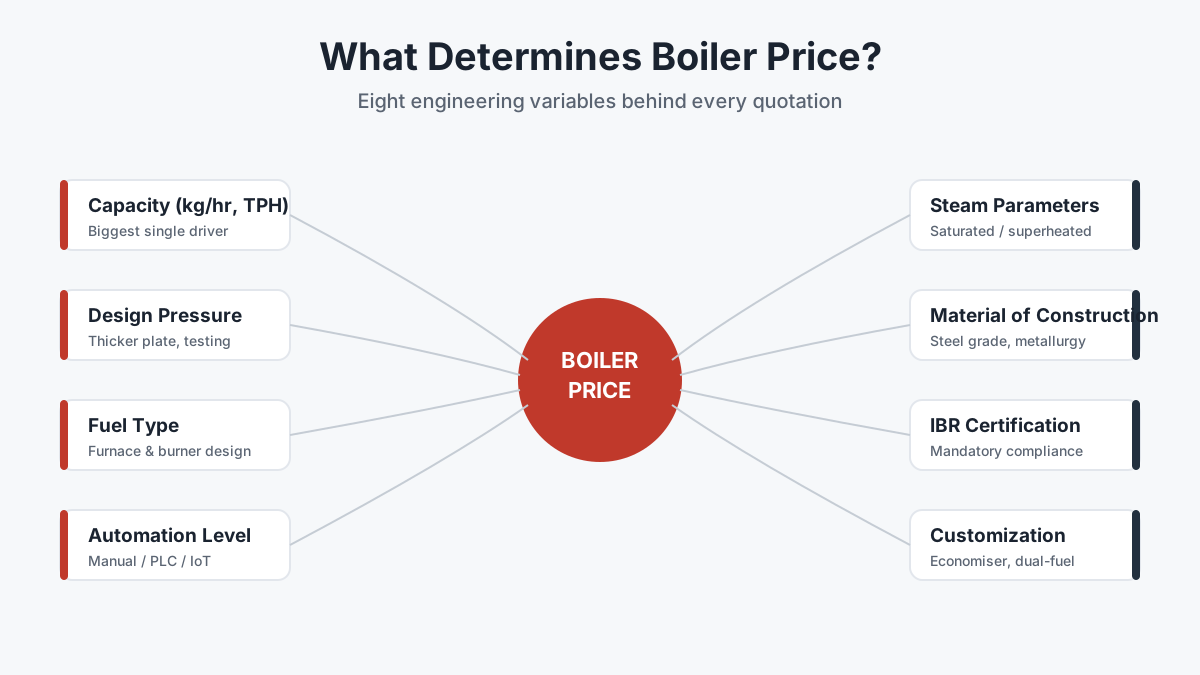
Engineer's note: Two "5 TPH" boilers can differ in price by a wide margin purely because one is a low-pressure package unit and the other is a high-pressure, fully automated, IBR unit with an economiser. Always compare like for like.
Industrial Boiler Price by Capacity
Capacity is where most buyers start. As a rule of thumb, price does not rise in a straight line larger boilers cost more in absolute terms but usually less per kg of steam produced, because fixed engineering and control costs are spread over more output.
Short answer (40–60 words): Small boilers of 100–500 kg/hr are the most affordable entry point and are often non-IBR. From 1 TPH upward, most units become IBR boilers with rising capital cost. Large boilers of 20–50 TPH carry the highest ticket price but deliver the lowest cost per tonne of steam, making them economical for continuous, high-demand plants.
| Capacity | Typical Segment | IBR Status | Relative Capital Cost | Best Suited For |
|---|---|---|---|---|
| 100 kg/hr | Micro / mini boiler | Often non-IBR | Lowest | Small workshops, labs, small food units |
| 300 kg/hr | Mini boiler | Often non-IBR | Very low | Small dairies, hotels, packaging |
| 500 kg/hr | Small package boiler | Borderline / IBR | Low | Small processing units |
| 1 TPH | Package boiler | IBR | Low–Medium | Textile finishing, small chemical |
| 2 TPH | Package boiler | IBR | Medium | Food processing, rubber |
| 3 TPH | Package boiler | IBR | Medium | Mid-size textile, pharma |
| 5 TPH | Package / membrane | IBR | Medium–High | Continuous process plants |
| 10 TPH | Water-tube / membrane | IBR | High | Large textile, paper, chemical |
| 15 TPH | Water-tube | IBR | High | Heavy process industry |
| 20 TPH | Water-tube | IBR | Very High | Large manufacturing, sugar |
| 30 TPH | Water-tube | IBR | Very High | Distilleries, large process |
| 40 TPH | Water-tube | IBR | Highest tier | Power & process cogeneration |
| 50 TPH | Water-tube | IBR | Highest tier | Captive power, heavy industry |
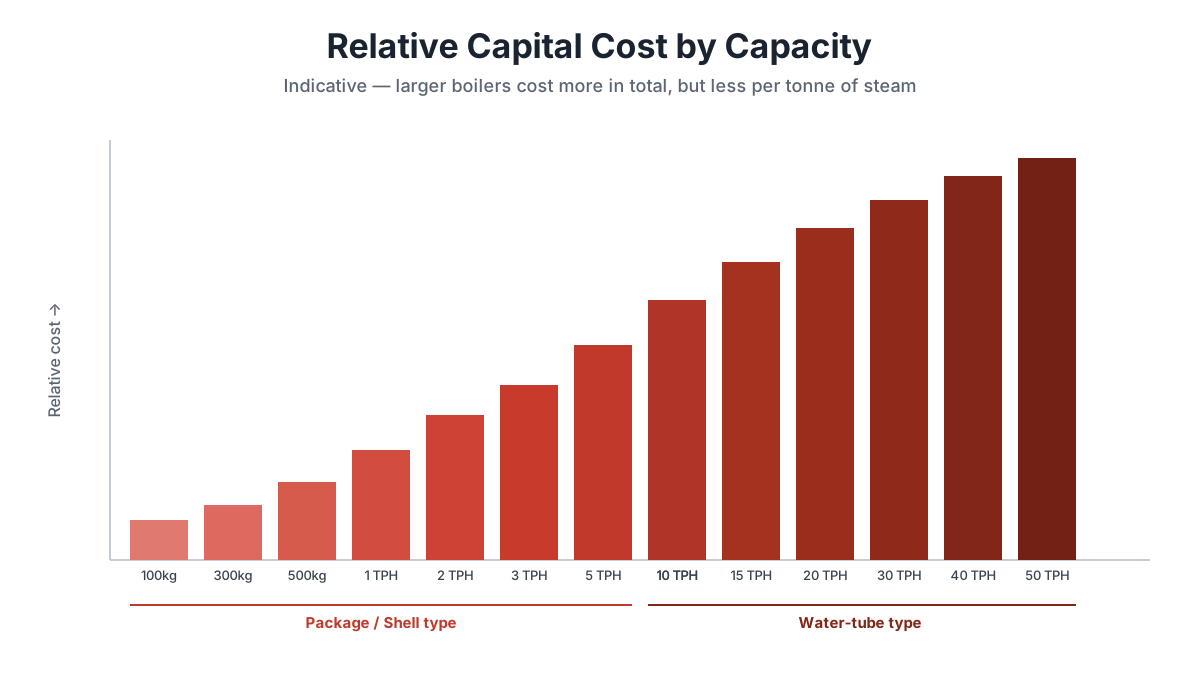
Notice the crossover point: below roughly 1 TPH you are usually in the small steam boiler segment with shell-type designs. At 10 TPH and above, water-tube construction takes over because it handles higher pressures and heat loads more safely and efficiently.
Boiler Price by Fuel Type
Fuel choice affects both the purchase price and far more importantly the running cost. The furnace, fuel feeding equipment and air pollution control equipment all change with the fuel.
| Fuel Type | Capital Cost | Running Fuel Cost | Key Cost Notes |
|---|---|---|---|
| Coal fired | Higher (grate, fuel handling, ESP/bag filter) | Historically low, but variable | Needs ash handling and pollution control; more manpower |
| Biomass (briquette, husk, pellet) | Higher (similar to coal) | Low–Medium, region dependent | Renewable, favourable emissions; fuel logistics matter |
| Oil fired (FO/LDO/HSD) | Lower (compact burner) | High | Cleanest solid-liquid option to install; costly to run |
| Gas fired (NG/LPG/PNG) | Lowest (simple burner, small footprint) | Medium–High | Cleanest combustion, low maintenance, high automation |
| Electric | Low–Medium | Highest per unit heat | Zero on-site emissions; best for small/intermittent loads |
| Waste heat recovery | Highest (custom engineered) | Near zero (free heat) | Best long-term economics where waste heat exists |
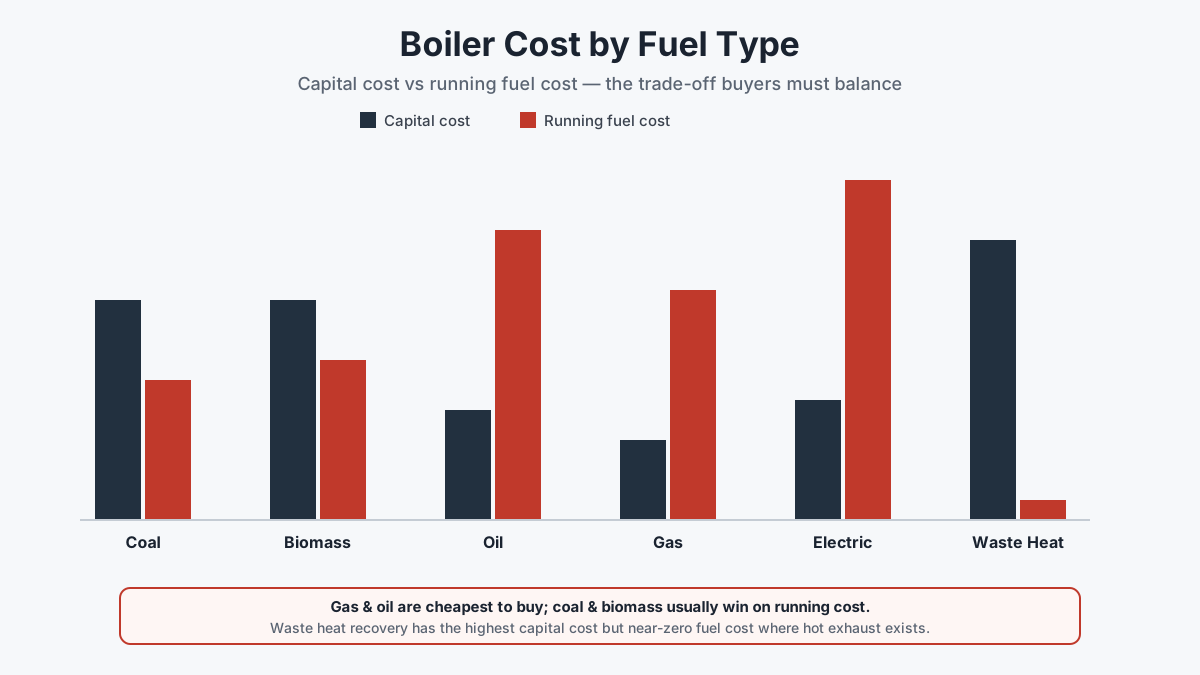
Key insight: Gas and oil boilers are cheaper to buy because the burner is compact and there is no ash handling. Solid-fuel (coal/biomass) boilers cost more upfront but often win on fuel cost, which is why so many Indian process plants still choose a biomass or coal fired steam boiler. Match the fuel to your local fuel availability and price, not just the sticker cost.
Still weighing solid fuel against gas? Our detailed comparison of biomass vs coal fired boilers breaks down the running-cost and emission trade-offs for Indian plants.
Boiler Price by Boiler Type
"Boiler" is a family, not a single product. The right type depends on whether you need steam, hot thermic fluid, hot water or hot air.
| Boiler Type | What It Produces | Relative Cost | Typical Application |
|---|---|---|---|
| Steam Boiler | Saturated / superheated steam | Medium–High | Process heating, sterilisation, drying |
| Thermic Fluid Heater | Hot thermic oil (high temp, low pressure) | Medium | Textile, chemical, plywood needs high temp without high pressure |
| Hot Water Boiler | Pressurised hot water | Low–Medium | Hospitals, hotels, space heating |
| Hot Air Generator | Clean or direct hot air | Low–Medium | Drying, spray dryers, tea, food |
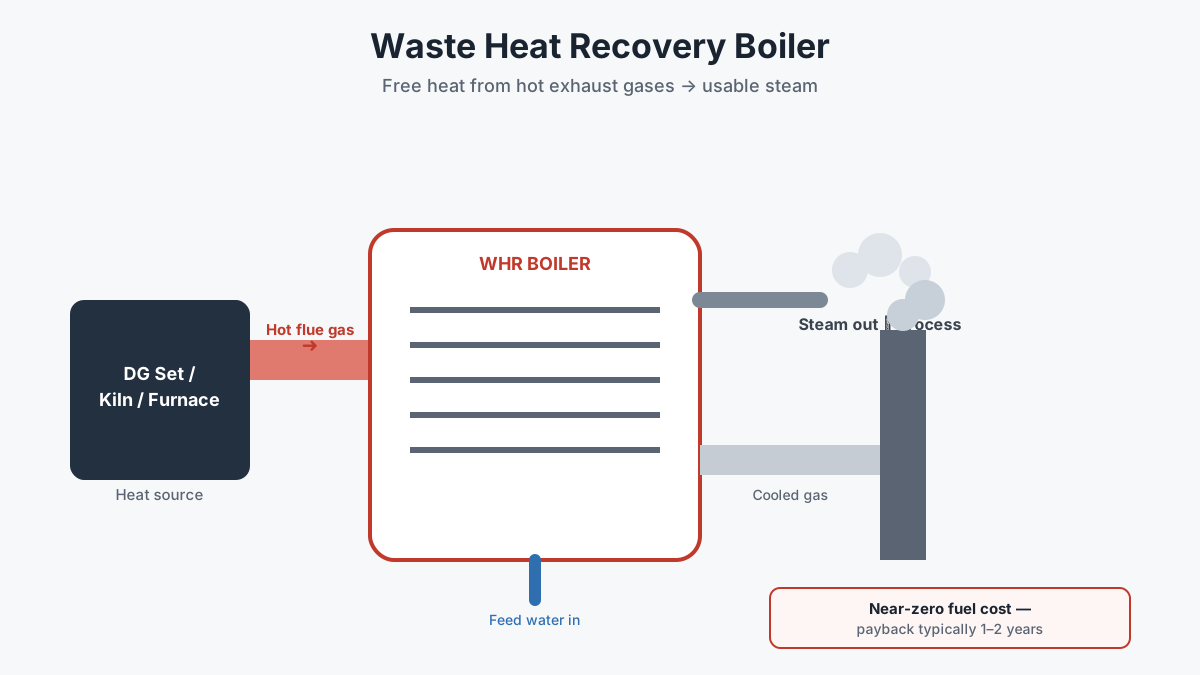
| Waste Heat Recovery Boiler | Steam from exhaust gases | High (custom) | DG sets, kilns, furnaces, cogeneration |
| Electric Boiler | Steam / hot water via elements | Low–Medium | Clean-room, pharma, small loads |
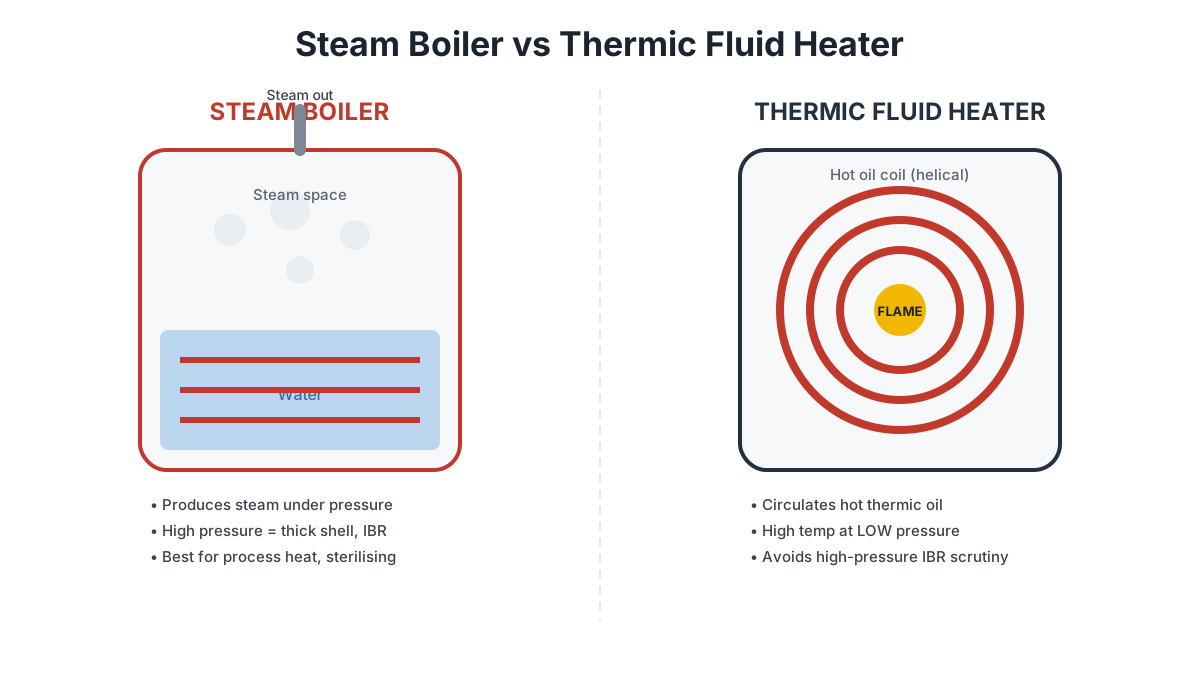
A thermic fluid heater is often cheaper to operate for high-temperature duties because it avoids the high pressures and therefore the thick shells and IBR scrutiny that steam at the same temperature would require.
Industrial Boiler Installation Cost
The boiler ex-works price is only part of the project. Installation and commissioning can add a meaningful percentage on top, and buyers who forget this line item blow their budgets.
| Installation Element | What It Covers | Cost Impact |
|---|---|---|
| Civil & foundation work | RCC foundation, boiler house, fuel storage, ash yard | Medium–High |
| Piping | Steam, feed water, blowdown, fuel lines, valves | Medium |
| Electrical | Panels, cabling, motors, instrumentation, earthing | Medium |
| Chimney & ducting | Statutory height chimney, ducting, dampers | Medium |
| Transportation & handling | Freight, crane, unloading, positioning | Varies with size & distance |
| Commissioning | Hydro test, IBR inspection, trials, operator training | Low–Medium |
Budgeting tip: Ask every vendor whether the quote is ex-works, FOR site, or supply-and-commission. The same boiler can look cheaper on paper simply because installation was excluded.
Operating Cost
Over a boiler's life, operating cost dwarfs the purchase price. This is where efficiency pays you back every shift.
- Fuel: Usually 70–85% of lifetime running cost. A 2–3% efficiency gain from an economiser or better boiler accessories compounds enormously.
- Water: Softened / demineralised feed water, plus makeup water for blowdown losses.
- Electricity: Fans (FD/ID), feed pumps, fuel feeders and controls.
- Labour: Certified boiler operators solid-fuel units need more manpower than gas.
- Maintenance: Routine upkeep to hold efficiency and safety (covered next).
Short answer: A boiler that costs 10% more but runs 3–4% more efficiently typically repays the difference within one to two years of continuous operation through fuel savings alone.
Boiler Maintenance Cost
Planned boiler maintenance is cheaper than breakdowns. Neglected water treatment or fouled tubes silently erode efficiency and can trigger costly failures. Keep a copy of our annual boiler maintenance checklist in the boiler house.
| Maintenance Item | Frequency | Why It Matters |
|---|---|---|
| Annual maintenance contract (AMC) | Yearly | Planned servicing, priority support, uptime |
| Spare parts | As needed | Gaskets, refractory, tubes, valves, bearings |
| Statutory inspection | Annual (IBR) | Legal compliance, safety certification |
| Water treatment | Continuous | Prevents scale & corrosion protects efficiency |
| Tube cleaning / descaling | Periodic | Restores heat transfer, cuts fuel use |
Boiler Lifecycle Cost (Total Cost of Ownership)
The smartest procurement teams evaluate a boiler on Total Cost of Ownership (TCO) over 10–15 years, not on purchase price. Here is the realistic weighting.
| Cost Component | Approx. Share of Lifecycle Cost | Notes |
|---|---|---|
| Fuel | ~70–85% | By far the dominant cost efficiency is king |
| Capital (boiler + install) | ~10–20% | One-time; often over-weighted by buyers |
| Maintenance & spares | ~3–7% | Rises sharply if neglected |
| Water & chemicals | ~1–3% | Small but critical for protection |
| Labour | ~2–5% | Lower with automation |
Bottom line: The purchase price you negotiate so hard over is often only 10–15% of what the boiler will truly cost you. Spend your negotiating energy on efficiency and reliability.
How to Reduce Boiler Cost
- Right-size the boiler. Oversizing wastes capital and runs inefficiently at part load. Base capacity on a realistic steam demand study our walkthrough on how to calculate boiler capacity shows the method.
- Add heat recovery. An economiser or air pre-heater typically pays back within 1–2 years. See our guide on how to improve boiler efficiency for practical fuel-saving steps.
- Choose the locally cheapest reliable fuel. Fuel dominates lifetime cost.
- Insulate and fix steam leaks. Good lagging and steam trap management save fuel continuously.
- Automate combustion. Oxygen trim and modulating controls squeeze out excess-air losses.
- Recover condensate. Returning hot condensate cuts both fuel and water bills.
- Buy from an experienced boiler manufacturer. Correct engineering avoids expensive retrofits later.
Hidden Costs Buyers Ignore
- Pollution control: Bag filters, multicyclones or ESP for solid fuel often quoted separately. See bag filter and air pollution control equipment.
- Fuel handling & storage: Sheds, feeders, ash handling and yard space.
- Water treatment plant: Softener or DM plant is essential, not optional.
- Statutory approvals: IBR, pollution board consent, factory approvals.
- Downtime during changeover: Lost production while installing or switching.
- Spare inventory: Critical spares to avoid long outages.
Common Mistakes When Buying a Boiler
- Choosing on lowest quoted price instead of lifecycle cost.
- Oversizing to "be safe," causing part-load inefficiency.
- Ignoring fuel availability and price volatility in the region.
- Overlooking emission norms and pollution control until commissioning.
- Comparing quotes that aren't like-for-like (pressure, IBR, scope).
- Underestimating installation and civil work.
- Selecting a vendor with weak after-sales support.
How to Select the Right Boiler
Follow these steps:
- Define the load: Peak and average steam demand, pressure and temperature required by your process.
- Fix the fuel: Based on local availability, price and emission norms.
- Choose the type: Steam, thermic fluid, hot water or hot air.
- Set automation level: Manual, PLC or full IoT control.
- Confirm compliance: IBR, pollution board, safety standards.
- Evaluate TCO: Compare vendors on 10-year cost, not sticker price.
- Check the manufacturer: Track record, service network, references.
| Check | Confirmed? |
|---|---|
| Steam demand study done | ☐ |
| Fuel finalised & available long-term | ☐ |
| Correct pressure & capacity specified | ☐ |
| IBR & emission compliance confirmed | ☐ |
| Installation scope clarified in quote | ☐ |
| Efficiency & heat recovery included | ☐ |
| After-sales & AMC support verified | ☐ |
| Priority | Best Fuel Choice |
|---|---|
| Lowest running cost + local biomass | Biomass fired boiler |
| Lowest running cost + coal belt region | Coal fired boiler |
| Cleanest combustion, low maintenance | Gas fired boiler |
| Low capital, intermittent load | Oil fired or electric boiler |
| Existing hot exhaust available | Waste heat recovery boiler |
Latest Boiler Technology Trends (2026)
- Industrial automation: PLC/SCADA combustion control with modulating burners and auto fuel feeding for stable efficiency.
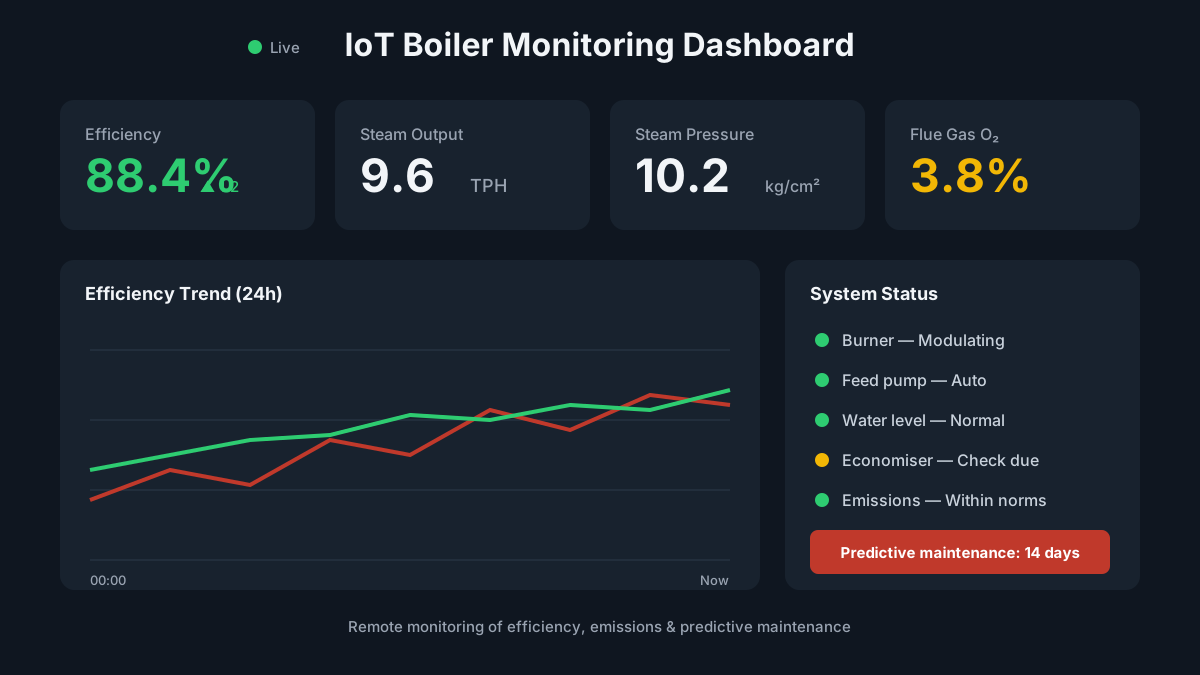
- IoT & remote monitoring: Live dashboards for efficiency, emissions and predictive maintenance alerts.
- Low-emission design: Advanced pollution control to meet tightening CPCB norms a major reason biomass boilers are gaining share.
- Heat recovery: Economisers, air pre-heaters and waste heat recovery boilers as standard, not extras.
- Energy-efficient boilers: Higher pressure ratings, better metallurgy and improved combustion pushing efficiencies upward.
Why Buying from a Trusted Boiler Manufacturer Matters
A boiler is a pressure vessel that will run for a decade or more under heat and pressure. The manufacturer's engineering discipline directly affects your safety, efficiency and uptime. An established industrial boiler manufacturer gives you IBR-compliant design, sound welding and metallurgy, correct sizing, genuine spares and a service network that responds when a shift is at risk.
Cheap, under-engineered boilers cost you in fuel every day and in breakdowns at the worst moments. When you evaluate a steam boiler manufacturer, weigh references, in-house design capability, after-sales reach and honesty about pricing as heavily as the number on the quotation.
Frequently Asked Questions
1. What is the price of an industrial boiler in India?
There is no single price. It depends on capacity, pressure, fuel, automation and IBR requirements. Small boilers are the most affordable entry point, while large 20–50 TPH water-tube boilers are the highest tier. Always request a project-specific quotation based on your steam demand and fuel.
2. Why won't suppliers give a fixed boiler price?
Because a boiler is engineered to your specification. The same nominal capacity can differ widely in price based on pressure rating, fuel, material and scope. A fixed price without a specification is a guess, not a quotation.
3. Which boiler is cheapest to buy?
Gas-fired and oil-fired boilers usually have the lowest capital cost because their burners are compact and they need no ash handling. However, their running fuel cost is often higher than solid-fuel boilers.
4. Which boiler is cheapest to run?
It depends on local fuel prices. In most Indian regions, biomass and coal fired boilers offer the lowest fuel cost per tonne of steam, while waste heat recovery boilers are cheapest of all where suitable hot exhaust gas already exists.
5. What is IBR and does it affect price?
The Indian Boilers Regulation governs boilers above 22.75 litres water capacity. IBR design, inspection and documentation add cost but are mandatory for legal, safe operation. Most boilers of 1 TPH and above are IBR boilers.
6. How is boiler capacity measured?
Small boilers are rated in kg/hr of steam; larger boilers in TPH (tonnes per hour). A 1 TPH boiler produces roughly 1,000 kg of steam per hour at rated conditions.
7. Does higher capacity mean higher cost per tonne of steam?
No the opposite. Larger boilers cost more in total but usually less per tonne of steam, because fixed engineering and control costs are spread over more output. This favours large, continuously running plants.
8. How much does boiler installation cost?
Installation civil work, piping, electrical, chimney, transport and commissioning adds a meaningful percentage on top of the ex-works price. Always confirm whether a quote includes installation or is supply-only.
9. What is the biggest cost over a boiler's life?
Fuel, typically 70–85% of total lifecycle cost. This is why a slightly more expensive but more efficient boiler almost always wins on total cost of ownership.
10. How long does an industrial boiler last?
With proper water treatment and maintenance, a well-built industrial boiler commonly serves 15–25 years. Poor water treatment and neglected maintenance shorten life dramatically.
11. What is the difference between a steam boiler and a thermic fluid heater?
A steam boiler produces steam under pressure; a thermic fluid heater circulates hot oil to deliver high temperatures at low pressure. For high-temperature process heating, a thermic fluid heater often avoids the high pressures and IBR scrutiny that steam would need.
12. Is a biomass boiler worth the higher upfront cost?
Often yes, where biomass fuel is locally available and affordable. The higher capital cost is repaid through lower fuel cost and favourable emissions, making it popular across Indian process industries.
13. What hidden costs should I budget for?
Pollution control equipment, fuel storage and handling, water treatment plant, statutory approvals, changeover downtime and critical spares. These are frequently omitted from headline quotes.
14. How do I avoid overpaying for a boiler?
Right-size the boiler, compare quotes like-for-like, evaluate on 10-year total cost of ownership rather than sticker price, and include efficiency features such as economisers that pay back quickly.
15. What automation options are available?
From manual firing to PLC-based semi-automatic control to full IoT-enabled automation with modulating combustion and remote monitoring. Higher automation raises capital cost but improves efficiency and cuts labour.
16. Do I need pollution control equipment?
Yes for solid-fuel boilers bag filters, multicyclones or ESPs are required to meet emission norms. Gas-fired boilers need the least. Budget for this from the start, not as an afterthought.
17. Can I recover waste heat to save money?
Absolutely. Economisers and waste heat recovery boilers capture heat from flue gas or process exhaust, cutting fuel use significantly and typically paying back within one to two years.
18. What size boiler do I need?
Base it on a realistic steam demand study covering peak and average load. Oversizing wastes capital and runs inefficiently at part load; undersizing starves your process. When unsure, consult an experienced boiler engineer.
19. What maintenance does an industrial boiler need?
Continuous water treatment, periodic tube cleaning, an annual maintenance contract, statutory IBR inspection and timely spares replacement. Planned maintenance is far cheaper than breakdowns.
20. How do I choose a reliable boiler manufacturer?
Look for IBR-compliant in-house design capability, a strong track record, genuine spares, a responsive service network and transparent pricing. Weigh after-sales support as heavily as the quoted price.
Final Word
An industrial boiler is a long-term investment, not a one-time purchase. Price it the way an engineer does by capacity, pressure, fuel, automation and compliance and judge it on total cost of ownership over its full life. Get a project-specific quotation, compare like-for-like, and buy from a manufacturer who will still answer the phone in year eight. Do that, and the boiler will pay you back in reliable steam, shift after shift.