


Picture a large chemical or paint manufacturing plant running at full production. Reactors are cycling, separation columns are operating, and somewhere within that complex a flare stack burns continuously. Day and night. Every day of the year.
That flare is not an emergency safety device in routine operation. It is a waste pipe. The gas burning there is a process tail gas a hydrogen-containing byproduct of the plant's core chemistry that has measurable calorific value but not enough consistency or purity to feed directly into a standard gas boiler. So it burns off at the flare stack. Its energy is lost. Its combustion adds to the plant's emission inventory. And the plant separately purchases natural gas or LPG to run its steam boilers paying full market price for fuel while a combustible energy stream already present on-site goes to waste.
This has been accepted practice in Indian process industries for decades. But it is not inevitable.
A purpose-engineered 4 TPH 35 Bar tail gas fired steam boiler breaks this cycle. It is designed from the ground up to handle the low calorific value, variable composition, and lean hydrogen characteristics of process tail gas burning it reliably in a high-pressure water tube boiler and delivering steam that the plant can use directly in its processes. No more flaring waste. No more paying full price for fuel when a combustible energy stream already exists on-site.
Par Techno-Heat Pvt. Ltd. has designed and manufactured systems of exactly this type high-pressure, special-fuel water tube boilers engineered for lean H₂ tail gas applications in process industries across India. This guide provides the complete technical picture of how these systems work, what makes them challenging to engineer, and which industries stand to benefit most.
A tail gas fired steam boiler is a specially engineered industrial steam generation system designed to use tail gas the residual, low-calorific-value process gas remaining after the primary reactions or separation stages of an industrial process as its main combustion fuel, either alone or supplemented by a conventional backup fuel.
The term "tail" refers to the exit or downstream end of a process sequence. In paint manufacturing, chemical synthesis, petrochemical processing, and fertilizer production, the tail gas stream is what remains after the valuable products have been separated out. It typically contains a mixture of hydrogen (H₂), carbon monoxide (CO), light hydrocarbons such as methane (CH₄) and ethylene (C₂H₄), nitrogen (N₂), and carbon dioxide (CO₂) in ratios that vary depending on upstream feed conditions, process load, and operating mode.
This variability is precisely what makes tail gas a challenging boiler fuel. A standard natural gas boiler is configured for a consistent fuel with a known calorific value of approximately 8,500 kcal/m³. Tail gas calorific value can range from as low as 1,000 kcal/m³ to around 4,000 kcal/m³ and it can shift during the day as process conditions upstream change. A conventional gas boiler burner calibrated for natural gas will lose flame stability or shut down on this kind of variable, low-energy fuel without specific redesign.
When the tail gas contains a significant lean hydrogen (lean H₂) fraction as is common in paint, chemical, and petrochemical process streams the engineering challenge increases further. Hydrogen behaves very differently from natural gas in a combustion environment, requiring specific burner geometry, air management strategy, and safety system design to achieve reliable operation.
A well-engineered tail gas fired boiler solves all of these challenges through purpose-designed combustion hardware, intelligent adaptive control systems, and a high-pressure water tube design that reliably converts this otherwise wasted energy stream into productive, high-pressure steam.
Before going into the working principle, it is worth understanding what the 4 TPH and 35 Bar figures mean because they define the engineering category this boiler falls into.
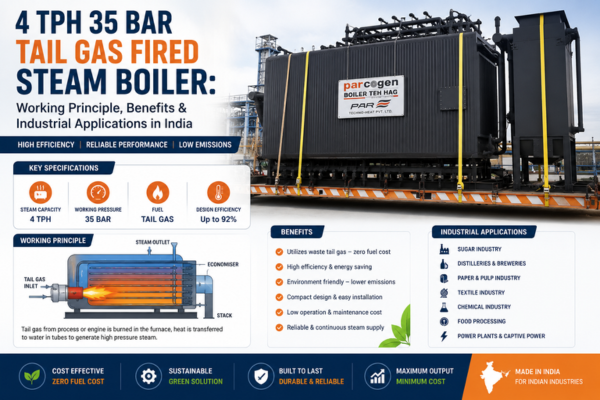
4 TPH (4 Tonnes per Hour Steam Output) This means the boiler generates 4,000 kg of steam per hour at its rated output. For context, a small industrial boiler might produce 500–1,000 kg/hr. A 4 TPH boiler is a medium-capacity industrial system sufficient to supply a significant portion of steam demand for a medium-scale process plant, textile unit, or manufacturing facility.
35 Bar Operating Pressure 35 Bar is approximately 35 kg/cm² a high-pressure specification that places this boiler firmly in the category of high-pressure industrial steam systems. At 35 Bar, the saturation temperature of steam is approximately 242°C. This is not the 10–12 Bar saturated steam used for basic process heating. This is high-pressure steam suitable for driving steam turbines for captive power generation, supplying high-temperature jacketed reactors, and serving demanding industrial process requirements that low-pressure boilers cannot meet.
Together, 4 TPH at 35 Bar defines a high-pressure, medium-capacity industrial water tube boiler a category that requires IBR high-pressure certification, water tube design (fire tube designs are not viable above approximately 18–21 Bar), certified pressure part materials, and rigorous factory inspection before commissioning.
The complete working cycle of this system integrates fuel supply conditioning, specialized lean H₂ combustion, high-pressure water tube heat transfer, steam separation, and intelligent automated control into one coordinated industrial system. Here is how each stage works in practice:
Tail gas from the upstream process unit arrives at the boiler's fuel gas header through a dedicated supply piping system fitted with pressure regulators, isolation valves, manual and automatic shutoff provisions, and flow instrumentation.
The supply pressure at the burner must be regulated from the higher, more variable process header pressure down to the stable range required at the burner inlet. Pressure regulation skids with upstream and downstream instrumentation handle this conditioning.
For lean H₂ applications, the gas composition particularly the hydrogen fraction and resulting calorific value is monitored continuously or intermittently using an online calorimeter or gas analyser. This calorific value measurement feeds into the combustion control system, enabling automatic adjustment of the combustion air supply as the fuel composition varies with upstream process conditions.
Most tail gas boiler installations also include a pilot or auxiliary burner fuelled by a stable conventional fuel natural gas or LPG for initial ignition and to provide combustion support during periods when tail gas supply is lean, low-pressure, or temporarily unavailable. This dual-fuel provision ensures uninterrupted steam availability even when the upstream process fluctuates.
The burner is the most technically critical component in the entire tail gas boiler system. Every characteristic that makes tail gas difficult low calorific value, variable composition, and lean hydrogen content must be managed at the burner to achieve stable, safe, and efficient combustion continuously.
Par Boiler's burner design for lean H₂ tail gas applications incorporates a staged combustion approach specifically developed for this fuel category:
Primary Combustion Zone: A stable high-temperature pilot zone supported by the auxiliary conventional fuel during startup and during lean gas periods provides reliable ignition energy. The tail gas enters the primary zone where it mixes with precisely metered primary air and ignites reliably even at low calorific values. The primary zone geometry and air velocity are engineered to anchor the flame stably despite the fuel's variability.
Secondary Combustion Zone: Additional secondary air is introduced above and around the primary flame zone to complete combustion of residual carbon monoxide, unburned light hydrocarbons, and hydrogen not fully oxidized in the primary zone. This two-stage air injection approach maximizes combustion efficiency while controlling peak flame temperature important for NOx management.
Lean H₂ Specific Safety Engineering: Hydrogen has a laminar flame speed approximately seven times faster than methane and a flammability range in air of 4–75% by volume, compared to just 5–15% for natural gas. These properties create real risks of flashback where the flame propagates backward into the fuel supply line and auto-ignition if the burner is not engineered specifically for hydrogen-containing fuel.
Par Boiler's burner for lean H₂ applications incorporates hydrogen-specific flame holder geometry, controlled fuel injection velocities maintained above the flashback limit across the operating range, and purge volume calculations based on hydrogen's lower explosive limit (LEL). These design elements ensure that the system operates safely across the full range of fuel compositions it will encounter in service.
The Burner Management System (BMS) governs the complete automated sequence pre-purge with timed air flow confirmation, pilot ignition, main tail gas valve opening, flame detection confirmation, operational monitoring, and safe shutdown on any abnormal condition. Undetected flame failure immediately closes all fuel valves and initiates a timed re-purge before any restart attempt eliminating the risk of unburned fuel accumulation in the furnace that could lead to an explosion on re-ignition.
At 35 Bar operating pressure, the boiler uses a high-pressure water tube configuration. Hot combustion gases from the lean H₂ tail gas flame typically at 900–1,100°C in the furnace zone transfer heat to water circulating inside small-diameter tubes through radiation in the furnace section and convection in the downstream tube bank passes.
Water absorbs this heat progressively as it circulates through the heated tube circuits, converting from subcooled liquid to a saturated steam-water mixture that rises toward the steam drum. The convective section downstream of the furnace houses the evaporator tube banks, economizer (which recovers heat from cooling flue gases to preheat the incoming feed water), and air preheater (which uses residual flue gas heat to preheat the combustion air supply improving overall thermal efficiency).
This multi-stage heat recovery from furnace through economizer and air preheater is what achieves the boiler's high overall thermal efficiency of 85–90% on tail gas fuel. For a detailed technical understanding of water tube boiler design principles at high operating pressure, our complete guide on water tube boiler working, types, and advantages covers the engineering fundamentals in depth.
The steam-water mixture from the heated tube circuits rises into the steam drum the main horizontal pressure vessel at the top of the boiler circuit. Inside the drum, gravity and internal separation devices cyclone separators, demisters, or baffle arrangements depending on the design separate steam from water.
Dry, clean saturated steam exits the drum through the main steam outlet at 35 Bar and is delivered to the plant's high-pressure steam distribution header. At 35 Bar and approximately 242°C, this steam is at the quality level required for turbine drives, high-temperature process reactors, and demanding industrial process applications.
The steam drum also manages feed water inlet, chemical dosing connections, continuous and intermittent blowdown, and drum level instrumentation all critical for water chemistry control and safe drum operation at sustained high pressure.
The PLC-based control system manages all operational parameters simultaneously steam pressure regulation, drum water level control, combustion air-to-fuel ratio adjustment, feed water flow management, and flue gas oxygen monitoring in a fully automated closed-loop architecture.
For a tail gas application specifically, the control system must handle fuel quality variation gracefully. As tail gas calorific value shifts with upstream process conditions, the combustion air supply is automatically adjusted to maintain the correct air-to-fuel ratio and stable combustion. This calorific value compensation is a control feature that distinguishes a properly engineered tail gas boiler from a standard gas boiler attempting to burn variable-quality fuel.
The boiler integrates with the plant's distributed control system (DCS) through standard communication protocols allowing the plant's process control system to send steam demand signals that automatically modulate boiler firing rate, ensuring steam supply tracks process load without manual intervention.
Key safety interlocks include high steam pressure cutoff, low water level alarm and automatic shutdown, flame failure detection with immediate fuel isolation and re-purge requirement, BMS logic with pre-start interlock checks, high flue gas temperature alarm, and manual emergency stop at both local and remote locations. For high-pressure boiler operations, structured safety management is mandatory our boiler safety guidelines for industries outlines the key safety protocols applicable to high-pressure water tube systems. For a broader understanding of how steam boiler systems integrate into plant utility infrastructure, our guide on steam boiler systems in India — design, efficiency, and applications provides the full operational context.
This is a question plant engineers sometimes ask: why can't a fire tube boiler be used at 35 Bar? The answer is straightforward and grounded in physics.
A fire tube boiler relies on a large-diameter cylindrical shell as its primary pressure-bearing vessel. As operating pressure increases, the shell wall thickness required by pressure vessel codes grows proportionally and at pressures above approximately 18–21 Bar, the shell becomes so thick and heavy that the boiler is impractical from both a manufacturing and structural standpoint.
A water tube boiler, by contrast, uses small-diameter tubes typically 38–63 mm outside diameter as the primary pressure-bearing components. Small-diameter tubes withstand high internal pressure with very modest wall thickness increases. A 38 mm tube at 35 Bar requires only a few millimetres of additional wall thickness compared to the same tube at 10 Bar whereas a large-diameter fire tube shell at 35 Bar would require wall thicknesses that make the vessel impractically heavy.
This is why the 35 Bar specification for this project mandates a water tube design it is the engineering-correct choice for high-pressure industrial steam generation, not simply a preference. At 35 Bar, all pressure parts drum, headers, downcomers, riser tubes are designed and certified under IBR Schedule requirements for high-pressure service, with material test certificates traceable to approved manufacturers, full-penetration welds on all critical joints with radiographic or ultrasonic examination, and a factory hydraulic pressure test at 52.5 Bar (1.5 times working pressure) before dispatch.
The core value is simple and quantifiable. Tail gas that previously burned at the flare stack generating zero productive output now generates 4 TPH of 35 Bar steam that the plant uses directly. The energy value of the tail gas, which was a pure loss before, now displaces purchased fuel consumption at current market prices.
For a plant previously purchasing natural gas at ₹45–55/m³ to generate equivalent steam output, even partial displacement through tail gas recovery generates substantial recurring monthly savings that compound over the boiler's 15–20 year service life.
Industrial flaring contributes to a plant's CO₂, CO, and unburned hydrocarbon emission inventory. Consuming tail gas in a purpose-designed boiler combustion system where combustion efficiency runs at 85–90% versus 60–75% for open flares improves combustion completeness and directly reduces the emission quantities associated with flaring.
CPCB and State PCBs are applying increasing scrutiny to routine industrial flaring across process industries. Plants under ISO 14001 environmental management systems or preparing ESG sustainability disclosures benefit from documented flaring reduction through productive waste gas utilization a measurable, reportable environmental improvement.
At 35 Bar, the steam produced is suitable for turbine drives, high-temperature jacketed reactors, distillation column reboilers, and high-pressure autoclaves applications that low-pressure boilers cannot serve. This makes the tail gas boiler not just a cost-saving measure but a capability enabler for process configurations requiring high-pressure steam.
A plant that partially meets its steam generation fuel requirement from on-site waste gas is less exposed to conventional fuel price volatility. For Indian process industries that have experienced significant natural gas and LPG price movements over recent years, on-site fuel recovery provides energy security value that goes beyond simple cost accounting.
Integrating a tail gas fired boiler is a high-impact application of waste energy recovery one of the most effective routes to improving a plant's specific energy consumption (SEC). For plants pursuing ISO 50001 energy management certification or implementing PCRA audit recommendations, a waste gas fired steam boiler represents a top-tier efficiency investment. Our guide on how to improve boiler efficiency covers complementary operational measures that can further enhance the system's overall performance after commissioning.
Paint and Coatings Manufacturing Paint manufacturing processes generate hydrogen-containing tail gas streams from reactor operations, solvent recovery systems, and process gas separation streams with sufficient calorific value for tail gas boiler recovery when properly managed.
Chemical and Specialty Chemical Industry Chloralkali, methanol, ammonia synthesis, and organic chemical manufacturing plants generate hydrogen-rich purge gases and vent streams that are standard candidates for tail gas boiler recovery applications.
Petrochemical and Refinery Operations Petroleum refining generates refinery fuel gas, hydrotreater purge hydrogen, and cracked gas streams routinely recovered in purpose-designed process boilers within integrated refinery utility systems.
Fertilizer Manufacturing Ammonia synthesis loop purge gas containing hydrogen, nitrogen, argon, and methane is one of the most established tail gas boiler feed streams in the Indian fertilizer industry.
Hydrogen Production Facilities PSA tail gas from pressure swing adsorption units in industrial hydrogen plants is a classic lean H₂ tail gas stream, with hydrogen contents typically in the 20–40% range directly applicable to purpose-designed lean H₂ fired boilers.
Steel and Integrated Metal Plants Coke oven gas, blast furnace gas, and basic oxygen furnace gas from integrated steel plants are the original industrial application of low-calorific-value waste gas fired boilers a practice well-established in large Indian steel plants.
A 4 TPH 35 Bar tail gas fired boiler is not a catalogue product. It is a custom-engineered system where the quality of the combustion engineering, pressure vessel design, IBR compliance execution, and integrated control system design determines reliability over a 15–20 year operational life.
When evaluating manufacturers, the key differentiators for this category are: demonstrated special-fuel combustion system design capability for lean H₂ or low-calorific-value gas, high-pressure IBR certification experience with certified references, in-house engineering and design rather than outsourced, demonstrated installation references on comparable fuel types, and accessible local service support.
Our boiler manufacturer selection checklist provides a structured framework covering all critical evaluation criteria for specialized high-pressure boiler procurement. Once commissioned, our industrial boiler maintenance checklist provides the inspection and service schedule needed to sustain performance and safety across the operating life of a high-pressure water tube system.
For a broader reference on India's industrial boiler manufacturing landscape, our guide to top steam boiler manufacturers in India is a useful starting point for procurement teams building a qualified supplier shortlist.
Par Techno-Heat Pvt. Ltd. has over 25 years of focused industrial boiler manufacturing experience including high-pressure, special-fuel applications that require genuine engineering depth.
The company's capability in tail gas and lean H₂ fired boiler applications covers the complete project scope: combustion system engineering for low-calorific-value and lean hydrogen fuels, high-pressure water tube design and IBR certification management, BMS and PLC control system integration, fabrication and factory hydraulic testing, and delivery with full commissioning support.
For process industry plants evaluating waste gas recovery boilers, tail gas fired steam systems, or any high-pressure special-fuel requirement, Par Techno-Heat is prepared to review your fuel composition data, capacity requirement, operating pressure, and site conditions and provide a technically detailed, site-specific proposal.
Contact Par Techno-Heat Pvt. Ltd. Discuss Your Tail Gas Boiler Requirement
Q1. What is a tail gas fired steam boiler and how is it different from a standard gas boiler?
A tail gas fired steam boiler is purpose-engineered to burn tail gas a low-calorific-value, variable-composition process byproduct as its primary fuel. Unlike standard gas boilers designed for consistent natural gas or LPG, a tail gas boiler requires specialized burner design, calorific value-compensated combustion control, and safety systems engineered for variable fuel composition and lean hydrogen content.
Q2. What is lean H₂ and why does it require special burner design?
Lean H₂ refers to a process gas containing a below-stoichiometric proportion of hydrogen typically mixed with CO, N₂, CO₂, and light hydrocarbons. Hydrogen's high flame speed (seven times methane), wide flammability range (4–75% in air), and flashback tendency require specific burner geometry, air injection design, and BMS logic to ensure stable, safe combustion across varying fuel compositions.
Q3. Why does 35 Bar require a water tube boiler and not a fire tube design?
At 35 Bar, the large-diameter shell of a fire tube boiler would require impractically thick and heavy wall construction. Water tube boilers use small-diameter tubes as pressure-bearing components — which handle high pressures efficiently with modest wall thickness. 35 Bar mandates water tube design, IBR high-pressure material certification, and hydraulic testing at 52.5 Bar before commissioning.
Q4. What industries in India use tail gas fired boilers?
Paint and coatings, chemical and specialty chemical, petrochemical and refinery, fertilizer, industrial hydrogen production, and integrated steel plants are the primary users of tail gas fired boilers in India. Any process industry generating a combustible waste gas stream is a candidate.
Q5. Can a tail gas boiler fully replace a conventional fuel boiler?
In most process plants, tail gas supply volume is not sufficient to entirely replace conventional fuel consumption it supplements the plant's steam generation, reducing purchased fuel cost. In some high-volume tail gas applications, near-complete fuel displacement is achievable depending on plant size and tail gas flow rate.
Q6. What is the advantage of using a 4 TPH tail gas boiler over continuing to flare?
Flaring wastes the energy content of the tail gas completely. A 4 TPH tail gas boiler converts that energy into 4,000 kg/hr of high-pressure steam displacing conventional fuel purchases, reducing flare emissions, and improving the plant's overall energy efficiency and environmental compliance simultaneously.
Q7. Is IBR certification required for a 35 Bar tail gas fired boiler?
Yes. All steam boilers above the IBR threshold must comply with the Indian Boilers Regulation (IBR) Act, 1950 including high-pressure water tube designs at 35 Bar. This covers design approval, certified material procurement, stage inspection during fabrication, hydraulic pressure testing at 52.5 Bar, and IBR stamping before the boiler enters service. Par Techno-Heat manages the complete IBR compliance process as part of its standard project scope.
Designing a waste gas recovery or tail gas fired boiler for your process plant? Par Techno-Heat Pvt. Ltd. has demonstrated high-pressure, special-fuel boiler manufacturing capability including the 4 TPH 35 Bar lean H₂ fired steam boiler delivered to Asian Paints, Cuddalore. Contact us to discuss your specific fuel composition, capacity, and pressure requirements.
Visit Par Techno-Heat Pvt. Ltd. → www.parboiler.com
