


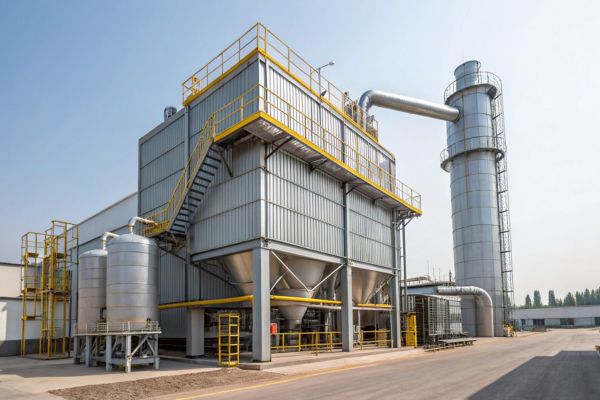
An electrostatic precipitator (ESP) removes particulate matter from industrial flue gas by charging dust particles in an electrical field and collecting them on grounded plates. Its main benefits are high particulate removal capability, the ability to handle very large gas volumes without a large pressure drop, suitability for high-temperature flue gas streams from boilers and furnaces, generally low operating cost relative to gas flow handled, long service life with proper maintenance, and continuous operation without interrupting production. Actual collection efficiency is not fixed it depends on ESP design, particle size, dust electrical resistivity, gas conditions, electrical operation, gas distribution, inlet dust loading, and maintenance quality. ESPs support environmental compliance when correctly designed, sized, and operated, but no single technology suits every industrial pollution-control requirement.
Thermal power plants, cement kilns, steel reheating furnaces, and large industrial boilers all share the same problem: their exhaust gas carries a significant load of fine particulate matter that cannot legally or responsibly go up the stack. Among the technologies built to solve this bag filters, wet scrubbers, cyclones the electrostatic precipitator remains one of the most widely used for high-volume, high-temperature applications.
This guide explains what an electrostatic precipitator is, how it actually works, what its genuine benefits are, where those benefits apply and where they don't, and how a plant engineer or procurement manager should evaluate one against alternatives. It's written to be useful whether you're specifying a new ESP, troubleshooting an underperforming one, or simply deciding whether ESP is the right technology for your application at all.
An electrostatic precipitator (ESP) is an industrial air pollution control device that removes particulate matter dust, fly ash, soot from a gas stream by charging the particles electrically and collecting them on grounded plates, using electrostatic force rather than mechanical filtration. It's used downstream of boilers, kilns, and furnaces where flue gas carries high particulate loading, particularly at high gas temperature or large gas volume.
What are the main benefits of an electrostatic precipitator? The core benefits are high particulate collection capability across a wide range of particle sizes, the ability to handle very large gas flow rates with a comparatively low pressure drop, suitability for high-temperature flue gas, generally favorable operating cost relative to the gas volume handled, and long service life when the unit is correctly maintained. These benefits are conditional on correct design and operation, not automatic.
An ESP works by passing flue gas through an electrical field created between discharge electrodes and collection plates. Discharge electrodes generate a corona that electrically charges dust particles in the gas stream; the charged particles migrate toward the grounded collection plates under electrostatic force, accumulate there, and are periodically dislodged by rapping into hoppers below.
Step by step, the process runs as follows:
The electrical charging step is what fundamentally distinguishes an ESP from a bag filter or cyclone the gas doesn't need to pass through a physical barrier for particulate removal, which is why ESPs can handle very large gas volumes with comparatively low resistance to flow.
An ESP is a system of coordinated components, each with a distinct function in the charging-collection-removal sequence.
| Component | Function |
|---|---|
| Discharge Electrodes | Generate the corona discharge that ionizes gas and charges particles |
| Collection Electrodes / Plates | Grounded surfaces that attract and hold charged particles |
| High-Voltage Power Supply | Supplies the high voltage needed to sustain corona discharge |
| Transformer-Rectifier Set | Converts and rectifies incoming power to the high DC voltage the ESP requires |
| Rapping System | Dislodges accumulated dust from collection and discharge electrodes at intervals |
| Hoppers | Collect and store dust dislodged from the electrodes before removal |
| Insulators | Electrically isolate the high-voltage system from the grounded casing |
| Gas Distribution Screens | Spread incoming gas evenly across the collection field cross-section |
| Support Structure | Holds electrodes, casing, and internals in correct alignment |
| Control System | Regulates voltage, monitors sparking, and sequences rapping cycles |
| ESP Casing | Encloses the gas path and internal components, maintaining gas-tight operation |
ESPs are capable of collecting fine particulate matter across a wide size range, including sub-micron particles that are difficult for cyclones to capture. Actual removal efficiency for a given installation depends on particle size distribution, dust electrical resistivity, gas conditions, and how well the field is maintained it isn't a fixed property of the technology itself.
Because gas passes through an open electrical field rather than a physical filter medium, ESPs scale well to the very large gas volumes typical of thermal power plants, cement plants, steel plants, and large industrial furnaces, where handling millions of cubic metres of flue gas per hour is routine.
An ESP presents comparatively little resistance to gas flow compared with a bag filter's fabric media, which means lower ID fan power demand and lower energy consumption for moving the same gas volume an important consideration on large flue gas systems where fan power is a significant ongoing cost.
ESPs can be engineered for high-temperature service where material selection, insulation, and electrical design are matched to the process conditions. Suitability at a given temperature depends on these engineering choices rather than being automatic across all designs.
Relative to the gas volume handled, ESPs can offer favorable operating cost because of their low pressure drop and correspondingly lower fan energy demand. This is a potential advantage, not a guarantee electrical consumption, maintenance requirements, and component replacement all factor into actual operating cost, and it should not be assumed that an ESP will always be the lowest-cost option for every application.
Robustly constructed ESPs with properly maintained electrical systems and collection plates can operate for many years. Actual service life depends on construction quality, maintenance discipline, and wear conditions specific to the dust and gas being handled no fixed lifespan applies across every installation.
ESPs are well suited to continuous industrial processes power generation, cement production, steel making where the pollution control equipment must run alongside the process without frequent interruption for cleaning or media replacement.
When correctly designed and operated, an ESP reduces the quantity of dust, fly ash, soot, and fine particulate matter reaching the stack, supporting the plant's overall particulate emission control strategy.
The scalability of ESP design from moderate industrial boilers to utility-scale power plants makes it a technology that can be engineered across a wide range of gas-flow capacities within a broadly similar design framework.
A dry ESP operates without water consumption for the collection process itself, which can be an advantage where water availability or wastewater generation is a concern. Wet ESP configurations, discussed below, do use water and this advantage does not apply to them.
An ESP that is correctly designed, sized, operated, and maintained can support compliance with applicable particulate emission requirements. Installing an ESP does not by itself guarantee compliance performance depends on ongoing operation and maintenance matching the design conditions.
Depending on the material composition, industry, and applicable standards, dust collected by an ESP fly ash being the most common example may have reuse value in applications such as cement or construction material. Whether recovery is viable depends on contamination level and specific process requirements, and shouldn't be assumed for every material stream.
| Benefit | Why It Matters |
|---|---|
| High particulate collection | Reduces dust emissions across a wide particle size range |
| Large gas-volume handling | Suitable for large industrial and power generation processes |
| Low pressure drop | Can reduce gas-side fan energy demand |
| Long operating life | Supports lifecycle value with proper maintenance |
| Continuous operation | Suitable for continuous industrial plants |
| Low water requirement (dry ESP) | Useful where water use or wastewater is a concern |
| Dust recovery potential | Collected material may have reuse value depending on application |
| Automation | Supports consistent, monitored operation |
ESP collection efficiency is not a single fixed number it results from the interaction of particle characteristics, gas conditions, electrical operation, and mechanical maintenance. A well-designed ESP matched to its actual operating conditions performs very differently from the same design running outside its intended parameters.
| Factor | Effect on ESP Performance |
|---|---|
| Particle size | Very fine or coarse particles can be harder to charge and collect efficiently than mid-range sizes |
| Electrical resistivity of dust | High or low resistivity dust can reduce collection efficiency and increase back-corona or re-entrainment risk |
| Gas temperature | Affects dust resistivity and material/design suitability |
| Gas velocity | Higher velocity reduces residence time available for charging and collection |
| Residence time | Longer time in the field generally improves collection opportunity |
| Collection area | Larger specific collection area generally supports higher removal |
| Electrical field strength / corona power | Insufficient power limits charging and collection capability |
| Gas distribution | Uneven flow across the field creates zones of reduced collection |
| Dust loading | Very high inlet loading can challenge the design collection capacity |
| Rapping performance | Poor rapping allows dust buildup or causes excessive re-entrainment |
| Re-entrainment | Dust knocked loose without settling into the hopper reduces net collection |
| Maintenance quality | Deferred maintenance on electrodes, insulators, and rapping degrades performance over time |
In each case, the source of particulate emissions is combustion or high-temperature process off-gas, and ESP suitability depends on matching the design to the specific gas volume, temperature, and dust characteristics of that source.
Dry ESP: collects dust in dry form on collection plates, removed by mechanical rapping. The most common configuration for boiler and kiln flue gas particulate control.
Advantage: no water consumption in the collection process.
Limitation: performance can be sensitive to dust resistivity, particularly with very high or low resistivity dust.
Wet ESP: uses a water wash to remove collected material from the plates instead of rapping.
Advantage: effective for sticky, wet, or fine sub-micron particulate that resists dry collection.
Limitation: generates wastewater requiring treatment, and adds water system complexity.
Plate ESP: the standard configuration using flat collection plates and wire or rigid discharge electrodes the most widely deployed design for large industrial gas flows.
Tubular ESP: uses cylindrical collection tubes with a discharge electrode centered in each tube sometimes used for smaller gas volumes or specific gas conditions where the tubular geometry suits the application.
Single-Stage ESP: charging and collection occur in the same field the standard industrial configuration.
Two-Stage ESP: charging and collection are separated into distinct stages, a configuration more common in smaller-scale or specialty applications than in large industrial flue gas duty.
| ESP Type | Working Principle | Typical Application | Main Advantage | Key Consideration |
|---|---|---|---|---|
| Dry ESP | Mechanical rapping removes dry dust | Boiler, kiln flue gas | No water consumption | Sensitive to dust resistivity |
| Wet ESP | Water wash removes collected material | Sticky, fine, or sub-micron particulate | Handles difficult particulate | Generates wastewater |
| Plate ESP | Flat collection plates, wire/rigid electrodes | Large industrial flue gas | Proven for large gas volumes | Requires significant footprint |
| Tubular ESP | Cylindrical collection tubes | Smaller or specific gas conditions | Suits certain compact applications | Less common at very large scale |
| Single-Stage | Charging and collection in one field | Standard large industrial duty | Simpler configuration | Field design must handle full duty |
| Two-Stage | Separate charging and collection stages | Smaller-scale or specialty use | Can suit specific gas conditions | Less common in large flue gas duty |
Neither ESP nor bag filter is universally better selection depends on gas volume, temperature, moisture, dust characteristics, available footprint, and pressure drop tolerance. Our detailed guide on the bag filter for boiler applications covers the fabric filtration side of this comparison in depth.
| Factor | Electrostatic Precipitator | Bag Filter |
|---|---|---|
| Collection Principle | Electrostatic charging and plate collection | Mechanical filtration through fabric media |
| Pressure Drop | Generally lower | Generally higher, depends on media condition |
| Gas Volume Handling | Well suited to very large volumes | Scales with additional filter bags/compartments |
| Temperature Suitability | Can be engineered for high temperature | Limited by filter media temperature rating |
| Particle Characteristics | Performance sensitive to dust resistivity | Less sensitive to resistivity; sensitive to sticky/hygroscopic dust |
| Maintenance | High-voltage system, electrode, and insulator upkeep | Bag replacement and cleaning system upkeep |
| Energy Considerations | Electrical power for corona; lower fan power | Higher fan power to overcome media resistance |
| Footprint | Typically larger for equivalent gas volume | Can be more compact for moderate volumes |
| Moisture Sensitivity | Wet ESP variant handles moisture directly | Moisture can blind or damage fabric media |
| Typical Applications | Power plants, cement, steel, large furnaces | Boilers, general industrial dust collection |
An ESP primarily targets particulate matter. A wet scrubber can address particulate and, depending on design, certain gaseous pollutants such as acid gases simultaneously a capability a standard dry ESP doesn't offer. Wet scrubbers consume water and generate wastewater requiring treatment; a dry ESP does not. Wet scrubbers typically present a higher pressure drop than an ESP for comparable gas volumes. The two technologies solve different pollution-control requirements: where the challenge is purely particulate at large gas volume, ESP is often considered; where soluble gaseous pollutants must also be addressed, a scrubber or an ESP combined with additional gas-treatment equipment may be the more complete answer.
A balanced evaluation requires understanding where ESP technology has genuine constraints.
An ESP may be a suitable option when gas flow is very large, particulate loading is significant, low pressure drop is an important design priority, continuous operation is required, high-temperature gas is involved, long operating life is desired, and particulate control rather than gaseous pollutant removal is the primary requirement.
Another technology may be more appropriate where gas volumes are moderate and footprint is constrained, where dust resistivity characteristics are known to be problematic for electrostatic collection, where gaseous pollutant removal is required alongside particulate control, or where intermittent rather than continuous operation makes a bag filter's simpler operating profile more practical. Final selection requires engineering analysis specific to the gas stream and site conditions not a generic rule of thumb.
A properly specified ESP starts with accurate process data, not a catalogue selection. Buyers should be prepared to define or request engineering support for the following:
| Parameter | What the Buyer Should Specify |
|---|---|
| Gas Flow Rate | Project-specific |
| Gas Temperature | Project-specific |
| Inlet Dust Loading | Project-specific |
| Particle Size | Project-specific |
| Dust Resistivity | Project-specific |
| Required Outlet Emission | Applicable regulatory requirement |
| ESP Type | Dry / Wet / Other, engineering dependent |
| Number of Fields | Engineering dependent |
| Collection Area | Engineering dependent |
| Power Supply | Engineering dependent |
| Hopper Capacity | Engineering dependent |
| Gas Distribution | Engineering dependent |
| Rapping System | Engineering dependent |
| Control System | Manual / Automatic / PLC |
| Maintenance Access | Required |
High-voltage maintenance work should only be performed by qualified personnel following proper lockout and safety procedures this article does not provide step-by-step electrical maintenance instructions.
| Problem | Possible Cause | General Corrective Action |
|---|---|---|
| Low collection efficiency | Poor electrical operation or gas distribution | Inspect operating conditions and electrical parameters |
| High spark rate | Electrical or dust-condition issue | Review ESP electrical parameters and dust characteristics |
| Dust re-entrainment | Poor rapping timing or high gas velocity | Review rapping schedule and gas velocity conditions |
| Hopper blockage | Poor ash flow characteristics | Inspect hopper condition and ash removal system |
| High pressure drop | Gas-flow or internal system issue | Inspect the gas path for obstruction or buildup |
| Insulator problems | Dust, moisture, or temperature exposure | Inspect insulation system condition |
| Uneven gas distribution | Flow-distribution component issue | Review gas distribution screens and ductwork |
Industrial particulate emissions in India are regulated under standards set by the Central Pollution Control Board (CPCB) and enforced at the state level by the respective State Pollution Control Board (SPCB), as part of each facility's applicable consent-to-operate conditions. An ESP contributes to a plant's particulate emission control strategy, and stack emission monitoring is typically used to verify ongoing performance against the applicable limit.
ESP performance can support compliance when the system is correctly designed, operated, maintained, and matched to the applicable emission requirement for that specific installation. Installing an ESP does not, by itself, guarantee compliance actual stack performance depends on how closely operating conditions match the design basis and how consistently the unit is maintained.
ESP cost varies substantially by project and cannot be reduced to a single figure. Key cost drivers include gas flow rate, ESP size and number of fields, collection area, gas temperature, dust loading characteristics, required outlet emission level, dry or wet configuration, electrical system specification, material selection, automation level, civil work requirements, installation, and commissioning scope.
CAPEX (capital expenditure) covers equipment, structural steel, electrical systems, civil work, and installation. OPEX (operating expenditure) covers electrical power consumption, routine maintenance, spare parts, and periodic component replacement over the unit's operating life. A meaningful cost comparison between suppliers requires evaluating both together rather than CAPEX alone.
The lowest initial quotation does not necessarily represent the lowest lifecycle cost. A complete total cost of ownership assessment should include: initial equipment cost, ongoing electrical energy consumption, ID fan or system energy demand, routine and preventive maintenance labor, spare parts consumption, downtime cost during maintenance or failure events, cleaning and rapping system upkeep, electrical component replacement (transformer-rectifier sets, electrodes) over the operating life, external service requirements, and the expected operating life of the unit relative to its capital cost. A design with a higher upfront cost but lower energy consumption and longer component life can represent better lifecycle value than a cheaper unit with higher ongoing costs.
Electrostatic precipitators are one part of a broader air pollution control strategy. Our overview of air pollution control solutions covers how ESPs, bag filters, and wet scrubbers fit together across different industrial applications. If your particulate source is a solid fuel boiler, our guide on industrial dust collector manufacturers in India covers cyclone and dust collector options that often work alongside an ESP. For plants also evaluating steam generation equipment, our guides on waste heat recovery boilers and thermic fluid heaters cover adjacent industrial heating equipment that shares many of the same customer applications.
An electrostatic precipitator (ESP) is an industrial air pollution control device that removes particulate matter from flue gas by electrically charging particles and collecting them on grounded plates, rather than filtering the gas mechanically.
Flue gas passes through an electrical field where discharge electrodes generate a corona that charges particles. Charged particles migrate to grounded collection plates, accumulate, and are periodically dislodged by rapping into hoppers for removal.
Key benefits include high particulate collection capability, the ability to handle large gas volumes with low pressure drop, suitability for high-temperature flue gas, generally favorable operating cost relative to gas volume, and long service life with proper maintenance.
An ESP is designed to remove particulate matter dust, fly ash, soot from a gas stream. A standard dry ESP does not remove gaseous pollutants such as SO₂ or NOx; those require separate or additional treatment technology.
ESP collection efficiency can be very high, but actual performance depends on ESP design, particle characteristics, electrical conditions, gas distribution, inlet dust loading, and operating and maintenance conditions. There's no single efficiency figure that applies universally.
Thermal power plants, cement manufacturing, steel plants, metallurgical industries, chemical processing, pulp and paper, lime plants, industrial furnaces, and waste-to-energy facilities commonly use ESPs for particulate control.
An ESP uses electrostatic charging and plate collection with generally lower pressure drop, while a bag filter uses mechanical filtration through fabric media with generally higher pressure drop. Selection depends on gas volume, temperature, and dust characteristics.
ESPs are widely used at thermal power plants for boiler fly ash control, given their capability for handling very large gas volumes at the temperatures typical of power plant flue gas.
ESPs are commonly used in cement manufacturing for kiln and clinker cooler dust control, though suitability for a specific plant depends on the gas conditions and dust characteristics of that process.
A dry ESP removes collected dust by mechanical rapping without water; a wet ESP uses a water wash to remove collected material, which is effective for sticky or fine sub-micron particulate but generates wastewater requiring treatment.
Main components include discharge electrodes, collection electrodes, a high-voltage power supply and transformer-rectifier set, a rapping system, hoppers, insulators, gas distribution screens, support structure, control system, and casing.
ESPs require daily monitoring of electrical parameters and hopper levels, periodic inspection of electrodes, insulators, and the rapping system, and scheduled preventive maintenance covering electrical, mechanical, and control components.
Particle size, dust electrical resistivity, gas temperature and velocity, residence time, collection area, electrical field strength, gas distribution, dust loading, rapping performance, re-entrainment, and maintenance quality all affect collection efficiency.
Particle electrical resistivity is a measure of how easily a dust particle accepts and holds an electrical charge and releases it upon contact with the collection plate. Very high or very low resistivity dust can reduce ESP collection efficiency.
A properly designed ESP can collect fine particulate matter including PM2.5-range particles, though collection efficiency for very fine particles depends on the specific design, electrical operation, and dust characteristics involved.
ESP cost depends on gas flow, size, number of fields, collection area, dust characteristics, required outlet emission, configuration (dry or wet), electrical system, materials, automation, and installation scope there's no fixed price applicable across projects.
Limitations include high initial capital cost, electrical complexity, sensitivity to particle resistivity, significant space requirements, high-voltage maintenance needs, re-entrainment risk, and the fact that ESP alone doesn't address gaseous pollutants.
A robustly constructed ESP with proper maintenance can operate for many years. Actual service life depends on construction quality, dust and gas conditions, and how consistently maintenance is performed no fixed lifespan applies to every installation.
A dry ESP does not consume water in its collection process. A wet ESP uses water for washing collected material from the plates and does consume water, generating wastewater that requires treatment.
Selection should be based on gas flow rate, temperature, dust loading, particle size and resistivity, required outlet emission, available space, electrical power, maintenance access, and total lifecycle cost — evaluated through engineering analysis rather than a generic specification.
A standard dry ESP is designed to remove particulate matter and does not remove gaseous pollutants such as SO₂ or NOx. Where gaseous pollutant control is also required, additional or alternative technology is needed.
An ESP primarily targets particulate matter using electrostatic collection. A wet scrubber can address particulate and, depending on design, certain gaseous pollutants, but consumes water and generates wastewater that an ESP does not.
Poor performance commonly results from incorrect electrical operation, uneven gas distribution, dust resistivity outside the design range, deferred maintenance on electrodes or insulators, poor rapping timing, or operating conditions that differ from the original design basis.
Ask how the design was sized for your specific gas flow, temperature, dust loading, and resistivity; what outlet emission level the design targets; what maintenance access and spare parts support is available; and what the total lifecycle cost looks like, not just the initial quotation.
An electrostatic precipitator is a genuinely capable technology for particulate control at the gas volumes and temperatures typical of power plants, cement kilns, steel furnaces, and similar industrial processes but its benefits are conditional on correct design, sizing, and ongoing maintenance, not automatic. Understanding both what an ESP does well and where it has real limitations is what lets a plant engineer make a sound technology choice rather than a default one.
If you're evaluating an ESP for a power plant, cement plant, steel plant, or another industrial application, Par Boiler can help assess the application and develop an appropriate pollution-control solution.
Evaluating particulate control equipment for your plant? Par Boiler's engineering team reviews your gas flow, temperature, and dust characteristics before recommending a system configuration. Contact Par Boiler for a technical consultation.
Par Boiler works with power, cement, steel, and process industries to assess particulate control requirements and develop appropriate air pollution control solutions, including electrostatic precipitators.
View Electrostatic Precipitator Solutions