



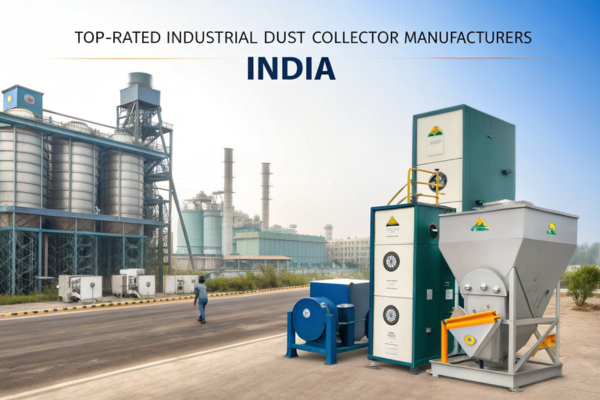
India's top industrial dust collector manufacturers include Par Boiler Pvt. Ltd., Thermax, AAF India, Dynavac, Enviro International, and AQC Systems. These companies design and supply pulse jet bag filters, cyclone dust collectors, cartridge collectors, baghouse systems, and wet dust collectors for cement, steel, pharma, chemical, textile, food, and power industries. When selecting a dust collector manufacturer, evaluate filtration efficiency, airflow capacity (CFM), CPCB compliance, customisation capability, filter bag quality, and after-sales service. A correctly specified dust collection system reduces PM2.5 and PM10 emissions, protects workers, and ensures regulatory compliance under CPCB and SPCB guidelines.
Dust is one of the most underestimated hazards in Indian manufacturing. It damages lungs, degrades equipment, contaminates products, and creates explosion risks in industries handling combustible particulates all while quietly racking up regulatory violations that procurement managers discover only when the CPCB notice arrives.
The right industrial dust collection system removes this risk entirely. But selecting the right manufacturer from a crowded market of dust collector suppliers in India is where most procurement decisions go wrong buying on price rather than on the match between the system's specification and the actual dust characteristics of the plant.
This guide covers what to look for, which manufacturers in India have the engineering capability to deliver it, and how to match a dust collector type to your specific process. It is written for plant engineers, factory owners, and procurement managers who need a practical reference not a supplier directory.
An industrial dust collector is an air pollution control system that captures and removes particulate matter (dust, fumes, and fine particles) from industrial exhaust air streams before they are discharged to atmosphere or recirculated to the workplace. It protects workers from PM2.5 and PM10 exposure, prevents equipment contamination, reduces fire and explosion risk from combustible dust, and ensures compliance with CPCB and SPCB emission standards.
Every dust collection system operates on the same fundamental principle: contaminated air is drawn into the collector by a fan or blower, particulates are separated from the air stream by a filter medium or mechanical separation mechanism, the cleaned air exits through the outlet, and the collected dust is discharged into a hopper or collection bin for disposal.
The mechanism of separation differs between collector types. Bag filters and pulse jet collectors use fabric filter media to capture particles by interception, impaction, and diffusion. Cyclone collectors use centrifugal force to spin heavy particles out of the air stream. Wet dust collectors use liquid contact to capture particles. Cartridge collectors use pleated filter elements for high surface area in a compact enclosure.
The performance of the system measured as filtration efficiency, pressure drop, and airflow capacity in cubic feet per minute (CFM) or cubic metres per hour (m³/hr) depends on matching the collector type and filter media to the specific dust characteristics: particle size, bulk density, moisture content, temperature, and whether the dust is combustible, hygroscopic, or chemically reactive.
A dust collection system is not optional for most Indian manufacturing operations. Under CPCB emission standards and State PCB consent conditions, industrial plants are legally required to control particulate emissions from process equipment, material handling, and combustion sources. A plant operating without adequate dust collection systems faces consent-to-operate withdrawal, pollution penalties, and the occupational health liability that comes from documented worker PM exposure above permissible limits.
Beyond compliance, the business case for effective dust collection is direct. Filter bags clogged with re-entrained dust, compressors worn by particulate contamination, and product batches rejected for dust contamination all have measurable cost consequences. The plants that track these costs find that a properly specified dust collection system pays back its capital cost within two to four years through reduced maintenance, rework, and product loss before accounting for the regulatory exposure it eliminates.
India's industrial dust collector market has grown steadily with manufacturing expansion across cement, steel, power, pharma, food, and automotive sectors. Tightening CPCB and SPCB enforcement has accelerated demand, as plants that previously operated without adequate dust control now face active compliance pressure. The push toward cleaner production and ESG reporting has added a second layer of demand from export-oriented manufacturers who need to demonstrate environmental management to overseas buyers.
Indian manufacturers have moved well beyond basic cyclone and baghouse supply. Established companies now offer pulse jet bag filters with PLC-based automated cleaning control, IoT-connected monitoring systems that track pressure drop and filter condition remotely, and modular dust collection designs that can be expanded as plant capacity grows. The combination of improving engineering capability and competitive pricing makes Indian manufacturers the practical choice for most domestic industrial applications.
This list was not compiled from advertising directories. Each manufacturer was evaluated against thirteen practical criteria that reflect what actually determines a dust collector system's performance and total cost of ownership over its operating life.
Par Boiler Pvt. Ltd. is one of the most trusted industrial dust collector manufacturers in India, designing and supplying high-efficiency dust collection systems from its Ahmedabad manufacturing facility for over 25 years. The company's dust collector range covers pulse jet bag filters, multi-cyclone dust collectors, industrial baghouse systems, and heavy-duty dust extraction units built for continuous high-load operation in demanding industrial environments.
Par Boiler's dust collectors are widely used in cement plants, chemical factories, metal fabrication units, food processing facilities, rice mills, and pharmaceutical manufacturing. What distinguishes the company's offering from catalogue-based suppliers is the application engineering approach: filter media, air-to-cloth ratio, pulse cleaning frequency, and hopper geometry are all specified around the actual dust characteristics of the customer's process rather than defaulting to a standard size.
The company's integration of dust collectors with its core boiler and air pollution control product range is a practical advantage for plants that need both combustion equipment and the associated emission control in a single coordinated supply. This eliminates the interface problems that commonly arise when boiler and dust collector suppliers are different companies with different design assumptions about the flue gas characteristics at the collector inlet.
Every Par Boiler dust collection system is supplied with CPCB-compliance documentation, commissioning support, and access to filter bag replacements and spare parts through the company's national service network.
Best for: Plants needing integrated boiler and dust collection supply, cement, chemical, food, and pharmaceutical applications, medium to large industrial installations in Gujarat and surrounding regions.
Key products: Pulse jet bag filters, multi-cyclone separators, baghouse dust collectors, wet scrubbers, electrostatic precipitators.
Need a dust collector matched to your specific dust and airflow? Par Boiler's engineering team reviews your process data before recommending a system configuration. Contact Par Techno-Heat Pvt. Ltd. for a free technical consultation.
Thermax is one of the most established names in Indian industrial engineering, with a comprehensive air pollution control portfolio covering pulse jet bag filters, electrostatic precipitators, and integrated dust control systems. Their dust collectors serve cement, steel, chemical, and power plant applications where large gas volumes and high dust loads require proven, scalable solutions.
Best for: Large-scale cement, steel, and power plant dust control requiring full APC system integration.
AAF India brings international air filtration engineering to the Indian market. Their dust collector range focuses on pharmaceutical, food processing, and precision manufacturing applications where fine dust filtration to sub-micron particle sizes is required. HEPA filtration and high-efficiency cartridge collectors are their core product lines.
Best for: Pharmaceutical clean rooms, food processing, electronics manufacturing, and applications requiring sub-micron filtration.
Dynavac serves small and medium-scale industries with a range of cost-effective dust collection systems covering portable units, woodworking collectors, cyclone separators, and pulse jet bag filters. Their designs prioritise ease of maintenance and energy efficiency for facilities with limited technical maintenance staff.
Best for: Woodworking, furniture manufacturing, small fabrication workshops, and medium-scale production facilities.
Enviro International focuses on large-scale industrial pollution control for power plants, steel operations, and mining facilities. Their baghouse systems, industrial scrubbers, and ventilation systems handle very high dust volumes and are engineered for continuous 24-hour operation under heavy industrial conditions.
Best for: Power plants, steel mills, mining, and large process plants requiring heavy-duty continuous duty dust control.
CLEANTEK is widely used in textile, CNC machining, and small manufacturing applications. Their portable and centralised dust collectors are designed for simplicity of operation and consistent performance at moderate dust loads, with a strong service presence across South India.
Best for: Textile units, CNC machining centres, and small to medium manufacturing facilities in South India.
Airfilt Technologies specialises in high-performance pulse jet bag filters and cyclone collectors for pharmaceuticals, chemical processing, metal fabrication, and grain handling. Their focus on quality fabrication and precise filter media selection makes them a preferred choice for applications where dust composition and particle morphology vary significantly.
Best for: Pharmaceutical, chemical, grain handling, and precision metal processing applications.
Usha AirTech provides customised dust extraction solutions across a wide range of industrial applications, with particular strength in fume extraction, multi-stage filtration, and space-constrained installations where standard dimensions will not fit the available plant room.
Best for: Applications requiring custom-dimension dust collectors, fume extraction, and multi-stage filtration in constrained spaces.
AQC Systems provides cartridge-based dust collectors for fine dust environments including welding fumes, metal grinding, laser cutting, and powder coating. Their compact, high-efficiency cartridge units reduce filter wear and energy consumption for applications where traditional bag filters would be oversized or impractical.
Best for: Welding, laser cutting, powder coating, and metalworking applications requiring compact cartridge filtration.
| Manufacturer | Location | Key Products | Industries Served | Core Strength |
|---|---|---|---|---|
| Par Boiler Pvt. Ltd. | Ahmedabad | Pulse jet BF, multi-cyclone, baghouse | Cement, chemical, food, pharma | Integrated boiler + dust control supply, 25+ years |
| Thermax | Pune | Pulse jet BF, ESP, full APC range | Cement, steel, power | Large-scale APC integration |
| AAF India | Mumbai | HEPA, cartridge, high-efficiency | Pharma, food, electronics | Sub-micron filtration, international standards |
| Dynavac | Pan-India | Portable, cyclone, pulse jet | Woodworking, fabrication, SME | Cost-effective SME solutions |
| AQC Systems | Pan-India | Cartridge collectors, compact units | Welding, metalworking, powder coating | Fine dust cartridge filtration |
The pulse jet bag filter is the most widely used industrial dust collector in India across cement, steel, food, pharma, and power applications. Fabric filter bags capture particulate from the air stream as it passes through the bag material. When differential pressure across the bags rises to a set point, a timed pulse of compressed air is injected through each bag row from the top, flexing the fabric and dislodging the accumulated dust cake into the hopper below. The pulse jet cleaning cycle is automated by a PLC timer or differential pressure controller, allowing continuous operation without shutting the system for cleaning.
Pulse jet bag filters are available in online cleaning (can clean while operating under full load) and offline cleaning configurations. Online cleaning is preferred for large plants that cannot tolerate reduced airflow during cleaning cycles.
Cyclone collectors use centrifugal force gas enters tangentially, spins, and heavy particles separate to the outer wall and fall into the hopper, while cleaned air exits from the centre top. Multi-cyclone units use multiple small-diameter cyclone tubes in parallel to achieve higher separation efficiency at moderate pressure drop.
Cyclones are almost always used as pre-separators ahead of a pulse jet bag filter or ESP rather than as standalone collectors, because their efficiency drops sharply for particles below 10 microns. For cement, grain, and wood dust where coarse particles dominate, a cyclone pre-separator extends the life of downstream filter bags significantly.
Cartridge collectors use pleated filter elements with much higher surface area per unit volume than conventional bag filters, resulting in compact equipment with lower space requirements. They are well-suited for fine, light dust loads in metalworking, pharmaceutical, woodworking, and electronics manufacturing where the dust concentration is moderate and the particle size is small.
A baghouse is a large-scale fabric filter enclosure housing many filter bag rows in a compartmentalised structure. Baghouses handle very high gas volumes typically 100,000 m³/hr and above and are standard equipment in cement factories, steel plants, and coal-fired power plants. They are available in reverse-air, shaker, and pulse jet cleaning configurations depending on the gas characteristics and continuous versus intermittent operation requirement.
Wet dust collectors capture particles using liquid contact rather than fabric filtration. They are used when the dust is sticky, hygroscopic, combustible at high concentration, or when simultaneous gas absorption is required alongside particulate removal. Chemical plants handling reactive dust and processes generating dust that would create a fire or explosion risk in dry filtration equipment commonly specify wet dust collectors.
Portable dust collectors are compact, mobile units used for point-of-use dust extraction at individual machines or workstations in smaller manufacturing facilities. They are standard equipment in woodworking shops, welding stations, and small fabrication units where a centralised system is not justified by the scale of operations.
A centralised dust collection system serves multiple extraction points across a plant through a duct network connected to a single large collector. Centralised systems are more capital-intensive than individual unit collectors but reduce maintenance complexity (one system rather than many) and allow consistent filtration efficiency across all extraction points.
| Type | Best Application | Filtration Efficiency | Pressure Drop | Maintenance Level |
|---|---|---|---|---|
| Pulse Jet Bag Filter | General industrial, cement, food, pharma | 99 – 99.9% | Medium | Low (automated) |
| Cyclone / Multi-Cyclone | Coarse dust pre-separation | 70 – 90% (coarse PM) | Low | Very Low |
| Cartridge Collector | Fine dust, metalworking, welding | 99 – 99.97% | Medium | Low–Medium |
| Baghouse | Cement, steel, power large volumes | 99 – 99.9% | Medium | Medium |
| Wet Dust Collector | Sticky, combustible, reactive dust | 85 – 99% | Medium–High | Medium–High |
| ESP | Very fine PM, large power plants | 95 – 99.5% | Very Low | Medium–High |
| Industry | Dust Type | Recommended Collector |
|---|---|---|
| Cement & Construction | Cement, lime, fly ash | Pulse Jet Bag Filter, Baghouse |
| Steel & Metal Processing | Iron oxide, metal fumes, grinding dust | Pulse Jet BF, Cartridge, ESP |
| Pharmaceutical | API dust, excipient powder, fine particles | HEPA Cartridge, Pulse Jet BF |
| Chemical Industry | Chemical dust, reactive particles | Wet Collector, Special Pulse Jet BF |
| Food Processing & FMCG | Flour, sugar, spice, starch | Pulse Jet BF (food grade), Cartridge |
| Rice Mill & Flour Mill | Rice husk, bran, flour dust | Cyclone + Pulse Jet BF |
| Woodworking & Furniture | Wood dust (combustible) | Portable, Cyclone, Pulse Jet BF |
| Textile Industry | Fibre, lint, cotton dust | Pulse Jet BF, Centralised System |
| Power Plant / Boiler | Fly ash, flue gas PM | Baghouse, ESP, Pulse Jet BF |
| Mining & Stone Crushing | Silica, rock dust, mineral PM | Cyclone + Baghouse |
| Fertilizer Industry | Urea, DAP, fertilizer granule dust | Pulse Jet BF, Wet Collector |
| Automotive & Foundry | Sand, metal fumes, grinding dust | Pulse Jet BF, Cartridge, Wet |
Most dust collector procurement failures trace back to the same source: the buyer specified a system based on what the sales team offered rather than what the process actually requires. A dust collector sized and configured for your specific dust and airflow will perform consistently for years. One that is not will fail its CPCB test within months.
The manufacturer who walks through all twelve of these points before quoting is the one who will deliver a system that actually meets your CPCB consent. The manufacturer who sends a price within 24 hours of your enquiry without asking about your dust type, temperature, and required outlet concentration has not done the engineering.
Filtration efficiency is stated as the percentage of incoming dust that the collector removes from the air stream. A pulse jet bag filter using a standard woven polyester bag achieves 99–99.5% efficiency. A filter using PTFE-laminated bags achieves 99.9–99.97%. The difference matters when your CPCB consent specifies outlet PM below 50 mg/Nm³ versus below 10 mg/Nm³ the same collector with different bag media delivers very different outlet concentrations.
Pressure drop across the filter is the resistance the fan must overcome to push air through the system. As dust accumulates on the bags, pressure drop rises. The pulse jet cleaning cycle knocks the dust cake off the bags and restores pressure drop. A system with insufficient compressed air supply, failed pulse valves, or bags that are blinded with moisture or oil will show steadily rising pressure drop and falling airflow long before it fails visibly.
Air-to-cloth ratio (ACR, stated in m³/min per m² of filter area) determines how hard the fabric filter is being worked. A higher ACR means less filter area relative to the gas flow, which raises pressure drop and shortens bag life. Design ACR values vary from 0.8 for fine pharmaceutical dust to 2.5 for coarser cement dust. Ask your manufacturer what ACR they have designed to for your application.
A dust collector that passed its CPCB stack emission test at commissioning and fails at the next annual test twelve months later has almost always suffered a maintenance failure rather than a design failure. The most common causes are failed pulse valves, blinded filter bags, and a compressed air supply that has drifted below the 5–6 bar required for effective pulse cleaning.
| Type | Airflow Capacity | Application | Approx. Price Range (₹) |
|---|---|---|---|
| Portable Collector | 500 – 3,000 m³/hr | Small workshops | ₹30,000 – ₹2 lakh |
| Cartridge Collector | 1,000 – 10,000 m³/hr | Welding, metalworking, pharma | ₹1.5 lakh – ₹8 lakh |
| Pulse Jet Bag Filter (small) | 5,000 – 20,000 m³/hr | Food, pharma, chemical | ₹3 lakh – ₹12 lakh |
| Pulse Jet Bag Filter (medium) | 20,000 – 80,000 m³/hr | Cement, steel, general industrial | ₹12 lakh – ₹50 lakh |
| Baghouse (large) | 80,000 – 500,000+ m³/hr | Power plant, large cement | ₹50 lakh – ₹5 crore+ |
| Multi-Cyclone | 5,000 – 50,000 m³/hr | Pre-separator for bag filter | ₹1.5 lakh – ₹10 lakh |
Prices are indicative 2026 estimates. Actual cost depends on airflow, dust type, required filtration efficiency, material specification, automation level, and installation requirements.
Industrial dust collectors sold and operated in India must comply with CPCB emission standards applicable to the installation's industry category and plant size. State PCBs (GPCB, MPCB, etc.) issue consent-to-operate conditions that specify the maximum outlet PM concentration the collector must achieve. A manufacturer who cannot provide emission test data from reference installations on comparable applications is not able to guarantee that their system will meet your consent conditions.
Need a dust collector specification for your process? Par Boiler's engineering team reviews your airflow requirement, dust type, and CPCB consent conditions before recommending a system not a catalogue size. Contact Par Techno-Heat Pvt. Ltd. for a free technical consultation.
| Advantage | What It Means for Your Plant |
|---|---|
| Lower capital cost | 30–50% lower than equivalent imported systems, same filtration performance |
| Faster delivery | 6–16 weeks rather than 4–6 months for imported equipment |
| Local service support | Service engineers reachable within 24–48 hours rather than international escalation |
| Filter bag availability | Replacement bags available from local manufacturers, no import lead time |
| CPCB-specific design | Designed to Indian emission standards from the outset, not adapted from foreign specs |
| Customisation | Indian manufacturers readily adapt dimensions, materials, and configurations to site constraints |
An industrial dust collector is an air pollution control system that captures particulate matter (dust, fumes, and fine particles) from industrial exhaust air streams. It protects workers from PM2.5 and PM10 exposure, prevents equipment contamination, reduces explosion risk from combustible dust, and ensures CPCB and SPCB emission compliance.
Par Boiler Pvt. Ltd., Thermax, AAF India, Dynavac, and Enviro International are among the most trusted. The best choice depends on your dust type, airflow requirement, industry sector, and whether you need the dust collector integrated with existing boiler or process equipment.
Contaminated air is drawn into the collector by a fan. Particles are separated from the air stream by a filter medium (fabric bags, cartridges), mechanical separation (cyclone), or liquid contact (wet collector). Cleaned air exits through the outlet. Collected dust discharges into a hopper for disposal. Pulse jet bag filters use compressed air pulses to clean filter bags automatically during operation.
Cement, steel, pharmaceutical, food processing, chemical, textile, woodworking, rice mills, flour mills, foundry, power plants, and mining industries are the largest users of industrial dust collectors in India.
A pulse jet bag filter uses fabric filter bags to capture dust and compressed air pulses to clean the bags automatically while the collector remains in operation. It is the most widely used industrial dust collection system in India, covering 80–90% of general industrial dust control applications due to its high filtration efficiency (99–99.9%) and suitability for continuous operation.
A baghouse is a large-scale fabric filter enclosure housing many filter bag rows, designed for very high gas volumes (100,000 m³/hr and above). Standard equipment in cement plants, steel mills, and power stations. Baghouses use reverse-air, shaker, or pulse jet cleaning mechanisms depending on the operating requirements.
A cyclone dust collector uses centrifugal force to separate coarse particles from an air stream. Gas enters tangentially, spins, and heavy particles separate to the outer wall and fall into the hopper. Cyclones are typically used as pre-separators ahead of bag filters rather than as standalone collectors, because their efficiency drops sharply below 10-micron particle size.
Dry dust collectors (bag filters, cyclones, cartridge collectors) use mechanical separation or fabric filtration to capture dry particulate without water. Wet dust collectors use liquid contact to capture particles, generating liquid effluent requiring further treatment. Wet collectors are preferred for sticky, hygroscopic, combustible, or chemically reactive dust where dry filtration is unsuitable.
Filtration efficiency is the percentage of incoming dust that the collector removes from the air stream. Standard pulse jet bag filters achieve 99–99.5%. PTFE-laminated bag filters achieve 99.9–99.97%. The required efficiency depends on your CPCB consent condition typically expressed as maximum outlet PM in mg/Nm³.
CFM (cubic feet per minute) or m³/hr is the volumetric airflow the dust collector must handle. This must match the total extraction requirement of all connected extraction points plus a design margin. An undersized collector one with insufficient airflow cannot maintain adequate air velocity at extraction hoods, allowing dust to escape into the workplace rather than being captured.
Pressure drop is the resistance the fan must overcome to push air through the collector's filter media. It rises as dust accumulates on the filter bags and falls after pulse cleaning. Excessive pressure drop signals filter bag blinding, failed pulse valves, or insufficient compressed air supply. A pressure drop gauge is the primary daily monitoring tool for dust collector health.
Dust collector prices in India range from ₹30,000 for portable units to ₹5 crore and above for large baghouse systems. A pulse jet bag filter for 20,000–80,000 m³/hr industrial applications typically costs ₹12–₹50 lakh. Price depends on airflow, dust type, required efficiency, and material specification.
Standard woven polyester is suitable for most dry, moderate-temperature industrial dust applications (up to 130°C). PTFE-laminated polyester achieves higher filtration efficiency and easier pulse cleaning for fine dust. For high-temperature applications (150–260°C), Nomex (aramid) or fibreglass bags are specified. The correct media depends on dust particle size, temperature, moisture content, and chemical compatibility.
Filter bag life depends on dust type, operating temperature, and ACR (air-to-cloth ratio). Typical service life ranges from 1–2 years for abrasive or high-temperature applications to 3–5 years for moderate-duty general industrial use. Replace bags when pressure drop cannot be restored by pulse cleaning or when visible holes or abrasion are found during inspection.
ISO 9001 for quality management and CPCB compliance documentation are the minimum requirements for Indian industrial buyers. ATEX certification is required for dust collectors handling combustible dust (wood, grain, sugar, certain chemical and pharmaceutical materials). CE marking is relevant for equipment being exported.
A well-maintained dust collector structural frame typically lasts 15–25 years. Filter bags require periodic replacement (every 1–5 years depending on application). Pulse valves, solenoids, and fan bearings are wear components replaced on schedule. The total lifetime is determined more by maintenance quality than by initial build quality.
Large pulse jet bag filters and baghouse systems are standard for cement plants. Cyclone pre-separators ahead of the bag filter extend bag life by removing coarse cement and clinker particles. Gas flows in cement kilns, raw mills, and cement mills range from 50,000 m³/hr to over 500,000 m³/hr, requiring large-capacity multi-compartment baghouse designs.
Yes. Pulse jet bag filters and multi-cyclone separators are widely used on industrial boiler flue gas streams to control particulate emissions from coal, biomass, and solid fuel firing. Bag filter media must be specified for the actual flue gas temperature typically Nomex or fibreglass for high-temperature boiler applications above 150°C. Learn more in our bag filter guide for industrial boilers.
Ask five questions: (1) Can they provide a process design document specifying inlet and outlet conditions? (2) Do they have reference installations on your specific dust type? (3) What filter media do they specify for your temperature range? (4) Can they supply replacement filter bags locally? (5) What is their response time for on-site service? Manufacturers who answer these questions with data rather than promises are worth shortlisting.
Air-to-cloth ratio (ACR) is the gas flow per unit area of filter fabric, typically measured in m³/min per m². A higher ACR means less filter area for the same airflow, raising pressure drop and reducing bag life. Design ACR values range from 0.8 (fine pharmaceutical dust) to 2.5 (coarse cement dust). An undersized dust collector with too high an ACR will struggle to maintain low pressure drop regardless of pulse cleaning performance.
Par Techno-Heat Pvt. Ltd. designs and manufactures customised pulse jet bag filters, multi-cyclone separators, baghouse systems, and complete air pollution control equipment for cement, chemical, food, pharmaceutical, and boiler applications across India.
A 20-minute technical discussion covers your airflow requirement, dust type, CPCB consent conditions, and installation constraints before any system is proposed.
