

India's leading wet scrubber manufacturers include Par Boiler Pvt. Ltd., Thermax, Forbes Marshall, Enviro Concepts, and Dürr Systems. These companies design and supply wet scrubber systems for particulate removal, acid gas absorption, and industrial fume control across chemical, pharmaceutical, textile, food, and power sectors. When selecting a wet scrubber manufacturer, evaluate efficiency rating, gas flow capacity, CPCB compliance, customisation capability, and after-sales support. A properly sized wet scrubber reduces PM, SO₂, HCl, and HF emissions to meet current Indian pollution norms.
Walk into any industrial plant that has spent years fighting CPCB notices and you will hear the same story: the pollution control equipment was either undersized, poorly supported, or bought from a supplier who vanished after installation. Wet scrubbers are not immune to this problem. The market in India has a wide range of suppliers, and the gap between a well-engineered system and a poorly built one shows up quickly in emission reports and in downtime.
This guide covers what wet scrubbers actually do, how to select the right type for your process, and which manufacturers in India have the track record to back their product through commissioning, CPCB inspection, and the years that follow. It is written for plant engineers, procurement managers, and factory owners who want a straight answer not a brochure.
A wet scrubber is an air pollution control device that removes particulate matter, acid gases, and industrial fumes from an exhaust gas stream by contacting it with a liquid typically water or a chemical solution. The scrubbing liquid captures contaminants, which are then separated and disposed of, while the cleaned gas exits through the stack within permitted emission limits.
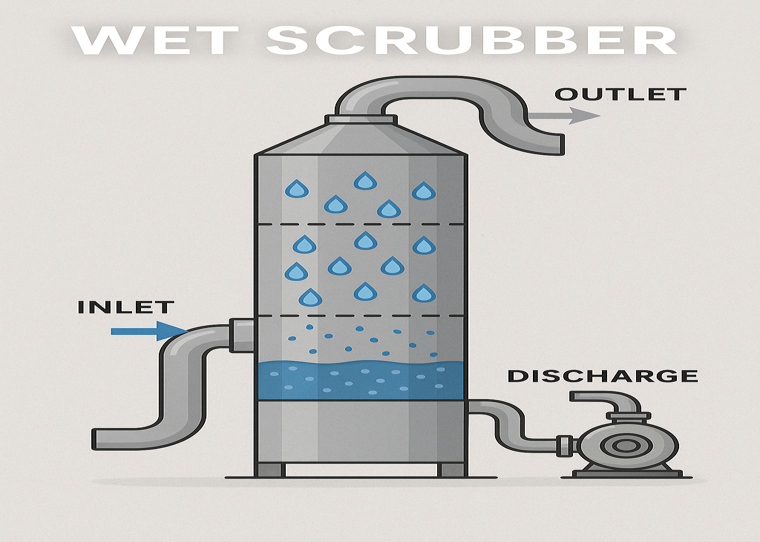
The working principle is straightforward. Contaminated gas enters the scrubber vessel and comes into contact with a scrubbing liquid sprayed or injected across its path. Particulates get captured when they collide with liquid droplets and are carried down into the sump. Soluble gases HCl, SO₂, HF, NH₃ dissolve into the liquid phase and are neutralised by the chemical reagent in the scrubbing solution. Clean gas exits from the top after passing through a mist eliminator that strips out entrained liquid droplets.
The efficiency of this process depends on three things: the contact surface area between gas and liquid, the residence time, and the chemistry of the scrubbing solution. Getting all three right for your specific gas stream is what separates a well-engineered wet scrubber from one that passes initial inspection and struggles at actual operating load.
Not every wet scrubber design suits every application. The gas flow rate, contaminant type, inlet concentration, and required outlet efficiency all determine which type is correct for your plant.
Gas is accelerated through a venturi throat where high-velocity contact with the scrubbing liquid breaks particles into the liquid film. Venturi scrubbers handle high particulate loading, sticky dust, and high inlet temperatures that would clog a fabric filter. They are the standard choice for boiler flue gas with heavy particulate content, foundry exhaust, and agro-processing dust streams. The pressure drop is higher than other wet scrubber types typically 100–500 mm WC which adds to the fan power requirement.
The gas stream rises through a bed of packing material (Raschig rings, saddles, or structured packing) while the scrubbing liquid flows downward over the packing surface. This counter-current contact gives very high liquid-gas contact area, making packed towers the preferred design for absorbing soluble acid gases. Chemical plants handling HCl, SO₂, HF, and NH₃ routinely specify packed tower scrubbers as their primary gas control device.
Liquid is sprayed into the gas stream through nozzle banks, capturing coarse particles and providing evaporative cooling of the gas. Spray towers operate at very low pressure drop and are often used as pre-scrubbers ahead of a packed tower or Venturi when the inlet gas is hot and heavily loaded.
Gas enters tangentially, creating a spiral flow. Liquid injected at the walls combines with centrifugal separation to remove medium-size particles efficiently in a compact footprint. Plants with limited installation space and moderate dust concentrations commonly use this design.
| Scrubber Type | Best Application | PM Efficiency | Gas Absorption | Pressure Drop |
|---|---|---|---|---|
| Venturi | High dust, sticky particles, high temp | 85–99% | Moderate | High |
| Packed Tower | Acid gas absorption (HCl, SO₂, HF) | Moderate | Very High (99%+) | Medium |
| Spray Tower | Coarse PM, pre-cooling, pre-scrubbing | 60–80% | Low | Very Low |
| Cyclonic | Medium PM, compact space | 80–92% | Low | Medium |
| Multi-Stage | Combined PM + acid gas control | 95–99%+ | High | Medium-High |
Wet scrubbers serve a wider range of industries than most buyers initially consider. The contaminant type and operating conditions differ significantly across sectors, which is why scrubber design must be application-specific rather than catalogue-standard.
| Industry | Contaminants Controlled | Typical Scrubber Type |
|---|---|---|
| Chemical & Pharma | HCl, SO₂, HF, NH₃, Cl₂, organic vapours | Packed Tower, Multi-Stage |
| Boiler & Power Plant | Flue gas PM, SO₂, fly ash | Venturi, Spray Tower |
| Fertilizer | NH₃, HF, fluorine compounds | Packed Tower |
| Metal & Foundry | Metal fumes, dust, SO₂ | Venturi, Cyclonic |
| Food & FMCG | Odour, organic fumes, PM | Spray Tower, Packed Tower |
| Textile & Dyeing | Acid fumes, PM, HCl | Packed Tower, Multi-Stage |
| Paper & Pulp | H₂S, chlorine, PM | Packed Tower, Venturi |
| Sugar & Distillery | Bagasse dust, SO₂, odour | Venturi, Spray Tower |
| Ceramic & Cement | Dust, HF, fluorine gases | Venturi, Packed Tower |
| Electroplating | Chromic acid mist, HCN, HCl | Packed Tower |
This list is not based on advertising spend or directory rankings. The manufacturers below were evaluated on seven practical criteria that a procurement manager would use when comparing wet scrubber suppliers for a real installation.
Par Boiler Pvt. Ltd. is one of the most established air pollution control equipment manufacturers in India, supplying wet scrubber systems alongside its core range of industrial boilers, thermic fluid heaters, and waste heat recovery systems. With over 25 years of manufacturing experience from Ahmedabad, the company's wet scrubber range covers Venturi scrubbers, packed tower scrubbers, spray scrubbers, and multi-stage systems for industrial gas and particulate control.
What makes Par Boiler's wet scrubber offering particularly relevant for Indian process industries is the integration with their boiler systems. Plants that source both a boiler and the associated wet scrubber system from a single supplier benefit from matched design: the scrubber is sized for the boiler's actual flue gas flow, temperature, and particulate loading rather than a generic specification. This integration reduces commissioning problems and avoids the finger-pointing between separate equipment suppliers when emission targets are not initially met.
The company's material selection covers polypropylene (PP), fibre-reinforced plastic (FRP), and stainless steel construction depending on the chemical nature of the gas stream. All systems are designed to meet current CPCB and State PCB emission norms, with commissioning support and after-sales service available through a national service network.
Best for: Plants requiring integrated boiler and emission control supply, medium to large industrial scrubber applications, chemical and food processing industries in Gujarat and surrounding regions.
Key products: Venturi scrubbers, packed tower scrubbers, spray scrubbers, multi-stage wet scrubbers, bag filters, electrostatic precipitators.
Looking for a wet scrubber matched to your boiler or industrial process? Par Boiler's engineering team reviews your gas flow, temperature, and contaminant data before recommending a configuration not a catalogue size. Contact Par Techno-Heat Pvt. Ltd. for a free technical consultation.
Thermax is one of India's most established energy and environment engineering companies, with a comprehensive air pollution control portfolio that includes wet scrubbers, dry scrubbers, electrostatic precipitators, and bag filters. Their wet scrubber range is backed by in-house chemical engineering capability for complex multi-component gas streams.
Best for: Large-scale process industries, power plants, chemical complexes requiring full APC system integration.
Forbes Marshall brings deep process engineering expertise to industrial gas cleaning. Their wet scrubber systems are used in steam system and process utility applications where integration with plant instrumentation and control systems is important.
Best for: Process industries requiring scrubber integration with broader steam and energy management systems.
Enviro Concepts specialises in customised air pollution control systems with a strong focus on wet scrubber design for chemical and pharmaceutical applications. Their systems cover packed towers, Venturi scrubbers, and multi-stage configurations with FRP and PP construction for corrosive service.
Best for: Chemical plants, pharmaceutical manufacturers, electroplating operations with acid gas streams.
Ion Exchange is widely known for water treatment but also operates in industrial air pollution control, supplying wet scrubber systems with an emphasis on effluent management for the captured scrubbing liquid an important consideration for applications where the scrubber produces liquid waste requiring further treatment.
Best for: Industries where liquid effluent management from the scrubber is as important as the gas-side performance.
Clean Air Power specialises in industrial air pollution control equipment including wet scrubbers, dust collectors, and mist eliminators. Their wet scrubber range is particularly active in the food, pharmaceutical, and textile sectors.
Best for: Small to medium industrial installations needing compact, CPCB-compliant wet scrubber systems.
Dürr brings German engineering standards to industrial air pollution control in India. Their wet scrubber range is positioned at the premium end, with advanced automation and emission monitoring capabilities for large process plants and automotive manufacturing facilities.
Best for: Multinational plants, automotive manufacturing, large chemical complexes requiring international engineering standards.
Veesons supplies air pollution control equipment as part of a broader industrial thermal and environmental engineering range. Their wet scrubbers complement the company's boiler and combustion equipment supply for integrated plant installations.
Best for: Plants sourcing integrated thermal and emission control equipment from a single regional supplier.
Primasonics focuses on industrial dust and fume control with a range of wet and dry scrubber solutions for agro-processing, chemical, and manufacturing applications. Their strength lies in cost-effective designs for small and medium Indian manufacturing units.
Best for: Small to medium manufacturing plants seeking cost-effective CPCB-compliant scrubber solutions.
Hamon Research-Cottrell is a global name in industrial gas cleaning, with Indian operations supplying wet scrubbers, electrostatic precipitators, and dry injection systems for power and process plant applications. Their systems are engineered for large gas flow rates at high efficiency.
Best for: Power plants, large cement, fertilizer, and chemical complexes requiring high-volume gas cleaning systems.
| Manufacturer | Location | Key Scrubber Types | Best For | Core Strength |
|---|---|---|---|---|
| Par Boiler Pvt. Ltd. | Ahmedabad | Venturi, Packed Tower, Multi-Stage | Integrated boiler + scrubber supply | 25+ years, custom engineering |
| Thermax | Pune | Full APC range | Large-scale process / power | Scale and sustainability |
| Forbes Marshall | Pune | Process scrubbers | Steam + scrubber integration | Process instrumentation depth |
| Enviro Concepts | Mumbai | Packed Tower, Venturi | Chemical, pharma, electroplating | Acid gas customisation |
| Dürr Systems India | Multiple | Advanced wet scrubbers | Automotive, large process | German engineering standard |
Buying a wet scrubber on the lowest quote is the most reliable way to end up with a CPCB notice twelve months later. The right manufacturer is the one who can demonstrate with data and reference installations that their system will meet your outlet emission requirement at your actual operating gas flow and temperature, with a chemistry that suits your contaminant.
Wet scrubbers are not always the right choice. Before specifying one, it is worth understanding where they outperform alternatives and where they do not.
| APC Equipment | Best Application | Limitation vs Wet Scrubber |
|---|---|---|
| Wet Scrubber | Simultaneous PM + gas absorption; hot, humid, or sticky gas streams | Generates liquid effluent requiring treatment |
| Bag Filter | Dry particulate at moderate temperature | Cannot absorb gases; fails on wet or hygroscopic dust |
| ESP (Electrostatic Precipitator) | Very fine particulate at large gas volumes | No gas absorption capability; high capital cost |
| Dry Scrubber | Acid gas with no effluent generation | Lower gas absorption efficiency than packed tower wet scrubber |
| Multi-Cyclone | Coarse PM pre-separation | Cannot handle fine PM or gases; used as pre-separator only |
The practical rule: choose a wet scrubber when your gas stream contains soluble acid gases, the gas is hot and humid, dust is sticky or hygroscopic, or you need simultaneous particulate and gas removal. Choose a bag filter when the gas is dry and cool and you only need particulate removal. The two technologies are complementary many plants run a bag filter or cyclone as a pre-separator ahead of a wet scrubber to extend the scrubber's service life.
For plants already operating industrial boilers, the connection is direct: boiler flue gas often requires wet scrubbing when sulfur content in the fuel creates SO₂ levels above CPCB limits, or when particulate from biomass or solid fuel firing requires combined PM and gas treatment. Learn more about air pollution control equipment specifically matched to industrial boiler systems in our complete air pollution control solutions guide and our guide to bag filter selection for industrial boilers.
A wet scrubber that was meeting emission norms at commissioning and is failing its annual CPCB inspection eighteen months later is almost always a maintenance failure, not a design failure. The three most common causes are packing fouling, nozzle blockage, and incorrect scrubbing solution chemistry management.
Wet scrubber pricing varies significantly with gas flow rate, contaminant type, required removal efficiency, material of construction, and automation level. Here is a realistic 2026 price reference for common configurations:
| Scrubber Type | Gas Flow Range | Material | Approx. Price Range (₹) |
|---|---|---|---|
| Spray Tower | 1,000 – 5,000 m³/hr | PP / FRP | ₹1.5 lakh – ₹6 lakh |
| Venturi Scrubber | 2,000 – 20,000 m³/hr | MS / FRP | ₹3 lakh – ₹18 lakh |
| Packed Tower | 1,000 – 15,000 m³/hr | PP / FRP / SS | ₹4 lakh – ₹25 lakh |
| Multi-Stage System | 5,000 – 50,000 m³/hr | FRP / SS | ₹15 lakh – ₹80 lakh+ |
Prices are indicative 2026 estimates. Actual cost depends on specific gas composition, flow rate, required removal efficiency, automation level, and site conditions. Always request a process-specific quotation.
The Central Pollution Control Board (CPCB) sets emission standards for particulate matter, SO₂, NOx, HCl, HF, and other contaminants across different industry categories. The specific limits applicable to your plant depend on your industry type, plant capacity, and the date of establishment or expansion.
A wet scrubber specified to meet CPCB norms at commissioning must continue to meet those norms at the gas flow rates and contaminant concentrations that actually occur during operation not just at the design condition. This is a critical point that manufacturers sometimes obscure in quotation documentation. Always ask for performance guarantees at your worst-case operating condition, not just the nominal design point.
State PCBs (GPCB in Gujarat, MPCB in Maharashtra, etc.) apply the same or stricter standards and conduct periodic stack emission tests. Plants that fail these tests face consent-to-operate withdrawal, which shuts the facility. A correctly specified, properly maintained wet scrubber is the most reliable path to passing these tests consistently.
Need a wet scrubber that meets your CPCB requirements? Par Boiler's engineering team designs to your specific emission limit, gas flow, and contaminant not a standard catalogue size. Discuss your requirement with Par Techno-Heat Pvt. Ltd. no obligation before the technical conversation.
A wet scrubber is an air pollution control device that removes particulates and soluble gases from an exhaust stream by contacting the gas with a liquid. Contaminants are absorbed into or captured by the liquid, which is then separated and treated, while clean gas exits through the outlet stack.
Par Boiler Pvt. Ltd., Thermax, Forbes Marshall, Enviro Concepts, and Dürr Systems are among the most trusted. The best choice depends on your application, gas composition, and whether you need the scrubber to integrate with an existing boiler or process system.
The main types are Venturi scrubbers, packed tower scrubbers, spray tower scrubbers, cyclonic scrubbers, impingement scrubbers, and multi-stage systems. Each is suited to different gas flows, contaminant types, and required removal efficiencies.
Chemical, pharmaceutical, fertilizer, power, textile, food processing, paper, metal, ceramic, and sugar industries all use wet scrubbers for particulate and gas-phase emission control.
Wet scrubber prices range from ₹1.5 lakh for small spray towers to ₹80 lakh and above for large multi-stage systems. A packed tower scrubber handling 5,000–10,000 m³/hr typically costs ₹8–₹20 lakh depending on material and automation.
A bag filter captures dry particulate from a gas stream using fabric filter media. A wet scrubber uses liquid contact to remove both particulate and soluble gases simultaneously. Wet scrubbers are preferred for hot, humid, or sticky gas streams and when acid gas removal is required alongside PM control.
Packed tower scrubbers are the standard choice for absorbing soluble acid gases including HCl, SO₂, HF, NH₃, and Cl₂. Counter-current liquid-gas contact over packing material provides very high removal efficiency typically 99%+ for highly soluble gases.
Wet scrubbers are pollution control devices and do not require separate CPCB product approval, but the plants installing them are subject to CPCB and State PCB emission standards. The scrubber must be designed and operated to keep stack emissions within applicable consent conditions.
Spray nozzles and liquor pH should be checked weekly. Packing inspection and cleaning should occur quarterly to annually depending on fouling rate. Mist eliminators and recirculation pumps should be inspected monthly. Scrubbing liquor chemistry must be monitored continuously for plants with critical removal requirements.
Water is used for simple particulate removal. Sodium hydroxide (NaOH) solution is standard for acid gas absorption (HCl, SO₂, HF). Sodium hypochlorite is used for Cl₂ and H₂S. Sulphuric acid solution is used for ammonia (NH₃) scrubbing. The correct chemical depends on the specific gas being removed.
Yes. Multi-stage wet scrubbers combine a Venturi or spray pre-scrubber stage for particulate removal with a packed tower second stage for acid gas absorption. This combined approach is used in applications such as boiler flue gas cleaning where both SO₂ and particulate must be controlled simultaneously.
Polypropylene (PP) and fibre-reinforced plastic (FRP) are the standard materials for most acid gas scrubbing applications. Stainless steel (SS 316L) is used for higher temperature service or when FRP is unsuitable. Carbon steel with rubber lining is used for some specific applications. Material selection depends on the chemical nature, concentration, and temperature of the gas.
Choose an electrostatic precipitator (ESP) when you need very fine particulate removal at large gas volumes with minimal pressure drop and no liquid handling. Choose a wet scrubber when you need simultaneous gas absorption, when the dust is sticky or hygroscopic, or when the gas stream is hot and humid conditions where ESPs perform poorly.
A Venturi scrubber accelerates gas through a narrow throat and injects scrubbing liquid at the high-velocity zone, creating intense gas-liquid contact. It is used for high particulate loading, high-temperature gas streams, and sticky or viscous dust that would clog other air pollution control equipment.
Yes. Wet scrubbers are effective for odour control when the odorous compounds are water-soluble or chemically reactive. H₂S, ammonia, and organic amines are commonly removed in wet scrubbers using oxidising agents (hypochlorite) or acid/alkali solutions. Odour applications are common in wastewater treatment, food processing, and chemical manufacturing.
Efficiency depends on scrubber type and application. Venturi scrubbers achieve 85–99% particulate removal. Packed towers achieve 99%+ for soluble gas absorption. Spray towers achieve 60–80% for coarse PM. Multi-stage systems combine both mechanisms for high overall efficiency on mixed gas streams.
Yes. Packed tower scrubbers are widely used in pharmaceutical manufacturing for controlling HCl, solvent vapours, and reactive gases from reactors and process vessels. Clean, non-contaminating FRP or SS construction is standard for pharma applications.
A wet scrubber uses liquid to capture contaminants and generates liquid effluent. A dry scrubber injects a dry reagent (lime, sodium bicarbonate) into the gas stream, which reacts with acid gases and is collected as a solid in a downstream filter. Wet scrubbers achieve higher gas absorption efficiency; dry scrubbers avoid liquid effluent generation.
A properly maintained FRP or PP wet scrubber typically lasts 10–20 years. Packing replacement is the most common maintenance requirement, typically every 3–7 years depending on fouling rate. Pump components, nozzles, and mist eliminators require more frequent replacement as wear items.
Par Boiler Pvt. Ltd. (Par Techno-Heat) designs and manufactures wet scrubbers in Ahmedabad for industrial applications across India. Contact the engineering team with your gas flow rate, temperature, and contaminant data for a process-specific design and quotation.
Par Techno-Heat Pvt. Ltd. designs and manufactures customised wet scrubber systems Venturi, packed tower, spray, and multi-stage for chemical, pharmaceutical, boiler, textile, and food processing applications across India.
A 20-minute technical discussion covers your gas composition, flow rate, required outlet emission, and material requirement before any quotation is prepared.
