


Your plant has been running the same dust collection setup for eight years. It handles most of what comes out of the process. But six months before your next CPCB inspection, your EHS manager flags a problem: particulate matter at the stack exit is 30% above the permitted limit, and the current dry filter system can't handle the soluble gases in the exhaust stream simultaneously.
Replacing the system takes 12 to 16 weeks from specification to commissioning. You don't have 16 weeks before the inspection window. And the contractor you called last week quoted three different equipment categories without explaining which one actually solves your problem.
This is where most industrial air pollution control decisions go wrong: not at the installation stage, but at the specification stage, when the wrong equipment category gets ordered for the wrong pollutant profile.
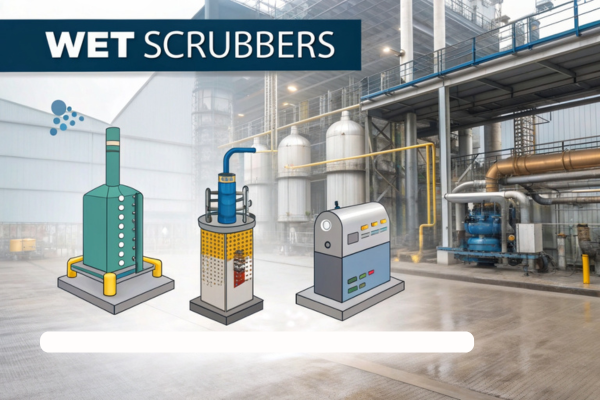
Wet scrubbers remove particulate matter and soluble gases in a single pass through a liquid contact zone. According to the Central Pollution Control Board's emission standards framework, over 60% of Indian industrial sectors require simultaneous control of dust and chemical fumes, making dry filtration alone insufficient for a large share of regulated processes. The wet scrubber is not a replacement for every pollution control device. It is the right tool when your exhaust stream carries both solid particulates and chemically reactive gases, and when a dry system cannot handle the temperature, humidity, or corrosivity of what you're treating.
This guide covers how the technology actually works, which design belongs in which application, and the operational realities that determine whether your wet scrubber delivers compliance or becomes expensive underperforming infrastructure.
A wet scrubber removes airborne pollutants by forcing contaminated gas through a liquid, typically water or a chemical solution, where particulates are captured in droplets and soluble gases are absorbed rather than passing through unchanged.
The principle sounds straightforward. The engineering behind reliable removal efficiency is not.
Contaminated gas enters the scrubber vessel and contacts the scrubbing liquid across a designed contact zone: whether that's a spray nozzle array, a packed bed of structured media, or a high-velocity venturi throat. The liquid captures particulates by inertial impaction, diffusion, or interception, depending on particle size and velocity. Soluble gases dissolve into the liquid phase through mass transfer. The cleaned gas then passes through a mist eliminator section that strips out entrained liquid droplets before the treated stream exits at the stack. The spent scrubbing liquid, now carrying the captured contaminants, is collected, treated, and either discharged within regulatory limits or recycled back into the scrubbing circuit.
The removal efficiency of a wet scrubber system is directly proportional to the energy input and the quality of gas-to-liquid contact. A venturi scrubber at high pressure drop achieves over 99% particulate removal for particles above 1 micron. A poorly designed spray tower with inadequate nozzle coverage achieves 60 to 70% on a good day. The design is not a commodity. Contact zone geometry, liquid-to-gas ratio, and mist eliminator specification determine the difference between a system that holds compliance and one that keeps failing stack tests.
The best wet scrubber installations treat the contact zone as a precision engineering problem, not a fabrication exercise.
The type of wet scrubber your process needs depends on three variables: what you're removing, at what concentration, and at what gas temperature and flow rate. Each design makes different tradeoffs. Selecting the wrong one means building pollution control infrastructure that doesn't meet your permit conditions.
A venturi scrubber accelerates contaminated gas through a narrow throat section where high-velocity scrubbing liquid is injected. The velocity differential shatters the liquid into fine droplets, maximising contact surface area. The gas-liquid mixture then decelerates in a separator vessel where droplets and captured particulates fall out of the stream.
Venturi scrubbers handle high-dust-load applications where particle concentrations are above 5 grams per normal cubic metre. Foundries, cement plants, fertiliser production, and carbon black manufacturing produce exhaust streams where this design performs rather than where a packed bed would block with accumulated solids within weeks. Pressure drop across the venturi throat runs from 500 to 3,000 Pascal depending on the required removal efficiency. A foundry handling iron dust at 15 g/Nm³ typically specifies a venturi system at 1,500 Pa pressure drop and achieves 97 to 99% collection efficiency on particles above 2 microns.
A packed bed scrubber passes contaminated gas upward through a tower filled with structured or random packing media. Scrubbing liquid flows downward across the packing surface, creating a continuous film of liquid that absorbs soluble gases as the contaminated stream rises through it.
This design is built for gas-phase pollutants rather than heavy particulate loads. Hydrogen chloride, sulphur dioxide, ammonia, chlorine, and hydrogen sulphide are the target contaminants. Chemical plants, acid production facilities, pharmaceutical manufacturing, and metal surface treatment lines use packed bed systems for inorganic acid gas control. Removal efficiencies for HCl and SO₂ exceed 99% when the scrubbing solution chemistry is correctly matched to the target pollutant. Caustic soda solution handles acidic gases. Dilute sulphuric acid handles alkaline gases like ammonia. The chemistry is not optional: a packed bed running plain water on HCl achieves 70% removal at best.
Spray towers use nozzle arrays to generate liquid droplets across the cross-section of a vertical vessel. Contaminated gas rises through the droplet field, and particulates and soluble gases are captured in the liquid phase before the treated stream exits at the top.
Spray towers are the lowest-pressure-drop option in the wet scrubber category. They suit large-volume, low-concentration exhaust streams where extreme removal efficiency is not the primary design target. Power plant cooling tower blowdown treatment, low-concentration dust suppression in material handling operations, and pre-conditioning of high-temperature gases before they enter a more efficient downstream scrubber: these are spray tower applications. Expecting 99% particulate removal from a spray tower on a cement mill exhaust is a specification error. Not a scrubber limitation.
Impingement plate designs pass gas upward through a series of perforated trays where scrubbing liquid pools. The gas jets through the perforations and impinges on the liquid layer above each tray, creating a turbulent contact zone on each stage.
Multi-stage designs accumulate removal efficiency stage by stage, making impingement plate systems suited to simultaneous particulate and gas removal in applications where flow rates are moderate and the dust is not sticky or prone to fouling the tray perforations. Sugar mills, food processing plants, and certain chemical production processes use this configuration for combined dust and odour control.
Wet scrubbers handle conditions that eliminate dry filtration as an option: high-temperature gas streams above 200°C, saturated or moisture-laden exhaust, explosive or combustible particulates where dry collectors create ignition risk, and streams carrying both solid particles and chemically reactive gases simultaneously.
No dry filter system removes acid gases. This is not a performance limitation. It is a physical constraint.
Consider the practical implication: a chemical plant processing chlorinated compounds produces exhaust carrying both hydrochloric acid vapour and fine process dust. A bag filter captures the dust. The acid gas passes through unchanged and exits at the stack above permit limits. A wet scrubber captures both in a single unit. The plant that specifies a bag filter for that application isn't saving capital cost. It's buying a second compliance problem with the first equipment purchase.
Wet scrubbers also handle sticky or hygroscopic particulates that bind to dry filter media and collapse under their own weight, causing bag failures and unplanned shutdowns. Fertiliser production, sugar refineries, and certain pharmaceutical processes produce these sticky dust profiles. The wet scrubber is the right infrastructure for these loads rather than a dry system that requires twice the maintenance at half the capture efficiency.
Already know which wet scrubber design fits your process? Talk to Par Techno-Heat Pvt. Ltd. about your application here — or keep reading to understand the operational factors that determine long-term performance.
The honest reality about wet scrubbers: they require more operational discipline than dry systems. Plants that don't build that discipline into their maintenance programme discover the cost through non-compliance events, not through predictive maintenance budgets.
Mist eliminator fouling is the most common failure mode. The mist eliminator strips liquid droplets from the treated gas stream before it exits the vessel. When it fouls with accumulated particulates or scale, carryover increases, stack opacity rises, and the facility fails its emission test. The scrubber is working correctly. The mist eliminator is not. The fix is a scheduled cleaning programme on a frequency matched to the dust load and scrubbing liquid chemistry: monthly in high-load applications, quarterly in lower-load gas-phase systems.
Scrubbing liquid chemistry demands continuous monitoring rather than periodic checks. As acid gases dissolve into the scrubbing solution, pH falls. When pH drops below the design threshold, removal efficiency for acid gases drops sharply because the solution loses its absorption capacity. A plant that monitors pH weekly rather than continuously risks running 72 hours of poor-efficiency scrubbing between checks without knowing it.
Scale formation on packing media in packed bed systems reduces the available mass transfer surface and raises pressure drop across the vessel. Regular inspection and scheduled cleaning with appropriate chemical descaling maintains performance. A packed bed that hasn't been inspected in two years is probably operating at 15 to 25% below its design removal efficiency, regardless of what the flow instrumentation shows.
The best industrial wet scrubber operators treat their scrubbing systems as process equipment rather than auxiliary pollution control hardware. The distinction matters: process equipment gets preventive maintenance schedules, spare parts inventory, and trained operators. Auxiliary equipment gets inspected when something goes wrong.
For context on the manufacturers building and commissioning these systems across Indian industry, see our analysis of the top wet scrubber manufacturers in India and our overview of the top 10 boiler manufacturers in India for plants managing integrated thermal and emission control requirements.
How does a wet scrubber work in industry?
A wet scrubber removes pollutants from contaminated gas by passing the exhaust stream through a scrubbing liquid, typically water or a chemical solution. Particulates are captured in liquid droplets by inertial impaction; soluble gases are absorbed into the liquid phase. The cleaned gas exits through a mist eliminator; the spent liquid is treated and discharged or recycled.
What is the difference between a venturi wet scrubber and a packed bed wet scrubber?
A venturi scrubber uses high-velocity gas flow through a narrow throat to atomise the scrubbing liquid, making it suited for high-particulate-load applications. A packed bed scrubber flows liquid over structured media, maximising gas-to-liquid contact for absorption of soluble gases. Venturi designs handle heavy dust; packed beds handle acid gases and chemical fumes.
What industries use wet scrubbers for air pollution control?
Wet scrubbers serve chemical plants, foundries, cement manufacturers, fertiliser producers, pharmaceutical facilities, sugar mills, metal surface treatment lines, and power plants. Any process generating both particulate matter and reactive or acid gases is a candidate for wet scrubber technology rather than dry filtration alone.
What removal efficiency does a wet scrubber achieve?
Venturi scrubbers achieve 97 to 99% particulate removal on particles above 2 microns at adequate pressure drop. Packed bed scrubbers achieve 95 to 99%+ removal for acid gases like HCl and SO₂ when scrubbing chemistry matches the target pollutant. Removal efficiency depends on design, liquid-to-gas ratio, and operational discipline.
What maintenance does a wet scrubber require?
Wet scrubbers require scheduled mist eliminator cleaning, continuous or frequent scrubbing liquid pH monitoring, nozzle inspection for blockage or wear, and periodic packing inspection in packed bed designs. Maintenance frequency scales with dust load and exhaust chemistry: high-load applications need monthly inspection cycles; lower-load gas-phase systems typically run on quarterly schedules.
When should a plant choose a wet scrubber over a dry filter?
Choose a wet scrubber when the exhaust stream contains both particulate matter and soluble gases, when gas temperature or humidity makes dry filtration impractical, when particulates are sticky or hygroscopic, or when the dust is combustible and dry collection creates ignition risk. For dry, inert, low-temperature dust without any gas-phase component, a dry filter is simpler and lower-maintenance.
The specification meeting that happens before equipment procurement determines whether your pollution control investment delivers compliance or underperforms for the next decade. Get three things right before anything else.
First: define your pollutant profile with measured data, not process assumptions. Stack testing or continuous emission monitoring data showing actual particulate concentration, particle size distribution, gas-phase pollutant identity, and concentration levels is the foundation for correct equipment selection. Specifying a packed bed scrubber based on the assumption that acid gas concentrations are low, and then discovering they run at 800 mg/Nm³ during actual operation, is a specification failure that costs two to three times the original equipment budget to correct.
Second: match the scrubbing liquid chemistry to the target pollutant before ordering. The liquid selection determines whether the system achieves 75% removal or 99% removal on your specific gas-phase contaminant. This is not a commissioning decision. It belongs in the process design phase.
Third: ask your equipment supplier to specify the maintenance programme alongside the equipment, not as an afterthought after installation. The best wet scrubber manufacturers build maintenance schedules into the system documentation because they understand that a well-maintained scrubber holds compliance for 15 years, and a poorly maintained one fails an inspection in year three.
Your emission control system is not a checkbox on the environmental clearance form. It is operating infrastructure that runs every hour your process runs. Treat the selection process accordingly.
If your plant needs a wet scrubber system designed for your specific exhaust profile, book a free 30-minute technical consultation with Par Techno-Heat Pvt. Ltd. No generic brochure. No pressure. Just a direct conversation about whether we're the right fit for your application.
Specify correctly the first time.
