

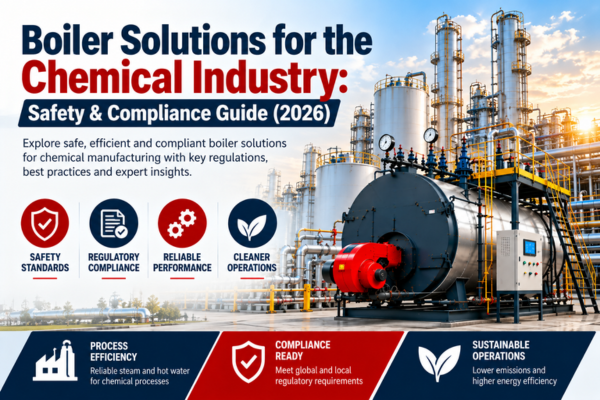
Chemical industry boiler selection requires evaluation beyond standard industrial boiler criteria process hazard compatibility, fuel system safety in potentially flammable atmospheres, steam pressure and quality matching specific chemical process requirements, CPCB/SPCB emission compliance, IBR statutory compliance, and integration with the plant's overall process safety management system. Key heating systems used in chemical plants include: steam boilers (fire tube for small-medium capacity; water tube for high pressure and large capacity); thermic fluid heaters (high-temperature indirect heating at low system pressure); waste heat recovery steam generators (from process exotherms, reactor off-gas); and, in some applications, direct-fired process heaters. India's chemical industry particularly API manufacturing, specialty chemicals, dyes and intermediates, agrochemicals, and petrochemicals represents one of the most demanding and compliance-intensive industrial boiler applications. Par Techno-Heat Pvt. Ltd. (Ahmedabad) manufactures steam boilers, thermic fluid heaters, and APC systems for chemical plant applications.
A chemical plant's heating and steam system is not simply a utility in most chemical manufacturing contexts, it is a process-critical infrastructure whose design, safety system, compliance status, and reliability directly affect product quality, production continuity, safety of personnel, and the plant's environmental consent status simultaneously.
The combination of process hazards (flammable solvents, reactive materials, high-pressure reaction systems), statutory compliance requirements (IBR for steam boilers, CPCB/SPCB for emissions, factory inspectorate for safety), and the diversity of process heating requirements (from low-temperature jacket heating to high-temperature distillation reboilers) makes chemical industry boiler selection one of the most technically nuanced applications in Indian industrial engineering.
This guide covers what chemical plant engineers, project managers, and utility engineers need to know when specifying, selecting, and operating boilers and heating systems for chemical manufacturing facilities from small specialty chemical plants to large API and bulk drug manufacturers.
| System Type | Capacity Range | Pressure / Temperature | Best Suited For | Key Chemical Industry Consideration |
|---|---|---|---|---|
| Fire Tube (Smoke Tube) Steam Boiler | 0.5–15 TPH | Up to 18–21 kg/cm² | Small to medium specialty chemical, agrochemical, dye/intermediate, API plants low to medium pressure steam demand | IBR compliance essential; gas-fired preferred in hazardous area proximity; correct boiler room area classification |
| Water Tube Steam Boiler | 5–100+ TPH | 15–100 kg/cm²+ | Large chemical complexes, petrochemicals, bulk chemicals requiring high-pressure steam, co-generation | High-pressure design; water chemistry stringent at high pressure; HAZOP reviewed steam distribution |
| Thermic Fluid Heater | 50 kW – 10 MW+ | 150–320°C+ at low system pressure | Reactor jacket heating, distillation column reboilers, storage tank heating where high temperature at low system pressure is required | Fire risk from fluid leakage correct installation and leak management essential in chemical plant environment |
| Waste Heat Recovery Steam Generator (WHRSG) | Application-specific | Depends on process gas temperature | Recovery of heat from exothermic reactions, process furnace flue gas, reactor off-gas, DG set exhaust | Gas composition and temperature must be matched to WHRSG design; IBR applies to generated steam |
| Packaged Gas/Oil Fire Tube Boiler | 0.5–10 TPH | Up to 18 kg/cm² | Specialty chemical, pharma API, agrochemical plants clean fuel, automated, no ash | Gas fuel preferred for clean boiler room and elimination of solid fuel ash in chemical manufacturing environment |
| Electric Steam Boiler | 10 kW – 500 kW | Up to 10 kg/cm² | Small quantity steam for pilot plant, R&D, or areas where combustion is excluded | No combustion suitable for areas where flammable materials preclude open flame; IBR thresholds may still apply |
Understanding where and how steam is used in a chemical plant is the foundation of correct boiler specification. Chemical process steam demand is typically characterised by: multiple simultaneous users at different pressures; batch-mode operations creating demand peaks that differ significantly from average consumption; exothermic reactions that may periodically reduce or eliminate steam demand in reactor systems; and critical process connections where steam supply interruption directly impacts batch outcome and product quality.
| Chemical Process Application | Steam or Heat Type | Typical Pressure | Key Consideration |
|---|---|---|---|
| Reactor jacket heating (batch) | Steam or thermic fluid | 3–15 kg/cm² (steam) or 150–280°C (thermic fluid) | Batch cycle creates demand peaks; temperature control precision; risk of reaction runaway from uncontrolled heat input |
| Distillation reboiler heating | Steam or thermic fluid | 6–25 kg/cm² (steam); thermic fluid preferred at high temperatures | Steady-state heating; high temperature may make thermic fluid more practical than high-pressure steam |
| Solvent recovery / distillation | Steam (indirect jacket or reboiler) | 3–10 kg/cm² | Flammable solvent vapours in area fuel system design must address hazardous area classification |
| Evaporation and concentration | Steam | 3–12 kg/cm² | Continuous high steam demand; multi-effect evaporators can reduce total steam consumption significantly |
| Steam stripping | Direct steam injection | 2–8 kg/cm² | Steam contacts product directly steam quality and chemical purity relevant |
| Sterilisation and autoclave (API) | Clean or pure steam | 2–4 kg/cm² | GMP and pharmaceutical steam quality requirements apply see pharmaceutical boiler guide |
| Process equipment tracing | Low-pressure steam | 1–3 kg/cm² | Often forgotten in load calculations; collectively significant steam demand in chemical plants with many trace-heated lines |
| HVAC and building heating | Low-pressure steam or hot water | 1–4 kg/cm² | Utility load often served from same boiler as process; separately metered for energy accounting |
| Turbine drive or co-generation | High-pressure superheated steam | 40–100 kg/cm²+ | High-pressure water tube boiler required; superheater section; complex IBR documentation; condensing turbine or back-pressure with process steam use |
| Hot storage tanks (chemicals, solvents, heavy liquids) | Steam coil or thermic fluid coil | 1–5 kg/cm² steam or 100–200°C thermic fluid | Heated tank contents may be flammable steam or thermic fluid coil integrity is a safety critical item |
Quick Answer: Steam is better when the process requires steam directly (stripping, sterilisation, indirect heating at moderate temperatures, turbine drive). Thermic fluid heating is better when the process requires temperatures above 180–200°C and avoiding high-pressure steam infrastructure is important or where precise, stable temperature control over a wide range (100–320°C) is critical. Many chemical plants use both steam for utility and moderate-temperature processes, thermic fluid for high-temperature reactor and distillation heating.
The most important practical consideration for chemical plant engineers choosing between steam and thermic fluid heating is the operating temperature vs pressure relationship:
Above approximately 200°C, thermic fluid heating is typically the more practical and cost-effective approach for chemical plant process heating unless the process specifically requires steam (for stripping, sterilisation, or turbine drive). For a complete guide to thermic fluid heater selection and specification, see our thermic fluid heaters working, types, and applications guide and our complete thermic fluid heater guide.
Chemical plant boiler safety operates at three levels: (1) Statutory IBR compliance — design approval, stage inspection, hydraulic test, registration, annual certificate of fitness under the Indian Boilers Act, 1923; (2) Process safety integration — the boiler and heating system must be included in the plant's HAZOP/PHA and all identified hazards addressed in the engineering design; (3) Operational safety practices — structured operator checks, safety device testing, water treatment, and planned maintenance that prevent the boiler from becoming a safety risk during its operating life.
All IBR-registered steam boilers in chemical plants must have the following safety devices as standard there is no exemption for chemical industry applications:
Gas-fired boilers additionally require: Gas train with dual solenoid safety valves (automatic closure on flame failure), gas pressure monitoring (high and low pressure cutout), flame failure detection with burner lockout, and where required by the hazardous area classification explosion-proof electrical equipment on all devices in the hazardous zone.
Chemical plants handling flammable materials must classify areas based on the likelihood of flammable atmosphere presence under IS 5572 (or IEC 60079-10 as referenced in Indian standards for electrical equipment in hazardous locations). The boiler and its fuel system must be designed and installed to be compatible with the area classification in which the boiler room is located. Key considerations:
⚠ Safety Warning: Hazardous area classification and explosion protection requirements for boiler installations in or adjacent to chemical process areas must be determined by a qualified process safety engineer through HAZOP/PHA review and area classification study not by the boiler manufacturer's general specification. The boiler manufacturer can supply equipment meeting specified electrical classification requirements, but the classification itself must come from the plant's safety engineering team.
Steam boilers above the applicable thresholds in chemical plants are subject to the same IBR requirements as any other industrial boiler under the Indian Boilers Act, 1923 there is no exemption or relaxation for the chemical industry. The IBR compliance sequence CBB design approval, material certification with traceability, stage inspection, hydraulic test at 1.5× MAWP, State Boiler Inspectorate registration, certificate of fitness, and annual inspection applies in full.
What is specific to chemical plant IBR applications is the interaction between IBR requirements and the chemical plant's own quality and safety management systems:
For a complete IBR compliance guide applicable to any industrial boiler, see our IBR compliance guide for industrial boilers.
The most common capacity sizing error in chemical plant boiler specification is using average batch steam consumption rather than peak simultaneous demand. A chemical batch plant may have three reactors in different phases of their batch cycle simultaneously one in the heating phase (high steam demand), one at reaction temperature (low steam demand), and one in cooldown (zero steam demand). The boiler must be sized for the case where multiple reactors are simultaneously in their maximum-demand phase not for the average across all phases.
Additional capacity factors specific to chemical plants:
Chemical plants frequently require steam at multiple pressure levels from a single boiler through a pressure distribution system with PRV stations. The boiler header pressure is set by the highest-pressure user plus distribution losses all lower-pressure users are served through PRVs set at their required local pressure. A common configuration for medium-sized chemical plants is:
Boiler water treatment in chemical plants has the same fundamental requirements as any industrial boiler hardness removal, dissolved oxygen removal, pH control, chemical dosing but with additional considerations specific to the chemical plant environment:
| Water Treatment Element | Standard Requirement | Chemical Plant-Specific Consideration |
|---|---|---|
| Softening | Remove calcium and magnesium hardness to prevent scale | Groundwater in many Indian chemical clusters (Dahej, Ankleshwar, Vapi) has very high TDS additional treatment (RO or DM) may be required before softening for high-pressure boilers |
| Deaeration | Remove dissolved oxygen to prevent pitting corrosion | Chemical plant condensate return may be contaminated by process leaks contaminated condensate must be diverted and not returned to the deaerator without quality monitoring |
| pH control | Maintain boiler water pH in manufacturer's recommended range | Chemical splashes, acid or alkali vapour in the atmosphere, or contaminated condensate can affect feedwater pH monitor at higher frequency in chemical plant environments |
| Chemical dosing | Corrosion inhibitor, oxygen scavenger, scale inhibitor as per boiler pressure and design | Where steam contacts the chemical product directly (steam stripping), chemical additive selection must consider compatibility with the product consult water treatment supplier and process engineer together |
| Condensate monitoring | Monitor condensate return conductivity for contamination | Critical in chemical plants any process leak into steam condensate can cause immediate and severe boiler chemistry upset. Conductivity-based diversion valves on condensate return lines are standard practice |
| Blowdown | Regular blowdown to control TDS and dissolved solids | Blowdown water may contain trace chemicals from contaminated condensate verify that boiler blowdown water can be discharged per the site's effluent treatment consent |
Energy cost in chemical manufacturing is significant and the boiler and heating system together represent a major share of total site energy consumption. Energy efficiency in chemical plant boiler systems has the same fundamental levers as any industrial boiler, with some additional opportunities specific to the chemical process environment:
For a comprehensive guide to industrial boiler efficiency improvement applicable to chemical plant boilers, see our how to improve boiler efficiency guide.
Chemical plants are subject to both CPCB/SPCB emission consent conditions for the boiler stack (PM, SOx, NOx) and as hazardous waste generators in many cases additional environmental compliance obligations that are specific to the chemical industry. The boiler's APC system must be specified to meet the consent-to-operate PM outlet limit, which may be stricter in chemical industrial clusters (GIDC, CPC, Dahej, Vapi, Ankleshwar) that have historically faced significant cumulative air quality impact.
For chemical plants using natural gas as their boiler fuel: PM emission is negligible; no bag filter or APC is required for PM; NOx limits may apply for larger gas-fired boilers. For chemical plants using coal or biomass: standard cyclone separator plus bag filter configuration applies. The chemical plant's environmental consent document should be reviewed carefully some chemical clusters have imposed stricter PM limits or additional pollutant monitoring requirements beyond the CPCB national baseline.
For APC equipment selection, sizing, and specification applicable to chemical plant boilers, see our air pollution control solutions guide.
The operational consequences of boiler failure in a chemical plant extend beyond lost production. A boiler shutdown mid-batch may mean batch rejection, process safety events if the batch cannot be held safely without heating, and significant waste disposal obligations. Chemical plant boiler maintenance must therefore be structured to minimise the probability of unplanned failure not simply to address problems when they occur.
For the complete structured maintenance checklist with all tasks, frequencies, and recording requirements, see our industrial boiler maintenance checklist.
Par Techno-Heat Pvt. Ltd. designs and manufactures industrial steam boilers and thermic fluid heaters for chemical plant applications from its facility in Sanand, Ahmedabad, Gujarat. The company's product range covering gas and oil-fired fire tube boilers (0.5–15 TPH), thermic fluid heaters (for high-temperature process heating at low system pressure), and waste heat recovery steam generators addresses the most common heating system requirements of small to medium-sized chemical plants across India's chemical manufacturing clusters in Gujarat (Dahej, Ankleshwar, Panoli), Maharashtra, Rajasthan, and other industrial states.
The complete IBR documentation package CBB design approval, material test certificates, stage inspection records, hydraulic test certificate is supplied as a standard deliverable with all steam boilers, not as an optional extra. This documentation package is what chemical plant project managers need for State Boiler Inspectorate registration, and having it ready as a complete package from the manufacturer avoids the delays that arise when documentation is assembled piecemeal after boiler delivery.
Par Techno-Heat Pvt. Ltd. industrial boiler and thermic fluid heater manufacturer in Sanand, Ahmedabad supplies gas-fired, oil-fired, and biomass-fired boilers with complete IBR documentation, commissioning support, and after-sales service for chemical plants, API manufacturers, specialty chemical, dye, agrochemical, and petrochemical applications across India.
Request Chemical Plant Boiler Technical ProposalThe chemical industry uses: fire tube (smoke tube) boilers for small to medium steam demands (0.5–15 TPH) at low to medium pressure in specialty chemical, API, agrochemical, and dye plants; water tube boilers for high-pressure steam, large capacity, or co-generation at large chemical and petrochemical complexes; thermic fluid heaters for high-temperature indirect heating (150–320°C) at low system pressure preferred for reactor and distillation heating above 200°C; and waste heat recovery steam generators for recovering steam from exothermic processes, furnace flue gas, or DG set exhaust. The correct type depends on required pressure, capacity, temperature, safety requirements, and fuel type.
Required steam pressure depends on the specific chemical processes. Chemical plants typically use steam at multiple pressure levels: 1–3 kg/cm² for steam tracing and low-temperature utilities; 5–10 kg/cm² for reactor jacket heating and heat exchangers; 10–18 kg/cm² for distillation reboilers and high-temperature processes; 40–100 kg/cm² for turbine drive or co-generation (high-pressure water tube boiler required). The boiler header pressure is set by the highest-pressure process user plus distribution losses lower-pressure users are served through pressure-reducing valves (PRVs) at sub-headers or points of use.
Key safety requirements are: IBR compliance (CBB design approval, stage inspection, hydraulic test, registration, annual certificate of fitness); all IBR-mandatory safety devices (two safety valves, pressure gauge, dual gauge glasses, low-water cutoff, feed check valve); PLC-based safety interlocks; compatibility with the chemical plant's HAZOP/PHA and process safety management system; hazardous area classification compatibility for fuel system and electrical equipment; gas train safety (solenoid valves, flame failure detection, gas leak detection for gas-fired boilers); and a structured maintenance programme that keeps all safety devices fully functional throughout the boiler's operating life.
Both are often used together in the same chemical plant for different applications. Steam is better where the process requires steam directly (stripping, sterilisation, turbine drive, co-generation, moderate-temperature indirect heating). Thermic fluid heating is better above approximately 180–200°C where equivalent steam would require very high pressure, or where precise temperature control over a wide range is critical (reactor temperature profiling). The economic crossover point is where the thermic fluid system's lower capital and pressure requirements outweigh the additional operational complexity of thermal oil management versus a steam system.
Yes. Steam boilers above the applicable thresholds under the Indian Boilers Act, 1923, must comply with IBR requirements regardless of the industry they serve the chemical industry is not exempt. CBB design approval, stage inspection, hydraulic test at 1.5× MAWP, State Boiler Inspectorate registration, certificate of fitness, and annual inspection are all required. Chemical plant project managers should build IBR registration lead time into the project schedule the registration process requires submission of the complete documentation package, inspector scheduling, and site inspection before the certificate of fitness is issued.
Natural gas (PNG) is the most common choice for chemical plants in industrialised areas with PNG infrastructure clean combustion, no ash, excellent automatic pressure control, and no APC equipment requirement. The boiler room remains clean, which is important in chemical manufacturing environments. LPG is the alternative where PNG is unavailable. Oil-fired boilers serve areas without gas access or as backup. Biomass is occasionally used for large utility steam loads where fuel cost is the primary driver but ash handling in a chemical plant environment requires careful management to avoid contamination of chemical manufacturing areas.
Sum the steam demand of all equipment simultaneously operating at maximum load during the plant's peak demand period not average daily consumption. Include: all reactors in their maximum heating phase simultaneously (conservative assumption), all distillation reboilers at full steam flow, all heat exchangers at maximum duty, all steam tracing at full flow, HVAC and utility loads, and startup heating if startup load exceeds steady-state peak. Add 15–25% engineering margin. Calculate separately for each pressure level and sum for the total boiler rating. Engage a qualified process engineer with actual equipment datasheets do not estimate from production throughput figures alone.
Hazardous area classification (IS 5572 / IEC 60079 series) defines zones around chemical process equipment where flammable atmosphere may exist Zone 0 (continuous), Zone 1 (likely in normal operation), Zone 2 (unlikely in normal operation but possible in abnormal conditions). Electrical equipment installed in classified zones must be explosion-proof (Ex-rated) to prevent ignition. For a chemical plant boiler: the boiler room must be classified based on its proximity to process areas and ventilation; gas-fired boiler fuel train components in classified zones require Ex-rated equipment; the burner control panel must be appropriately classified. This is determined by the plant's safety engineering team, not by the boiler manufacturer alone.
Standard water treatment applies (softening, deaeration, pH control, chemical dosing) with these chemical-plant-specific additions: condensate return must be monitored for contamination by process chemical leaks contaminated condensate must be diverted rather than returned to the boiler; raw water in chemical industrial clusters (Ankleshwar, Vapi, Dahej) often has very high TDS requiring additional treatment (DM or RO) for high-pressure boilers; where steam contacts the product (steam stripping), chemical dosing additive selection must be reviewed for product compatibility; and blowdown water disposal must comply with the site's effluent consent conditions.
A waste heat recovery steam generator (WHRSG) generates steam from high-temperature exhaust gas from process furnaces, exothermic reactions, reactor off-gas, or DG set exhaust without any additional fuel combustion. In chemical plants with exothermic reactions or process furnaces, waste heat recovery can supply a significant fraction of total steam demand at essentially zero additional fuel cost. This reduces the load on the fired boiler, lowers total fuel consumption, and improves the overall energy efficiency of the chemical facility. The WHRSG design must match the exhaust gas temperature, mass flow, composition, and pressure to produce steam at the required conditions.
Daily: water level (gauge glass blowdown), steam pressure, blowdown, burner flame observation all logged. Weekly: safety valve easing test, low-water cutoff simulation, water quality test, flue gas temperature. Monthly: combustion analysis with flue gas analyser, feedwater pump inspection, steam trap survey, condensate contamination check. Quarterly: pressure controls calibration. Annual: IBR statutory inspection, internal drum/shell and tube inspection, chemical tube descaling, complete burner overhaul, safety valve bench test and recertification. More frequent checks may be appropriate for chemical plant boilers in demanding service confirm intervals with the manufacturer's operating manual and the boiler engineer.
For chemical plants with batch processes where a boiler failure mid-batch creates product rejection, process safety risk, or significant waste disposal obligation, N+1 boiler redundancy (two boilers, each capable of sustaining production) is typically the correct reliability strategy. The cost of one lost batch in a specialty chemical or API plant frequently exceeds the additional capital cost of a standby boiler. For plants with regular planned production windows where batches can be scheduled around maintenance, a single well-maintained boiler may be acceptable this decision should be based on a formal risk assessment by the plant's safety and engineering team, not on generic guidance.
Steam tracing is low-pressure steam piping installed around chemical process pipelines, valves, instruments, and storage vessels to prevent them from cooling below the temperature at which the chemical solidifies, becomes too viscous to flow, or freezes. Chemical plants handling waxy chemicals, viscous intermediates, molten materials, or cold-sensitive products have extensive tracing networks. The collective steam demand of all trace heating often several hundred kg/hr in a medium-sized chemical plant is frequently underestimated or omitted in boiler sizing calculations. Include total steam tracing demand at full design ambient temperature in the peak simultaneous demand calculation.
Key fuel reduction measures for chemical plant boilers: (1) Waste heat recovery from process streams the single largest opportunity in many chemical plants; (2) Monthly combustion analysis and burner retuning; (3) Systematic steam trap audit and maintenance failed traps in chemical plant tracing networks can waste significant steam continuously; (4) Condensate recovery from non-contaminated steam users; (5) Insulation maintenance on steam mains and process heat exchangers; (6) Multi-effect evaporation where evaporation loads are significant; (7) Process heat integration using hot product streams to heat cold feed streams before using steam, reducing the net steam demand of the process.
Chemical plant boilers are subject to CPCB/SPCB consent-to-operate conditions specifying PM, SOx, and NOx limits for the boiler stack. Chemical industrial clusters (GIDC, Dahej, Vapi, Ankleshwar) may have stricter local limits than the CPCB national baseline verify with the specific State PCB consent. Gas-fired boilers typically meet PM limits without APC; coal and biomass-fired boilers require cyclone + bag filter for PM control. The environmental consent for the chemical plant is a single document that addresses all site sources including the boiler the boiler APC must be specified to meet the boiler-specific emission limits in that consent.
HAZOP (Hazard and Operability Study) is a structured process hazard identification technique required for chemical process plants above applicable thresholds. The steam boiler and heating system is included in the HAZOP study typically as a node on the steam distribution P&ID. The HAZOP team identifies potential hazardous scenarios (e.g., steam line failure near a flammable chemical storage area; boiler overpressure and safety valve discharge direction; loss of steam to reactor causing batch safety issues) and specifies safeguards to address each. The boiler design and installation must incorporate the safeguards identified in the HAZOP review.
Yes thermic fluid heaters are widely used in chemical plants handling flammable solvents. The key safety considerations are: correct installation and joint integrity to prevent fluid leakage (thermal oil at operating temperature is a combustible liquid any leak near a flammable chemical source creates a fire risk); correct area classification and compatible electrical equipment; low-flow interlock that shuts the burner immediately if circulation fails (preventing fluid overheating in the coil); and a regular inspection programme for all pipe joints, valve glands, and pump seals. These risks are manageable with correct design and discipline thermic fluid heaters are not inherently unsuitable for chemical plant environments.
The complete IBR documentation package for a chemical plant steam boiler includes: CBB design approval with reference number; material test certificates for all pressure parts (shell plate, drum heads, boiler tubes, tube plates) with heat number traceability; complete stage inspection records signed by the IBR-authorised inspector at each fabrication stage; hydraulic test certificate at 1.5× MAWP; safety fittings certification; original approved design drawings; and the State Boiler Inspectorate registration document and certificate of fitness after installation. All of these documents must be maintained throughout the boiler's operating life for IBR inspection and any future repair documentation.
Integration of boiler safety into chemical plant PSM includes: inclusion of steam boiler and distribution in HAZOP study; identification of safeguards for HAZOP findings in the steam system; mechanical integrity programme covering boiler pressure parts and steam distribution in the same framework as process equipment; management of change process applied to any modification of the boiler or steam system; pre-startup safety review (PSSR) before commissioning a new boiler or returning to service after major maintenance; and emergency response plan covering boiler incidents as part of the plant's site emergency plan. The boiler's IBR annual inspection provides an independent pressure vessel assessment that supports the PSM mechanical integrity programme.
Evaluate: IBR documentation capability (confirm CBB approval, named inspection agency, complete documentation package); experience with chemical plant applications (ask for references from similar chemical plant installations); fuel system safety capability for your fuel and area classification; thermic fluid heater capability if required alongside steam boiler; APC system integration for solid fuel; commissioning scope; after-sales service network in your chemical cluster location; spare parts availability; and total cost of ownership. See our complete boiler manufacturer in India selection checklist for a structured evaluation framework.
