


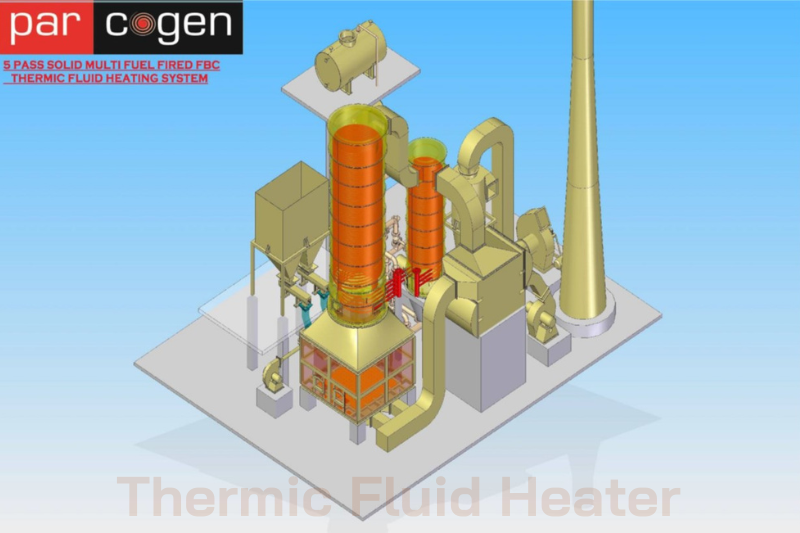
A thermic fluid heater is an indirect industrial heating system that burns fuel to heat a thermal oil (thermic fluid), which is circulated through a closed-loop system to deliver process heat. Unlike steam boilers, thermic fluid heaters operate at low system pressure while delivering high temperatures typically 150°C to 320°C+ depending on the thermal oil selected. Key components: heater coil, combustion chamber, burner, circulation pump, expansion tank, control panel, and safety interlocks. Major applications: chemical processing, food, textile, pharmaceutical, rubber, plastics, edible oil, bitumen, and paper industries. Selection factors: required heat duty (kW or kcal/hr), fluid supply temperature, fuel type, thermic fluid selection, automation, and safety requirements. Par Techno-Heat Pvt. Ltd. manufactures thermic fluid heaters from its facility in Sanand, Ahmedabad, Gujarat.
Industrial heating is not a background function it is a core process variable. Whether you are controlling a chemical reaction, refining edible oil, dyeing fabric, or heating bitumen for road construction, the precision and reliability of your heating system directly affects product quality, energy cost, and production continuity.
Thermic fluid heaters have become the preferred heating system for high-temperature industrial applications because of one fundamental engineering advantage: they deliver temperatures above 200°C — and well above 300°C for synthetic fluid grades at near-atmospheric system pressure. This eliminates the high-pressure steam infrastructure that equivalent steam-based heating would require, reducing both capital investment and regulatory complexity.
This guide covers what a plant engineer or procurement manager needs to know before specifying a thermic fluid heater: how it works, what types are available, how it compares to steam, which industries use it, how to evaluate efficiency and safety, and what to ask a manufacturer before placing an order.
This is an updated version of Par Boiler's existing guide: Thermic Fluid Heaters – Benefits, Types & Industrial Uses. The original useful content has been preserved and substantially expanded.
A thermic fluid heater is an indirect industrial heating system that burns fuel to heat a specially formulated thermal oil (thermic fluid or heat-transfer oil), which is pumped through an insulated closed-loop pipeline to deliver process heat. The thermal oil absorbs heat at the heater coil, circulates to process heat exchangers where it releases heat to the process, and returns to the heater to be reheated continuously. System operating pressure is typically low, even when delivering temperatures of 150–320°C+. The thermic fluid never contacts the process product.
The fundamental engineering advantage of thermic fluid heating is the decoupling of temperature from pressure. In a steam system, delivering 300°C process heat requires steam at approximately 86 kg/cm² a high-pressure system requiring IBR registration, certified operators, and significant pressure vessel investment. In a thermic fluid system, delivering 300°C uses a synthetic thermal oil circulating at a system pressure of approximately 3–5 kg/cm² significantly simpler and less capital-intensive.
This is also called a thermal oil heater, hot oil heater, or thermic oil heater all names describing the same type of system. The choice of name varies by industry and region, but the technology is identical.
Quick Answer: Fuel burns in the heater's combustion chamber. Hot flue gases pass over the heater coil, heating the thermic fluid inside. The heated fluid is pumped to process heat exchangers, releasing heat to the process. Cooled fluid returns for reheating. The expansion tank manages volume change with temperature. PLC controls maintain the outlet temperature at the set point through burner modulation.
System Flow: Fuel → Burner → Combustion Chamber → Heater Coil → Thermic Fluid Heated → Circulation Pump → Process Heat Exchanger → Heat Released → Cooled Fluid Returns → Reheated → Continuous Cycle
The heater coil is the primary heat exchange surface a helically wound or multi-pass tube bundle inside the combustion chamber. Hot flue gases transfer heat to the thermic fluid inside. Coil material, tube thickness, and surface area must be designed for the operating temperature, fluid flow rate, and heat duty. Scale or fouling on the coil's internal or external surface reduces heat transfer and raises flue gas exit temperature a key maintenance monitoring parameter.
The combustion chamber provides the enclosed space for fuel combustion and the pathway for hot flue gases to contact the heater coil. Furnace design affects combustion completeness, heat distribution, and flue gas exit temperature. A correctly designed combustion chamber achieves complete fuel burnout while maximising heat transfer to the coil.
The burner mixes fuel and combustion air and ignites the mixture in the furnace. Modulating burners which continuously adjust their firing rate to match heat demand deliver better temperature control and improved fuel efficiency compared to simple on/off burners. For oil-fired heaters, the burner includes fuel preheating for heavy oil grades. Regular burner maintenance (cleaning, nozzle inspection, air-fuel ratio check) is the most commercially important routine maintenance task.
The circulation pump drives continuous thermic fluid flow. It must be sized for the actual system flow rate and the total pressure drop. Pump reliability is critical a pump failure with the heater still firing creates a fluid overheating risk. Systems include a duty and standby pump with automatic changeover. The pump mechanical seal must be rated for the operating fluid temperature and inspected regularly for weepage.
The expansion tank always at the highest point accommodates the thermal expansion of the thermic fluid as it heats from ambient to operating temperature (typically 5–15% of total fluid volume). It maintains positive suction head at the pump. Incorrect sizing or positioning creates either fluid overflow or insufficient pump suction head.
The thermic fluid is the heat carrier. It must be selected for the required operating temperature range, thermal stability at operating conditions, viscosity at start-up, and flash and fire point margins. Synthetic fluids suit continuous operation above ~250–280°C; mineral oil grades are used below this threshold. Fluid quality must be monitored periodically testing viscosity, flash point, and acid value to determine fluid condition and replacement timing.
The PLC regulates: fluid outlet temperature (through burner modulation), pump operation (including standby changeover), safety interlock logic (high temperature trip, low flow trip, flame failure), alarm annunciation, and data logging. Independent safety shutdown logic separate from the main temperature control ensures that a temperature control loop failure does not also disable the safety shutdown.
Safety interlocks protect against the most dangerous fault conditions: fluid overtemperature (high-temp cutout shuts the burner), low flow (flow switch detects pump failure and shuts burner before localised fluid overheating occurs), flame failure (flame scanner closes fuel supply on flame loss), and expansion tank level monitoring. For gas-fired heaters, fuel train safety (solenoid valves, gas leak detection) adds a critical additional layer.
| Type | Fuel | Key Advantage | Main Consideration | Best Application |
|---|---|---|---|---|
| Gas Fired | Natural gas (PNG), LPG | Clean combustion; modulating control; no ash | Gas supply availability | Urban zones with PNG; pharma; food |
| Oil Fired | Furnace oil, LDO, HSD | Widely available; high heat output | Fuel storage; preheating for heavy oils; running cost | Large capacity; areas without PNG supply |
| Solid Fuel | Coal, wood chips, briquettes | Lower fuel cost where solid fuel is available | Ash handling; emission control equipment; less precise temperature response | Areas with low-cost solid fuel; large capacity |
| Biomass | Rice husk, bagasse, wood waste, agro-waste | Very low fuel cost; renewable; green manufacturing | Fuel handling; ash and emission control; output consistency | Agro-processing, food, paper, textile near biomass source |
| Electric | Electricity | Clean; precise; no combustion; compact | Electricity cost per unit of heat; limited to smaller capacities | Small capacity; clean environments; no combustion permitted |
Quick Answer: The key difference is the heat transfer medium and system pressure. A thermic fluid heater circulates thermal oil at low system pressure to deliver high-temperature indirect heating. A steam boiler generates steam under pressure for steam-based processes. For temperatures above 200°C, thermic fluid systems operate at far lower pressure than equivalent steam, reducing pressure vessel requirements, regulatory burden, and safety risk.
| Parameter | Thermic Fluid Heater | Steam Boiler |
|---|---|---|
| Heat transfer medium | Thermal oil (thermic fluid) | Steam (water vapour) |
| System operating pressure | Low typically near atmospheric at heater; modest system pressure | Medium to high 86 kg/cm² for 300°C steam |
| High-temp capability | Excellent 150–320°C+ at low system pressure | Possible but requires very high-pressure vessel above ~220°C |
| Water treatment | Not required fluid quality monitoring required instead | Essential scale, corrosion, carryover controlled through water chemistry |
| IBR registration | Generally not required (confirm with applicable authority for your system) | Required for steam boilers above IBR thresholds |
| Temperature control | Precise and stable no pressure-related fluctuations | Good but affected by steam pressure variations and load changes |
| Maintenance focus | Fluid quality monitoring; burner; pump seal; coil inspection | Water treatment; blowdown; safety valve; scale removal; IBR inspection |
| Best suited for | High-temperature indirect heating chemical, rubber, plastics, food, textile, bitumen, edible oil | Steam processes sterilisation, power generation, textile dyeing, food cooking, co-generation |
If the process inherently requires steam for sterilisation, turbine driving, or direct steam contact a steam boiler is the only answer. If the process needs high-temperature indirect heat transfer without high-pressure steam infrastructure, a thermic fluid heater is typically the better engineering choice. For guidance on steam boiler selection, see our steam boiler systems in India guide.
| Industry | Typical Heating Application | Why Thermic Fluid Heating Is Used |
|---|---|---|
| Chemical Processing | Jacketed reactors, distillation columns, heated storage tanks | Precise temperature control across extended reaction windows; high temperature at low system pressure |
| Food Processing | Cooking, frying, edible oil refining, drying | Indirect heat no food product contamination; stable temperature throughout production |
| Textile | Stenter machines, dyeing, finishing, calendering | Uniform high-temperature delivery to large heat exchanger surfaces; controlled drying |
| Pharmaceutical | Jacketed vessel heating, formulation, synthesis | Precise batch temperature control for GMP environments; stable indirect heating |
| Rubber and Plastics | Mold heating, vulcanization, extrusion, calender rolls | Rapid, precise temperature control; indirect uniform heat; rapid response |
| Paper and Packaging | Dryer cylinders, calenders, adhesive heating | Continuous indirect heating of large roller surfaces; stable temperature throughout production run |
| Bitumen and Asphalt | Storage tank heating, pipeline heating, mixing plant | High-temperature heating and temperature maintenance for viscous materials requiring sustained heat |
| Edible Oil | Refining, deodorising, fractionation | High-temperature indirect heating without contamination of edible oil product |
| Paint, Resin, and Adhesive | Reactor heating, mixing, drying | Precise temperature control for polymerisation; indirect heat prevents contamination |
| Oil & Gas / Petrochemical | Crude oil heating, pipeline transport, process heating | Reliable high-temperature heating for viscous materials and petrochemical processes |
Quick Answer How to Improve Efficiency: Tune the burner to reduce excess air (measured by flue gas O₂% analysis); clean the heater coil to restore heat transfer when rising stack temperature indicates fouling; maintain insulation to reduce standby losses; use VFD on the pump where variable flow is appropriate; and test thermic fluid annually to confirm heat-carrying properties have not degraded. Monthly combustion analysis and annual burner overhaul are the highest-impact routine efficiency measures.
Thermic fluid heater efficiency is determined by: combustion efficiency (excess air level measured by flue gas O₂%), heat transfer surface condition (coil fouling raises flue gas exit temperature), fluid circulation rate (must maintain design temperature differential), insulation quality (standby losses through heater body and pipework), and operating load factor (part-load operation increases proportional standby losses). A combustion analyser should be used at least annually to measure flue gas O₂% and stack temperature. Rising stack temperature compared to commissioning baseline indicates coil fouling recoverable through cleaning.
Safety in a thermic fluid system depends on equipment design, correct installation, correctly specified safety interlocks, disciplined maintenance, and operator training not on any single device.
| Frequency | Task | Purpose |
|---|---|---|
| Daily | Verify outlet temperature at set point; check flow; observe burner flame; check expansion tank level; visual leak inspection; log all readings | Early detection of developing problems; confirm safety interlocks are operative |
| Weekly | Inspect pump seals for weepage; check burner combustion air; test low-flow interlock; inspect insulation for damage | Early seal failure detection; efficiency verification; safety interlock confirmation |
| Monthly | Combustion analysis (O₂%, CO, stack temperature); clean suction strainer; verify high-temperature cutout set point | Efficiency monitoring rising stack temperature indicates coil fouling; confirm safety set points |
| Annual / Periodic | Thermic fluid laboratory testing (viscosity, flash point, acid value, water content); complete burner overhaul; heater coil inspection and cleaning; full safety interlock function test; refractory inspection | Determine fluid condition; restore combustion efficiency; confirm coil integrity; verify all safety shutdowns |
For a complete industrial boiler and heater maintenance framework covering all maintenance frequencies, see our industrial boiler maintenance checklist.
| Problem | Possible Cause | Recommended Investigation |
|---|---|---|
| Low outlet temperature | Reduced firing; coil fouling; low fuel supply; incorrect set point | Check burner; measure stack temperature (fouling indicator); verify fuel pressure and set point |
| Rising stack temperature over time | Heater coil fouling deposits reducing heat transfer | Compare to commissioning baseline at same load; schedule coil inspection and cleaning |
| Low circulation flow | Pump impeller wear; blocked suction strainer; partially closed valve; high cold-start viscosity | Check pump discharge pressure vs rated; clean strainer; verify all valves open |
| Fluid degradation | Fluid overtemperature beyond rated maximum; air ingress into expansion tank; extended service without testing | Fluid laboratory test viscosity, flash point, acid value; check operating temperature vs fluid rating |
| Frequent burner lockout | Flame failure (ignition problem, flame scanner fault); fuel supply interruption; blocked nozzle | Check flame scanner; verify fuel supply pressure; inspect burner nozzle and ignition electrode |
| Fluid leakage | Pipe joint failure; pump seal failure; valve packing wear; coil failure | Locate source; shut down safely before repair; address immediately due to fire risk |
Selecting the right thermic fluid heater manufacturer is important for ensuring efficient performance, long-term reliability, and safe industrial operations. Factors such as manufacturing experience, technical expertise, fuel flexibility, temperature requirements, and after-sales support should be evaluated before making a decision.
For businesses looking to select the right supplier, understanding the leading manufacturers and their capabilities is essential. Explore our detailed guide on Top 5 Thermic Fluid Heater Manufacturers in India to compare industry expertise, product quality, and engineering solutions.
| Parameter | What to Define |
|---|---|
| Heat Duty | Total process heat requirement in kW or kcal/hr at peak demand sum of all heat exchangers in the system |
| Supply Temperature | Required thermic fluid temperature at the process heat exchanger inlet |
| Return Temperature | Expected return temperature from the process heat exchanger to the heater |
| Fuel | Gas (PNG/LPG), oil (grade), solid fuel, or biomass with calorific value and quality specification |
| Thermic Fluid | Confirm fluid type and maximum temperature rating verify with both heater manufacturer and fluid supplier |
| Control | Manual temperature control, automatic, or PLC-based with data logging and remote monitoring |
| Safety Interlocks | High temperature cutout, low flow shutdown, flame failure protection confirm all independent of main control |
| Emission Control | For solid fuel/biomass: confirm APC system requirement based on fuel and applicable SPCB consent conditions |
| Installation | Indoor/outdoor; available footprint; chimney route; expansion tank location (must be highest point) |
| System | Best Suited For | Main Advantage | Key Consideration |
|---|---|---|---|
| Thermic Fluid Heater | High-temperature indirect heating chemical, rubber, plastics, food, textile, bitumen | High temperature at low system pressure; precise control | Fluid management; fire risk from leakage; not for steam-using processes |
| Steam Boiler | Steam-based processes sterilisation, power generation, dyeing, food cooking | Steam versatility; latent heat; irreplaceable for steam processes | High pressure for high temperature; water treatment; IBR compliance |
| Hot Air Generator | Drying applications ceramic, food, agro-processing, paper coating | Direct or indirect hot air supply; no liquid heat carrier | Direct HAG allows combustion gas contact with product; indirect does not |
| Electric Heater | Small-capacity clean heating; no combustion permitted | Clean; very precise control; no combustion | High electricity cost per unit of heat for large capacity |
Par Techno-Heat Pvt. Ltd. manufactures thermic fluid heaters as part of its industrial heating solutions range from its facility in Sanand, Ahmedabad, Gujarat. Each system is designed for the buyer's specific heat duty, fluid supply temperature, fuel type, site layout, and automation requirement rather than applying a standard configuration.
The engineering scope covers the heater, combustion system, circulation pump and standby arrangement, expansion tank, PLC control, and safety interlocks as a complete package. For solid fuel and biomass-fired systems, integrated air pollution control equipment is designed alongside the heater to meet applicable SPCB consent conditions. Installation, commissioning, and operator training are standard deliverables.
For a complete manufacturer evaluation framework applicable to thermic fluid heaters and steam boilers, see our boiler manufacturer selection checklist. For Par Boiler's complete product capabilities, see our guide on why choose Par Boiler as an industrial boiler manufacturer.
Planning a Thermic Fluid Heating System? Share your heat duty, required supply temperature, fuel type, and application with Par Techno-Heat's engineering team for a system-specific technical proposal. Contact Par Boiler for a technical discussion.
Par Techno-Heat Pvt. Ltd. industrial heating equipment manufacturer in Sanand, Ahmedabad designs and supplies thermic fluid heaters for gas, oil, solid fuel, and biomass applications across chemical, food, textile, pharmaceutical, rubber, and plastics industries. Share your heat duty, temperature, fuel type, and site details for a complete engineering proposal.
Contact Par Boiler Thermic Fluid Heater EnquiryA thermic fluid heater is an indirect industrial heating system that burns fuel to heat a thermal oil (thermic fluid), pumped through a closed-loop pipeline to deliver process heat at industrial heat exchangers. The thermal oil absorbs heat at the heater, circulates to process equipment, releases heat, and returns for reheating. The system operates at low system pressure even when delivering temperatures of 150–320°C+. The thermic fluid never contacts the process product.
Fuel burns in the combustion chamber. Hot flue gases pass over the heater coil, heating the thermic fluid inside. The circulation pump moves heated fluid through insulated pipework to process heat exchangers, where heat transfers to the process. Cooled fluid returns to the heater for reheating. The expansion tank manages thermal volume change. The PLC control system maintains fluid temperature at the set point through burner modulation. Safety interlocks shut the burner on high temperature, low flow, or flame failure.
Thermic fluid heaters are used for high-temperature indirect industrial process heating wherever temperatures above 150°C are required but high-pressure steam infrastructure is not justified. Common applications: chemical reactor heating, food processing (cooking, edible oil refining, frying), textile stenter and dyeing, pharmaceutical process heating, rubber mold heating and vulcanization, plastics extrusion, paper drying, bitumen and asphalt heating, paint and resin manufacturing, and edible oil refining.
A thermic fluid heater circulates thermal oil at low system pressure to deliver high-temperature indirect heating; a steam boiler generates steam under pressure for steam-based processes. Thermic fluid heaters can deliver temperatures above 300°C at near-atmospheric system pressure, where equivalent steam delivery would require very high-pressure vessels. Steam boilers require water treatment, IBR registration, and blowdown management; thermic fluid heaters require periodic fluid quality monitoring instead. If the process requires steam, a steam boiler is needed thermic fluid heating cannot substitute.
Thermal oil (thermic fluid or heat-transfer oil) is a specially formulated liquid used as the heat-carrying medium in a thermic fluid heating system. It must remain liquid across the full operating temperature range, have adequate thermal stability at maximum operating temperature, and have a flash point well above the maximum operating temperature. Synthetic thermal oils are specified for continuous operation above approximately 250–280°C; mineral oil grades are generally used at lower temperatures.
Temperature capability depends on the thermic fluid selected and the heater's design. Most industrial thermic fluid systems operate between 150°C and 300°C. High-temperature synthetic thermal oils can support continuous operation up to 320°C or above depending on the specific fluid grade. The maximum operating temperature must be confirmed against both the fluid's rated maximum continuous temperature and the heater coil's maximum film temperature rating not simply the heater's nameplate maximum.
Chemical processing (reactors, distillation), food processing (cooking, edible oil refining), textile (stenter, dyeing, finishing), pharmaceutical (jacketed vessel heating), rubber (vulcanization, mold heating), plastics (extrusion, thermoforming), paper and packaging (dryer cylinders), bitumen and asphalt, paint and resin, edible oil refining, and oil and gas (crude oil heating) all use thermic fluid heaters as standard industrial equipment where high-temperature indirect heating is required.
The main components are: heater coil (primary heat exchange surface inside the combustion chamber), furnace/combustion chamber, burner (fuel ignition and combustion control modulating burners preferred), circulation pump with duty and standby arrangement, expansion tank (at highest system point accommodates thermal fluid expansion), thermic fluid (heat-carrying medium requiring periodic testing), PLC-based control panel (temperature regulation and safety interlock logic), and the insulated piping network connecting heater to process heat exchangers.
Thermic fluid heaters are available in: gas-fired (natural gas/PNG, LPG clean combustion, modulating control), oil-fired (furnace oil, LDO, HSD), solid fuel-fired (coal, wood chips, briquettes), biomass-fired (rice husk, bagasse, agro-waste very low fuel cost where biomass is available), and electric (suitable for small capacity or where no combustion is permitted). Fuel selection should be based on local availability, delivered cost, required temperature precision, and applicable emission compliance requirements.
Thermic fluid heater efficiency depends on combustion efficiency (excess air level measured by flue gas O₂%), heater coil condition (fouling raises flue gas exit temperature), insulation quality, fluid circulation rate, and operating load factor. Efficiency should be compared between manufacturers at identical defined conditions same load, fuel calorific value, and fluid temperatures. Monthly combustion analysis and annual burner overhaul are the most effective efficiency management activities.
Select based on: maximum continuous operating temperature (fluid rating must exceed heater maximum with margin), maximum film temperature rating (tube wall temperature inside heater coil is higher than bulk fluid fluid must be rated for the film temperature), start-up viscosity (check pump selection handles cold-start viscosity), flash point safety margin above operating temperature, and compatibility with system materials. Confirm selection with both the heater manufacturer and the thermal oil supplier for your specific application.
Thermic fluid should be sampled and laboratory-tested at least annually under normal operating conditions, and more frequently if the system has experienced a high-temperature event or the fluid has been in service for 3+ years. Tests should include: kinematic viscosity, flash point (indicator of thermal degradation), acid value (indicator of oxidation), and water content. Test results determine whether the fluid remains suitable for continued service or whether replacement is approaching.
A well-maintained thermic fluid heater with correct fuel, correct fluid specification, and disciplined maintenance typically operates reliably for 15–25 years. The heater coil and combustion chamber life depends on operating temperature staying within design limits, combustion quality, and whether the coil is cleaned and inspected annually. The thermic fluid is a consumable typically requiring replacement every 5–8 years depending on operating temperature and maintenance quality.
Two primary mechanisms: (1) Thermal cracking exposure above the fluid's rated maximum causes breakdown of larger molecules into smaller fractions, lowering flash point and changing viscosity; prevented by keeping operating temperature within the fluid's rated maximum. (2) Oxidation air contact in the expansion tank causes acid formation and viscosity change; prevented by keeping the expansion tank sealed or using nitrogen blanket for high-temperature applications. Both causes are manageable through correct system design and operation.
Cost depends on: heat capacity (kW or kcal/hr), maximum fluid temperature, fuel type and combustion system, material specification, pump arrangement, control level (manual, automatic, or PLC), insulation, and whether APC equipment is required for solid fuel or biomass systems. A project-specific quotation from the manufacturer based on your actual heat duty, temperature, and fuel specification is more useful than a general price range. Contact Par Boiler with your project parameters for an accurate proposal.
Essential safety systems: high-temperature cutout (independent of main temperature control shuts burner if fluid exceeds maximum safe temperature), low-flow protection (flow switch shuts burner if circulation fails most critical interlock), flame failure detection (shuts fuel valves on flame loss), pump interlock (burner cannot fire without confirmed circulation), and expansion tank level monitoring. For gas-fired systems, add fuel train safety valves and gas pressure monitoring. All safety interlocks must be independent of the main temperature control system.
Evaluate: experience with your specific fuel type and temperature requirement, engineering capability for application-specific sizing, clarity on heater coil maximum film temperature and compatibility with your selected fluid, commissioning support scope, spare parts availability and lead times, service network in your location, warranty terms, and references from similar installations. Request at least two reference contacts from comparable heat duty, temperature, and fuel applications before finalising any manufacturer selection.
Yes. Biomass-fired thermic fluid heaters are widely used in agro-based, food processing, paper, and textile industries where biomass rice husk, bagasse, wood chips, or agro-waste is available at low cost. Biomass-fired designs use a grate or FBC combustion system with ash handling and air pollution control equipment (cyclone plus bag filter). The combustion system must be designed for the specific biomass fuel's moisture content, ash percentage, and calorific value not generically specified from a catalogue.
Yes. Modern thermic fluid heaters are designed with PLC-based automatic control as standard managing fluid outlet temperature through burner modulation, duty/standby pump changeover, safety interlock logic, alarm annunciation, and data logging. Advanced systems can include remote monitoring and integration with plant DCS or SCADA. The degree of automation should match the plant's operational requirements, staffing model, and the production continuity requirements of the connected processes.
"Thermal oil heater," "thermic fluid heater," "hot oil heater," and "thermic oil heater" all describe the same type of industrial heating system a closed-loop indirect heating system that circulates thermal oil to transfer process heat. The terminology varies by industry and region but refers to the same fundamental technology: a heater that uses oil as the heat-transfer medium rather than steam or water, operating at high temperature and low system pressure.
