

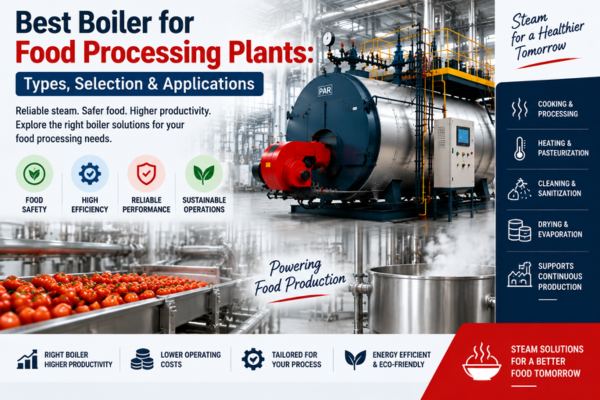
There's no single best boiler for every food processing plant the right choice depends on the plant's required steam pressure, capacity, process application, steam-quality requirements, fuel availability, operating schedule, and applicable regulations. Common options evaluated by food manufacturers include fire tube steam boilers for small-to-medium continuous loads, water tube boilers for large or high-pressure demand, electric boilers where combustion emissions at the point of use must be avoided, gas-fired boilers where pipeline gas is available and clean combustion matters, oil-fired boilers where gas isn't accessible, biomass-fired boilers where agro-waste fuel is available locally, and FBC boilers for larger solid-fuel installations. Selecting between them requires evaluating your actual process steam demand, whether steam contacts food directly, water quality, and lifecycle cost not defaulting to one boiler type as a universal answer.
Ask a food plant engineer which boiler they'd recommend, and the honest answer is always "it depends" on your steam pressure, your batch cycle, whether steam touches the product, and what fuel is actually available at your site. A dairy running continuous pasteurization has a completely different steam profile than a bakery running batch ovens or a canning plant running retort cycles, even though all three are "food processing."
This guide walks through the boiler technologies commonly used across Indian food manufacturing fire tube, water tube, electric, gas, oil, biomass, and FBC along with the steam quality, water treatment, fuel, capacity, safety, and compliance factors that actually determine which one fits your plant. It's built for the people responsible for that decision: plant managers, process engineers, utility and energy managers, and procurement teams evaluating a new or replacement boiler.
The best boiler for a food processing plant is determined by process steam requirements, not by boiler type alone. Evaluate required capacity, operating pressure, steam quality (especially for direct food contact), fuel availability, batch or continuous operating profile, and regulatory compliance before selecting between fire tube, water tube, electric, gas, oil, biomass, or FBC designs.
In food processing, a boiler generates steam or hot water used for cooking, pasteurization, sterilization, cleaning (CIP), drying, evaporation, and general process heating through heat exchangers or, in some applications, direct steam contact. It is one component of a complete plant thermal utility system rather than a standalone piece of equipment.
The boiler itself is only the heat source. What actually determines whether a food plant's heating system works well is the complete chain steam generation, distribution piping, pressure reduction where needed, heat exchangers or direct-contact points, condensate return, and water treatment feeding back into the boiler. Our overview of what an industrial boiler is and our guide on how a steam boiler works cover the foundational mechanics behind this system.
Food processing adds requirements that a generic industrial process doesn't always have: hygiene standards, steam quality expectations where steam contacts product, consistent pressure for repeatable process results, frequent batch-driven load fluctuations, and stricter reliability expectations because a boiler outage can halt an entire production line. Water quality feeding the boiler matters more here too, since scale and corrosion problems compound the cleaning and maintenance burden already inherent to food-grade equipment.
It's important to distinguish between different categories of steam used in a food plant, because they're not interchangeable:
A standard industrial boiler producing utility or process steam does not automatically produce steam suitable for direct food contact. Whether your application needs direct-contact steam, and what treatment, filtration, or generator configuration that requires, depends on your specific process and the food-safety standards that apply to it This should be confirmed with a qualified process engineer rather than assumed.
Hot combustion gases pass through tubes surrounded by water inside a large cylindrical shell. Fire tube boilers are widely used across small-to-medium food processing plants for their compact footprint, simpler operation, and lower capital cost.
Advantages: straightforward maintenance, quick availability, well-suited to moderate pressure requirements.
Limitations: practical capacity and pressure ceiling compared to water tube designs. Our detailed comparison of steam boiler types covers fire tube design in more depth.
Water flows inside tubes with hot gas passing around them, enabling higher pressure and larger steam capacity than fire tube designs. Larger food manufacturing operations high-volume dairies, large beverage plants, big bakeries with continuous ovens often need this scale.
Advantages: faster load response, higher achievable pressure, better suited to large continuous demand.
Limitations: higher capital cost and more involved maintenance than fire tube designs.
Electric boilers use resistance or electrode heating instead of combustion, producing no on-site flue gas emissions. They're compact and offer precise control, which suits smaller or cleanroom-adjacent applications where combustion byproducts at the point of use are unwanted. Electric boilers are not automatically the cheapest option running cost depends heavily on local electricity tariffs relative to fuel alternatives, and capacity is generally more limited than combustion-fired designs at comparable footprint.
Running on natural gas or LPG, gas-fired boilers offer clean combustion, good automation compatibility, and generally lower maintenance than solid fuel systems. They're a common choice where pipeline gas access exists, particularly in urban and industrial-belt food plants. Operating cost depends on local gas pricing relative to alternatives, and availability is the primary constraint outside gas-connected regions.
Furnace oil or diesel-fired boilers serve plants without gas pipeline access, offering reasonable combustion cleanliness with the tradeoff of on-site fuel storage requirements and generally higher running cost than gas. They remain relevant as a primary or backup fuel option in areas without reliable gas supply.
Biomass boilers burn rice husk, bagasse, wood-based fuels, or other agro-waste, offering significantly lower fuel cost where these materials are available locally. They require fuel storage and handling infrastructure, ash management, and generally more maintenance attention than gas systems, along with emission control equipment appropriate to the fuel and capacity. Our hot water boiler guide covers a related lower-pressure heating alternative that some food plants use alongside steam systems for washing and lower-temperature needs.
Fluidized Bed Combustion (FBC) boilers burn solid fuel biomass, coal, or blends in a turbulent, air-suspended bed, achieving more complete and flexible combustion than conventional grate-fired solid fuel systems. FBC is generally relevant at larger food processing scale where solid fuel economics justify the additional capital investment, not for every food plant considering biomass. Our detailed guide on FBC boiler working principle and biomass fuel compatibility covers this technology in full.
| Boiler Type | Typical Fuel/Energy Source | Main Advantages | Key Limitations | Suitable Food Applications |
|---|---|---|---|---|
| Fire Tube | Gas, oil, biomass | Compact, simpler maintenance, lower cost | Pressure and capacity ceiling | Small-medium dairy, bakery, general processing |
| Water Tube | Gas, oil, biomass | High pressure, large capacity, fast response | Higher capital and maintenance cost | Large dairy, beverage, high-volume canning |
| Electric | Electricity | No on-site emissions, precise control, compact | Running cost depends on tariffs; limited scale | Small batch, cleanroom-adjacent operations |
| Gas Fired | Natural gas, LPG | Clean combustion, good automation, low maintenance | Requires pipeline or LPG supply | Dairy, beverage, bakery, pharma-adjacent food plants |
| Oil Fired | Furnace oil, diesel | Available without gas pipeline | Higher running cost, fuel storage needed | Plants without gas access, backup duty |
| Biomass | Rice husk, bagasse, wood-based fuel | Lower fuel cost near source | Fuel storage, ash handling, more maintenance | Rice processing, larger agro-adjacent food plants |
| FBC | Biomass, coal, blends | Flexible solid fuel combustion at scale | Higher capital cost, suited to larger installations | Large-scale solid-fuel food processing operations |
The honest answer is that "best" depends entirely on matching boiler characteristics to your specific plant requirement. The table below frames this as a set of evaluation starting points rather than fixed rules.
| Plant Requirement | Boiler Type(s) to Evaluate | Why |
|---|---|---|
| Small-to-medium steam demand | Fire tube, packaged | Lower cost and footprint match the scale |
| Large continuous steam demand | Water tube | Handles higher capacity and pressure efficiently |
| Limited emissions at point of use | Electric, gas-fired | Cleaner combustion or no on-site combustion |
| Reliable natural gas supply | Gas-fired fire tube or water tube | Clean, automatable, lower maintenance |
| Low-cost biomass availability | Biomass, FBC | Lower fuel cost, subject to handling infrastructure |
| High-pressure process requirements | Water tube | Only design practical above moderate pressure |
| Batch processing with variable demand | Fire tube (buffer capacity), water tube (fast response) | Depends on whether buffering or fast response matters more |
| Direct-contact steam | Any type, with appropriate water treatment/generator config | Steam quality treatment matters more than boiler type here |
| Cleanroom-adjacent applications | Electric | No combustion byproducts near sensitive areas |
| Variable/seasonal steam demand | Fire tube, multi-boiler configuration | Easier to stage multiple smaller units for turndown |
Steam quality its purity, moisture content, and freedom from boiler-water contaminants matters most where steam contacts food product directly. Requirements vary significantly between indirect process heating through a heat exchanger and direct-contact applications, which typically need dedicated water treatment, filtration, and system design considerations beyond a standard utility boiler.
Wet steam carrying moisture and boiler-water carryover reduces heat transfer efficiency and, in direct-contact applications, can introduce boiler water treatment chemicals into contact with food. Steam separators and properly maintained boiler internals reduce carryover; chemical dosing programs must be selected and managed appropriately for the specific application, particularly where any possibility of direct or indirect product contact exists. Condensate management also matters condensate quality and any contamination risk should be assessed as part of the overall steam system design, not treated as a detail to resolve later.
What type of steam is required for food processing? The steam type required depends on whether it contacts food directly. Indirect process heating through a heat exchanger can generally use standard treated boiler steam, while direct food contact typically requires additional filtration, specific water treatment, and system design confirmed against applicable food-safety standards for that process.
Feedwater hardness, dissolved solids, and dissolved gases drive scale formation and corrosion inside the boiler problems that reduce heat transfer efficiency, shorten equipment life, and can compromise steam quality. A proper water treatment program addresses feedwater softening or demineralization as required, oxygen scavenging, pH control, and scale inhibition, paired with a disciplined blowdown routine to keep dissolved solids within the boiler manufacturer's specified range. Condensate returned to the boiler should also be monitored, since contamination in the condensate stream carries directly back into the feedwater system. Treatment chemistry must be selected for the specific application and managed according to the boiler manufacturer's guidance and applicable regulatory requirements a generic water treatment program isn't automatically appropriate for every food plant's water source and process.
| Fuel/Energy Source | Advantages | Limitations | Best Fit |
|---|---|---|---|
| Natural Gas | Clean, automatable, low maintenance | Requires pipeline access | Gas-connected industrial zones |
| LPG | Clean combustion where pipeline gas is unavailable | Higher cost than piped gas; storage needed | Sites without gas pipeline |
| Diesel/Furnace Oil | Available without gas infrastructure | Higher running cost; fuel storage and handling | Remote sites, backup duty |
| Biomass | Lower fuel cost near source | Storage, handling, ash management, emissions control | Agro-adjacent plants with reliable local supply |
| Electricity | No on-site combustion emissions | Running cost depends on local tariffs | Smaller loads, emission-sensitive areas |
No fuel is universally cheapest evaluate availability, delivered cost, storage space, emission requirements, automation needs, and future supply security specific to your site before deciding.
Boiler capacity for process steam is commonly expressed in kg/hr or TPH (tonnes per hour), where 1 TPH = 1,000 kg/hr. For reference: 500 kg/hr = 0.5 TPH, 1,000 kg/hr = 1 TPH, 2,000 kg/hr = 2 TPH, 5,000 kg/hr = 5 TPH, and 10,000 kg/hr = 10 TPH. These are unit conversions only, not capacity recommendations actual sizing depends entirely on your connected process load.
A proper capacity calculation considers total connected steam demand across all process equipment, average versus peak demand, batch load timing, which equipment runs simultaneously, operating hours, start-up steam demand, condensate return rate, required steam pressure, and planned future production expansion.
Consider a hypothetical food plant with the following connected loads:
Total connected steam demand: 3,000 kg/hr (3 TPH). If CIP and pasteurization rarely run simultaneously with peak cooking demand, actual expected simultaneous demand may be lower than the connected total but this diversity assumption must be verified against your real operating schedule, not assumed generically. Add an appropriate engineering margin for peak demand and future expansion before finalizing capacity. This example is illustrative only; final sizing requires your specific process heat-load data confirmed by a qualified boiler or process engineer.
Food processing steam demand rarely runs flat. Batch operations create sharp demand spikes at cook or CIP cycle start, pasteurization runs on defined daily cycles, seasonal production can shift baseline demand significantly, and equipment start-up often pulls more steam than steady-state operation. A boiler sized only to average demand can be badly undersized for these peaks, causing pressure drops that affect product consistency. Sizing needs to account for realistic peak demand and part-load operation, not just an averaged daily figure.
Dairy plants use steam for pasteurization, hot water generation, CIP cleaning cycles, and in some processes, sterilization. Consistent pressure and reliable continuous or near-continuous operation matter here, since pasteurization temperature control depends on stable steam supply. Capacity and boiler type should reflect actual processing volume and whether pasteurization runs continuously or in batches.
Beverage plants need steam for pasteurization, hot water supply, CIP systems, and bottle or container washing. Load patterns often follow production line scheduling closely, with CIP cycles creating periodic demand spikes between production runs. Boiler selection should account for this cyclical pattern alongside baseline process heat demand.
Bakery operations use steam for oven humidity and baking processes, sometimes for dough processing, and for general cleaning. Oven steam injection cycles create short, sharp demand pulses distinct from a dairy's more continuous profile a factor worth discussing explicitly with your boiler supplier when sizing.
Canning and RTE food processing commonly involves cooking, retort (thermal processing/sterilization) cycles, hot water generation, and cleaning. Retort cycles in particular demand precise, sustained pressure and temperature control over defined cycle times, making steam supply reliability especially important for these processes.
This sector uses steam for blanching, cooking, pasteurization, cleaning, and hot water generation, often with seasonal production volume swings tied to harvest cycles. Boiler capacity and turndown flexibility should reflect this seasonal variability rather than a single fixed annual average.
Cooking vessels, heating jackets, and cleaning cycles drive steam demand in sauce, spice, and condiment production. Process temperature control for cooking vessels typically requires stable, well-regulated steam supply rather than raw capacity alone.
Edible oil processing involves various heating requirements through the refining and processing sequence, with specific steam or thermal fluid needs depending on the exact process stages installed. Given the process-specific nature of edible oil heating requirements, capacity and steam quality specifications should be developed directly with your process equipment supplier and boiler engineer rather than assumed from general industry practice.
Meaningful efficiency gains come from a combination of measures rather than any single fix: proper combustion tuning and regular burner maintenance, adequate insulation on the boiler and distribution piping, economizer installation to recover flue gas heat for feedwater preheat, keeping feedwater temperature as high as practical, effective condensate recovery to reduce makeup water and fuel demand, controlled blowdown that removes dissolved solids without wasting excess heat, consistent water treatment to prevent scale buildup on heat transfer surfaces, heat recovery where process conditions allow it, matching boiler operation to actual load rather than running oversized capacity at part load, and disciplined preventive maintenance including steam trap inspection and leak detection across the distribution system. No fixed savings percentage applies universally actual gains depend on your starting condition and which measures are already in place. Our guide on industrial boiler maintenance covers the specific inspection tasks that support these efficiency measures.
Boiler safety in a food plant follows the same fundamental requirements as any industrial installation: functioning pressure protection and safety valves, reliable water level controls to prevent low-water conditions, flame safeguard and burner management systems, emergency shutdown capability, and regular statutory inspection. Operator training and clear boiler-room and steam piping safety procedures matter as much as the equipment itself a well-designed boiler operated without proper training or maintenance discipline is not a safe boiler. Applicable Indian regulations govern boiler design, inspection, and operation above defined thresholds; verify current requirements with the relevant boiler inspection authority for your installation rather than assuming a blanket rule applies. Never bypass or disable safety systems under any operating circumstance.
Compliance requirements for an industrial boiler depend on factors including boiler type, operating pressure, capacity, and the state jurisdiction where it's installed, alongside applicable food-safety requirements governing the plant's broader operations and environmental requirements related to emissions. This article does not provide legal advice verify current requirements with the relevant state boiler inspection authority, food-safety regulatory bodies such as FSSAI where applicable to your operation, and qualified engineering and compliance professionals before finalizing an installation.
| Maintenance Area | What to Check | Why It Matters |
|---|---|---|
| Burner | Combustion condition, nozzle cleanliness | Fouled burners reduce efficiency and increase emissions |
| Boiler Tubes | Scale, soot deposits, corrosion | Fouled tubes reduce heat transfer and can cause overheating |
| Water Level Controls | Correct function, gauge glass condition | Low water protection is a critical safety function |
| Safety Valves | Lift pressure, seat condition | Last line of defence against over-pressure |
| Pressure Controls | Calibration, response accuracy | Maintains stable process steam pressure |
| Feedwater | Quality, temperature, pump function | Affects steam generation reliability and scale risk |
| Water Treatment | Dosing rates, chemical stock | Prevents scale, corrosion, and foaming |
| Blowdown | Frequency and rate against TDS levels | Manages dissolved solids concentration |
| Steam Traps | Function, condensate discharge | Failed traps waste steam or block condensate flow |
| Condensate Return | Flow, quality, pump condition | Recovers heat and reduces makeup water treatment |
| Insulation | Condition on boiler and piping | Limits heat loss and protects personnel |
| Piping | Leaks, support condition | Leaks waste energy and can create safety hazards |
| Flue Gas / Combustion | O₂, temperature, emissions | Confirms combustion efficiency and compliance |
| Electrical/Control System | Function, alarm testing | Ensures reliable automated operation and fault detection |
Exact maintenance intervals depend on manufacturer instructions, operating conditions, applicable regulations, and your plant's specific procedures follow the documented schedule for your equipment rather than a generic interval.
Cost varies too much by specification to quote a general price. Major cost drivers include capacity, operating pressure, fuel type, boiler design (fire tube vs water tube), automation level, materials of construction, accessories such as economizers, water treatment systems, pollution-control equipment where the fuel requires it, installation and piping work, insulation, civil work, certification, and commissioning scope. CAPEX covers the upfront equipment and installation cost; OPEX covers ongoing fuel, water, maintenance, and labor cost; and lifecycle cost combines both over the boiler's operating life. A lower CAPEX quotation doesn't necessarily mean lower lifecycle cost once fuel efficiency and maintenance demand are factored in request a specification-based quotation rather than relying on general price assumptions.
| Food Industry | Common Boiler Options to Evaluate | Key Selection Factor |
|---|---|---|
| Dairy | Fire tube, water tube (large scale) | Consistent pressure for pasteurization |
| Beverage | Fire tube, gas-fired | CIP cycle load response |
| Bakery | Fire tube, electric (smaller units) | Short-cycle oven steam demand |
| Biscuit | Fire tube, gas-fired | Continuous line steam supply |
| Canning | Fire tube, water tube | Sustained pressure for retort cycles |
| Ready-to-Eat | Fire tube, water tube | Sterilization cycle reliability |
| Frozen Food | Fire tube | Blanching and cleaning demand |
| Fruit & Vegetable | Fire tube, biomass (seasonal cost) | Seasonal demand variability |
| Spice | Fire tube | Process temperature control |
| Sauce/Condiment | Fire tube | Cooking vessel heat consistency |
| Edible Oil | Fire tube, water tube (process-specific) | Matched to specific refining process stages |
| Food Ingredients | Fire tube, biomass | Process-specific heat load |
These are common starting points for evaluation, not fixed recommendations actual selection depends on your specific process data.
Par Boiler designs and manufactures industrial steam boilers used across food processing and other process industries, with the right configuration determined by your specific steam capacity, operating pressure, fuel availability, process application, load profile, and steam quality requirements rather than a fixed product recommendation. Whether you're evaluating a fire tube boiler for a smaller batch operation, a water tube system for continuous high-volume demand, or a biomass or FBC configuration where solid fuel economics apply, the starting point is always your actual process data.
Our engineering team works through these specifics as part of any technical discussion steam capacity, pressure, fuel type, process application, and site conditions to help identify a boiler configuration matched to your food processing operation. For broader reference on manufacturers and boiler categories, see our roundup of top 10 boiler manufacturers in India and our guide on industrial electric boilers for combustion-free options.
Looking for the right boiler for your food processing plant? Contact Par Boiler to discuss your steam capacity, pressure, fuel, process, and operating requirements.
There is no single best boiler for every food processing plant. The right choice depends on required steam capacity, pressure, steam quality, fuel availability, process application, and operating schedule.
Fire tube boilers are commonly used for small-to-medium food processing operations, while water tube boilers serve larger continuous or high-pressure demand. Electric, gas, oil, and biomass configurations are also used depending on site-specific factors.
The best type depends on your specific factory's capacity, pressure, and fuel availability requirements rather than a fixed answer evaluate fire tube, water tube, electric, gas, and biomass options against your actual process data.
Start with your actual steam demand, required pressure, whether steam contacts food directly, fuel availability, water quality, and operating schedule, then evaluate boiler types and manufacturers against these specific requirements.
Required capacity depends entirely on your connected process load, peak demand, and operating pattern there is no fixed capacity that applies generically across food processing plants without process-specific calculation.
Boiler capacity is commonly measured in kg/hr or TPH (tonnes per hour), where 1 TPH equals 1,000 kg/hr of steam generation at the boiler's rated operating conditions.
TPH stands for Tonnes Per Hour and represents a boiler's steam generation capacity the standard capacity unit used across Indian industrial boiler specification and manufacturing.
No fuel is universally best. Natural gas offers clean, low-maintenance combustion where pipeline access exists; biomass offers lower fuel cost where locally available; electricity avoids on-site emissions but depends on tariff economics.
Electric boilers suit smaller loads or cleanroom-adjacent applications where on-site combustion emissions must be avoided, though running cost depends on local electricity tariffs relative to fuel alternatives and capacity is generally more limited.
Yes, where reliable pipeline gas or LPG supply is available, gas-fired boilers are commonly used across food processing for their clean combustion and lower maintenance demand compared to solid fuel systems.
Biomass boilers suit food plants with reliable local access to agro-waste fuel and the infrastructure to manage fuel storage, handling, and ash removal, particularly at larger processing scale where fuel savings justify the added operational complexity.
Clean steam is a more rigorously defined category of steam, typically generated from purified feedwater through a dedicated generator, used where the specific application demands a defined level of purity beyond standard process steam.
Culinary or direct-contact steam is steam that physically contacts food product, requiring specific water treatment, filtration, and system design considerations to meet applicable food-safety requirements for that contact.
Not automatically. Standard utility or process steam is not the same as steam prepared for direct food contact, which typically requires additional treatment and filtration confirmed against applicable food-safety standards for the specific process.
Water treatment prevents scale and corrosion inside the boiler, which reduces efficiency and shortens equipment life, and supports the steam quality required for reliable, hygienic process operation.
For direct-contact applications, steam quality including moisture content and freedom from boiler-water contaminants directly affects whether the steam meets applicable food-safety requirements for that specific process.
Dairy plants typically use fire tube boilers for smaller operations or water tube boilers for larger continuous demand, selected to provide the consistent pressure pasteurization requires.
Beverage plants commonly use fire tube or gas-fired boilers sized to handle the periodic demand spikes typical of CIP cleaning cycles alongside baseline pasteurization and process heat needs.
Bakery plants often use fire tube or smaller electric boilers suited to the short-cycle steam demand typical of oven humidity and baking processes.
Canning plants typically need fire tube or water tube boilers capable of sustaining precise pressure and temperature over retort sterilization cycle durations.
CIP systems generally work with fire tube or gas-fired boilers capable of responding to the periodic demand spikes CIP cycles create between production runs.
Improve combustion tuning, insulation, condensate recovery, water treatment, and preventive maintenance including steam trap inspection, while matching boiler operation closely to actual load rather than running oversized capacity at part load.
Maintenance intervals depend on manufacturer instructions, operating conditions, water quality, and applicable regulations follow the documented schedule specific to your equipment rather than a generic interval.
Essential safety systems include pressure relief and safety valves, water level controls, flame safeguard and burner management systems, and emergency shutdown capability, all subject to regular inspection and operator training.
Cost depends on capacity, pressure, fuel type, boiler design, automation, and accessories request a specification-based quotation rather than relying on a general price figure.
Fire tube boilers suit small-to-medium demand at moderate pressure with lower capital cost, while water tube boilers suit large or high-pressure demand with faster load response, at higher capital cost.
Sum the steam consumption of all connected process equipment, identify realistic peak and simultaneous demand based on actual operating patterns, and add an engineering margin for future expansion, confirmed with a qualified process engineer.
Key factors include steam demand and pressure, steam quality and direct-contact requirements, fuel availability, water quality, operating schedule, space, emission requirements, maintenance capability, and total lifecycle cost.
There is no universal best boiler for food processing the right choice depends on your process requirements, not a fixed technology preference. Steam quality matters more where steam contacts food directly. Capacity and load profile determine whether a fire tube or water tube design fits better. Fuel choice depends on local availability and cost, not a blanket assumption. Water treatment protects both equipment life and steam quality. Safety and regulatory compliance are non-negotiable regardless of boiler type. And lifecycle cost, not just purchase price, determines whether a boiler investment actually pays off over its operating life.
Working through these factors systematically rather than defaulting to whatever boiler type is most familiar is what leads to a boiler that actually performs for your specific food processing operation.
Par Boiler works with dairy, beverage, bakery, canning, and other food manufacturing plants to identify the right boiler configuration for their process.
A technical discussion covers your steam capacity, pressure, fuel, process, and operating requirements before any system is proposed.
Technical, food-safety, and regulatory claims in this article should be cross-checked against FSSAI guidance where applicable, the Indian Boiler Regulations, Bureau of Indian Standards (BIS) publications, the relevant state boiler inspection authority, CPCB and State Pollution Control Board requirements for emissions, and recognized engineering standards such as ASME where referenced. No specific regulatory limits or food-safety certifications have been asserted as verified facts in this article; confirm any project-specific requirement with the applicable authority or a qualified professional before installation.
