


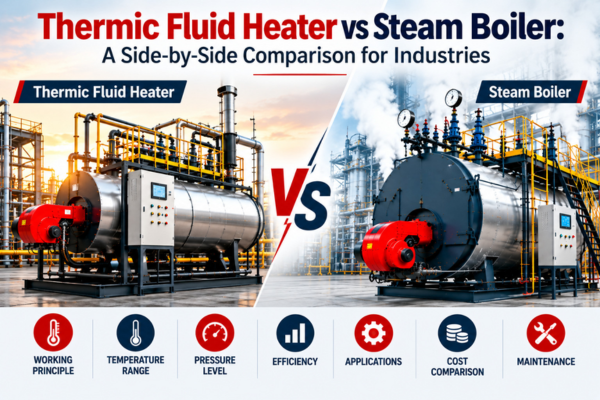
A thermic fluid heater circulates heated thermal oil through a closed loop to transfer heat to process equipment the heat carrier is oil, not steam. A steam boiler heats water to generate steam under pressure, which delivers heat by condensing at the process. A thermic fluid heater may suit processes requiring high-temperature indirect heating without using steam at the equivalent pressure; a steam boiler suits processes requiring steam directly (heating, sterilisation, humidification, stripping). Neither is universally better. The correct choice depends on the required temperature, whether steam is needed in the process, fuel, available utilities, safety requirements, and total cost of ownership over the planned operating life. Many industrial facilities use both systems for different applications within the same plant.
Selecting the right industrial heating system is one of the most consequential utility engineering decisions a manufacturing plant makes. The system chosen determines process temperature capability, energy cost, maintenance burden, statutory compliance obligations, and operational reliability for 15–20 years. And unlike many engineering decisions that can be reversed at moderate cost, a heating system installation is infrastructure: it shapes the plant's piping, electrical, and safety systems in ways that are expensive to change.
The two most widely used indirect industrial process heating technologies in India are the steam boiler and the thermic fluid heater. Both generate heat by combusting fuel, and both transfer that heat to process equipment through a distribution system but they differ fundamentally in the heat-carrying medium, operating principle, temperature and pressure characteristics, maintenance requirements, and the range of applications each serves well.
This guide provides a technically grounded, side-by-side comparison of thermic fluid heaters and steam boilers to help plant engineers, procurement managers, and production decision-makers evaluate which system or which combination suits their specific industrial process requirements.
A thermic fluid heater circulates heated thermal oil through a closed loop the oil absorbs heat from the burner and transfers it to process heat exchangers without generating steam or operating at high steam pressure. A steam boiler heats water to produce steam under pressure for process heating, sterilisation, and other steam-using applications. The right choice depends on whether the process requires steam directly, the required temperature range, available utilities, and total cost of ownership. Both technologies serve distinct industrial applications and are often used together within the same manufacturing facility.
A thermic fluid heater (also called a thermal oil heater, hot oil heater, or thermic fluid system) is an indirect heating system that heats a synthetic or mineral-based heat-transfer fluid (thermal oil) by combustion and circulates that heated fluid through a closed loop to deliver heat to process equipment. The thermal oil acts as the heat carrier between the heater and the process delivering heat through oil-to-process heat exchangers without phase change (the oil remains liquid throughout normal operation).
For a complete technical guide to thermic fluid heaters, including types, applications, and specification, see our complete thermic fluid heater guide and our thermic fluid heaters working and types guide.
An industrial steam boiler is a closed pressure vessel that uses fuel combustion (or another heat source) to heat water and generate steam under pressure for industrial process heating, sterilisation, power generation, and other steam-using applications. The steam acts as the heat carrier it travels through distribution pipework to the process, where it condenses and releases its latent heat. Condensate may be recovered and returned to the boiler feed system.
For a complete introduction to how steam boilers work, see our guide on what is a steam boiler and how does it work.
| Factor | Thermic Fluid Heater | Steam Boiler |
|---|---|---|
| Heat-transfer medium | Thermal oil (synthetic or mineral heat-transfer fluid) | Steam (water vapour under pressure) |
| Primary output | Hot oil at controlled temperature, circulated continuously | Steam at controlled pressure and temperature |
| Phase change in system? | No oil remains liquid throughout normal operation | Yes water converts to steam (phase change); condenses back at process |
| Heat delivery mechanism | Sensible heat transfer oil cools as it delivers heat to process | Primarily latent heat release steam condenses at near-constant temperature |
| Circulation | Forced circulation by pump continuous flow required | Pressure-driven steam flow to consumers; gravity-assisted condensate return |
| System pressure | Low system pressure relative to equivalent steam temperature but not atmospheric; system must be designed for operating conditions | System pressure set by operating temperature (saturation relationship) increases significantly with temperature |
| Key auxiliary system | Circulation pump, expansion tank, fluid monitoring | Feedwater treatment system, blowdown management, condensate recovery |
| Temperature control | Heater outlet temperature set point; process control valves regulate oil flow to each consumer | Steam pressure controls temperature; PRVs at each consumer reduce to required local pressure |
Quick Answer: The fundamental difference is the heat-transfer medium and the mechanism of heat delivery. A thermic fluid heater uses thermal oil circulated by a pump delivering sensible heat at controlled oil temperature without phase change. A steam boiler generates pressurised steam delivering primarily latent heat as the steam condenses at the process. Thermic fluid systems avoid the high steam pressure required at equivalent temperatures; steam systems deliver very high heat flux through condensation and suit direct steam applications (sterilisation, stripping, humidification).
| Parameter | Thermic Fluid Heater | Steam Boiler |
|---|---|---|
| Heat-transfer medium | Thermal oil (synthetic or mineral) | Steam / water |
| Process temperature capability | Typically up to 300–320°C for standard synthetic fluids; higher with specialist fluids (verify with fluid supplier) | Saturated steam temperature limited by pressure at 10 kg/cm², approximately 180°C; at 25 kg/cm², approximately 224°C; higher temperatures require higher pressure |
| System operating pressure | Typically 3–8 kg/cm² system pressure (pump head + thermal expansion pressure) much lower than equivalent steam pressure at the same temperature | Directly tied to required steam temperature cannot be decoupled from temperature |
| Pressure vessel requirements | Heater coil designed for system pressure; lower pressure than equivalent steam system; IBR does not typically apply to thermic fluid heaters (verify with applicable authority) | IBR-registered pressure vessel required for boilers above applicable thresholds; annual inspection; certificate of fitness |
| Water treatment | Not required for the thermal fluid circuit (no water); fluid condition monitoring required instead | Essential softening, deaeration, chemical dosing, blowdown management, TDS monitoring |
| Temperature stability at process | Oil temperature changes continuously across the heating circuit process temperature varies with oil flow and load | Condensing steam maintains near-constant temperature at a given pressure very stable process temperature |
| Direct product contact | Not suitable oil must never contact the product; indirect heating only | Direct steam injection possible for stripping, sterilisation, humidification where required |
| Maintenance fluid/water | Thermal fluid condition monitoring; periodic fluid sampling; eventual fluid replacement | Feedwater quality management; blowdown; scale and corrosion monitoring; water treatment consumables |
| Safety risk profile | Thermal oil leakage at high temperature fire risk if oil contacts ignition source; oil flashpoint and autoignition temperature are critical design parameters | High-pressure steam burn risk from steam leaks; risk of pressure vessel failure without safety devices and IBR compliance |
| Startup time | Longer system must heat from ambient to operating temperature gradually to avoid thermal shock and fluid degradation | Packaged fire tube boilers can raise steam in 30–60 minutes from cold; faster than thermic fluid in practice |
| Multiple temperature levels | Single oil supply temperature lower temperatures served by partial flow or mixing; complex multi-temperature systems require additional circuit design | Single boiler serves multiple pressure/temperature levels through PRV stations common and straightforward |
| Best suited for | High-temperature indirect heating (chemical reactors, rubber, textiles, wood panels, asphalt); processes >180°C without high-pressure steam | Process heating, sterilisation, food & dairy, textile dyeing, pharmaceutical, paper, co-generation; multi-pressure plants |
This is the most important engineering distinction between the two systems, and the one most commonly misunderstood in the equipment selection process.
In a steam system: temperature and pressure are inseparable the steam temperature is determined entirely by the system pressure (the saturation relationship). To heat a process to 250°C with steam, the steam supply must be at approximately 40 kg/cm² (approximately 3.9 MPa). This requires a high-pressure water tube boiler with demanding design, inspection, and safety requirements. Every 10°C increase in required process temperature above approximately 180°C represents a significant increase in required steam pressure and the associated engineering complexity.
In a thermic fluid system: the fluid temperature and the system pressure are largely independent. A thermal oil operating at 280°C may have a system pressure of only 5–7 kg/cm² determined primarily by the pump head and expansion tank height, not by the fluid's boiling point (which, for synthetic thermal oils, is typically above 300°C at atmospheric pressure). This decoupling of temperature from pressure is the primary practical advantage of thermic fluid heating for high-temperature applications.
Important: A thermic fluid heater is not a zero-pressure system. The piping, pumps, expansion tank, and all associated equipment must be designed and maintained for the actual operating pressure and temperature conditions. Thermal oil at high temperature and pressure is a combustible liquid leakage onto a hot surface or ignition source can cause fire. Correct design, installation, and regular inspection of the entire system are essential.
Comparing the thermal efficiency of a thermic fluid heater and a steam boiler requires careful definition of system boundaries and operating conditions. An equipment nameplate efficiency figure alone does not determine which system delivers more useful process heat per unit of fuel consumed.
| Efficiency Factor | Thermic Fluid Heater | Steam Boiler |
|---|---|---|
| Combustion efficiency | Depends on burner design, tuning, excess air, and fuel quality same principles as any fired heater | Same combustion efficiency is a function of burner and combustion system, not steam generation |
| Distribution losses | Oil distribution losses depend on insulation quality and pipe length oil cools in transit to process consumers | Steam distribution losses include pipe heat loss, steam trap failures, flash steam from condensate; can be significant in large plants |
| Blowdown losses | No blowdown closed oil circuit with no equivalent loss | Blowdown removes energy along with dissolved solids a real efficiency loss, reducible with automatic blowdown control and heat recovery |
| Condensate recovery | Not applicable closed oil circuit | Good condensate recovery significantly improves overall steam system efficiency hot condensate reduces feedwater heating energy requirement |
| Auxiliary energy | Continuous pumping energy for circulation pump(s) a real, ongoing electrical cost | Feedwater pumps; smaller pump energy than thermic fluid circulation in most cases |
| Heat recovery | Economiser on flue gas improves combustion efficiency; no condensate heat recovery (no condensate) | Economiser; condensate recovery; blowdown heat recovery multiple heat recovery opportunities in steam system |
| Standby losses | Circulation pump must run during standby to prevent thermal stratification; some heat loss from hot oil system when not delivering process heat | Boiler at steam pressure on standby loses heat through radiation and blowdown requirements |
| Overall system efficiency | Comparable to well-maintained steam system for indirect heating applications advantage primarily comes from avoiding steam system losses where condensate recovery is poor | Comparable to thermic fluid system with good condensate recovery and blowdown management multiple heat recovery opportunities available |
| Industry / Process | Typical Heating Requirement | System Often Considered | Key Consideration |
|---|---|---|---|
| Chemical processing reactor jacket heating | 150–280°C indirect heating; wide temperature range control | Thermic fluid heater (above ~180°C); steam boiler (below ~180°C) | Temperature range and whether direct steam is needed in any part of the process |
| Textile stenter heating | 150–220°C air heating for fabric drying and setting | Thermic fluid heater or steam (depending on stenter design) | Many textile plants use thermic fluid; some use steam-to-air heat exchangers |
| Rubber processing vulcanisation | 150–200°C indirect mould or platen heating | Thermic fluid heater or steam | Temperature uniformity critical; both technologies used in Indian rubber industry |
| Edible oil deodorisation and refining | 200–260°C indirect heating of deodoriser | Thermic fluid heater (standard for this application) | High temperature without high-pressure steam is the primary advantage |
| Plywood / MDF manufacturing | 150–200°C press platen heating | Thermic fluid heater (widely used) | Uniform platen temperature critical for panel quality |
| Asphalt / bitumen storage and processing | 150–220°C tank coil and jacketed pipe heating | Thermic fluid heater (standard) | Bitumen must be kept fluid thermic fluid maintains consistent coil temperature |
| Food processing sterilisation | 120–140°C steam for autoclave or retort sterilisation | Steam boiler | Direct steam required for sterilisation thermic fluid cannot substitute |
| Dairy processing | Steam for pasteurisation, CIP, sterilisation, HTST | Steam boiler | Food-grade steam quality; condensate management for hygiene |
| Pharmaceutical sterilisation | Pure/clean steam for autoclave, SIP of sterile lines | Steam boiler + clean/pure steam generator | Pharmaceutical GMP steam quality thermic fluid cannot substitute for sterilisation |
| Paper and pulp | Steam for drying cylinders, digester heating | Steam boiler | Large steam quantities; condensate recovery important for efficiency |
| Distillery | Steam for distillation, cooking, lees evaporation | Steam boiler | Steam for distillation columns; large, fluctuating demand |
| Maintenance Area | Thermic Fluid Heater | Steam Boiler |
|---|---|---|
| Fluid / water management | Annual thermal fluid sampling (viscosity, flash point, acid number, degradation products); fluid top-up; eventual fluid replacement and safe disposal | Daily water quality testing (pH, TDS, hardness, O₂); weekly blowdown; chemical dosing; softener regeneration |
| Heat-transfer surfaces | Heater coil inspection during shutdown; fouling (coke/carbon) from fluid overheating; coil cleaning | Annual internal inspection; tube descaling (chemical or mechanical); soot cleaning on fireside |
| Pumps and circulation | Continuous monitoring; pump seal leakage is safety-critical (hot oil leak = fire risk); standby pump readiness | Feedwater pump maintenance; steam trap survey and maintenance; condensate pump checks |
| Burner maintenance | Annual burner overhaul; combustion analysis; nozzle inspection (oil); gas train service (gas) | Annual burner overhaul; combustion analysis; nozzle, electrode, and scanner inspection |
| Safety instrumentation | High-temperature cutout; low-flow cutout; over-temperature protection on fluid; flame safeguard; pressure relief where required | Two safety valves (weekly easing, annual bench test); low-water cutout (weekly test); pressure gauge calibration; IBR annual inspection |
| Statutory inspection | IBR does not typically apply to thermic fluid heaters but factory inspectorate safety requirements and manufacturer inspection schedules apply; verify with applicable authorities | Annual IBR inspection by authorised inspector; certificate of fitness renewal; statutory requirement under Indian Boilers Act |
| Primary safety risk | Hot oil leakage from pump seals, pipe joints, heat exchanger connections potential fire; fluid degradation leading to coking in heater coil | Steam burns from leaks; pressure vessel risk if safety devices fail; low-water condition leading to tube damage |
Par Techno-Heat Pvt. Ltd. (Par Boiler) manufactures industrial steam boilers and thermic fluid heaters from its facility in Sanand, Ahmedabad, Gujarat. The company's product range covers the most common process heating configurations required by Indian manufacturing industries: gas and oil-fired packaged fire tube steam boilers for moderate-temperature process heating, sterilisation, and utility applications; biomass and solid-fuel-fired water tube steam boilers for larger utility loads; thermic fluid heaters for high-temperature indirect process heating in chemical, textile, rubber, plywood, and edible oil industries; and waste heat recovery steam generators for industries with recoverable thermal energy in process exhaust streams.
Many chemical plants, textile manufacturers, and process industries require both a steam boiler and a thermic fluid heater the steam boiler for utility steam and lower-temperature heating, the thermic fluid heater for high-temperature process applications above 180–200°C. Par Boiler's ability to supply both from a single engineering team and single service organisation simplifies project execution and post-commissioning support. For detailed guidance on thermic fluid heater types and applications, see our thermic fluid heaters guide. For steam boiler selection, see our boiler manufacturer selection checklist.
Contact Par Techno-Heat Pvt. Ltd. to discuss your process heating requirements, required temperature and pressure, fuel options, plant layout, and whether a thermic fluid heater, steam boiler, or both best suit your application. Our engineering team can help evaluate the right system configuration for your specific industrial process.
Contact Par Boiler Heating System EnquiryA thermic fluid heater circulates heated thermal oil through a closed loop to deliver indirect heat to process equipment the heat carrier is oil, not water or steam. A steam boiler heats water to generate pressurised steam for process heating, sterilisation, and other steam-requiring applications. The fundamental difference is the heat-transfer medium (thermal oil vs steam), the mechanism of heat delivery (sensible heat from cooling oil vs latent heat from condensing steam), and the pressure required to achieve a given process temperature.
Neither is universally better. A thermic fluid heater is better suited when high-temperature indirect heating is needed without high-pressure steam infrastructure. A steam boiler is better suited when the process requires steam directly for sterilisation, stripping, humidification, or heating at moderate temperatures. Many industrial plants use both: a steam boiler for utility and lower-temperature applications, a thermic fluid heater for high-temperature process heating. The correct selection requires engineering analysis of the specific process.
Overall system efficiency depends on combustion design, distribution losses, heat recovery, and maintenance for both systems. A thermic fluid heater has no blowdown loss and no steam trap losses, but has continuous pumping energy cost and circulation losses. A well-maintained steam boiler with good condensate recovery can be comparably efficient. Compare total fuel input to useful process heat delivered under equivalent conditions, for the specific application rather than comparing nameplate efficiencies.
Fuel burns in the combustion chamber, heating flue gas. The flue gas passes over a coil or tube arrangement through which thermal oil circulates. Heat transfers from the flue gas through the coil wall into the oil. A circulation pump moves the heated oil through insulated pipework to process heat exchangers, where the oil transfers heat to the process. The cooled oil returns to the heater to be reheated in a continuous closed loop. Temperature is controlled by adjusting the burner firing rate.
A fuel burner fires in the combustion chamber. In a fire tube boiler, hot combustion gases pass through tubes submerged in water, heating it from the fireside. In a water tube boiler, water flows inside tubes with combustion gases outside. As water reaches boiling temperature at the operating pressure, it converts to steam. Steam accumulates in the steam space, exits through the main stop valve, and flows through distribution pipework to process equipment, where it condenses and releases latent heat. Condensate may be returned to the feedwater system.
Thermic fluid heaters are primarily used where high-temperature indirect heating is required: rubber vulcanisation (mould and platen heating), textile stenter heating (air heating for fabric finishing), plywood and MDF press heating, edible oil deodorisation and refining, chemical reactor jacket heating (above ~180°C), asphalt and bitumen storage and processing, dye and chemical intermediate manufacturing, and industrial drying systems requiring controlled high-temperature air. They are used where steam at the equivalent temperature would require very high pressure.
Steam boilers are used across virtually all manufacturing industries: food processing (cooking, sterilisation, CIP), dairy (pasteurisation, HTST), pharmaceutical (sterilisation, SIP, process heating), textile (dyeing, sizing), paper and pulp (drying, digester heating), chemical processing (reactor heating, distillation, evaporation), distilleries (distillation, cooking), sugar mills (evaporation, crystallisation), packaging, and general manufacturing. Steam is the dominant process heating medium in industries where direct steam contact is beneficial or where multiple heating applications are served from one boiler.
Yes providing high-temperature indirect heating at relatively low system pressure is the primary design advantage of a thermic fluid heater. Standard synthetic heat-transfer fluids can operate up to approximately 300–320°C at system pressures of 5–8 kg/cm² (verify with the fluid manufacturer's published specification for the specific fluid). Specialist high-temperature fluids extend this range further. Equivalent steam temperatures would require very high pressures making the thermic fluid heater the more practical solution for high-temperature processes that do not require steam directly.
Yes a thermic fluid heater system operates under pressure. While the system pressure is much lower than equivalent steam pressure at the same temperature, the piping, pump, expansion tank, and all connected equipment must be designed for the operating pressure and temperature conditions. Thermal oil at 250–300°C and 5–7 kg/cm² system pressure is a hot combustible liquid under pressure. Correct system design, material selection, leak management, and safety instrumentation are essential a thermic fluid heater is not a zero-pressure atmospheric system.
Steam boiler operating pressure is determined by the highest process temperature requirement because steam temperature and pressure are directly linked by the saturation relationship. A process requiring 180°C needs approximately 10 kg/cm² steam pressure; 220°C needs approximately 24 kg/cm²; 260°C requires approximately 47 kg/cm². The boiler header pressure must be above the highest-pressure process requirement plus distribution losses. Lower-pressure processes are served through pressure-reducing valves. This temperature-pressure coupling is the primary reason thermic fluid heating is preferred for high-temperature applications.
Main thermic fluid heater operating costs: fuel consumption (dominant 60–75% of total lifecycle cost, same as any fired heater); circulation pump electricity (continuous); thermal fluid condition monitoring and periodic fluid sampling; eventual fluid replacement and disposal (significant cost); burner maintenance; and pipe joint and seal inspection and repair. Fluid degradation from overheating (operating above maximum film temperature) accelerates replacement intervals and increases cost. Correct heater design, operation within design limits, and annual fluid sampling are the primary cost-management tools.
Main steam boiler operating costs: fuel consumption (dominant); water treatment chemicals; makeup water (where condensate recovery is incomplete); blowdown heat loss; electricity for feedwater pumps; routine maintenance and burner overhaul; IBR annual inspection; steam trap maintenance (failed-open traps waste live steam continuously); and periodic tube descaling. Fuel cost and condensate recovery are the two highest-impact operating cost factors improving condensate recovery and maintaining good combustion efficiency typically deliver the greatest ongoing cost savings.
Not necessarily. While thermic fluid systems avoid the boiler feedwater treatment system and IBR pressure vessel compliance costs, they add circulation pumps, an expansion tank, and a longer oil piping network with high-temperature joints and insulation. The relative cost depends on capacity, temperature, number of consumers, site layout, and fuel system. A small system may be comparable in capital cost to an equivalent steam system; larger or more complex systems require site-specific comparison. Always compare total installed cost for the specific application, not generic cost benchmarks.
Both require structured maintenance the type differs more than the total burden. A thermic fluid heater requires: annual fluid sampling and condition assessment; pump seal inspection (leak = fire risk); coil inspection for coking; and eventual fluid replacement. A steam boiler requires: daily water quality testing; blowdown management; annual IBR inspection; safety valve testing; tube condition monitoring; and steam trap maintenance. In plants with extensive steam distribution, steam trap management is a significant ongoing maintenance task. Thermic fluid pump seal maintenance is more safety-critical than most steam boiler routine maintenance tasks.
Key maintenance tasks for a thermic fluid heater: annual thermal fluid sampling for viscosity, flash point, acid number, and degradation products; heater coil inspection during annual shutdown for coke deposits; circulation pump mechanical seal inspection and replacement (leakage is a fire risk); expansion tank level and condition check; insulation inspection on distribution pipework and process heat exchangers; burner annual overhaul; combustion analysis and retuning; temperature and flow control calibration; and all pipe joints and valve packing inspection for leakage. Frequency should follow the manufacturer's maintenance schedule and applicable factory safety requirements.
Water treatment is the foundation of steam boiler reliability and efficiency. Untreated water causes: calcium and magnesium scale on heat exchange surfaces (scale insulates tubes, raising metal temperature, increasing fuel consumption, and eventually causing tube failure); dissolved oxygen pitting corrosion (deep pits that penetrate tube wall and cause leakage); and carry-over of dissolved solids into the steam (affecting steam quality and process equipment). Scale and corrosion cause the majority of tube failures in industrial boilers. Correct water treatment prevents both, protecting the boiler and maintaining efficiency throughout its service life.
The primary safety risk of a thermic fluid heater is hot oil leakage. Thermal oil at operating temperature (250–320°C) is a combustible liquid with a flashpoint well above ambient temperature but a leak onto a hot surface, spark, or ignition source can ignite. Key risk control measures: correct pipe joint design and regular leak inspection; pump mechanical seal monitoring; emergency shutdown on low circulation flow (preventing coil overheating); expansion tank venting arrangements; and fire detection in the heater room. Thermal fluid must be selected with an appropriate autoignition temperature and flashpoint for the operating conditions.
Choose a steam boiler when: the process requires steam directly (sterilisation, SIP, CIP, stripping, humidification, direct injection); multiple processes at different temperatures are served through PRV stations from one boiler; operating temperatures are below 180°C where steam at moderate pressure is practical; the industry already has steam distribution infrastructure; condensate recovery is practical and will improve efficiency; or co-generation of steam and electricity is under evaluation. Steam boilers are the standard for food, dairy, pharmaceutical, paper, distillery, and many chemical industry utility applications.
Choose a thermic fluid heater when: the process requires temperatures above 180–200°C and using high-pressure steam at the equivalent temperature would create unacceptable system complexity or risk; steam is not required directly in any part of the process; indirect heating only is needed; the plant is in an industry where thermic fluid heating is standard (rubber, plywood, textile finishing, edible oil refining, asphalt); or simplifying the utility system by avoiding boiler water treatment, blowdown management, and IBR pressure vessel compliance is a commercial priority. Engineering analysis of the specific process is essential.
Yes many industrial plants use both systems simultaneously for different applications. A textile plant may use a thermic fluid heater for stenter heating (requiring 180–200°C oil) and a steam boiler for dyeing vats, humidification, and fabric steaming. A chemical plant may use a thermic fluid heater for high-temperature reactor heating and a steam boiler for utility steam, sterilisation, and lower-temperature heat exchangers. The two systems complement each other each serving the applications it suits best. Par Boiler supplies both systems and can design the combined utility layout for plants requiring both.
Thermal fluid degrades over time through oxidation (if air contacts the hot fluid), thermal cracking (if film temperature exceeds specification), and contamination. Degraded fluid shows: increasing viscosity and acid number; decreasing flash point (indicating light-fraction cracking products that increase fire risk); and deposits (coke and sludge) that foul heat exchange surfaces. Annual fluid sampling confirms the rate of degradation. Fluid replacement cost varies with system volume and fluid type. Operating within design temperature limits and maintaining nitrogen blanket or proper expansion tank venting significantly extends fluid service life.
Industrial steam boiler efficiency is determined by: combustion air-fuel ratio (excess air level the most adjustable factor); heat exchange surface cleanliness (scale waterside, soot fireside); flue gas exit temperature; feedwater inlet temperature; condensate recovery (higher condensate return = less energy to heat cold makeup water); blowdown rate and heat recovery; insulation quality on the boiler and distribution system; load profile relative to rated capacity (part-load efficiency decreases); and steam trap condition. Monthly combustion analysis and systematic steam trap maintenance are the highest-impact routine efficiency actions.
Compare both systems on the same basis: cost per unit of useful process heat delivered (kcal or kJ of heat actually transferred to the process per rupee of total energy cost fuel plus electricity). This requires: measured fuel consumption at the same process heat output; measured auxiliary electricity; a consistent system boundary (from fuel meter to process heat exchanger); and equivalent operating conditions (same load, same ambient temperature). Do not compare nameplate efficiency figures from different system configurations or operating conditions they are not comparable without detailed engineering analysis.
Define first: required process temperature (this alone often determines the choice above ~180°C, thermic fluid; below ~180°C, either); whether steam is needed directly in any process; fuel availability and cost at your site; existing utility infrastructure (existing steam or thermic fluid circuit?); space and layout constraints; budget for capital and operating cost; and maintenance capability. Then compare new thermic fluid heater vs steam boiler (or both) on total cost of ownership for your specific application. Engage a qualified heating system engineer rather than relying on supplier recommendations alone.
Need Help Choosing? Par Techno-Heat Pvt. Ltd. manufactures both thermic fluid heaters and industrial steam boilers and can help evaluate which system, or which combination, suits your specific process requirements, temperature, fuel, and operating conditions. Contact Par Boiler for a technical consultation.
