


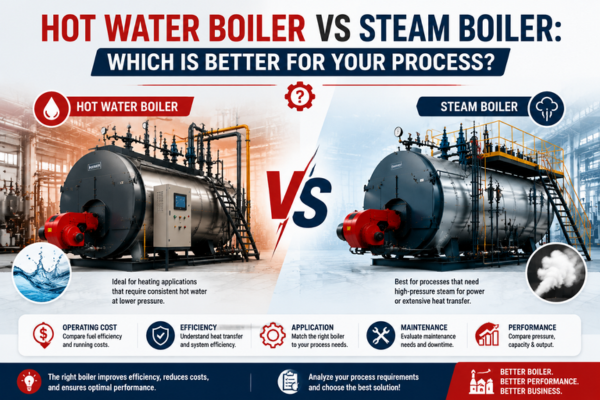
Which is better, a hot water boiler or a steam boiler, depends entirely on what your process needs. A hot water boiler heats water in a closed loop and circulates it as a liquid, typically at lower pressure, suited to space heating, process washing, and heat-exchanger-based applications. A steam boiler converts water into steam, carrying latent heat that can travel further and deliver higher-temperature heat, suited to sterilization, drying, and processes with equipment specifically designed for steam. Steam systems need condensate return and pressure management; hot water systems need circulation pumps and expansion control. Neither is inherently more efficient actual efficiency depends on distribution losses, insulation, controls, and how well the system matches the process duty. The correct choice comes from matching boiler type to your actual temperature, pressure, and equipment requirements.
A steam boiler is generally the right fit when a process needs steam itself, latent heat, or higher-temperature heating sterilization, drying, or steam-driven equipment. A hot water boiler is generally the right fit for closed-loop hot water heating, process washing, and heat-exchanger-based applications running at lower pressure. The correct choice depends on your process temperature, pressure, existing equipment design, and operating pattern not a fixed rule that applies to every plant.
A plant engineer specifying a new heating system rarely starts with "which boiler type is better." They start with a process problem a dryer that needs consistent heat, a reactor that needs precise temperature control, a CIP system that needs hot water on demand. The boiler type that solves that problem correctly is the right answer, and it's usually not the same answer for every plant.
This guide compares hot water boilers and steam boilers across the factors that actually determine the right choice: heat transfer method, operating pressure and temperature, distribution requirements, efficiency considerations, cost, safety, and maintenance. It also covers how the decision plays out differently across textile, food, pharmaceutical, chemical, dairy, and paper industries because the right answer genuinely does depend on the process.
A hot water boiler is a heating system that heats water and circulates it as a liquid through a closed loop, delivering heat to process equipment or space heating systems via heat exchangers, without converting the water into steam. It's typically used where the process needs moderate, controllable heat rather than the higher temperatures and latent heat steam provides.
Inside a hot water boiler, a burner or heating element transfers heat to water contained within the vessel or flowing through tubes, raising its temperature without allowing it to boil under normal operating pressure. A circulation pump moves this heated water through a closed piping loop to heat exchangers, radiators, or process equipment, where it gives up heat and returns to the boiler at a lower temperature for reheating. Because the system is closed, water loss is minimal and the same water circulates continuously, unlike an open steam distribution network. Our complete hot water boiler guide covers the design and application detail in full.
Hot water boilers are common in space heating, industrial washing systems, process hot water supply, and any application where a heat exchanger transfers heat from the circulating water to the process without direct contact.
A steam boiler is a closed pressure vessel that heats water past its boiling point to generate steam, which is distributed through piping to deliver heat, drive process equipment, or supply direct process steam. Steam carries latent heat energy released when it condenses which lets it deliver more heat per unit mass than hot water at a comparable temperature.
Feedwater enters the boiler and is heated by combustion or another heat source until it converts to steam at the design pressure. This steam travels through distribution piping to the point of use, where it either transfers heat through a heat exchanger, drives equipment, or contacts the process directly, depending on the application. As steam gives up its latent heat, it condenses back into water this condensate is typically returned to the boiler as preheated feedwater, improving overall fuel efficiency when the return system is well designed. Steam boilers operate at higher pressure than hot water systems for equivalent temperature, because generating steam requires overcoming atmospheric pressure at the boiling point. Our detailed guide on how a steam boiler works and its types covers the complete working principle.
Steam boilers serve textile processing, food sterilization, pharmaceutical autoclaving, chemical reactor heating, and any application where equipment is specifically designed around steam as the heating medium.
| Comparison Factor | Hot Water Boiler | Steam Boiler |
|---|---|---|
| Heating Medium | Liquid water, circulated continuously | Steam, generated and distributed as vapor |
| Heat Transfer | Sensible heat via circulating hot water | Latent heat released on condensation |
| Typical Pressure Range | Low to moderate, closed-loop pressure | Higher, corresponding to saturation pressure of steam at required temperature |
| Process Application | Space heating, process washing, heat-exchanger duty | Sterilization, drying, direct process steam, steam-driven equipment |
| Heat Delivery | Continuous circulation loop | Distributed through piping, condenses at point of use |
| Distribution | Closed loop, pump-driven | Pressure-driven, often open at point of use |
| Condensate Requirement | Not applicable water stays liquid | Condensate return system needed for efficiency |
| Expansion System | Expansion tank to accommodate thermal expansion | Steam drum manages phase change and steam space |
| Controls | Temperature and flow-based control | Pressure and water-level based control |
| Water Treatment | Required, but lower makeup water volume in closed systems | Required, with ongoing makeup water and blowdown considerations |
| Maintenance | Pump, expansion tank, and circuit-focused | Steam drum, condensate system, and pressure-part focused |
| Safety Requirements | Temperature and pressure protection at lower stored energy | Pressure vessel safety systems at higher stored energy |
| Installation Complexity | Generally simpler closed-loop piping | Steam distribution and condensate return add complexity |
| Typical Industries | HVAC, process washing, some food and dairy applications | Textile, pharma, chemical, food sterilization, paper |
| Best Suited For | Closed-loop heating and heat-exchanger duty | Direct steam use and higher-temperature process heating |
Not every plant in these industries relies solely on steam many operations combine steam and hot water systems depending on the specific process step involved.
Neither system is inherently more efficient. Boiler efficiency and system efficiency are different things a hot water system may have lower distribution losses due to its closed loop, while a steam system with well-designed condensate recovery can also achieve strong overall efficiency. The determining factors are insulation, controls, part-load operation, and how well the system matches actual process duty, not the heating medium itself.
A hot water system's closed loop generally means fewer opportunities for heat loss through open venting or steam leaks, and no condensate to manage. A steam system without a good condensate return loses both heat and treated water continuously but the same steam system with an effective condensate return can recover a substantial share of that heat as feedwater preheat. Fuel type, insulation quality, and how closely the boiler's capacity matches actual demand avoiding excessive cycling or oversized part-load operation affect both system types roughly equally. Comparing efficiency meaningfully requires evaluating the complete system, not just the boiler nameplate rating. Our guide on how to improve boiler efficiency covers the specific measures that apply to both.
| Cost Factor | Hot Water Boiler | Steam Boiler |
|---|---|---|
| Initial Capital Cost | Generally lower for equivalent heat output | Generally higher due to pressure vessel design |
| Installation & Piping | Closed-loop piping, simpler layout | Steam distribution and condensate return piping add cost |
| Pumps | Circulation pump required | Feedwater and condensate pumps required |
| Controls | Temperature-based control system | Pressure and level control, generally more complex |
| Water Treatment | Lower ongoing makeup water treatment need | Ongoing treatment for makeup water and blowdown |
| Condensate System | Not applicable | Additional capital and maintenance cost |
| Fuel Consumption | Depends on load profile and insulation | Depends on load profile, insulation, and condensate recovery |
| Maintenance & Spares | Pump and circuit-focused, generally lower complexity | Pressure-part and safety-system focused, generally higher complexity |
| Lifecycle Cost | Depends on load profile and system design | Depends on load profile, condensate recovery, and system design |
Actual project costs vary substantially by capacity, fuel type, operating pressure, material selection, automation level, and site-specific conditions. Neither system has a fixed price advantage request a specification-based quotation rather than relying on general cost assumptions.
Both systems are pressure equipment requiring proper design, safety devices, and operator training. A steam boiler generally stores more thermal energy at higher pressure than a comparable hot water system, which is why steam boilers above defined thresholds fall under statutory regulation in India requiring design approval, inspection, and registration. Both system types require correctly rated safety valves, functioning water level or pressure controls, and regular inspection.
Regardless of boiler type, operators should follow manufacturer instructions, site safety procedures, and applicable Indian regulations without exception. Our boiler maintenance checklist covers the inspection routines that support safe operation for both boiler types, and any signs of abnormal operation should prompt immediate professional assessment see our guide on warning signs an industrial boiler needs repair.
| Maintenance Area | Hot Water Boiler | Steam Boiler |
|---|---|---|
| Water Quality | Monitor closed-loop chemistry, lower makeup volume | Monitor feedwater and boiler water chemistry continuously |
| Scale & Corrosion | Lower risk due to closed system, still requires monitoring | Higher risk from continuous makeup water; requires active control |
| Pumps | Circulation pump inspection and servicing | Feedwater and condensate pump inspection |
| Burner | Regular combustion inspection and tuning | Regular combustion inspection and tuning |
| Valves & Controls | Temperature control and relief valve checks | Pressure control, safety valve, and level control checks |
| Heat Exchanger | Periodic inspection for fouling | Periodic inspection at point-of-use heat exchangers |
| Piping | Closed-loop piping inspection for leaks | Steam and condensate piping inspection, including trap function |
| Condensate System | Not applicable | Steam trap and condensate pump maintenance required |
| Blowdown | Generally minimal in closed systems | Regular blowdown required to manage dissolved solids |
| Insulation | Periodic inspection to limit heat loss | Periodic inspection to limit heat loss along distribution piping |
Exact maintenance intervals depend on the specific boiler design, manufacturer instructions, operating conditions, water quality, and applicable regulatory requirements follow the manufacturer's documented schedule rather than a generic interval.
A sound decision weighs fifteen factors together rather than any single one in isolation: required process temperature, required pressure, heat-transfer method your equipment is designed for, existing process equipment, whether the process needs steam specifically, heating load, operating hours, fuel availability, water treatment requirements, available installation space, safety requirements, maintenance capability, capital budget, lifecycle cost, and future expansion plans.
| If Your Process Requires... | Consider... | Why |
|---|---|---|
| Direct process steam | Steam boiler | Only steam can supply steam-contact processes directly |
| Steam-based process equipment | Steam boiler | Equipment is designed around steam's latent heat delivery |
| Closed-loop hot water heating | Hot water boiler | Simpler system matched exactly to the heating duty |
| Process heat through hot-water circulation | Hot water boiler | No benefit to generating steam if the process uses circulated hot water |
| Higher-temperature steam application | Steam boiler, where process design requires it | Steam reaches higher temperatures more practically than hot water at comparable pressure |
| Heat exchanger-based hot water process | Hot water boiler, where technically suitable | Matches the delivery method the process equipment expects |
These are starting points, not absolute rules a plant with mixed process requirements may reasonably operate both systems side by side, each serving the applications it fits best.
Textile processing dyeing, printing, finishing often relies on steam for its established equipment compatibility and higher-temperature capability in dye baths and drying stages. Hot water systems can serve auxiliary heating and washing needs within the same plant. Actual selection depends on the specific process equipment already installed or specified for the facility.
Food processing frequently uses steam for cooking, blanching, and sterilization where direct or near-direct heat contact and precise temperature are required. Hot water systems suit washing, cleaning, and some lower-temperature process steps. The right mix depends on the specific unit operations in the production line.
Chemical plants often need steam for reactor heating, distillation, and processes requiring precise, higher-temperature control, particularly where existing process equipment is steam-jacketed. Hot water systems may serve auxiliary heating or lower-temperature process steps. Selection should follow the specific reactor and process equipment design rather than a general industry assumption.
Pharmaceutical facilities commonly require steam for sterilization and autoclave processes where saturated steam at controlled quality is specifically required by the process. Hot water systems can serve general facility heating and some process washing needs. The sterilization requirement usually dictates steam where it applies, but not every pharmaceutical heating need requires steam.
Dairy operations use steam for pasteurization and CIP (clean-in-place) systems where consistent, controllable heat is essential, while hot water boilers can serve general washing and lower-temperature process needs. The specific pasteurization and cleaning equipment installed determines which system the plant actually needs for each process step.
Paper manufacturing typically relies on steam for drying cylinders and the continuous high-volume process heat these operations demand. Hot water systems may support auxiliary facility heating. Given the scale and continuous nature of paper drying, steam is the more common choice for the core process, though this depends on the specific mill's equipment design.
Signs worth evaluating include the condition of your existing system, frequency of breakdowns, rising energy consumption relative to output, planned production expansion, process changes that alter heating requirements, outdated controls limiting efficiency or monitoring, safety concerns raised during inspection, escalating maintenance cost, and shrinking availability of spare parts for an older design. Rather than a fixed age threshold, the right time to evaluate a new system is when these factors, considered together, suggest the existing boiler's lifecycle economics are working against you.
Par Boiler designs and manufactures both steam boiler and hot water boiler systems for industrial applications, working from the specific process requirement rather than a fixed product recommendation. Boiler selection should always start with your process required capacity, operating pressure, temperature, fuel availability, and how the system will actually run day to day because the right configuration for one plant is rarely identical to another's, even within the same industry. Our team reviews these requirements as part of any technical discussion, alongside considerations like water treatment needs, installation space, and automation preferences, to help identify a boiler configuration matched to your application. For a broader view of manufacturers across India, see our roundup of top 10 boiler manufacturers in India, and our overview of what an industrial boiler is and how it works for foundational background.
Need help choosing the right industrial boiler for your process? Contact Par Boiler to discuss your heating requirements and identify a suitable boiler configuration.
A hot water boiler heats water in a closed loop and circulates it as a liquid, typically at lower pressure. A steam boiler converts water into steam, which carries latent heat and can be distributed at higher pressure and temperature to serve steam-specific processes.
Neither is universally better. The right choice depends on your process temperature and pressure requirement, whether your equipment is designed for steam or hot water, heat-transfer method, operating hours, and lifecycle cost considerations specific to your plant.
Use a steam boiler when your process requires direct steam contact, higher-temperature heating, latent heat delivery, or when existing process equipment is specifically designed around steam, such as sterilizers or steam-jacketed reactors.
Use a hot water boiler for closed-loop space heating, process washing, or heat-exchanger-based process heating where the process doesn't need steam directly and moderate, controllable temperature is sufficient.
Not inherently. Efficiency depends on the complete system insulation, controls, condensate recovery for steam, distribution losses, and how well capacity matches actual demand rather than the heating medium itself.
Hot water boilers are often lower in initial capital cost for equivalent heat output due to simpler pressure vessel design and no condensate system, but actual project cost depends on capacity, fuel, automation, and site conditions.
It depends on the specific process. Processes needing direct steam contact or higher temperatures generally favor steam boilers; processes using circulated hot water through heat exchangers generally favor hot water boilers.
Textile, food processing, pharmaceutical, chemical, and paper industries commonly use steam boilers, particularly where process equipment is specifically designed around steam's latent heat delivery.
Facilities needing space heating, process washing, or heat-exchanger-based process heating commonly use hot water boilers, often alongside steam systems for other process steps within the same plant.
Steam boilers deliver latent heat efficiently, suit higher-temperature applications, work with steam-specific equipment, distribute well over larger plant footprints, and can recover significant heat through condensate return.
Hot water boilers offer simpler closed-loop design, lower stored energy, no condensate system to maintain, lower ongoing water treatment demand, and are well suited to consistent moderate-temperature heating loads.
Steam boilers require more rigorous safety systems due to higher stored energy, need condensate return infrastructure, and generally involve higher ongoing water treatment demand than hot water systems.
Hot water boilers cannot supply direct steam for processes that require it, deliver less energy per unit mass than steam, and aren't compatible with steam-driven equipment or direct steam contact applications.
Consider process temperature and pressure requirements, heat-transfer method, existing process equipment, fuel availability, operating hours, water treatment needs, installation space, safety requirements, and total lifecycle cost.
Steam boilers generally involve more maintenance points due to condensate return systems, steam traps, and pressure-part inspection requirements, though exact maintenance burden depends on the specific design and operating conditions.
Both boiler types require water treatment to control scale, corrosion, and dissolved solids, though steam boilers typically need ongoing treatment for continuous makeup water, while closed-loop hot water systems need less frequent makeup water treatment.
Condensate recovery returns hot water from condensed steam back to the boiler as preheated feedwater, reducing the fuel needed to reheat fresh makeup water and improving overall system efficiency.
Only where the process doesn't specifically require steam. If existing equipment is designed for direct steam contact or steam-driven operation, a hot water boiler generally cannot substitute without significant process equipment changes.
Yes, steam can be used to heat water indirectly through a heat exchanger, though this adds complexity and cost compared to using a dedicated hot water boiler for a purely hot-water application.
Boiler capacity is determined by calculating the actual heat demand of your process including peak load, operating schedule, and any anticipated future capacity typically as part of a proper engineering load study rather than a rule-of-thumb estimate.
Textile processing commonly uses steam boilers due to established equipment compatibility with dyeing and finishing processes, though hot water systems can serve auxiliary heating needs within the same facility.
Food processing often uses steam boilers for cooking and sterilization where direct heat and precise temperature are needed, with hot water boilers serving washing and lower-temperature process steps.
Pharmaceutical facilities typically need steam boilers for sterilization and autoclave processes requiring controlled saturated steam, while hot water boilers can serve general facility heating needs.
Improve insulation, maintain effective condensate recovery on steam systems, keep combustion tuned, address water treatment consistently to prevent scale, and match boiler capacity closely to actual load to avoid inefficient part-load operation.
Technical and regulatory claims in this article should be cross-checked against the Indian Boiler Regulations, Bureau of Indian Standards (BIS) publications, the relevant government boiler inspection authority for the state of installation, and applicable ASME standards where referenced. No specific citations, statistics, or regulatory limits have been asserted in this article as verified facts; where regulatory or technical specifics matter to your project, confirm them directly with the applicable authority or your equipment manufacturer.
Par Boiler works with plants across textile, food, pharmaceutical, chemical, dairy, and paper industries to identify the right heating configuration for their specific process.
A technical discussion covers your process temperature, pressure, and equipment requirements before any system is proposed.
