



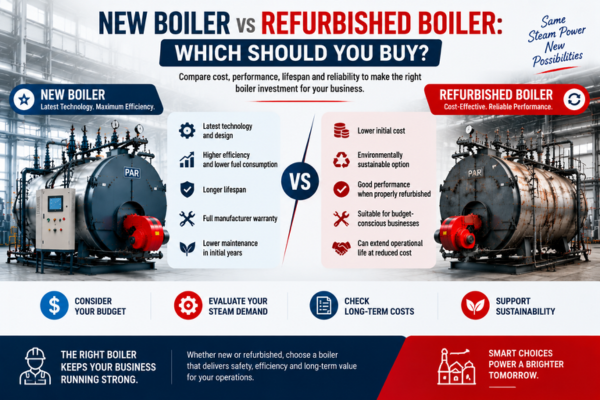
Choosing between a new and a refurbished industrial boiler comes down to weighing lower upfront cost against higher uncertainty. A new boiler comes with full manufacturer warranty, current design efficiency, complete documentation, and no unknown operating history, at a higher capital cost. A refurbished boiler an older unit inspected, repaired, and resold can significantly reduce upfront investment, but its remaining service life, actual internal condition, and certification status require careful verification, since a boiler's most critical wear (tube thinning, internal corrosion) isn't always visible externally. The right choice depends on your budget, timeline, risk tolerance, in-house inspection capability, and how confident you can be in the specific unit's documented history not a blanket rule favoring one option over the other.
Every plant manager facing a boiler replacement eventually runs into the same fork in the road: a new unit that costs more but comes with a clean slate, or a refurbished boiler that costs less but comes with someone else's operating history attached. Both are legitimate options the mistake is choosing between them based on price alone, without actually working through what "refurbished" means for the specific unit in front of you.
This guide walks through what a refurbished boiler actually is, how it compares to a new unit across cost, risk, warranty, and compliance, and gives you a practical framework for deciding which fits your plant's budget, timeline, and risk tolerance.
A new boiler suits buyers prioritizing warranty coverage, current efficiency design, and predictable long-term reliability, at higher upfront cost. A refurbished boiler suits buyers with a tighter capital budget or urgent timeline who can verify the specific unit's condition, documentation, and remaining service life through independent inspection before purchase.
A new industrial boiler is a unit fabricated and tested by the manufacturer specifically for your order, built to current design standards, supplied with full manufacturer warranty, complete technical documentation, and where applicable fresh IBR design approval and material certification with no prior operating history.
Because it's built to your specification, a new boiler can be sized precisely to your steam demand, pressure, and fuel requirement rather than adapted to fit an existing unit's configuration. Our overview of what an industrial boiler is and our guide on how a steam boiler works cover the fundamentals of what you're actually buying either way.
A refurbished industrial boiler is a previously used unit that has been inspected, cleaned, repaired, and had worn components replaced before resale, aiming to restore it to reliable working condition at a lower price than an equivalent new boiler. The scope of refurbishment varies significantly between suppliers from a basic inspection and cosmetic cleanup to a thorough overhaul including pressure part testing and control system replacement.
The term "refurbished" isn't standardized in the way "new" is one supplier's refurbishment might mean a full internal inspection, hydrostatic re-testing, and replacement of all wear components, while another's might mean a cleaning and a coat of paint. This is the single most important thing to clarify before evaluating price: what specifically was done, and what wasn't.
| Factor | New Boiler | Refurbished Boiler |
|---|---|---|
| Upfront Cost | Higher | Generally lower, varies by condition and scope of work done |
| Warranty | Full manufacturer warranty | Limited or supplier-specific, varies significantly |
| Operating History | None fresh unit | Unknown or partially known, depends on documentation available |
| Remaining Service Life | Full design life ahead | Reduced and less certain, depends on prior use and refurbishment scope |
| Design & Efficiency | Current design standards | Reflects the design era of the original unit |
| Documentation | Complete and current | Variable may be incomplete or unavailable |
| IBR/Certification Status | Fresh design approval and material certification | Requires verification; re-certification process depends on the unit and authority requirements |
| Lead Time | Manufacturing lead time applies | Often faster if a suitable unit is already available |
| Customization | Built to your exact specification | Limited to what's already available on the market |
| Risk Profile | Lower known build quality and condition | Higher depends heavily on inspection quality and refurbishment scope |
| Spare Parts | Current model, readily available | May be for an older or discontinued model |
CAPEX (capital expenditure) is typically lower for a refurbished boiler and higher for a new one, though the gap varies with the specific units being compared.
OPEX (operating expenditure) fuel consumption, maintenance frequency, and repair cost depends heavily on the actual condition and design efficiency of the unit rather than simply whether it's new or refurbished; an older refurbished boiler with lower design efficiency and more frequent component wear can carry meaningfully higher OPEX than its lower purchase price initially suggests.
Lifecycle cost CAPEX plus OPEX plus downtime cost over the boiler's remaining useful life is the only fair basis for comparison, and it requires an honest estimate of the refurbished unit's remaining service life, not just its purchase price. A refurbished boiler that needs major repair within two years may end up costing more than a new unit once total cost is tallied.
A new boiler's warranty is a manufacturer commitment backed by fresh fabrication and known build quality. A refurbished boiler's warranty terms vary enormously by supplier some offer meaningful coverage on the refurbishment work performed, others offer very limited or no warranty at all. Before purchasing any refurbished unit, get the warranty scope in writing: what exactly is covered, for how long, and whether it covers the boiler as a whole or only specific refurbished components. A vague verbal assurance of "good condition" is not a warranty.
A refurbished boiler's certification status must be independently verified do not assume a unit is currently IBR-registered, or that registration transfers automatically with a change of ownership or location. Re-certification requirements depend on the specific unit's condition, documentation, and the applicable state boiler inspection authority's process.
Before purchasing a refurbished boiler, request current inspection certificates, confirm whether IBR registration is active and transferable to your site and ownership, and clarify what re-inspection or re-registration steps will be needed once it's installed. Our boiler safety guidelines for industries guide covers the statutory framework that applies regardless of whether the unit is new or refurbished. This article does not provide legal advice confirm certification requirements directly with the relevant boiler inspection authority for your state before finalizing a purchase.
A new boiler is generally the stronger choice when your plant needs a long-term reliability guarantee, when your process can't tolerate unplanned downtime from an unknown-history unit, when you need a specific capacity or fuel configuration not readily available refurbished, when full warranty coverage matters for your risk management approach, or when your production timeline allows for standard manufacturing lead time.
A refurbished boiler may be worth evaluating when capital budget is genuinely constrained, when you need an interim solution while a new unit is being manufactured, when a specific unit's documented condition and independent inspection results are strong, when the supplier offers a meaningful warranty backed in writing, and when your team has the technical capability to properly evaluate the unit's condition before committing or is willing to pay for an independent inspection to do so.
| If Your Situation Is... | Consider... | Why |
|---|---|---|
| Long-term core process boiler | New | Full service life and warranty matter more for critical, continuous equipment. |
| Tight capital budget, some risk tolerance | Refurbished, with independent inspection | Can reduce upfront cost if the specific unit checks out. |
| Urgent temporary/interim need | Refurbished (if available) or mobile/rental steam | Availability often beats lead time for short-term bridging. |
| Specific custom capacity/fuel requirement | New | Built exactly to your specification rather than adapted. |
| No in-house capability to inspect used equipment | New, or refurbished only with paid independent inspection | Reduces risk of missing a critical defect. |
| Strong documented refurbished unit with real warranty | Refurbished may be reasonable | Verified condition and backed warranty reduce the main risks. |
Par Boiler manufactures new industrial boilers built to your specific steam capacity, pressure, and fuel requirement, with full IBR-related documentation and manufacturer warranty. Whether you're weighing a new boiler against a refurbished option, or deciding between repair and replacement for an existing unit, the right answer depends on your specific budget, timeline, and risk tolerance — not a fixed rule. For related guidance, our boiler maintenance checklist and our article on warning signs your boiler needs repair cover the questions worth asking before deciding whether your existing unit is worth keeping at all.
Weighing a new boiler against a refurbished one? Contact Par Boiler to discuss your capacity, pressure, and fuel requirement, and get a specification-based comparison.
Neither is universally better. A new boiler offers full warranty, current design, and no unknown history at higher cost. A refurbished boiler can lower cost but requires careful verification of condition, documentation, and remaining service life.
It typically means a previously used boiler that's been inspected, cleaned, and had some worn components repaired or replaced before resale, but the exact scope of work varies significantly between suppliers, so it should always be confirmed in detail.
A refurbished boiler can potentially be registered or re-certified under the Indian Boiler Regulations, but this depends on the unit's condition, available documentation, and applicable requirements — confirm directly with the relevant boiler inspection authority.
The price difference varies significantly based on the specific units, capacity, condition, and refurbishment scope involved there's no fixed percentage discount that applies universally.
Check wall thickness on pressure parts, internal tube and shell condition, current certification status, available documentation, warranty terms in writing, and spare parts availability, ideally through an independent inspection rather than relying on the seller's assessment alone.
Warranty coverage varies significantly by supplier some offer meaningful coverage on refurbishment work performed, others offer very limited or no warranty. Always get warranty terms in writing before purchasing.
Remaining service life depends heavily on the unit's age, prior operating conditions, and the actual scope of refurbishment performed it cannot be assumed to match a new boiler's full design life without specific verification.
Generally yes, because its actual condition, remaining component life, and documentation completeness are less certain than a new unit's though thorough independent inspection can meaningfully reduce this risk for a specific unit.
Total cost of ownership combines purchase price, expected fuel efficiency, maintenance frequency, and downtime risk over the boiler's remaining life a cheaper refurbished unit can end up costing more overall if it requires early major repairs.
For processes where downtime is especially costly, a new boiler's full warranty and known condition generally reduce risk more than a refurbished unit would, though a well-documented, thoroughly inspected refurbished unit with strong warranty backing may still be worth evaluating.
Sometimes. If the refurbished unit is an older or discontinued model, spare parts availability may be more limited than for a current production model confirm this before purchase.
In many cases yes warranty scope and duration on refurbished equipment is often negotiable with the supplier, which is why getting specific terms in writing before purchase matters.
Look for original manufacture records where available, refurbishment work records, inspection and testing results, current certification status, and written warranty terms incomplete documentation is a genuine risk factor, not just an inconvenience.
Generally yes in terms of purchase price, though the gap varies by capacity and specification, and total lifecycle cost can sometimes favor a new boiler once efficiency and reliability differences are factored in.
Weigh your existing boiler's condition, repair frequency, and remaining service life against the cost and risk profile of both new and refurbished alternatives this decision benefits from a qualified boiler engineer's assessment rather than being made on cost alone.
Par Boiler manufactures new industrial boilers built to your specific capacity, pressure, and fuel requirement, with full documentation and manufacturer warranty.
A technical discussion covers your budget, timeline, and process requirements before any recommendation is made.
