


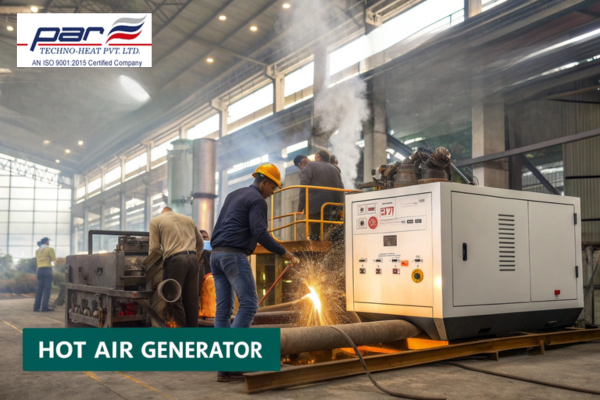
India's leading hot air generator manufacturers include Par Techno-Heat Pvt. Ltd., Thermax, Forbes Marshall, Heatmaster, and Maxon (Honeywell). These companies supply direct fired and indirect fired hot air generators for textile, food processing, pharmaceutical, ceramic, chemical, and agro-processing industries. Hot air generators produce a controlled stream of hot air from 60°C to 600°C+ using gas, diesel, oil, biomass, or multi-fuel configurations without the IBR compliance complexity of a steam boiler. When selecting a hot air generator manufacturer, evaluate heating capacity (kcal/hr), temperature range, fuel type, direct vs indirect fired design, thermal efficiency, and after-sales service capability.
Every experienced plant engineer knows that steam is the workhorse of industrial heating and for good reason. Steam carries enormous amounts of energy, distributes easily through pipework, and serves dozens of industrial process applications reliably.
But steam has a fundamental limitation that creates a real operational problem in certain industries: it adds moisture. For industries where the core process is drying removing moisture from a product rather than adding heat to it injecting steam into the process airstream is counterproductive.
A food processing plant dehydrating vegetables, a textile mill drying freshly dyed fabric, a pharmaceutical manufacturer drying granules, a ceramic manufacturer curing formed products all of these processes need hot, dry air. Not steam. This is precisely where an industrial hot air generator becomes the correct process heating solution, and why demand for hot air generator manufacturers in India has grown steadily across food, textile, pharma, chemical, and agro-processing sectors.
An industrial hot air generator is a heating system that burns fuel gas, oil, diesel, biomass, or solid fuel in a combustion chamber and transfers the resulting heat energy to an air stream delivered to the industrial process. Unlike a steam boiler, it produces hot air rather than steam, operating at atmospheric pressure without IBR certification requirements. Output is measured in kcal/hr and outlet air temperature, ranging from 60°C for gentle grain drying to 600°C+ for ceramic curing.
The working principle of a hot air generator is more straightforward than a steam boiler no pressure vessel, no phase change from water to steam, and no steam distribution complexity. The system is a controlled combustion system with an efficient heat transfer arrangement between combustion gases and the process air stream.
Step 1 — Fuel Supply and Burner Ignition: Fuel is supplied to the burner assembly at the front of the generator. A high-efficiency industrial burner produces a controlled, stable flame inside the combustion chamber. PLC-based burner management handles ignition, flame monitoring, temperature control, and safety shutdowns automatically.
Step 2 — Combustion and Heat Generation: Inside the refractory-lined combustion chamber, fuel burns completely at 800–1,200°C. The chamber geometry ensures complete, efficient combustion with minimal unburned fuel loss.
Step 3 — Heat Transfer to Process Air: This is where direct and indirect fired designs diverge. In a direct fired system, combustion gases mix directly with process air high efficiency but introduces combustion products. In an indirect fired system, combustion gases pass through a heat exchanger, keeping process air completely clean and combustion-free.
Step 4 — Temperature Control and Air Distribution: A thermocouple at the outlet feeds continuous temperature data to the PLC, which modulates burner firing rate to maintain setpoint temperature within ±2–5°C. A high-volume industrial blower delivers the heated air stream to the process equipment through insulated ductwork.
Step 5 — Exhaust Handling: In direct fired systems, combustion products exit with the process air stream. In indirect systems, exhaust exits through a separate flue and chimney. Biomass and solid fuel systems require dust collection equipment — cyclone separators and bag filters to meet CPCB emission norms.
For a complete technical reference on working principles and component specifications, see our detailed guide on what is a hot air generator working principle and uses.
Choose Direct Fired when air purity is not critical aggregate drying, mineral processing, brick kilns, space heating. Higher thermal efficiency (92–96%) and lower capital cost.
Choose Indirect Fired when process air contacts a food product, pharmaceutical material, or any product sensitive to combustion byproducts food drying, pharma fluid beds, textile stenters, spray drying. Clean, combustion-free air (82–88% efficiency).
| Parameter | Direct Fired HAG | Indirect Fired HAG |
|---|---|---|
| Air–Gas Contact | Yes mixed | No completely separated |
| Process Air Purity | Contains CO₂, moisture, combustion products | Clean, combustion-free |
| Thermal Efficiency | 92 – 96% | 82 – 88% |
| Capital Cost | Lower | Higher (heat exchanger added) |
| Max Outlet Temperature | 600°C+ | Up to 400°C (heat exchanger limit) |
| Maintenance | Simpler | Higher (heat exchanger cleaning) |
| Best Applications | Aggregates, minerals, brick kilns, space heating | Food, pharma, textile, spray drying |
For industries that already have a steam boiler and want to use steam as the heat source for air heating rather than adding a separate combustion system the correct solution is an indirect type hot air generator with steam, which uses steam as the heating medium through a steam-to-air heat exchanger without any combustion on the HAG unit itself.
| Generator Type | Fuel Used | Temp Range | Efficiency | Best For |
|---|---|---|---|---|
| Direct Fired | Gas, oil, diesel | 100°C – 600°C+ | 92 – 96% | Aggregates, minerals, kilns, space heating |
| Indirect Fired (Gas/Oil) | Natural gas, LPG, diesel, LDO | 60°C – 400°C | 82 – 88% | Food, pharma, textile, spray drying |
| Biomass Fired (Indirect) | Rice husk, wood chips, bagasse, briquettes | 80°C – 350°C | 78 – 84% | Textile stenter, agro-drying, ceramic pre-drying |
| Solid Fuel / Coal Fired | Coal, lignite | 150°C – 500°C | 75 – 82% | Brick kilns, ceramic, heavy mineral processing |
| Electric Hot Air Generator | Electricity | 50°C – 350°C | 95 – 99% | Laboratory, small pharma, clean room drying |
| Multi Fuel | Gas + biomass or gas + diesel | 80°C – 450°C | 80 – 90% | Plants wanting fuel flexibility and backup |
| High Temperature | Gas, oil, direct fired | 400°C – 1,000°C | 88 – 96% | Ceramic sintering, metal heat treatment |
| Fuel Type | Approx. Cost | Emission Level | Best Application | Key Advantage | Limitation |
|---|---|---|---|---|---|
| Natural Gas (PNG) | ₹40–55/m³ | Very Low | Food, pharma, textile | Clean, precise, no storage | Pipeline needed |
| LPG | ₹90–110/kg | Low | Pharma, food, remote locations | Clean, no pipeline needed | Higher running cost |
| Diesel / LDO | ₹80–95/litre | Medium | Where gas unavailable | Reliable, available everywhere | Highest running cost |
| Rice Husk / Agro-Waste | ₹1.5–3/kg (near source) | Low (managed) | Textile stenter, agro-drying | Very low fuel cost | Requires dust control, indirect only |
| Wood Chips / Briquettes | ₹3–6/kg | Low (managed) | Ceramic, textile, paper | Renewable, widely available | Ash handling required |
| Coal | ₹10–16/kg | High | Brick kilns, minerals | High temperature capability | High emission, direct fired only |
| Electricity | ₹5–9/kWh | Zero on-site | Lab, pharma clean room | Clean, precise, no combustion | Highest energy cost for large capacity |
This guide does not rank manufacturers by advertising spend or directory listings. Each company was evaluated on the criteria that actually determine whether a hot air generator performs as specified over its operating life: application engineering capability, fuel flexibility, thermal efficiency credentials, reference installations in specific industries, commissioning support quality, and after-sales service access.
Par Techno-Heat Pvt. Ltd. is one of the leading hot air generator manufacturers in India, designing and manufacturing direct and indirect fired hot air generators from its Ahmedabad facility for over 25 years. The company's HAG range covers capacities from 1 lakh kcal/hr to 50 lakh kcal/hr, across natural gas, LPG, diesel, LDO, and biomass fuel configurations, with PLC-based automation and precise temperature control standard on all systems.
What distinguishes Par Techno-Heat's hot air generator engineering from catalogue-based suppliers is the application engineering approach. Every system is sized around the customer's actual process air temperature requirement, volume flow rate, inlet air condition, and product sensitivity rather than the nearest standard catalogue unit. For a pharmaceutical fluid bed drier requiring clean air at 80°C ±2°C and for a textile stenter needing 200°C hot air across a 3-metre wide range, the engineering inputs and the resulting system design are fundamentally different, and Par Boiler's team handles both from in-house process design capability.
The company's HAG product range covers all major types: gas-fired indirect for food and pharma, biomass-fired indirect for textile and agro-processing, direct fired gas for high-temperature ceramic and mineral applications, and steam-indirect configurations for plants wanting to use an existing boiler as the heat source. All systems are supplied with commissioning support, operator training, and after-sales service through a national service network.
Best for: Gujarat and pan-India industries in textile, food, pharma, and ceramic sectors requiring custom-engineered HAG solutions with single-source supply from design through commissioning.
Capacity range: 1 lakh kcal/hr to 50 lakh kcal/hr
Fuels: Natural gas, LPG, diesel, LDO, biomass, steam-indirect
Looking for a hot air generator matched to your specific drying process? Par Techno-Heat's engineering team reviews your process air temperature, volume flow, and fuel access before recommending a system. Contact Par Techno-Heat Pvt. Ltd. for a free technical consultation.
Thermax manufactures industrial hot air generators as part of a comprehensive heating and energy engineering portfolio. Their HAG range serves large-scale drying applications in food processing, chemical, and mineral processing industries, with strong integration into broader plant energy management systems.
Best for: Large-scale process industries requiring HAG integrated with broader plant energy systems.
Forbes Marshall offers process heating solutions including hot air generation equipment for pharmaceutical, food, and textile industries, with particular depth in steam engineering and the integration of steam-heated indirect HAG systems into existing steam infrastructure.
Best for: Pharmaceutical and food industries with existing steam infrastructure wanting steam-indirect HAG integration.
Heatmaster specialises in industrial hot air generators and drying system equipment for food processing, agro-processing, and textile applications. Their product range is focused on direct and indirect fired designs for medium capacity drying applications across India's agricultural processing sector.
Best for: Agro-processing, food drying, and medium-capacity textile drying applications.
Maxon, now part of Honeywell, manufactures premium industrial burner systems and hot air generation equipment for high-temperature process applications. Their systems are specified for applications requiring precise combustion control at high temperature — ceramic, metal treatment, and high-temperature drying applications.
Best for: High-temperature industrial applications requiring precision combustion engineering at international standards.
| Company | Experience | Key Products | Fuels Supported | Industries | Core Strength |
|---|---|---|---|---|---|
| Par Techno-Heat | 25+ years | Direct, Indirect, Biomass, Steam-Indirect HAG | Gas, LPG, Diesel, Biomass, Steam | Textile, food, pharma, ceramic, agro | Custom engineering, full range, application expertise |
| Thermax | 50+ years | Industrial HAG, process heaters | Gas, oil, biomass | Food, chemical, mineral | Large-scale, energy integration |
| Forbes Marshall | 75+ years | Steam-indirect HAG, process heaters | Steam, gas, oil | Pharma, food, textile | Steam integration, instrumentation depth |
| Heatmaster | 20+ years | Direct, indirect HAG | Gas, diesel, biomass | Agro, food, textile | Mid-capacity agro-processing |
| Maxon (Honeywell) | Global brand | High temp burner systems, HAG | Gas, oil | Ceramic, metal, high-temp | International precision combustion |
| Industry | Application | Temp Required | Recommended HAG Type |
|---|---|---|---|
| Textile | Stenter heating, yarn drying, fabric curing | 130°C – 220°C | Gas or biomass indirect |
| Food Processing | Dehydration, tunnel drying, fluid bed drying | 60°C – 180°C | Gas/oil indirect (clean air) |
| Pharmaceutical | Granule drying, fluid bed, spray drying | 60°C – 120°C (±2°C) | Gas indirect, clean air critical |
| Ceramic & Brick | Pre-drying, curing before kiln firing | 200°C – 600°C | Direct or indirect gas/coal |
| Rice Mill | Paddy drying, husk utilisation | 50°C – 80°C | Biomass (rice husk) indirect |
| Tea Industry | Withering, drying of tea leaves | 40°C – 90°C | Gas or biomass indirect |
| Chemical Industry | Chemical powder drying, spray drying | 100°C – 300°C | Gas indirect or direct |
| Paper & Printing | Paper drying, ink curing | 100°C – 200°C | Gas or biomass indirect |
| Paint & Coatings | Coating cure, surface drying | 80°C – 180°C | Gas indirect or direct |
| Wood & Plywood | Timber drying, veneer drying | 60°C – 120°C | Biomass or gas indirect |
| Agriculture | Grain drying, seed treatment, crop drying | 40°C – 70°C | Biomass or diesel direct |
| Capacity | Fuel Type | Type | Approx. Price Range (₹) |
|---|---|---|---|
| Up to 3 lakh kcal/hr | Gas / Diesel | Direct / Indirect | ₹1.5 lakh – ₹5 lakh |
| 3 – 8 lakh kcal/hr | Gas / Diesel | Indirect | ₹5 lakh – ₹12 lakh |
| 8 – 20 lakh kcal/hr | Gas / Biomass | Indirect | ₹12 lakh – ₹28 lakh |
| 20 – 50 lakh kcal/hr | Gas / Biomass | Indirect | ₹28 lakh – ₹65 lakh |
| Above 50 lakh kcal/hr | Biomass / Coal | Direct / Indirect | ₹65 lakh – ₹1.5 crore+ |
Prices are indicative for 2026. Actual cost varies with fuel type, firing design, temperature range, automation level, and pollution control requirements. Contact Par Techno-Heat for a site-specific quotation.
| Parameter | Hot Air Generator | Steam Boiler |
|---|---|---|
| Output | Hot air stream (kcal/hr) | Steam (TPH) |
| Best Application | Drying, curing, dehydration | Heating, sterilisation, power |
| Moisture Added to Process | None (indirect design) | Yes |
| IBR Compliance Required | No (atmospheric pressure) | Yes (above IBR threshold) |
| Installation Complexity | Low | Medium to High |
| Temperature Range | 60°C – 600°C+ (air) | Up to 300°C+ (steam) |
| Thermal Efficiency | 82 – 96% | 80 – 92% |
The decision is straightforward: if your process requires dry heat drying, curing, dehydrating choose a hot air generator. If your process requires steam sterilisation, process heating, power generation choose a boiler. Plants needing hot water for heating rather than steam or hot air should see our complete hot water boiler guide.
Already comparing manufacturers? A 20-minute technical conversation with Par Techno-Heat's engineering team covers your process temperature requirement, airflow, fuel access, and direct vs indirect specification before any quotation is prepared. Start the conversation here.
| Selection Criteria | Why It Matters |
|---|---|
| Heating capacity (kcal/hr) | Must match peak process air demand undersizing creates bottlenecks |
| Process air temperature | Defines whether direct or indirect fired and what heat exchanger material is needed |
| Direct vs indirect fired | Product air purity requirement determines this food/pharma always indirect |
| Fuel type and availability | Determines running cost for the next 15 years evaluate carefully |
| Thermal efficiency | Each percentage point directly reduces monthly fuel cost |
| Automation level | PLC with temperature modulation reduces operator workload and fuel waste |
| Reference installations | Ask for proven installations on your specific process and fuel type |
| After-sales service | Burner service, heat exchanger cleaning, spare parts ask about local availability |
| Spare parts availability | Burner components, thermocouples, blower bearings locally available or imported? |
| Warranty terms | At minimum 12 months on all components including burner and controls |
| Feature | Business Benefit |
|---|---|
| No pressure vessel | No IBR registration, no statutory inspection, faster commissioning |
| 92–96% thermal efficiency (direct fired) | Less fuel burned for the same heat output lower monthly operating cost |
| 60°C – 600°C+ output range | Single technology platform covers grain drying to ceramic curing |
| Dry process air (indirect design) | No moisture added ideal for drying processes where steam would counteract the process |
| PLC temperature modulation ±2–5°C | Consistent product quality eliminates over/under drying in pharma and food |
| Low installation complexity | No steam piping, no condensate return, no steam traps simpler plant layout |
| Fuel flexibility | Gas, diesel, biomass, or multi-fuel designs protect against fuel price volatility |
A hot air generator that was performing at commissioning and is under-delivering on outlet temperature or efficiency six months later has almost always suffered a maintenance failure rather than a design failure. The three most common causes are burner fouling, heat exchanger fouling in indirect systems, and blower bearing wear from inadequate lubrication maintenance.
Par Techno-Heat Pvt. Ltd., Thermax, Forbes Marshall, and Heatmaster are among the most trusted. The best manufacturer depends on your capacity requirement, fuel type, process air purity requirement (direct vs indirect), and whether you need integration with existing boiler or steam infrastructure.
An industrial hot air generator is a heating system that burns fuel in a combustion chamber and transfers the heat to an air stream delivered to an industrial drying, curing, or heating process. It produces hot air rather than steam, operates at atmospheric pressure without IBR compliance, and delivers controlled temperature air from 60°C to 600°C+ depending on design and fuel.
Fuel burns inside a combustion chamber producing hot gases at 800–1,200°C. In a direct fired system, these gases mix with incoming air to produce the hot air stream. In an indirect system, gases pass through a heat exchanger and the process air absorbs heat without ever contacting combustion gases. A blower delivers the heated air at the required flow and temperature to the process equipment through insulated ductwork.
Textile (stenter heating, yarn and fabric drying), food processing (dehydration, tunnel and fluid bed drying), pharmaceutical (granule and spray drying), ceramic (pre-drying before kiln firing), rice mills, tea processing, wood and plywood drying, and agro-processing are the primary users of industrial hot air generators in India.
In a direct fired hot air generator, combustion gases mix directly with the process air stream, producing the hot air output. This gives very high thermal efficiency (92–96%) but the process air contains CO₂, water vapour, and trace combustion products. Direct fired systems are suitable for mineral processing, aggregate drying, brick kilns, and space heating where air purity is not required.
In an indirect fired hot air generator, combustion gases and process air are kept completely separated by a heat exchanger. Process air absorbs heat from the exchanger surface without ever contacting combustion products, delivering clean, dry, combustion-free hot air. Indirect fired systems are mandatory for food processing, pharmaceutical, and textile drying where product contact with combustion byproducts is unacceptable.
Natural gas (PNG) is cleanest and most cost-effective where pipeline access exists. Biomass (rice husk, wood chips, briquettes) gives the lowest fuel cost for large-volume drying applications near agro-waste sources. Diesel/LDO is reliable where gas is unavailable. The best fuel depends on your location, available fuel supply, process air purity requirement, and monthly consumption volume.
Direct fired hot air generators achieve 92–96% thermal efficiency. Indirect fired systems achieve 82–88%. Both compare favourably with steam-based process air heating, which involves multiple heat transfer stages from burner to water, water to steam, steam through heat exchanger to air each stage adding thermal losses.
Hot air generators deliver process air from as low as 40–60°C (gentle grain drying, seed treatment) up to 600°C and above for high-temperature ceramic curing and mineral processing. The required temperature defines the design low-temperature applications use indirect systems with standard heat exchangers, while high-temperature applications use direct fired designs with refractory-lined chambers.
Direct fired: combustion gases mix with process air 92–96% efficiency, lower cost, but process air contains combustion products suitable for minerals, aggregates, kilns. Indirect fired: combustion gases and process air separated by heat exchanger 82–88% efficiency, higher cost, but completely clean process air required for food, pharma, textile applications.
Industrial hot air generator prices in India range from ₹1.5 lakh for small gas-fired units (up to 3 lakh kcal/hr) to ₹1.5 crore and above for large biomass-fired systems above 50 lakh kcal/hr. A medium-capacity 10 lakh kcal/hr indirect gas-fired HAG typically costs ₹15–₹28 lakh depending on automation level.
Gas-fired or oil-fired indirect hot air generators are the standard choice for food processing applications. The indirect design keeps combustion products completely separated from the process air, meeting food safety standards for clean air contact with food products. Temperature control accuracy of ±2–5°C is achievable with PLC-based modulating burner control.
Modern direct fired hot air generators achieve 92–96% thermal efficiency. Indirect fired systems achieve 82–88%. With modulating burner control, O₂ trim combustion optimisation, and exhaust heat recovery, overall plant energy efficiency can be improved by an additional 5–12% beyond baseline efficiency at commissioning.
Daily: temperature setpoint verification and blower motor check. Weekly: burner flame inspection and air filter check. Monthly: heat exchanger cleaning (indirect systems), thermocouple calibration, blower impeller inspection. Annual: full burner overhaul, heat exchanger deep clean, blower bearing replacement, refractory inspection. Gas line pressure test at annual service.
ISO 9001 quality management certification is the baseline. For biomass and solid fuel systems, CPCB emission compliance documentation for the pollution control equipment (cyclone, bag filter) is required. Burner systems should be CE marked for safety. CPCB and SPCB compliance for the overall installation depends on the industry sector and plant scale.
A well-maintained industrial hot air generator typically lasts 15–20 years. Combustion chamber refractory lining requires periodic patching and replacement (typically every 5–8 years for solid fuel systems). Burner components are wear items requiring periodic replacement. Heat exchanger tubes in indirect systems typically last 8–15 years depending on fuel type and maintenance quality.
Daily temperature and blower checks, weekly burner flame and fuel pressure inspection, monthly heat exchanger cleaning and thermocouple calibration, and annual full burner overhaul with blower bearing replacement. The two most performance-critical maintenance tasks are keeping heat exchanger tubes clean in indirect systems and maintaining correct burner air-to-fuel ratio through regular combustion analysis.
Gas-fired indirect hot air generators are the standard specification for modern textile finishing plants stenter machines, yarn dryers, and fabric curing ovens. For plants near biomass sources (rice husk, wood chips), biomass-fired indirect HAG systems significantly reduce fuel cost while delivering the clean process air required for textile applications.
No. Hot air generators operate at atmospheric pressure and are not pressure vessels under the Indian Boilers Regulation Act. They do not require IBR registration, statutory IBR inspection, or the associated certification process that applies to steam boilers. This is one of the practical installation advantages of hot air generators over steam boiler-based heating systems for drying applications.
Ask these five questions: (1) Do they have reference installations on your specific process and fuel type? (2) Can they provide a process design specifying inlet/outlet air conditions? (3) Is their indirect heat exchanger designed for your temperature and chemical environment? (4) What is their spare parts availability and local service response time? (5) Do they provide PLC automation with modulating burner control as standard?
Par Techno-Heat Pvt. Ltd. designs and manufactures custom direct and indirect fired hot air generators gas, diesel, biomass, and steam-indirect configurations for textile, food, pharmaceutical, ceramic, and agro-processing industries across India.
A 20-minute technical discussion covers your process air temperature, volume flow, fuel type, and direct vs indirect requirement before any system is proposed.
