


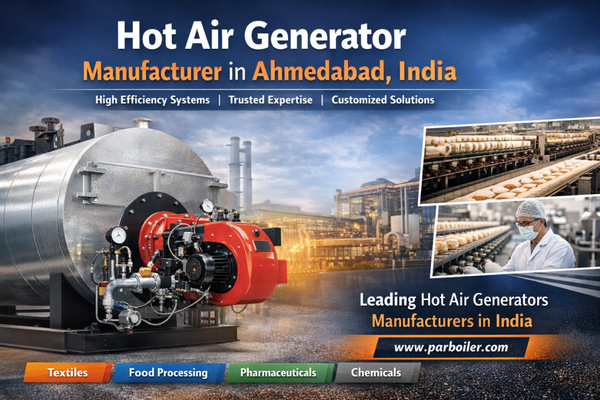
A hot air generator is an industrial heating system that burns gas, diesel, biomass, or coal to produce hot air for drying, curing, and process heating without the pressure vessel, feedwater treatment, or steam distribution infrastructure a boiler requires. Systems are either direct fired, where combustion gases mix into the process air, or indirect fired, where a heat exchanger keeps the air completely clean for sensitive industries like food and pharma. In India, prices range from around ₹1.5 lakh for small units to over ₹50 lakh for large PLC-automated systems. Leading hot air generator manufacturers in India include Par Boiler Pvt. Ltd., Thermax, Bosch Thermotechnology, Forbes Marshall, and Sitson India. When selecting a Hot Air Generator Manufacturer in Ahmedabad, evaluate thermal efficiency, burner quality, fuel flexibility, safety certification, and after-sales service not price alone.
If you're evaluating a Hot Air Generator Manufacturer in Ahmedabad or comparing the leading Hot Air Generator Manufacturers in India, this guide is built to save you time. It's written the way a plant engineer or procurement manager actually shops for thermal equipment by capacity, fuel, automation level, and total cost of ownership, not just brand name.
Hot Air Generators (HAG) have quietly become the default heating choice across pharmaceuticals, food processing, textiles, and chemicals. They heat faster than steam systems, need far less piping and insulation work, and cut the distribution losses that steam networks are prone to. This 2026 guide walks through how a hot air generator works, the different types available, realistic pricing in India, and how to shortlist a manufacturer you can actually rely on for the next 15–20 years.
A hot air generator (HAG) is an industrial heating system that burns a fuel gas, diesel, coal, or biomass to produce and deliver hot air directly into a process, instead of converting water into steam. It's used wherever a process needs dry, uniform heat drying, baking, curing, or conditioning with faster response and lower distribution losses than a boiler-and-steam-line setup. Operating designs fall into two categories: direct fired, where combustion gases mix into the air stream, and indirect fired, where a heat exchanger keeps the air completely clean.
Unlike a steam boiler, which needs feedwater treatment, steam piping, condensate return, and pressure vessel compliance, a hot air generator heats ambient or recirculated air and pushes it straight into the process through ducting and blowers. Understanding each stage explains why the system performs the way it does and why a poorly specified component compromises the entire installation.
Step 1 — Fuel combustion: Fuel burns in a refractory-lined combustion chamber. The burner controls fuel-air mixing to ensure stable, efficient combustion across the full firing range.
Step 2 — Heat transfer: In a direct fired hot air generator, hot combustion gases mix directly with the process air stream efficient, but only suitable where trace combustion by-products in the air are acceptable. In an indirect fired hot air generator, flue gases pass through a heat exchanger, transferring heat to a separate, clean air stream that never contacts combustion gases the version pharma and food plants almost always specify.
Step 3 — Air circulation: A blower or ID fan draws in and circulates the heated air through ducting into the drying chamber or process line, with dampers controlling airflow distribution.
Step 4 — Temperature control and safety: A temperature controller increasingly PLC-based modulates burner firing to hold the outlet air temperature at setpoint. Safety systems include flame failure protection, high-temperature cutoff, and pressure safety interlocks that shut the system down safely on fault.
The shift toward hot air systems isn't a trend it's a response to real operating costs. A hot air generator delivers heat exactly where the process needs it, with minimal transmission loss, and gives more uniform airflow-driven moisture removal than static steam-heated drying. Modern units routinely run 80–90% thermal efficiency, and heat-recovery add-ons push that higher still.
The economic case is just as strong as the process case. A hot air system has no feedwater treatment cost, no condensate recovery infrastructure, and needs less skilled manpower to operate than a boiler-and-steam-line setup. Faster startup means less downtime between batches, and cleaner-burning fuel options combined with heat recovery reduce emissions per unit of output a growing consideration as CPCB and SPCB norms tighten.
India's industrial heating equipment sector has grown alongside its manufacturing base food processing, pharmaceuticals, textiles, and chemicals are all expanding, and each sector leans on hot air generators for drying and process heat. Demand is rising fastest in food processing and pharma, where hygiene and precise temperature control are non-negotiable, while manufacturers are increasingly shifting to PLC-based automation and modular skid-mounted units that are faster to install.
SMEs are steadily replacing older coal-fired boilers with cleaner, more compact hot air systems, and Indian manufacturers are exporting more to the Middle East, Africa, and South Asia, where rugged, cost-effective designs are valued. Emission norms from State Pollution Control Boards (SPCB) and the Central Pollution Control Board (CPCB) are pushing buyers toward cleaner-fuel and heat-recovery systems expect continued growth in biomass and multi-fuel designs as industries hedge against fossil fuel price volatility.
| Type | Fuel | Air Cleanliness | Typical Efficiency | Best Suited For |
|---|---|---|---|---|
| Direct Fired | Gas, oil, diesel | Moderate | 85 – 92% | Material drying, non-sensitive processes |
| Indirect Fired | Gas, oil, biomass | High | 78 – 86% | Food, pharma, chemicals |
| Biomass Fired | Wood chips, husk, briquettes | Moderate | 75 – 85% | Cost-sensitive, high-volume drying |
| Gas Fired | Natural gas, LPG | High | 82 – 90% | Pharma, food, urban plants |
| Coal Fired | Coal | Low | 75 – 82% | Cost-driven heavy industry (subject to norms) |
| Electric | Electricity | Very High | 95%+ | Small-scale, cleanroom-adjacent |
| Multi Fuel | Gas + biomass or oil + coal | Moderate – High | 80 – 88% | Plants needing fuel flexibility |
The manufacturers below were evaluated on criteria that reflect what actually determines a hot air generator's long-term performance and total cost of ownership not sales brochure claims. Years of operating experience, breadth of product range, in-house manufacturing capability, engineering expertise for custom applications, innovation in automation and fuel flexibility, build quality, relevant certifications (ISO, CE, statutory approvals), customer feedback, and strength of after-sales support and AMC service all factored into the shortlist.
Par Boiler Pvt. Ltd. is a long-standing manufacturer of industrial heating systems, designing and supplying hot air generators from its Ahmedabad manufacturing facility alongside steam boilers and thermic fluid heaters. The company's HAG range covers direct fired, indirect fired, gas, oil, and biomass-fired configurations, engineered for pharmaceuticals, textiles, and food processing where efficiency and low maintenance matter as much as upfront price.
The company's engineering team calculates airflow, temperature rise, and heat exchanger sizing (for indirect systems) specific to each client's process a level of customization that determines whether a system runs efficiently at rated load or requires costly rework after commissioning. Service coverage includes installation supervision, commissioning support, and AMC packages.
Best for: Textile, chemical, pharmaceutical, food processing, and engineering industries across Gujarat and pan-India requiring a single-source hot air generator manufacturer in Ahmedabad with integrated engineering and service support.
Fuels: Gas, oil, diesel, biomass
Need a hot air generator sized for your specific process temperature and airflow? Par Techno-Heat's engineering team reviews your heat load, temperature requirement, and fuel availability before recommending a system. Contact Par Techno-Heat Pvt. Ltd. for a free technical consultation.
Thermax is one of India's larger names in industrial heating and energy solutions, with a hot air generator range spanning biomass-fired systems, oil and gas-fired units, and waste heat recovery integration. Its national scale and broad product portfolio make it a common shortlist entry for larger industrial buyers.
Best for: Large-scale industrial buyers requiring national service support and a broad heating equipment portfolio.
Bosch brings global engineering standards to its Indian heating equipment line, offering hot air generators alongside steam and hot water boiler ranges, generally positioned where buyers want an internationally recognized brand with standardized build quality.
Best for: Buyers prioritizing international engineering standards and brand consistency.
Forbes Marshall is best known for steam engineering and process automation, and applies that same automation depth to its hot air generator line, with strong process control integration favored by EPC contractors on larger industrial projects.
Best for: EPC-contracted projects requiring tight process automation integration.
Sitson India specializes in biomass and solid-fuel heating systems, offering customized hot air generator solutions designed for industries pursuing alternative fuel sources and cost-effective operation.
Best for: Agro-processing and textile plants seeking biomass or solid-fuel hot air generator systems.
An established boiler manufacturer that also supplies hot air generator systems aimed at improving operational performance and reducing energy consumption across industries.
Best for: Buyers seeking a boiler-manufacturer's engineering rigor applied to hot air systems.
IBL's hot air generator range covers a broad capacity spread designed for high efficiency and process optimization, with a portfolio that also includes steam boilers, making it a practical single-source supplier for plants needing multiple heating system types.
Best for: Plants seeking single-source supply of hot air generators alongside boilers.
A premium heating equipment brand with a strong efficiency and durability focus, used across commercial and industrial applications where long service life is a priority.
Best for: Buyers prioritizing premium build quality and long-term durability.
Provides industrial heating systems including hot air generators and steam boilers, positioned for reliability across varied industrial requirements.
Best for: General industrial buyers seeking dependable multi-fuel hot air systems.
Manufactures thermic fluid heaters and hot air generators built for durability and consistent performance in demanding industrial environments.
Best for: Heavy industrial applications requiring rugged, high-duty equipment.
Note: Details above are compiled from publicly available company information. Buyers should verify current certifications, capacity ranges, and pricing directly with each manufacturer before finalizing a decision.
| Company | Key Products | Fuels | Industries | Core Strength |
|---|---|---|---|---|
| Par Boiler Pvt. Ltd. | HAG, Boilers, Thermic Fluid Heaters | Gas, oil, biomass | Pharma, textile, food, chemical | Custom engineering, integrated service |
| Thermax Limited | HAG, waste heat recovery | Biomass, oil, gas | Multi-sector | Wide product range, national scale |
| Bosch Thermotechnology | HAG, steam & hot water boilers | Gas, oil | Industrial, commercial | Global engineering standards |
| Forbes Marshall | HAG, steam systems | Gas, oil | Process industries | Automation & process control |
| Sitson India | Biomass HAG | Biomass, solid fuel | Agro, textile | Alternative fuel expertise |
| Cheema Boilers Ltd. | HAG, boilers | Coal, biomass, gas | Multi-sector | Fuel efficiency focus |
| Industrial Boilers Ltd. | HAG, boilers | Gas, oil, solid fuel | Process industries | Process optimization |
| Viessmann India | HAG, heating systems | Gas, oil | Commercial, industrial | Durability, premium build |
| SAZ Boilers | HAG, steam boilers | Gas, oil, biomass | Multi-sector | Reliability |
| ThermoKrupp Engineers | HAG, thermic fluid heaters | Gas, oil, solid fuel | Heavy industry | Durability in demanding environments |
Industries served: Textile, Food Processing, Chemicals, Pharmaceuticals, and Engineering industries.
| Industry | Typical Application | Recommended HAG Type |
|---|---|---|
| Textile | Fabric, yarn, garment drying | Direct or indirect fired, gas/biomass |
| Food Processing | Spray drying, roasting, dehydration | Indirect fired, gas |
| Pharmaceutical | Tablet and granule drying | Indirect fired, gas/electric |
| Chemical | Powder and intermediate drying | Indirect fired, gas/oil |
| Paper | Sheet drying and finishing | Direct fired, gas/biomass |
| Rice Mill | Paddy drying | Biomass fired |
| Flour Mill | Grain conditioning | Direct fired, biomass/gas |
| Engineering | Paint curing, component drying | Indirect fired, gas |
| Steel | Pre-heating and process drying | Direct fired, oil/gas |
| Cement | Raw material drying | Direct fired, coal/multi-fuel |
| Ceramic | Tile and clay drying | Direct fired, gas |
| Paint | Curing ovens | Indirect fired, gas |
| FMCG | Packaging and product drying | Indirect fired, gas/electric |
| Agriculture | Crop and grain drying | Biomass or direct fired |
| Drying Plants | Dedicated industrial drying operations | Depends on product sensitivity |
| Parameter | Hot Air Generator | Steam Boiler |
|---|---|---|
| Heat Delivery Medium | Hot air, direct or via heat exchanger | Steam via piped distribution |
| Water Treatment Needed | No | Yes essential for scale prevention |
| Condensate/Distribution Loss | Minimal heat generated near point of use | Significant in open steam networks |
| Startup Time | Fast | Slower pressure buildup required |
| Compliance Burden | Lower no pressure vessel registration for most units | IBR registration required above threshold |
| Best For | Drying, curing, direct process heating | Sterilization, steam-specific processes |
The practical decision rule: choose a hot air generator when your process needs dry, uniform heat for drying or curing and doesn't specifically require steam. Choose a steam boiler when the process needs steam itself sterilization, autoclave, or direct steam injection. For related heating equipment, see our guide on steam boiler systems and thermic fluid heaters.
| Fuel | HAG Efficiency | Emissions | Best Application | Key Limitation |
|---|---|---|---|---|
| Natural Gas (PNG/LPG) | 82 – 90% | Very Low | Pharma, food, urban plants | Pipeline connection needed |
| Diesel / Furnace Oil | 80 – 86% | Medium | Remote locations, backup fuel | Higher running cost |
| Biomass (husk, wood chips) | 75 – 85% | Low-Medium | Agro-processing, textile | Economics depend on proximity to source |
| Coal | 75 – 82% | High | Cost-driven heavy industry | Ash handling, tightening emission norms |
| Electricity | 95%+ | Zero on-site | Small processes, cleanrooms | High running cost at large capacity |
Small-capacity hot air generators in India typically cost ₹1.5 lakh to ₹5 lakh. Medium industrial systems range from ₹5 lakh to ₹15 lakh. Large-scale, PLC-automated systems can cost ₹15 lakh to ₹50 lakh or more.
| Parameter | Small Capacity | Medium Capacity | Large Capacity |
|---|---|---|---|
| Heat Output | Up to 3,00,000 kcal/hr | 3,00,000–10,00,000 kcal/hr | 10,00,000+ kcal/hr |
| Typical Price Range | ₹1.5–5 lakh | ₹5–15 lakh | ₹15–50 lakh+ |
| Automation Level | Manual/Semi-automatic | Semi to Full PLC | Full PLC/SCADA with IoT monitoring |
| Typical Efficiency | 78–82% | 82–86% | 86–90%+ |
Prices are indicative 2026 estimates. Actual cost depends on capacity, fuel type, automation level, materials of construction, and customization. Contact Par Techno-Heat for a site-specific quotation.
| Criteria | What to Verify |
|---|---|
| Heating capacity | Matched to your actual process heat load, not oversized "just in case" |
| Temperature requirement | Determines burner and refractory/heat exchanger design |
| Fuel availability | Directly affects operating cost and long-term uptime |
| Thermal efficiency | Higher efficiency lowers fuel consumption over the system's life |
| Burner quality | Affects combustion stability, emissions, and turndown range |
| Automation | Reduces manpower dependency and human error |
| Safety features | Flame failure, over-temperature, pressure protection non-negotiable |
| Spare parts availability | Minimizes downtime during breakdowns |
| Warranty | Signals manufacturer confidence in build quality |
| After-sales support | Determines total cost of ownership over the equipment's life |
Evaluating hot air generator suppliers for your plant? Par Boiler's engineering team reviews your heat load, temperature requirement, fuel, and process layout before recommending a system configuration. Contact Par Techno-Heat Pvt. Ltd. for a free technical consultation.
Efficiency in a hot air generator is largely a function of combustion quality, insulation, and how much heat is recovered from exhaust gases before they're released. Direct fired systems generally post higher headline efficiency because there's no heat exchanger loss but indirect fired systems remain the right choice wherever air purity is non-negotiable. Adding a heat recovery unit even a simple air-preheater on the exhaust can push overall system efficiency up by several percentage points, often paying for itself within a couple of years through reduced fuel consumption.
| Frequency | Maintenance Task | Why It Matters |
|---|---|---|
| Monthly | Burner nozzle inspection & cleaning | Fouled nozzles reduce combustion efficiency |
| Monthly | Blower bearing lubrication | Prevents premature bearing failure and airflow loss |
| Monthly | Safety interlock & flame failure test | Confirms shutdown systems respond correctly on fault |
| Quarterly | Heat exchanger inspection (indirect systems) | Fouling reduces heat transfer and air purity assurance |
| Quarterly | Duct and damper cleaning | Maintains designed airflow distribution |
| Half-yearly | Refractory/insulation check | Damaged insulation raises fuel consumption and skin temperature |
| Annual | Full combustion tuning & efficiency test | Restores rated efficiency and verifies emission compliance |
Expect the next few years to bring more multi-fuel and hybrid systems, tighter integration with plant-wide IoT monitoring, and a continued push toward biomass as fuel costs and emission norms both tighten. Manufacturers who invest in automation and heat recovery now will be better positioned as industrial buyers increasingly weigh lifetime operating cost over sticker price.
| Advantage | What It Means for Your Plant |
|---|---|
| Established fabrication ecosystem | Deep base of component suppliers and skilled technicians in the region |
| Shorter lead times | Faster manufacturing and delivery vs distant suppliers |
| Easier site support | Simpler to arrange site visits during commissioning |
| Faster spare parts turnaround | Reduces downtime during breakdowns |
| Regional compliance familiarity | Service teams already understand Gujarat's industrial and SPCB requirements |
| Pros | Cons |
|---|---|
| Fast heat-up and shutdown | Direct fired types unsuitable for sensitive processes |
| No steam distribution losses | Requires good ducting design for even airflow |
| Lower infrastructure and water treatment cost | Fuel-dependent operating cost variability |
| Easier automation and monitoring | Requires periodic burner and safety system maintenance |
A hot air generator is used for industrial heating applications such as drying, curing, and processing in industries like food, textile, pharmaceuticals, and chemicals.
It depends on your capacity, fuel, and automation needs, but manufacturers like Par Techno-Heat are known for reliable, customized industrial heating solutions in the region.
It depends on cost and availability. Biomass and coal are cost-effective; gas and diesel offer cleaner, more automated operation.
Most modern units run 78–90% thermal efficiency, depending on design, fuel, and whether heat recovery is fitted.
Direct fired systems mix combustion gases with process air; indirect fired systems use a heat exchanger to keep the air completely clean the standard for food and pharma.
Prices range from roughly ₹1.5 lakh for small units to ₹50 lakh or more for large, fully automated systems.
In many drying and process heating applications, yes but processes that specifically need steam (sterilization, certain cooking processes) still require a boiler.
Textile, food processing, pharmaceuticals, chemicals, and agriculture-related drying operations are the heaviest users.
Yes, particularly for cost-sensitive, high-volume drying applications, provided a reliable biomass fuel supply is available near the plant.
Flame failure protection, over-temperature cutoffs, pressure safety devices, and properly interlocked control panels are essential.
Burners and safety systems should be checked monthly, with a full combustion tuning and efficiency test at least once a year.
Look for ISO certification, CE marking where applicable, and compliance with CPCB/SPCB emission norms.
Yes, most modern industrial units support PLC-based automation for precise temperature control and remote monitoring.
With regular maintenance, a well-built industrial unit can operate reliably for 15–20 years or more.
Generally yes, due to the added heat exchanger, but they're necessary wherever air purity is a process requirement.
A boiler produces steam or hot water under pressure; a hot air generator produces heated air directly, without an intermediate steam cycle.
No unlike steam boilers, hot air generators don't need feedwater treatment since there's no steam cycle involved.
Capacity depends on your required temperature rise, airflow volume, and process heat load a manufacturer can calculate this from your process data.
Yes, multi-fuel and dual-fuel designs are available, letting plants switch fuel sources based on cost and availability.
Ahmedabad's established industrial fabrication ecosystem typically means shorter lead times, easier site support, and faster access to spare parts and service teams.
Installation supervision, commissioning support, scheduled maintenance visits, and Annual Maintenance Contract (AMC) options.
In most cases yes the added fuel savings typically recover the extra investment within a couple of years.
Par Techno-Heat Pvt. Ltd. designs and manufactures direct fired and indirect fired hot air generators gas, oil, diesel, and biomass configurations for textile, chemical, pharmaceutical, food processing, and engineering industries across India.
A 20-minute technical discussion covers your heat load, process temperature, fuel type, and airflow requirement before any system is proposed.
